Listen Illusion

Stephen Heath
“Ambiviolences: Notes for reading Jocye”
in Post-Structuralist Jocye: Essays from the French edited by Derek Attridge and Daniel Ferrer

This ‘soundscript’ is not the reproduction of speech, but the ceaseless confrontation of writing and speech in which reference is involved in a tourniquet between the two, thus defining yet another strategy of hesitation. The written and the spoken are squashed together but in that very moment a distance opens between them and the reading hovers in an ‘optical listen’, between the one and the other, in a plurality outside any context.

auditory hallucination / optical illusion

odditory illumination

And so for day 2621
15.02.2014

Posted in Perception, Reading | Tagged | Leave a comment

How to Handle a High Stress Task or Request

I was asked by colleagues to synthesize what informed my practice. The net result was this algorithm.

Short Answer:

Act like a waiter – negotiating communication between kitchen and table: best advice
I got while waitering was “don’t run” – you are most likely going to cause an
accident.

Long Answer:

Stop
An initial step and of course important throughout the process of responding to a
request; pauses are your friends and you would be surprised at how short they are
but highly effective in collecting your thoughts.
Parse / Refine
List any clarification questions you might have; who, what, where and when are the
key questions (why is left to the mysteries of the universe); this is an important
step since it helps with triage and determining the next step.
Reach Out / Research
Resist the temptation to simply flip an email; be sure that your communications add
value; you may need to try multiple variations of key terms to successfully complete
a search.
Inform / Package
Sometimes it is important to let the requester know what stage you are at; review
the draft response for completeness and accuracy and readability (get an extra pair
of eyes if the matter is highly sensitive); a good trick is to slow down before
hitting send and remove your hands from the keyboard and parse your response.
Follow through
Don’t forget to thank folks – you are cultivating relations for the next mad dash.

And so for day 2620
14.02.2014

Posted in Uncategorized | Leave a comment

Lost Key

Dani Couture
“Another Earth”
Listen Before Transmit

[the ending]

The helicopter nears. Tonight, even the air is filled with bodies.
And in your pocket, a key to a motorbike you abandoned
on an island in the South China Sea sixteen years ago,
although you can no longer recall where you last left it,
or with whom. This key that will not unlock the next door.

The key may not unlock the door. Not because of a lack of fit. But because the door remains unlocked. And thus so much harder to open.

We may expect to feel tricked, deceived, abandoned, and therefore enchanted (or exasperated) when, having thought that we heard a key turn, it is finally clear to us that the key had no door, and was supported only by its sound as a key.

Hélène Cixous, “Joyce: The (r)use of writing” translated by Judith Still in Post-Structuralist Joyce: Essays from the French edited by Derek Attridge and Daniel Ferrer.

And so for day 2619
13.02.2014

Posted in Poetry | Leave a comment

After Alexandria Redux

Grayson James

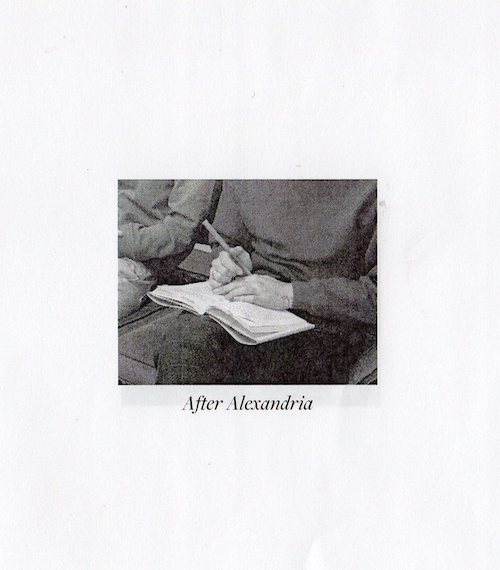
More keepsakes from the show at the Ryerson Image Centre: After Alexandria

One muses that this show about books and the traces people leave in them could reference the Alexandria of history’s great library. Or something else.

Recto – Image of woman’s lap with open book and writing implement in hand

Grayson James - keepsake - after alexandria - recto

One is somehow allusively drawn to comparisons with Barthes musings about a photograph of his mother in Camera Lucida given the project springs from a period of loneliness and is housed in a gallery devoted to the photographic image.

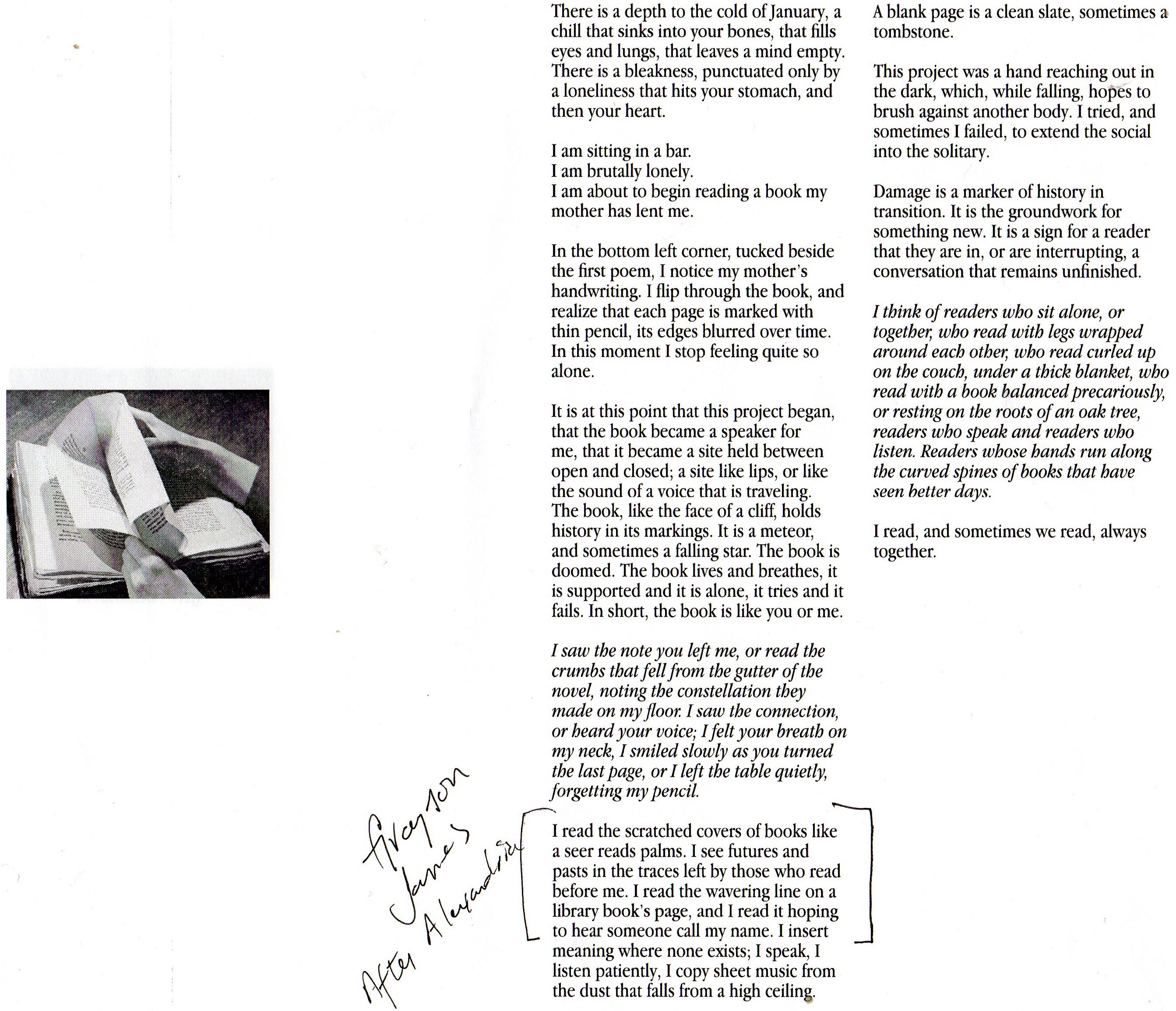
Verso – Image of a book with some of its pages yet to be cut. A verbal accompaniment.

Grayson James - keepsake - after alexandria - verso

Extract:

I read scratched covers of books like
a seer reads palms. I see futures and
pasts in the traces left by those who read
before me. I read the wavering line on a
library book’s page, and I read it hoping
to hear someone call my name.

Grayson, are you there?

I find you here in the repeated tumble of next stages:

After Alexandria hopes to recreate this experience. Leading up to and throughout the exhibition, people are invited to recommend books to me that in some way relate to their experiences of loneliness (for example, a book you read while lonely, or one you enjoyed about loneliness, or made you feel less lonely). I will then reproduce these books and bring them into the gallery, creating our own library. The books will be available for anyone to read, to write in, or, if so inclined, to bring home for themselves. A workspace with pens, pencils, and Post-it notes will be provided, so that readers can intervene in the books how they choose. I will intermittently photocopy some of these interventions, and hang them on the gallery wall. Viewers are invited to photocopy and hang interventions as well, creating a collaborative installation that indexes the ways these books become containers of a shared social experience. At the end of the exhibition, I will document a selection of these interventions, and produce a new publication from them.

I became interested in this project at a point in my life when I was experiencing a loneliness unlike any I had before. As an avid reader, I found myself turning to literature to mitigate these feelings. I began to read books almost exclusively borrowed from the library. These books were marked-up, damaged, dog-eared, and coffee-stained. It is through the bodily experience of encountering other readers through the traces that they left behind that I began to think of these books as a medium through which I was able to engage with others. Their notes had gravity, reminding me that as alone as I might feel, I am actually part of a broader conversation, of a micro-history, and of a community that supports me in ways that are impossible to articulate.

And so for day 2618
12.02.2014

Posted in Booklore, Ephemera | Tagged , | Leave a comment

Caffeine Fiends

Maged Zaher
from Thank You for the Window Office

The information society crept up on us
But now — armed with new ways of looking at things —
We make coffee daily

[it continues…]

Do you know how tiring the business of revolution is?

Daily Grind is of course the name of a coffee shop in Toronto where people know that all transformations, revolutionary or evolutionary, need their fuel. But Toronto has no monopoly on the name.

Daily Grind sticker designed by Yipptee, Manchester UK

Slap that sticker on your laptop care of the Yipptee design studio, Manchester UK – a real hot bed of revolutionary fervour.

And so for day 2617
11.02.2014

Posted in Poetry | Leave a comment

actualization of the potential form

life writing writing life …

Daphne Marlatt
“writing in order to be”
In Sp/elles: Poetry by Canadian Women edited by Judith Fitzgerald

perhaps the motivation behind the push to new forms is the need to find a way of writing the unprescribed, the not-already-scripted, that other women recognize as their unwritten too – a coming-into-being we participate in. this is not writing to demonstrate one is a writer & can follow the form, this is not mastery in the sense that “good form” implies (indeed we have no equivalent in the feminine for that term “mastery.”) what we can’t name we still call into being, by round-about means, from the far edges of the already-written – this is writing in order to be

[1985]

Introduction by Theodore Ziolkowski to Herman Hesse Autobiographical Writings

In the Pedagogic Province that provides the scene for Herman Hesse’s last novel, The Glass Bead Game (1943), the students are required each year to submit a “Life” – a fictitious autobiography set in any period of the past the writer may choose. Through writing these Lives the students learn “to regard their own persons as masks, as the transitory garb of an entelechy.” These compositions, in which the students enjoy complete freedom of invention and expression, often afford “astonishingly clear insight into the intellectual and moral state of the authors.” Accordingly, the fictional narrator of Hesse’s novel includes three Lives composed by the Magister Ludi, Joseph Knecht, suggesting that they represent “possibly the most valuable part of our book.”

[1971]

What would it be like to write, in either English or French, a “Life” of a woman writer in 1980s Canada? Begin by reading Reading life writing : an anthology edited by Marlene Kadar.

And so for day 2616
10.02.2014

Posted in Reading, Storytelling | Tagged | Leave a comment

Thrown in the Way of the Mind

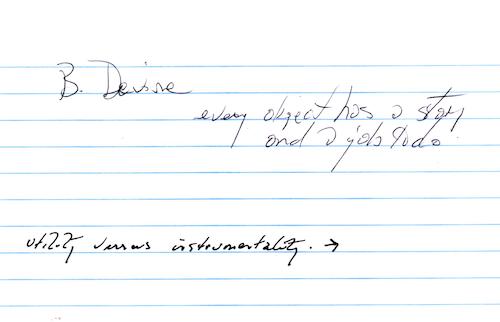
In conversation with Bonnie Devine about Indigenous objects in museum collections and the opening up of those collections to contemporary art practice, she made the point:

every object has a story and a job to do

I recorded that reflection on a sheet of foolscap and underneath her words with a different colour of pen (at some later date?) I wrote:

utility versus instrumentality . –>

handwritten note in two inks - Bonnie Devine - every object has a story and a job to do

I notice a little arrow pointing to some beyond. It is only some years later on a long (45 minute) walk home mulling over what could be the differences between utility and instrumentality that I finally braid together the elements and propose:

In the mode of utility an object carries a story; in the mode of instrumentality, objects are stripped of stories.

And the image is set here in duplicate to continue to do its work of a twice-told tale…

handwritten note in two inks - Bonnie Devine - every object has a story and a job to do

And so for day 2615
09.02.2014

Posted in Storytelling, Uncategorized | Tagged | Leave a comment

Scratching Lines

From “Advice to a Poet” by Susan Braley

There’s a mention of “blood” and a whole world comes pouring forth in the wake of “wine”. And the familiar becomes kindred. The old rose is only known by its leaves: rugosa.

It will be familiar:
you’ll know
the rugosa leaves, or
the blood-wine berries.

Beyond the bramble, lick your wounds.
Wait under the cedar sky. Hushed.

What you seek will greet you there:
fugitive, ancient, kindred.

Beyond blood-wine, any elaboration or allusion escapes me. And yet the proximity of “fugitive” to “kindred” reminds me of the novel by Octavia Butler. Which I now must reread for signs of roses or blackberries.

Freedom is a theme that Braley channels through a quotation in the side bar to the announcement of the publication of “Advice to a Poet” She brings to our attention: “A bird is a poem/that talks of the end of cages.” (Patrick Lane, “The Bird,” The Last Water Song)

I have searched the briar patch and found more berries. One brings the offers a berry-word simile; the other invokes wine and blood.

Blackberry Eating by Galway Kinnell

the ripest berries
fall almost unbidden to my tongue,
as words sometimes do, certain peculiar words
like strengths or squinched,
many-lettered, one-syllabled lumps
which I squeeze, squinch open, and splurge well
in the silent, startled, icy, black language
of blackberry-eating in late September.

Blackberry-Picking by Seamus Heaney

You ate that first one and its flesh was sweet
Like thickened wine: summer’s blood was in it
Leaving stains upon the tongue and lust for
Picking.

Heaney’s poem goes on to reminds us that it is a seasonal joy. Fugitive indeed.

And so for day 2614
08.02.2014

Posted in Poetry | Tagged | Leave a comment

Home Page — Paging Home

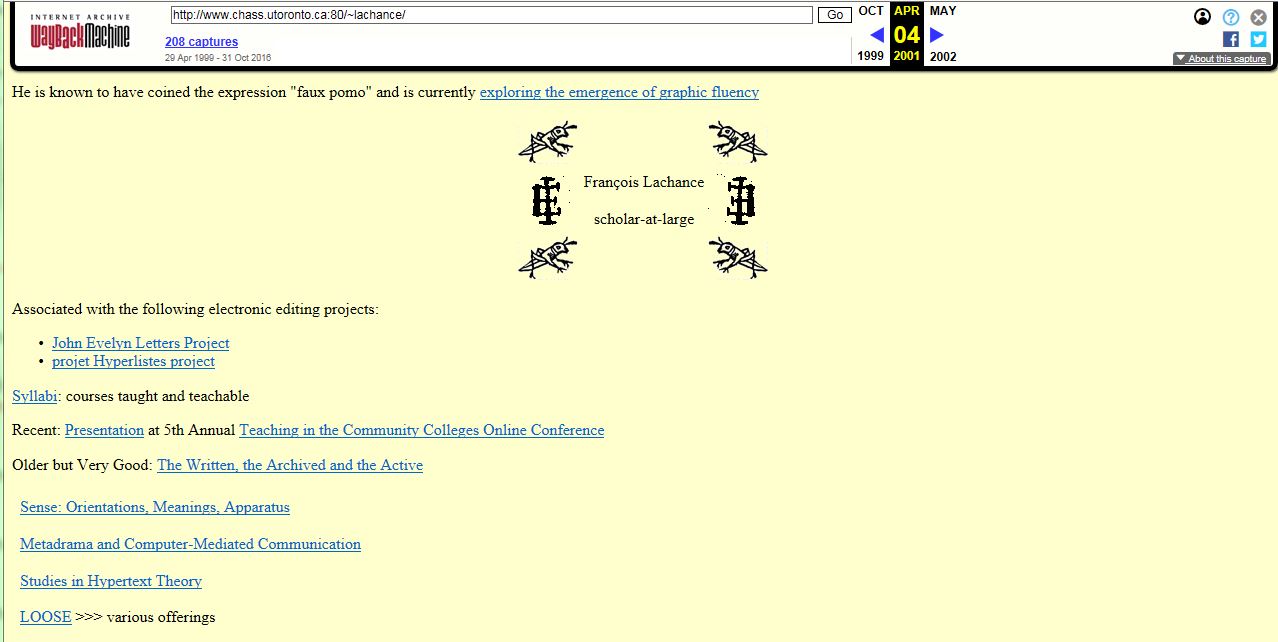
The Internet Archive Wayback Machine offers glimpses into one’s past like this home page from 2001
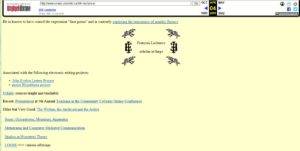
screenshot - homepage - 2001

What you may ask is a home page?

https://en.wikipedia.org/wiki/Home_page

A personal home page historically has served as a means of self-portrayal, job-related presentation, and pure enjoyment, giving way to professional advancement and social interaction.[12] Owing to the rise of social media sites, personal home pages are no longer as common as during the mid-late 1990s and early-2000s.

[12] Weibel, David; Groner, Rudolf; Wissmath, Bartholomaus (2010). “Motives for Creating a Private Website and Personality of Personal Homepage Owners in Terms of Extraversion and Heuristic Orientation“. Cyberpsychology: Journal of Psychosocial Research on Cyberspace.

One of the components of a home page was a list of hyperlinks to other resources. Some featured quotations.

Some who look back want to graft an evolution. It’s a very seductive proposition:

Let’s give credit where credit is due, however, Bush’s memex and the eventual parlaying of that diagrammatic insight into what became a hypertext transfer protocol took writing to the next level of apparatus consciousness. At first, it was conceived as a recordable memory device, but soon it evolved into an inventive remix machine that simulates specific thought processes as ways of seeing and processing the social spaces inhabited by the artificial intelligentsia as it operates in a peer-to-peer (P2P) open source environment, breaking all the laws and conventions of identity construction. (This last line is now the second theory loop playing on the essay soundtrack, along with the line that ends “a nomadic Net artist driving in cyberpsychogeographical spaces.”)

Mark Amerika
“Cyberpsychogeography (An Aimless Drift in Twenty Digressions)” [An earlier version of this essay was originally published as part of the Ciber@art Bilbao 2004 conference proceedings] reworked in Meta/Data: A Digital Poetics

Allow me to play this back in slow motion and indulge in my own cyberpsychogeographical dérive and suggest that the move from recordable memory device to inventive remix machine is a bit of sleight of hand to support the contention of the outlaw nature of the artificial intelligentsia. All writing deforms. All drives through cyberpsychogeograpical spaces break/brake identity construction. To record is to remix. [Witness that memex is “sometimes said to be a portmanteau of “memory” and “index””.]

I once made a picture to capture the ways one could process/record info:
https://berneval.hcommons-staging.org/2009/01/08/grids-lists-clusters/

I lavished some attention on the notion of story as container and riddle (in the sense of sieve). Storing, sorting (both involved in shuffling [remixing])
http://homes.chass.utoronto.ca/~lachance/S6.HTM

And later I indulged in transformation of an XML document into one of four HTML blog outputs depending upon the throw of a dice (one throw being reserved for non-transformation or non-passage).

MetaMimetics + HyperMnemonics
http://homes.chass.utoronto.ca/~lachance/jardin/html/TEIBLOG.HTM
http://homes.chass.utoronto.ca/~lachance/jardin/html/INVERTTEIBLOG.HTM

HyperMnemonics + MetaMimetics
http://homes.chass.utoronto.ca/~lachance/jardin/html/INVERTBLOGTEI.HTM
http://homes.chass.utoronto.ca/~lachance/jardin/html/BLOGTEI.HTM

In one of the corners of the Jardin is a quotation and comment (pertinent to any talk of “next levels”):

From With Towards

There is in the book On the Origin of Objects by Brian Cantwell Smith a passage that fascinates me.

World-directedness takes many forms. […] subjects (their experiences, representations, documents, intentions, thoughts, etc.) point or are directed towards the transcendent-but-immanent world that surrounds them. A symmetrically realist account per se supplies two of the requisite ingredients in this pointing: (i) the fact that subjects are in an enveloping world, which gives them a place to point from; and (ii) the fact that they are made of that same enveloping world, which gives them the wherewithal to point with. What a theory of intentionality needs to add is the far-from-obvious third ingredient: (iii) a way for subjects to orient towards that enveloping world, the world of which they are constituted and in which they live.

What fascinates me is the way in which “from” is paired with “in” and “with” is paired with “made” and that “towards” remains unpaired.

“‘Towards’ remains unpaired” — a theory loop.

Funny what one sees in that 2001 home page:

Sense: Orientations, Meanings Apparatus
Metadrama and Computer-Mediated Communication
Studies in Hypertext Theory

All still there http://homes.chass.utoronto.ca/~lachance/ and joined by a few others.

And revisited thanks to the Time Machine and some remixing (sans concern with identity construction, except of a bad boy sort), remixing pointing towards memory and pointing.

And so for day 2613
07.02.2014

Posted in Perception, Reading, Storytelling, Translations | Tagged , , , | Leave a comment

Mark Amerika Meets the Dixie Chicks

One + Infinity

“The important thing is to reembody sensual free zones while actively participating in the idealized gift economy.” Mark Amerika

Dixie Chicks
“Lullaby” refrain…

How long do you wanna be loved
Is forever enough, is forever enough
How long do you wanna be loved
Is forever enough
‘Cause I’m never, never giving you up

Looks flat on the page until one remembers that on the album Take The Long Way it is sung partially as a canon.

“While participating in the idealized gift economy, the important thing is to actively reembody sensual free zones.” Amerika Remix

Infinity + One

And so for day 2612
06.02.2014

Posted in Uncategorized | Tagged | Leave a comment