Collapsed Cake

Marguerite Patten’s 1,000 Favourite Recipes

She devotes a section to “Turn disaster into Success!” in which she suggests some ways of coping with collapsed cake…

The cake has sunk in the centre?
Cut out the centre carefully and turn the outside into a ring cake. Ice or decorate if wished. Crumble the cake from the centre and blend with an egg. Steam for 35-40 minutes and serve as a hot pudding. Or slice the cake from the centre neatly, dip in beaten egg and fry in hot butter. Sprinkle with sugar and serve as fritters.

We just ate the cake. No bother.

And so for day 2611
05.02.2014

Posted in Food Writing | Leave a comment

Racoon Spirits

In “Report on the Status of Raccoons on Fern Avenue” Dani Couture offers this concluding stanza:

They understand construction cranes to be a form of prayer. They take more meaning from the lay of flagstones than they should. They’re partial to the sound of human crying. They sleep unmolested on the eaves we’ll never finish paying for.

Which I here juxtapose with two poems from James Tate.

The first in the Paris Review, “Elvis Has Left the House”
https://www.theparisreview.org/poetry/7385/elvis-has-left-the-house-james-tate

[…]
I picked the raccoon up and walked to the door. It was Denny, the boy from next door. “Can I have my raccoon back?” he said. “I don’t know how he got in here, really I don’t. But, sure, here’s your raccoon,” I said. “By the way, what’s his name?” “Elvis,” he said, grabbing his pet. A few days later I had worked hard in the yard all day and was tired. I went to bed early and when I woke up Elvis was in my arms. It felt natural and good and I kissed him, which he seemed to like. I got up and fixed him breakfast, which was cereal and milk. He liked that. Then I went about my day and Elvis followed me around. He stayed that night. And the next night. In fact he seemed to be a permanent tenant by now. We had our routines and our meals. We slept together. One day when I was raking leaves in the fall I saw Bob and Susan in their yard. They were Dennis’s parents. After we exchanged greetings and talked for a little bit, I said, “How’s Denny?” “We thought you knew. Denny died last summer. It was polio,” Bob said. “Oh, I’m so sorry. He’ll be greatly missed, I know,” I said. Then I finished raking and went back in the house. I did some paperwork, napped for a while, and fixed dinner. Something was different. Elvis wasn’t there. I looked everywhere, but there was no Elvis.

The second in Poetry “Demigoddess”
https://www.poetryfoundation.org/poetrymagazine/browse?contentId=40863

Aunt Myrtle […] herself was a mess, her long stringy hair was filthy, and she walked around in an ancient bathrobe looking like a ghost. “This house needs some work, Aunt Myrtle,” I said. “It’s the racoons,” she explained. […] “I told you they want me, they worship me, I’m their goddess, and they won’t stop until I come live with them. There are hundreds of them.” […] Then around 2 a.m. I thought I heard something. From the kitchen window I saw Aunt Myrtle crouched in the backyard holding a plate of food in one hand and stroking the back of a standing racoon with the other. They looked like very good friends, indeed. And one is enough in this world.

And finally a quip from Ursula K. Le Guin

The curious comparison followed: Geertz is to Lévi-Strauss as a racoon is to a unicorn.

from her reading journal “The Hope of Rabbits: A Journal of a Writer’s Week” in Words Are My Matter.

And so for day 2610
04.02.2014

Posted in Uncategorized | Leave a comment

Space, Smell and Memory

Ursula K. Le Guin
“Living in a Work of Art”
Words Are My Matter

She grew up in a redwood house designed by Bernard Maybeck. She remembers:

The pantry, off the narrow hall at the foot of the back stairs […] was a tiny dark room full of shelves, smelling of apples and old pfeffernusse and other pantry things. I would go into the pantry sometimes just to smell it.

Its smell was partly redwood. The wood is aromatic; you can’t easily catch the scent in a single piece as you can in a piece of cedar or fresh-cut pine, but an enclosed space built of it has a characteristic fragrance, dearly welcome to the nose to which it smells like home. To come into our house after a long absence was to know again how immediately and profoundly the nose is connected to the emotions.

Because it has nothing to do with sight or touch or hearing, the space in which smell takes place seems to me to be dark or at least shadowy; still; and without boundaries, therefore very large: mysterious and benign. In this it resembles the very earliest and most primitive impressions that I find in my memory of the house itself.

Moth balls reminded me of the confined space of trunks. Hay, the heights of a barn with cathedral-like sunlight piercing the space between the vertical boards. Wet leaves and moss, a labyrinth of forest. And a very distinct paper smell transports me: library.

And so for day 2609
03.02.2014

Posted in Perception | Tagged | Leave a comment

creating a collaborative installation

Grayson James at the Ryerson Image Centre and the installation/project After Alexandria

I became interested in this project at a point in my life when I was experiencing a loneliness unlike any I had before. As an avid reader, I found myself turning to literature to mitigate these feelings. I began to read books almost exclusively borrowed from the library. These books were marked-up, damaged, dog-eared, and coffee-stained. It is through the bodily experience of encountering other readers through the traces that they left behind that I began to think of these books as a medium through which I was able to engage with others. Their notes had gravity, reminding me that as alone as I might feel, I am actually part of a broader conversation, of a micro-history, and of a community that supports me in ways that are impossible to articulate.

With this project, I aim to find a kind of reading that is done in solidarity, not in solitude, and to celebrate the ways in which objects that are owned and shared by the public become beautiful because they are used, not in spite of this fact.

https://ryersonimagecentre.ca/exhibition/grayson-james-after-alexandria/

What I like about this intimate work room with chairs, tables, pens, pencils, a photocopier, index cards and Post-it notes and of course the collection of books is the asynchronous nature of the possible exchanges. (The objects move: the gallery wall is periodically hung with photocopies of some of the interventions.) Not every reading (walk through the space, browsing of a book) leaves a traces. But those that do are displaced in time and curated. It really makes me think of the temporalities embedded in the circulation of written and printed material. How something grows beautiful from usage. I was touched by simple copy of the last page of Calvino’s If on a winter’s night a traveler — impressed by how the typography makes the page into self-contained unit — something that would have passed me by if someone else hadn’t passed by and Grayson James hadn’t exposed the product of that encounter on the wall and William Weaver translated from the Italian and

italo calvino - ending of If on a winter's night a traveller

And so for day 2608
02.02.2014

Posted in Booklore, Ephemera | Tagged , | Leave a comment

Jaguar, Stars and Neurons

Street art - 677 Bloor street west - toronto - jose gabriel (Kismet)

José Gabriel (Kismet) – Jaguar – Stars – Neurons


Along Bloor Street West in Korea Town in Toronto looking up at what used to be a porno theatre and is now Basecamp Climbing one sees this sleek feline slink along the roofs …

The Toronto Street Art Map (https://streetart.to) informs us that this work at 677 Bloor Street West was done by José Gabriel (Kizmet).

As for me I am reminded of the Joni Mitchell lyrics (“Woodstock”) — We are stardust /
We are golden — and I grow limber …

And so for day 2607
01.02.2014

Posted in Uncategorized | Leave a comment

Membership Has Its Privileges

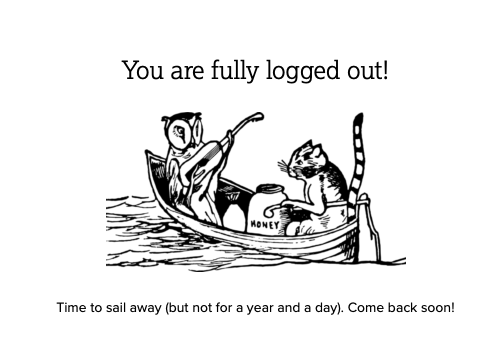
One of the joys of signing in to the Humanities Commons is logging out because there is a delightful invitation to return. It takes the form of an illustration and an allusion to a poem by Edward Lear, The Owl and the Pussy Cat.

Humanities Commons - screen shot - log off message

There is a neat Wikipedia article which features some of the many media appearances and allusions to the poem. I wonder if an edit mentioning the Humanities Commons adaptation would stick…

I get a kick every time out of the Humanities Commons announcement “You are fully logged out!” accompanied by Lear’s picture and the observation coupled with hope: “Time to sail away (but not for a year and a day). Come back soon!”

And of course Lear’s poem is the locus classicus of “runcible spoon” which inspired some rumination on the Humanist discussion list back at the dawn of the century.

Which leads me to quote the logo of the poetry and prose webzine Runcible Spoon which features a lovely silhouette of the duo

Runcible Spoon - poetry and prose webzine - logo - owl and pussy cat

It’s a privilege to be able to enjoy the creativity shared by so many with so many.

And so for day 2606
31.01.2014

Posted in Poetry | Tagged , | Leave a comment

Bones and Picking

Byron
Childe Harold’s Pilgrimage
Canto III Stanza 63

   But ere these matchless heights I dare to scan,
   There is a spot should not be pass’d in vain, —
   Morat! the proud, the patriot field! where man
   May gaze on ghastly trophies of the slain,
   Nor blush for those who conquered on that plain;
   Here Burgundy bequeath’d his tombless host,
   A bony heap, through ages to remain,
   Themselves their monument; — the Stygian coast
Unsepulchred they roam’d, and shriek’d each wandering ghost.

[Byron’s Note]
The chapel is destroyed, and the pyramid of bones diminished to a small number by the Burgundian legion in the service of France, who anxiously effaced this record of their ancestors’ less successful invasions. A few still remain notwithstanding the pains taken by the Burgundians for ages (all who passed that way removing a bone to their own country) and the less justifiable larcenies of the Swiss postillions, who carried them off to sell for knife-handles, a purpose for which the whiteness imbibed by the bleaching of years had rendered them in great request. Of these relics I ventured to bring away as much as may have made the quarter of a hero, for which the sole excuse is, that if I had not, the next passer by might have perverted them to worse uses than the careful preservation which I intend for them.

[McGann’s note to Byron’s note]
The Swiss successfully defended themselves in 1476 against the invading army of Charles the Bold, Duke of Burgundy. The battle of Morat, fought near the town and the lake of the same name, was the bloodiest of three battles (Grandson, Morat, Nancy) fought by the Swiss and the French. Charles was killed at Nancy, but he left more than ten thousand of his men dead at Morat. The ossuary in which their bones were collected was destroyed by the invading French forces in 1798, and the bones scattered about were not collected and reburied until 1822. B sent the bones he collected back to Murray in London, where they are still preserved.

Lord Byron. The Complete Poetical Works. Volume II. Child Harold’s Pilgrimage Edited by Jerome J. McGann

I remember spreading ashes. Aspiring to be tombless. Monumentless. Byron gets there by the end of Canto IV with the sea leaving no marks or markers.

And so for day 2605
30.01.2014

Posted in Poetry | Tagged | Leave a comment

Ephemera and Longevity

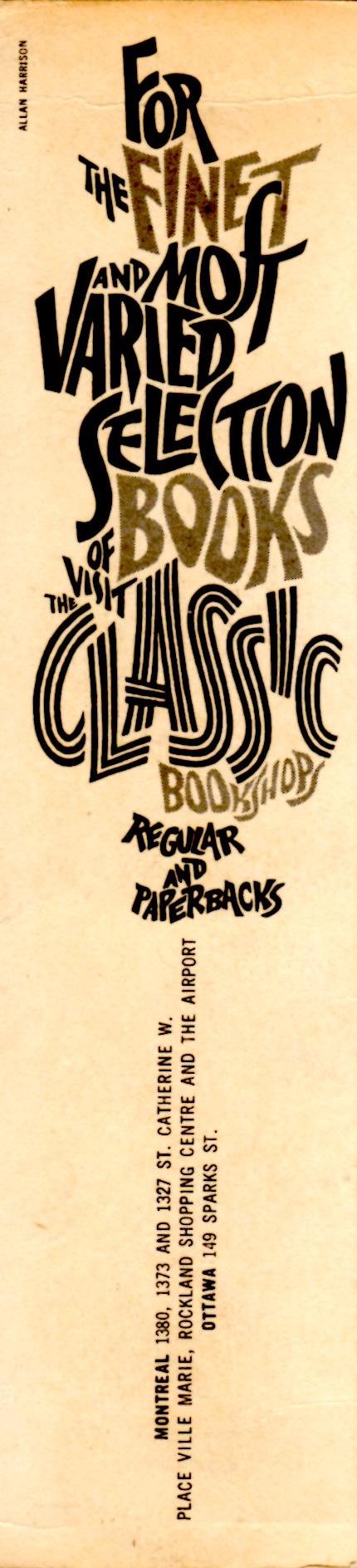
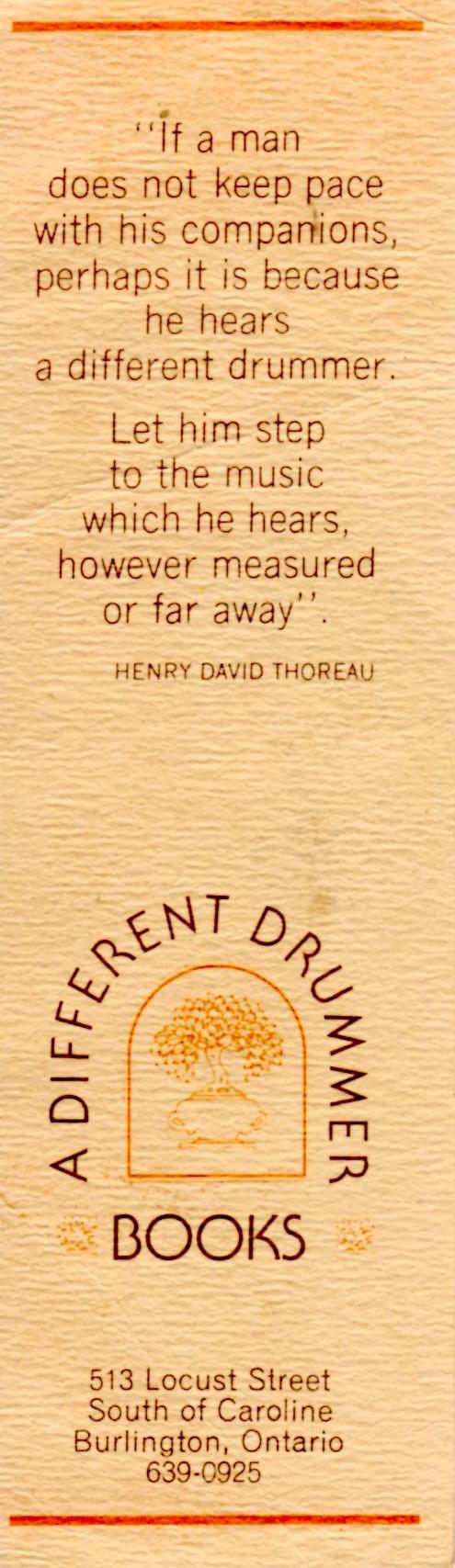
Which of these three is still in operation?

bookmarker - classic bookshop - montreal and ottawa - design by Allan Harrisonbookmarker - A Different Drummer bookstore - burlingtonbookmarker - Writers & Co - Toronto

The Classic Bookshop (Montréal and Ottawa) bookmarker was designed by Allan Harrison.

The Writers & Co (Toronto) example makes use of the white space to rubber stamp the new address.

A Different Drummer Books (Burlington) quotes Henry David Thoreau: “If a man does not keep pace with his companions, perhaps it is because he hears a different drummer. Let him step to the music which he hears, however measured or far away.”

***

Which expression do you use: “bookmarkers” or “bookmarks”? [I ask because for some reason autocorrect wants to change “bookmarkers” into “bookmakers”.]

And so for day 2604
29.01.2014

Posted in Booklore, Ephemera | Leave a comment

Tracks, Traces: Engaging Algorithms

Someone in need of digital detox?

   His had been quaff’d too quickly, and he found
   The dregs were wormwood; but he fill’d again,
   And from a purer fount, on holier ground,
   And deem’d its spring perpetual; but in vain!
   Still round him clung invisibly a chain
   Which gall’d for ever, fettering though unseen,
   And heavy though it clank’d not; worn with pain,
   Which pined although it spoke not, and grew keen,
Entering with every step, he took, through many a scene.

from Byron, Childe Harold’s Pilgrimage edited by Jerome McGann.

Could be a fitting epigraph to a group show at InterAccess:

https://interaccess.org/exhibition/scaffolds-i-can-no-longer-see

Scaffolds I can no longer see? reveals the unseen algorithms that govern digital infrastructures.

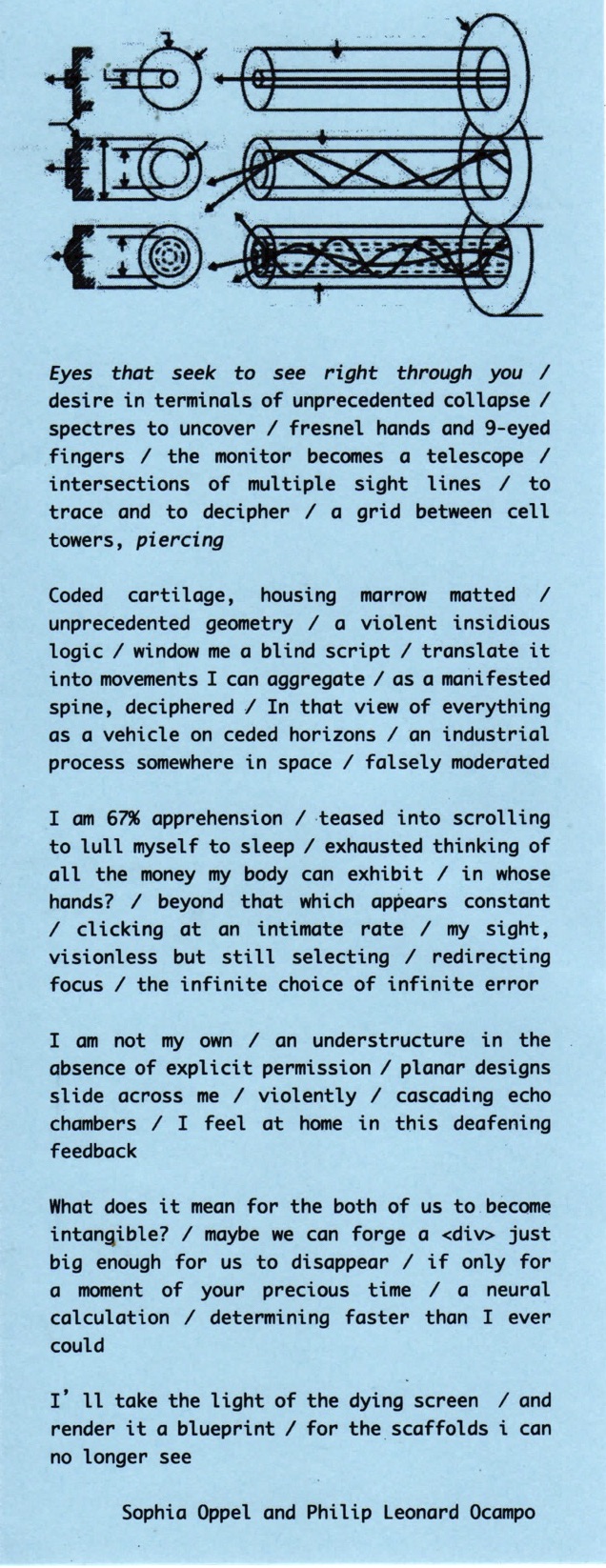
Here is a quotation from the paper keepsake authored by the curators, Sophia Oppel and Philip Leonard Ocampo

I am 67% apprehension / teased into scrolling
to lull myself to sleep / exhausted thinking of
all the money my body can exhibit / in whose
hands? / beyond that which appears constant
/ clicking at an intimate rate / my sight,
visionless but still selecting / redirecting
focus / the infinite choice of infinite error
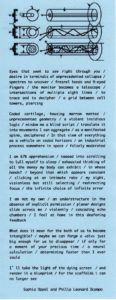
paper keepsake - InterAccess - scaffolds - sophia opal - philip leonard ocampo

At the time this group show was on in Toronto, a call for paper was published on Humanist for a conference to be held in Malmö, Sweden.

Humanist 33.445 – events: actors, logics & cultures behind it all
https://dhhumanist.org/volume/33/445/

Behind Data and Algorithms.

https://www.behindthealgorithm2020.de

Call for papers attending to the actors, logics and/or cultures behind digital technologies for a conference co-organized by Malmö University Data Society research program (www.mau.se/en/research/research-programmes/data-society)
& the Weizenbaum Institute for the Networked Society in Berlin (www.weizenbaum-institut.de).

We seek papers discussing any of the following exemplary questions:

Actors: Who are the people and organizations that create and maintain algorithms and other digital technologies behind the communication interfaces of platforms, apps, search engines or games? What about diversity and diversity challenges in the software industry? Under which working conditions is software produced? What are the professional norms and values of software designers, programmers and engineers?

Logics: What are the processes and rules of the game in the production of algorithms and digital technologies? What are criteria for “good” code? What are the business models behind algorithms, “big data” and artificial intelligence? How do monopolies or hegemonic actors influence the production and the design of digital technologies?

Cultures: Which norms and values inform the production of algorithms and digital technologies? Are there any specific views, ideas, narratives or imaginations of the world that inform the creation of technologies? Is there a specific culture of software creation? Are there critical, Marxist, feminist or queer approaches, and what are their contributions?

Making chains visible. And so less bearable? I can drink to that. Even quaff deeply.

And so for day 2603
28.01.2014

Posted in Ephemera | Leave a comment

Incitation to Larcency

Massimo Bottura from the concluding paragraph to the introduction to Bread is Gold

Food waste is one of the biggest problems of our century and our generation’s cross to bear. Numbers are numbers. Almost one billion people are undernourished. One-third of the food we produce globally is wasted every year, including nearly four trillion apples. Just imagine how many apple pies we could make? If we don’t do something about it now, the numbers will only get worse. I am an optimist and I believe that we are already making positive change. This is just one of many projects aimed at reducing food waste around the world. The good thing is that everyone can participate. A recipe after all is a solution to a problem. Choose to be part of the solution by cooking and sharing a meal around a table. It might be the most revolutionary thing you do all day.

Which leads me to a Blakean statement.

If a recipe is a solution, a garden is a crime.

A systems view of broaching the issue of food security and distribution:

https://en.wikipedia.org/wiki/Food_desert

where I learnt about other sorts of desert: banking desert; book desert.

Enough to loose one’s appetite. (ah, the radical potential of fasting).

And so for day 2602
27.01.2014

Posted in Food Writing | Tagged , | Leave a comment