To Gaze Upon the Glaze

Gjertrud Schnackenberg makes me want to want to read Osip Mandelstam. There is a passage in her poem about the poet that has him restored to health and return to his native city and observe the winter scene. The whole experience is cast in the conceit of a delicious pastry. It is utopia in the key of Cockaigne. Its mention of apricot glaze sent me in search of where Mandelstam may have made a reference to glazes. And I found…

Against pale blue enamel, the shade
That only April can bring,
The birch tree’s branches swayed
And shyly it was evening.

The pattern, precise and complete
A network of thinly etched lines
Like the ones on a porcelain plate
With its carefully drawn design,

When the dear artist creates
The design on the glaze’s hardness,
At that moment his skill awake,
No thought for death’s sadness.

1909

from Osip Mandelstam’s Stone translated by Robert Tracy available at the Poetry Foundation in a slightly different version.

Not quite sure if Schnackenberg had this poem in mind when she wrote. But the combination of artistic skill and “no thought for death’s sadness” ring true to the theme Schnackenberg tackles.

from “A Monument in Utopia” in A Gilded Lapse of Time

Even if the avenues will be mobbed
With former prisoners from that time,
A non-person will be free to survive the winter,
To observe, from the comfort of his own coat,
His native city by lamplight
Along the black ice of the frozen river,
With its frilly crust
Of half-lit, golden snow
Like a mille-feuilles
Glimmering with apricot glaze
And ready to crumble beneath the tooth,
Whose sugar grains melt on his tongue —

Richard Eder in a review of A Gilded Lapse of Time observed

Rich, even ornate at times, Schnackenberg’s poetry carries its weight as if it were no weight at all, partly by its thematic intensity and partly by the sheer beauty of its imagery.

city — mille-feuilles — apricot glaze — sugar grains melting on the tongue — freedom

And so for day 2601
26.01.2014

Posted in Poetry | Leave a comment

Smart People on Smart Cities

Attended a panel discussion at InterAccess.

Ctrl+Shift: Smart Cities

Interesting conclusion – trust generated out of civic engagement can lead to some really innovative city planning and data governance.

All the panelists stressed social justice and livability as part of the definition of smart city.

Panel:

Nasma Ahmed
Director of the Digital Justice Lab

Anthea Foyer
Project Lead, Smart City Mississauga

Leslie Regan Shade
Professor at the Faculty of Information, University of Toronto

Howard Tam
Designer and Urban Planner

Shawn Micallef
Author, served as moderator

Great fortune cookies (strawberry flavour) from SMRTCTY – Mississauga

smart city fortune cookie messages - mississauga.ca/smartcity SMRTCTY


Do you think technology can help with climate change?

[On the other side of the one with the SMARCITY URL] — How would you ensure all Mississaugans have access to technology?

And so for day 2600
25.01.2014

Posted in Uncategorized | Tagged | Leave a comment

Kissing Tangents

CBC story on the equality dollar

The Royal Canadian Mint unveiled a new commemorative loonie on Tuesday meant to mark what it calls a key milestone for lesbian, gay, transgender, queer and two-spirited people in the country. The new coin, which features the work of Vancouver artist Joe Average, was launched at the 519 Community Centre in Toronto.

https://www.cbc.ca/news/canada/toronto/loonie-lgbtq-1.5107077

The commemorative loonie is its usually gold monochrome. But the ten dollar coin is resplendent in its polychrome glory.

joe average design - equality 10 dollar coin - canada

What is more evident on the multi-coloured coin is that there are two faces kissing something that can be missed on the loonie. Queen (Her Majesty) on one side; queens on the other (unless you take the androgynous pair to be luscious lesbians or some bi-combo).

And so for day 2599
24.01.2014

Posted in Uncategorized | Leave a comment

Cuisine Choreography

James Barber
The Urban Peasant
Cooking for Two

Cooking for two is very intimate and very immediate. I very seldom start to cook of a guest until the doorbell rings, and then we do it together. Of course you can’t both hold the knife to chop parsley, nor can you both stir a sauce with the same spoon. But what you can do and will find yourselves doing, if you cook together, is dancing. That’s exactly what it is: learning to move and accommodate one another, learning to enjoy one another’s peculiarities and discovering the pleasure of unspoken communication.

Off to pair some soundtracks and some spices.

And so for day 2598
23.01.2014

Posted in Food Writing | Tagged , | Leave a comment

The Joy of Summaries

In case you hate the long read …

Great poets confront the limits of actual poems, tactically defeat or at least suspend that actuality, sometimes quit writing altogether, becoming celebrated for their silence; truly horrible poets unwittingly provide a glimmer of virtual possibility via the extremity of their failure; avant-garde poets hate poems for remaining poems instead of becoming bombs; and nostalgists hate poems for failing to do what they wrongly, vaguely claim poetry once did. There are varieties of interpenetrating demands subsumed under the word “poetry” — to defeat time, to still it beautifully; to express irreducible individuality in a way that can be recognized socially or, à la Whitman, to achieve universality by being irreducibly social, less a person than a national technology; to defeat the language and value of existing society; to propound a measure of value beyond money. But one thing all these demands share is that they can’t ever be fulfilled with poems. Hating on [sic] actual poems, then, is often an ironic if sometimes unwitting way of expressing the persistence of the utopian ideal of Poetry, and the jeremiads in that regard are defences, too.

[…]

Poets are liars not because Socrates says, they can fool us with the power of their imitations but because identifying yourself as a poet implies you might overcome the bitter logic of the poetic principle, and you can’t. You can only compose poems that, when read with perfect contempt, clear a place for the genuine Poem that never appears.

Ben Lerner
The Hatred of Poetry

The idiom of “hating on” in the sense to criticize is new to me. The preposition seems superfluous but not unpoetic.

And so for day 2597
22.01.2014

Posted in Poetry | Leave a comment

Paradise of the Paratext

The long list:

Contents

Editor’s Acknowledgments

Note to Readers

Forewords

Desiring

Initiating

Transgressing

Loving

Afterwords

Notes on Authors

Acknowledgements

Index of Authors and Titles

Which I condense to a burning core:

Desiring
Initiating
Transgressing
Loving

from Robert Dessaix
Australian Gay and Lesbian Writing: An Anthology (Oxford, 19913)

And so for day 2596
21.01.2014

Posted in Booklore | Tagged , | Leave a comment

Three Drawings from THIS IS WHAT IT IS LIKE TO BE LIKE THIS

THIS IS WHAT IT IS LIKE TO BE LIKE THIS
Stephen Ellwood
Art Metropole (2005)

The book contains 58 text works, each a language-based drawing of a specific moment, object, action, or state, and tour through the bed, the body, the garden, and the street. The drawings were originally shown in Spring 2003 at CANADA, NYC.

The book also includes ten reproduced landscape photographs taken by Wallace Nutting (1861-1941) in New York State and England between 1905 and 1915.

Ellwood’s work uses language as a means for creating narratives and indexes in various formats, including video, books, posters, cards, wall works, and temporary installations. Typeset or handwritten on the wall, the words double as drawings, using language as a stand-in, and freestanding narratives, gleaned from hermetic and social experiences.

Excerpt:

STAR ANISE
THE VIEW FROM THE BALCONY
A DOUBLE EFFECT

that IS WHAT IT IS LIKE TO BE LIKE that

And so for day 2595
20.01.2014

Posted in Booklore | Leave a comment

Obviously Valuing Vintage

Culimnation of an extended analogy between cars and people …

But there are exceptions. Every now and then one comes across people who have grown old gracefully, or have become more handsome, sprucer, and more active and vital than they used to be. Obviously such people have adjusted well to their changing environments, and have begun to ‘shine through use’ rather than allow themselves to ‘rust in idleness’. Almost without exception, people of my acquaintance who have improved in twenty or thirty years, have given thought, attention and discipline to the way they live and the food they consume. Obviously no car or human frame can expect to escape the ravages of time without some attention being given to its care. With care and polish, a car can be just as efficient, and look as splendid, a decade afterwards as the day it was new. With greater care and attention some may even graduate gracefully into the ‘vintage’ category after several decades, and be worth more than they originally were. Without due care and attention we all know a vehicle can become an unrecognizable shamble in a matter of months.

Kenneth Lo Chinese Cooking & Eating for Health

And so for day 2594
19.01.2014

Posted in Food Writing | Tagged | Leave a comment

Brown Bodies – Resistances

Aleatory curating.

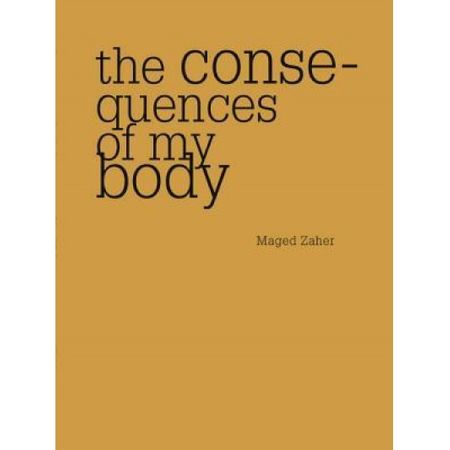
cover - hana shafi - it begins with the bodycover - maged zaher - the consequences of my body

The titles of their books:

Hana Shafi It begins with the body

Maged Zaher the consequences of my body

The use of anaphora and repetition:

i stayed up all night writing poetry
drank my sadness;
it was sweet tea,
nostalgic
[…]
so finally finally
finally, the tide came in
and the land was clean.
i was clean.

Hana Shafi “Ritual”

* * *

[p. 9 – the beginning]

Failing is an act of love
Oh purity
Words are slices of time
They travel with us
Alone with a few bags
After the duty free

[…]

[p. 26 – pages later]

Words are slices of time
Together with few bags
They travel with us
After the duty free

If surrounded by noise
They allow forgetting
I will love you
As a collateral revolution

Maged Zaher

The shared lexeme of “failure” — “Failing is an act of love” “humbled myself in the presence / of my own failure, so finally finally / finally, the tide came in / and the land was clean. / i was clean.”

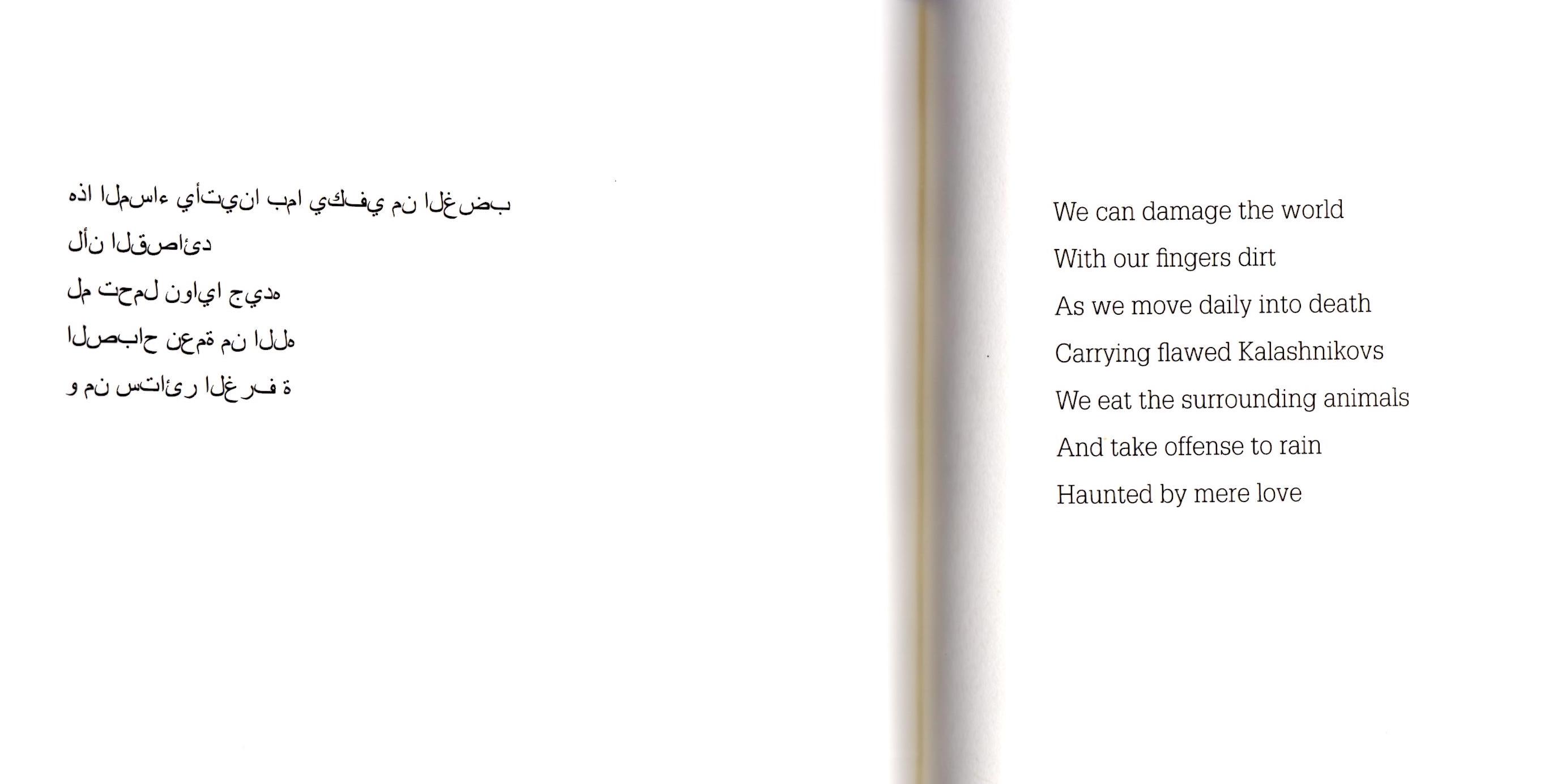
Failure of another sort — engineered failure for the monolingual English reader — you turn the page in Zaher’s book and on the verso is this section of what looks like Arabic. No translation, no annotation. You scan the WWW and find an interview:

On page 67, the reader encounters a poem in Arabic script. If this poem itself is translated elsewhere within The Consequences of My Body, it is not marked or identified in any way. Likewise, the reader is not privy to whether these Arabic lines constitute an original composition, or whether they are the work one of on those predecessor poets introduced later in the book. What hinges upon the un-translation of the poem on page 67?

So much hinges on this un-translation and its typeset — so much — I will leave it at that

https://entropymag.org/trying-to-bring-some-intensity-to-the-daily-a-conversation-with-maged-zaher/

You turn to your Arab-speaking friend:

Typically, one has to understand what one is reading in Arabic and do so with a good grasp of the grammar in order to read it correctly. This is one reason why the language is classified as one of the most difficult in the world.

Your poet is intentionally trying to make things even more difficult. The Arabic script is in mirror image. And, to complicate things further, it is all in upper case letters without any spaces separating the words.

I am assuming the intention here is to have the text resist optical recognition software and hence make it accessible only to a living breathing Arabic reading human.

The importance of typography indeed.

arabic segment - maged zaher - the consequences of my body

These have been placed here
a) because of their titles
b) because of their use of repetition
c) because of their theme of “failure”
d) because of none of the above
e) because of all of the above (including none of the above)

And so for day 2593
18.01.2014

Posted in Poetry, Translations | Tagged | Leave a comment

X Marks the Spot

It’s the challenge to a cartographic imagination that struck me.

Just to give an example of the problems with the heroic model of queer activism and scholarship, consider the recent uproar over bullying in schools. […] The reality of bullying and gay teen suicide is probably quite different from the media engineered showdowns between bullies and sissies. First, just because a teen is gay and kills himself, does not mean that he killed himself because he was gay. Second, looking for hard and fast reasons for suicide, particularly in young people, is a fool’s game and it ignores the multiple pressures facing young adolescents on account of the messed up worlds that we adults pass on to youth. Finally, the representation of adolescence as a treacherous territory that one must pass through before reaching the safe harbor of adulthood, and this is the explicit message of the “it gets better” campaign, is a sad lie about what it means to be an adult. In fact, to distort the saccharine message sent out by Dan Savage and his boyfriend, sometimes “things get worse” … The touchy feely notion embraced by this video campaign that teens can be pulled back from the brink of self-destruction by taped messages made by impossibly good-looking and successful people strongly recounting the highlights of their fabulous lives is just PR for the status quo, a way of patting yourself on the back without changing a thing, pretending to be on the front lines while you eat caviar and sip champagne in the VIP lounge. By all means make cute videos about you and your boyfriend, but don’t justify the self-indulgence by imagining you are saving a life.

The indignation is righteous. And embedded in this diatribe is the notion of multiple life worlds — a subtle if clear reminder that however messed up they may be they are not a single totalized world covered by a unique story of progress. It’s just way messier. Even the use of the second person pronoun makes the reader in part complicit in the champagne sipping. Cheering on the indignation is not enough.

All from a footnote from Jack Halberstam “Queer Betrayals” in Queer Futures: Reconsidering Ethics, Activism and the Political edited by Elahe Haschemi Yekani, Eveline Kilian and Beatrice Michaelis.

And so for day 2592
17.01.2014

Posted in Uncategorized | Leave a comment