De-Coupling

The Quickie:

The sacralization of the Child thus necessitates the sacrifice of the queer.

The Thus:

Demeaned, it embraces de-meaing as the endless instance of the Real that the Symbolic can never master for meaning now or in the “future.”

The Source:
Lee Edelman
No Future: Queer Theory and the Death Drive

And so for day 2591
16.01.2014

Posted in Uncategorized | Leave a comment

The Phenomenology of the Hand-held

From a town in eastern Canada (Kentville, Nova Scotia) comes this “simplistic example” notable for its meditation on technology, commerce and craft…

Andrew Steves
Smoke Proofs: Essays on Literary Publishing, Printing & Typography
“The Ecology of Publishing: an interview”

I started my typographic education with hand-set lead type and letterpress even though I knew I was destined to do most of my design work on a computer. I started off with letterpress because I wanted to understand how type worked and where it began. That experience was invaluable, and I loved letterpress so much that I just kept doing it alongside all of the digital design work I do. But my point is that we need to understand the tools we use and the tradition we work in. You need to understand what job one tool does well but another does not. This is why we combine many generations of technology in our shop; the inventory of the tools we use really spans the whole history of typography. It’s a very broad toolbox. I don’t want to rule out a tool just because it’s old or new. But I do want to understand what it does well and the implications of using it.

The electronic text formats and the types of hardware we use them on are still evolving. Personally, electronic texts don’t interest me that much, at least not as something I’d want to manufacture. This is largely because I’m having too much fun making physical books. But I do see their value. When I want to read Thoreau’s writings, I have most of the volumes in the wonderful Houghton Mifflin series that was produced by the Riverside Press in the 1890s. I often end up trying to locate a line or two in a book I’ve read, and I’ll remember that it was part way through this or that volume on a verso page near the top; I might have made a small mark in the margin with a pencil. And I will find it again. There’s something about our relationship with the codex format and the light reflected off of a book page that helps us with reading, and with recall. There’s something sympathetic to our physiology about that information storage and transmission format. However, if I want to count how many times Thoreau mentions pine trees in The Main Woods, I don’t go to the paper edition. I go instead to the searchable pdf of that same Riverside Press edition which is loaded on my laptop. That’s an incredibly elegant tool when use for that particular task. This is a simplistic example but it demonstrates my point: you have to understand what tool does what job best.

It reminds me that phenomenologically the book is hand-held. Yes those great hulking reference works sitting on a lectern are books too or so they are called. But consulting the big dictionary is not an intimate reading experience. The demarcation may not be between codex and scroll (so much of on screen reading involves scrolling) but between the intimate, focalized event and other events. Held in the hand like an offering received.

And so for day 2590
15.01.2014

Posted in Booklore, Reading | Leave a comment

Maps of Misreading

Encountering Dense Discourse and Utopian Leanings
Tamsin Spargo on Gender Trouble

The misreading of performativity as choosing gender, like selecting from a wardrobe, may stem from a utopian desire to evade the compulsions of the binary gender system and heterosexuality that Butler identifies, or from the pervasive consumerism of contemporary Western culture, which is structured around the myth of free choice. It may also, it has be said, be connected with Butler’s difficult and sometimes opaque writing style, and with a desire for answers, for tangible suggestions.

Tamsin Spargo
Postmodern Encounters: Foucault and Queer Theory
p. 58

Encountering Refusal to Read: Forms of Resistance
Lee Edelman on No Future

There are many types of resistance for which, in writing a book like this, it is best to be prepared. […] I have somewhat greater sympathy for those who might be inclined to dismiss the book for its language (which they’ll call jargon), for its theoretical framework (which they’ll view as elitist), for its difficulty (which they’ll see as pretension), or for its style (which they’ll find to be tortuous). These objections at least have the virtue of acknowledging a frustration of desire in the face of what is experienced as overpresence of a drive. “Somewhat greater” though it may be, however, my sympathy for even this form of response has its limits as well, I confess.

Lee Edelman
No Future: Queer Theory and the Death Drive
p. 157 n. 19

Re-encoutering maps, utopias and accessibility
Gjertrud Schnackenberg on Osip Mandelstam

He will be free to look into a succession
Of snowflakes poised on his glove
As if he had idly lifted a kaleidoscope
To his eye and seen street maps
Of harmless utopias succeed one another
In a swift, geometrical blaze,
Like hypothetical maps
Of a village you once passed through,
Though functionaries have made a point
Of sealing off those documents
That mention you.

Gjertrud Schnackenberg
“A Monument in Utopia”
A Gilded Lapse of Time
p. 98

tangible suggestions
I confess
mention you

And so for day 2589
14.01.2014

Posted in Poetry, Reading | Leave a comment

Escape and What the Waves Cast Up

There was something of a reverberation in the line about the lonely shore and the rapture.

Henri Cole
“The Constant Leaf”
Nothing to Declare

[…]
It is strange how the past holds on to us

how the rapture of the lonely shore
is agreeable only if we can
at any moment escape it,

and how the night feels
so indispensable, soothing.
[…]

The allusion tracked down to a stanza in Byron’s fourth canto of Childe Harold’s Pilgrimage.

     There is a pleasure in the pathless woods,
     There is a rapture on the lonely shore,
     There is society, where none intrudes,
     By the deep Sea, and music in its roar:
     I love not Man the less, but Nature more,
     From these our interviews, in which I steal
     From all I may be, or have been before,
     To mingle with the Universe, and feel
What I can ne’er express, yet cannot all conceal.

the rapture … a rapture … the shift from indefinite to definite article makes possible the re-orientation of escape from to to from

And so for day 2588
13.01.2014

Posted in Poetry | Tagged , | Leave a comment

Some Awesome Flavoursomeness

Ginger Ko
Motherlover

“Prayer for What’s Close”

          Let me stay here in the West please God
          Let me live on in shabby comfort
          Let me find the tinned tomatoes aisle without wandering
          Let me feel safe enough to have children someday

I’ll make every day worthy and won’t be unpleasant
I’ll remember not to dissolve into a malcontent
I’ll breathe and other cleansing things
I’ll walk in the mornings and write affirmations

It just to happens that when I was reading these lines, the background music featured another prayer from Madonna’s “Justify My Love”

Wanting, needing, waiting
For you to justify my love (my love)
Hoping, praying
For you to justify my love

Ko’s bargaining receives a note of sauciness from a more piquant offering earlier in the volume, from the opening sequence “Gaslight”

Things unremembered can be made unreal
A soft black eye perfectly round
Flavory fucking that fills the room
With a sodden smell

The nurture-danger flavours seep into the cover art by Sofi Thanhauser. Chopsticks resting on the edges of a bowl? Mouth and teeth devouring a title!

Ginger Ko - Motherlover - cover art by Sofi Thanhauser

And so for day 2587
12.01.2014

Posted in Booklore, Poetry | Leave a comment

Recipe Cards from a Fish Company

These two pieces of cooking ephemera were found in a second-hand book. At first I thought they were decorated with simulated coffee mug stains. On closer examination and noticing the logo of the company in the right hand corner, I realized that the pattern was that of a jumping fish.

ephemera - recipe card - chelsea fish co. inc. - fried okra

ephemera - recipe card - chelsea fish co. inc. - cream of pumpkin soup

Good tip: leaving the cut okra to dry out overnight before frying.

Fave technique: creating the cream base to which is added the flavouring veg

The company appears to be now defunct. The fish flies on.

And so for day 2586
11.01.2014

Posted in Ephemera, Food Writing, Uncategorized | Leave a comment

Body Less Word More

Nathalie Stephens
Touch to Affliction

First the invocation of distance…

It is not possible in your language to grieve. To touch the lungs that collapse or the bones that break. Water pouring from an unbreathing mouth. It is not a matter of words for things. Rather it is a matter of distance between the word and the thing.

Second, distance not only between word and thing but also between word and word…

In another language I would say: Désincarné. But I would not say: Disembodied.

Third, tied to place and yet unmoored…

Le corps is not the same as corpse. And this is not Paris. But it’s close enough.

Unbodied.

Hence to the possibility of grieving.

And so for day 2585
10.01.2014

Posted in Poetry, Translations | Leave a comment

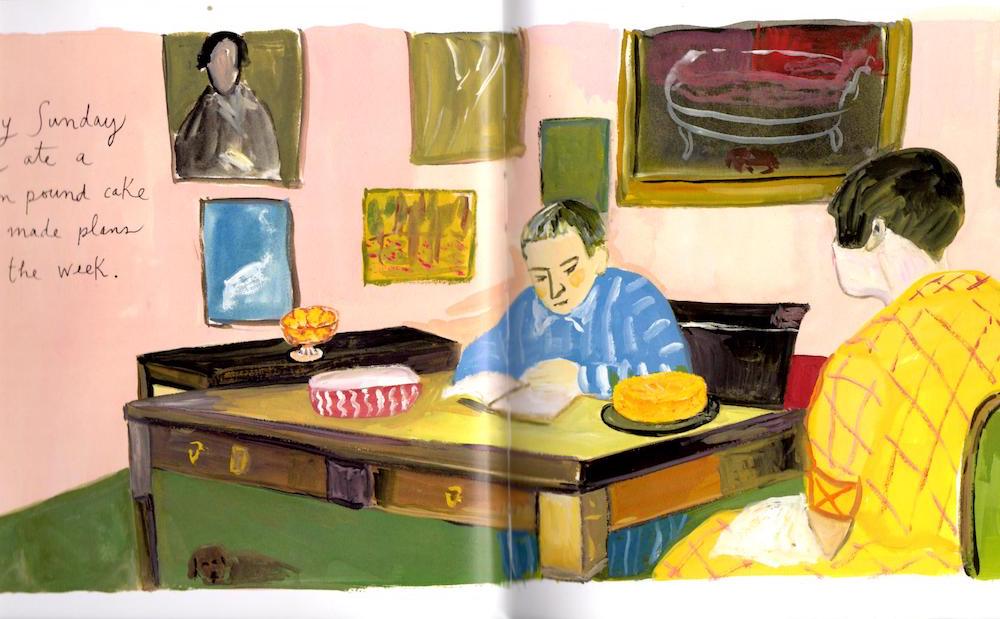
Kalman’s Stein and Toklas & Lemon Pound Cake

I like the calligraphy on the left. It occupies the space like the brushstrokes of a line or two of verse on a Japanese scroll.

Every Sunday
they ate a
lemon pound cake
and made plans
for the week.

The sitters are the famous pair of Alice Toklas and Gertrude Stein. Recognizable from their hair and the walls of paintings in the room.

Maira Kalman's Stein and Toklas & Lemon Pound Cake

Maira Kalman's Stein and Toklas & Lemon Pound Cake

Cake. Maira Kalman with recipes by Barbara Scott-Goodman.

Jama Rattigan at Jama’s Alphabet Soup: An Eclectic Feast of Food, Fiction, Folderol and Chewy Culinary Verse furnishes her article with a reproduction of the Kalman illustration (sans calligraphy) and provides a 1941 photograph by Thérèse Bonney (misidentified as Bonnet) that inspired the picture.

https://jamarattigan.com/2018/10/02/♥%EF%B8%8F-love-me-some-cake-by-maira-kalman-and-barbara-scott-goodman-a-giveaway♥%EF%B8%8F/

And so for day 2584
09.01.2014

Posted in Food Writing | Leave a comment

As the Wisteria Twines

A wondrous woody vine, wisteria stretches up and over supporting structures just like this opening verse

Don’t blame the wisteria for setting off a feeling like freedom a feeling like joy

Deborah Landau
“don’t blame the wisteria”
in Soft targets

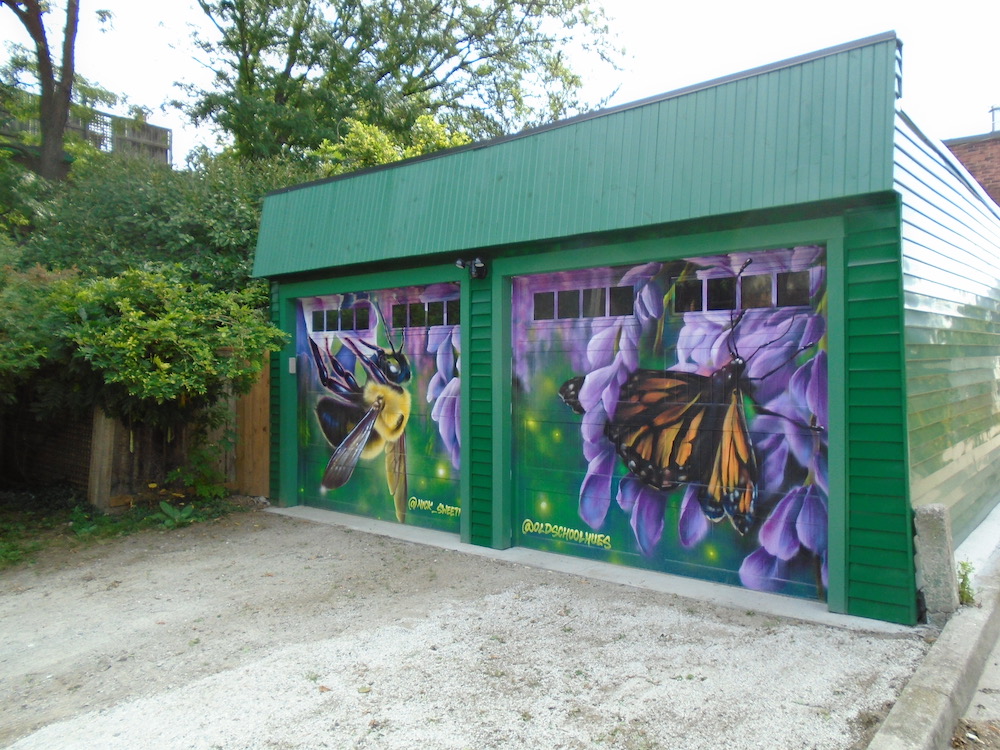
In my neighbourhood there was a splendid specimen sprawled over a wooden garage painted in a deep green. The garage was updated with new siding and the wisteria cut back and redirected. However the owners commissioned some artwork that references the previous growth. Two artists each contributed one painting for each door.

@oldschoolhues and @nick_sweetman

wisteria themed garage - london & palmerston street toronto

wisteria themed garage - london & palmerston street toronto

joy feeling like freedom

And so for day 2583
08.01.2014

Posted in Gardens, Uncategorized | Leave a comment

Listen to be Heard

Toronto Public Health has a Child Friendly Policy Framework with a notable acknowledgement of the importance of culture in its set of vision statements

Vision

Children in Toronto are valued, listened to and treated with respect.

Children in Toronto thrive because they live in safe, accessible, well-designed, healthy and nurturing communities.

Children in Toronto are acknowledged for cultural ways of knowing and are able to live their culture.

Parents, caregivers and communities feel included and supported to prepare for, take care of, and equip children for the best start in life continued into the middle years.

On of the goals of the Child Friendly Policy Framework is Child Engagement and commits Toronto Public Health to a set of actions to empower children.

TPH and its partners will ensure a greater voice for Toronto’s
children and improve opportunities for their meaningful
participation to build awareness and champion
improvements by:

Encouraging the participation of children to inform
decision making

Engaging with children on issues related to child health,
development and wellbeing

Collaboration across city divisions, their partners and
communities on issues related to child health, development
and wellbeing

Developing capacity to effectively engage children in
decision making

Reminded me of some relationship-building pointers from the 1969 classic The Little Red Schoolbook.

Maria Popova offers some selections from the book and observations about their relevance to older persons too …
https://www.brainpickings.org/2014/09/08/the-little-red-schoolbook/

To have influence it’s important to remember

  • That it’s easier to influence someone if you like them and they like you.
  • That the most influential thing you can do is to be honest (and tactful).
  • That you need to know the person you want to influence — and to understand why he does what he does.
  • That a person who’s frightened is hard to influence: he often gets angry so as to hide his fear.
  • That it’s best to bring disagreements out into the open if everybody knows they exist. That discussing and sorting out disagreements is a good way of learning more about each other. It also helps clear the air.
  • That if words fail, you can try positive action.

Cover - Little Red Schoolbook

What you get out of your education will largely decide what you get out of your whole life. So you have a right, and a duty to yourself, to insist on getting the best possible education. You should know how the present system works and what its limitations are. But you must not let this stop you demanding a proper education.

And so for day 2582
07.01.2014

Posted in Uncategorized | Tagged | Leave a comment