Painting, Image, Model

The model is not a muse. The painting is not an image.

Matisse: A Way of life in the South of France text by Gilles Plazy

He did not have the haste of the impressionists who chain the canvas to the subject, because rather than representing something, he was engaged in creating paintings, which is no mean feat. A painting is not an image, it is a new, autonomous being, which encapsulates the emotions and sensitivity of the painter and communicates them again to the spectator.

Karin Cope
“Painting after Gertrude Stein”
Diacritics
Vol. 24, No. 2/3, Critical Crossings (Summer – Autumn, 1994)

A model is not a muse, then, but the name of a force or problem that animates a particular body of work. Such models are legible not simply as the traces of “life” on work (as if work “confessed” to a life somehow separate form it) but in and as works or regimes of work themselves.

The painting is not an image. The model is not a muse.

And so for day 2571
27.12.2013

Posted in Uncategorized | Leave a comment

I ♥ The Ubiquitous Promiscuous Heart

This line speaks to a modus vivendi

To ♥ New York is to love it in an epicurean way, with one’s whole body, to accept its flaws, to revel in its sensory overload, to become accustomed to the unexpected.

which gains its import from a matter of intertextual interest..

Scott King’s graphic identity for the retrospective, displayed here and at other sites, recalls Milton Glaser’s iconic I ♥ NY and all the ubiquity, repeatability, and multiplicity of meaning that relentlessly reproduced piece of design has come to signify. To ♥ New York is to love it in an epicurean way, with one’s whole body, to accept its flaws, to revel in its sensory overload, to become accustomed to the unexpected. It’s a lot like ♥ing Giorno, whose work sets out to provoke and engage, to turn a passive viewer or listener into an active participant, a maker and a doer—hearting, helping, dialing, laughing. I ♥ John Giorno is itself a repeating mantra.

https://www.theparisreview.org/blog/2017/08/29/♥-john-giorno/
I ♥ John Giorno and So Should You
Chantal McStay
The Paris Review

Grounded in action …

For the AIDS Treatment Project, a grassroots program that collects funds and gives them directly to AIDS patients, [John] Giorno approached his philanthropic efforts with compassion and a do-what-you-can, do-it-yourself attitude:

My intention is to treat a complete stranger as a lover or a close friend; in the same spirit as in the golden age of promiscuity, we made fabulous love with beautiful strangers, and celebrated life with glorious substances. ‘God please fuck my mind for good!’ Now that their life is ravaged with AIDS, we offer love from the same root, in the form of boundless compassion.

or again…

to love in an epicurean way, with one’s whole body, to accept its flaws, to revel in its sensory overload, to become accustomed to the unexpected.

And so for day 2570
26.12.2013

Posted in Uncategorized | Tagged , | Leave a comment

Dialogue-provoking Temporal Deictic

Nic Salvato
“Camp Performance and the Case of Discotropic
in
After Queer Studies: Literature, Theory and Sexuality in the 21st Century
edited by Tyler Bradway and E.L. McCallum

A close reading of time stamps (and this day which is not one)

[…] the text contains headnotes above entries that record the sending of messages at “12/8/15, 11:29 PM,” “12/31/15, 10.03 PM,” and so forth. The final such headnote reads “Today,” and a deliberation informs its sharing. Acosta could have captured an image of what his screen displayed some day or days after the final instalment of Exquisite Corpse was produced, at which point the software used in its making would have dated it differently. Instead, he wants us to see the story “end” […] “Today,” in part because Discotropic implicitly poses the question, “What exactly is ‘today’?” Troubling any stable notion of linear time is common to camp, to the temporal turn in queer theory of which camp criticism comprises a subset, and to Afrofuturist cultural production, in all of which formations Discotropic ramifies. Today becomes yesterday. It comes tomorrow. […]

And the beat goes on.

https://nivacosta.com/DISCOTROPIC

And so for day 2569
25.12.2013

Posted in Uncategorized | Tagged | Leave a comment

In Praise of Cover Art and in Praise of Book Design

First, a reminder of the interplay of body and image in the remaking of the world through its shattering…

Nicole Brossard
Sous la langue (1987)
Under Tongue translation by Susanne de Lotbinière-Harwood

Rien n’est prévu pourtant au bout du corps la peau fera image du corps car il n’y a rien sans image au bout du corps ce sont les images qui foudroient l’état du monde.

Nothing is foreseen yet at body’s uttermost the skin will image the body for without image there is nothing at body’s uttermost images shatter the state of the world.

Second, visual work by Quill Christie-Peters from a series focused on the land and woman’s self-pleasuring as an act of reclaiming the Anishinaabe body as homeland. Her words are a key to reading the work.

Quill Christie-Peters Self-Portrait: Kwe loves herself despite all odds

Quill Christie-Peters
Self-Portrait: Kwe loves herself despite all odds
24×36″


Omnipresent Anishinaabekwe has never felt the compartmentalization in her body, but she feels it projected at her, attempting to make her readable through the separation of her being. She has always felt the soft hands of ancestors, heard them whisper in the night. They have made her laugh out loud at times at the gifts they give her, the purpose they feed her, the joy in knowing how close they are, watching, waiting. Omnipresent Anishinaabekwe feels her own body, can shrink into a piece of floating dust and visit her homelands in the night, feels them ache with the weight of what they carry. City Anishinaabekwe has always known she carries her homelands in her body and this keeps her oh so warm at night.

https://www.quillviolet.com/all-posts/chapter-1-being-in-full-anishinaabe-life-as-art-and-anishinaabe-body-as-homeland

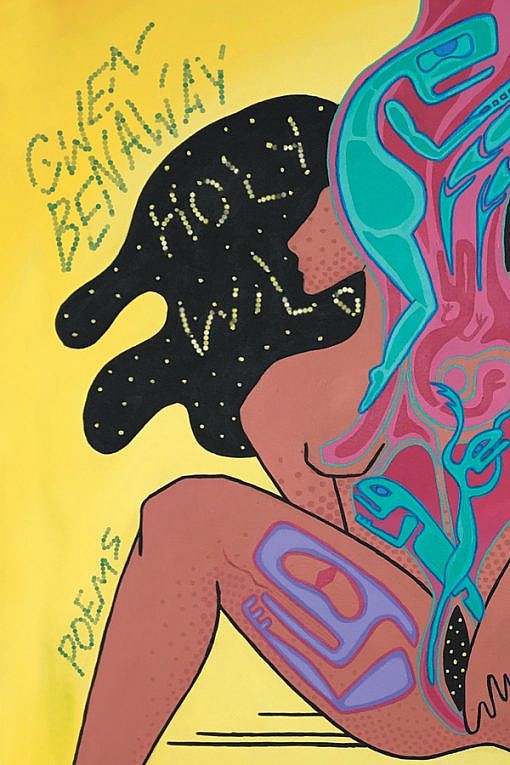
Third, part of Self-Portrait: Kwe loves herself despite all odds graces the cover of Gwen Benaway’s Holy Wild in a design by Kate Hargreaves.

Cover - Holy Wild - art by Quill Christie-Peters - design by Kate Hargreaves

Holy Wild
Cover Art – Quill Christie-Peters
Design – Kate Hargreaves


The image is split but not right down the centre. The scission leaves the vulva whole. There is a hint of a hand. And when the book is opened the endpapers reveal that there is indeed digital stimulation and fanning out the pages reveals a cerebral one as well. The neat trick of the layout is that the endpapers are actually a continuation of the cover: front cover inside; back cover inside. And the image spans this whole space inviting viewers to consider anew its import. Further, the book proper — all its leaves — occupy the central axis and link head, heart and sex.

And so for day 2568
24.12.2013

Posted in Booklore | Leave a comment

the impossibility of an ending never begun

We shall never again inhabit that fantasy of ourselves that never was, for now we know it to have been a fantasy.

Dana Seitler
“Write, Paint, Dance, Sex Queer Styles/American Fictions”
in After Queer Studies: Literature, Theory and Sexuality in the 21st Century edited by Tyler Bradway and E.L. McCallum

[in reference to the novels of Henry James and narrative closure]

We shall never again inhabit that fantasy of ourselves that never was, for now we know it to have been a fantasy. This makes the supposition that there can be an “after” queer studies somewhat incomprehensible. From a Jamesian perspective we could ask: Can queer desire be contained within a teleological narrative of beginnings and ends? Can ways of reading it? If, as readers, we crave a stable, simplified version of James’s, or any, novelistic world as one way to simplify and stabilize the relations we have in our own, this wish for a resolution is precisely what James mirrors back to us and then refuses by confronting us with a narrative that insists — through its presentation of provisional and impoverished forms of perception, its exhaustive use of prepositional clause as a way to mine the slow rhythms of thinking, its temporal discontinuities — upon the impossibility of an ending. In the writerly practices, the resolute attachments to irresolution, James shows himself at his most queer. To refuse the closure of the marriage plot is to refuse the time of heterosexuality. To embrace the structural and temporal vicissitudes of the narration of desire is to open up the categories of sexuality to greater, more multiple possibilities for attachment, intimacy, and sex.

a never ending beginning

And so for day 2567
23.12.2013

Posted in Storytelling | Tagged | Leave a comment

Ce Sexe Que N’est Pas Un Qui Nez Pas

Nicole Brossard
Picture Theory

un sexe de femme c’est mathématique.

Ultrasounds translated by Lucille Nelson in Nicole Brossard: Selections

Beautiful liaison, to which many women are indebted for a glimpse of the possibility that their sexual parts are more numerous than is usually thought.

“Poetic Politics” in Nicole Brossard: Selections
[Published in The Politics of Poetic Form: Poetry and Public Policy edited by Charles Bernstein (New York: Roof Books, 1990)]

For me the body is a metaphor of energy, intensity, desire, pleasure, memory and awareness. The body interests me in its circulation of energy and the way it provides, through our senses, for a network of associations out of which we create our mental environment, out of which we imagine far beyond what we in fact see, feel, hear or taste. It is through this network of associations that we claim new sensations, that we dream backward in accelerated or slow motion, that we zoom in on sexual fantasies, that we discover unexpected angles of thought.

**   **   **

CAConrad
Ecodeviance: (Soma)tics for the Future Wilderness

“Full Moon Hawk Application”

Once I dreamed that I had a cunt for a nose, and that was fantastic, putting finders in the cunt of my face!

“Children Know Mouth of Fable Pilots the Way to Womb Snout”
[this is the opening]

“he awoke with a / vagina instead of a / nose some women walked by pointing / how does that smell they asked”

And so for day 2566
22.12.2013

Posted in Poetry | Tagged | Leave a comment

間 Space Architecture Space 間

Judy Halebsky
Tree Line
“Space, Gap, Interval, Distance”

She concludes the poem with an ekphrasis of the written character followed by a mise en page (via an extended gap between words) that reduplicates the notion of negative space explicated in the ekphrasis.

             間 ma
             written as the sun
             coming through the gate

as what we leave open
between us
so the spirits        when they come
will have a place to land

This for me comes as an echo of “Ma continent” found in Nicole Brossard’s Amantes (translated as Lovhers,; by Barbara Godard) (which I first encountered as a separate poem in Fireweed‘s 1983 lesbian issue). In one section of Brossard poem there is a catalogue of women writers (spirits of ancestors?). The thematics is one of creating/occupying openings… The link to Japanese concepts of space is conveyed in a note:

mâ — japanese term for space
ma — possessive pronoun, feminine gender in French

After Halebsky, I note that the French rendering of the Japanese word features a circumflex over the “a” like a roof and that the Wikipedia article on negative space (ma) informs us that both Ma (negative space) and Ken (architecture) are written with the same character 間.

And so for day 2565
21.12.2013

Posted in Poetry, Transcriptions, Translations | Leave a comment

Captive to the Technology of Capture

I wrote to a friend about one particular aspect of the peaceful anti-transphobic protests at the Palmerston Branch of the Toronto Public Library – one that touches on the politics of representation (and insertion in social discourse)…

bio-power, regimes of truth-telling, policing, policing of speech,
policing of protest, policing of policing, ontological stakes, micro-aggressions …

There was a bit of activity at our local branch yesterday evening.

I wonder were we ever so earnest and devoid of self-reflexivity in our protests*. So contradictory when it came to the politics of surveillance and counter-surveillance?

What struck me in one of the Twitter streams… taking umbrage at the Library’s policy of no photography or filming on the premises without prior permission. It’s in the Rules of Conduct. Wouldn’t this protect privacy rights of patrons and yes protestors in the library are patrons too? Seems like the camera phone has become weaponized. A right to bear phones : )

Those cameras could have been trained outside the venue on a black trans woman declaiming the words of Sojourner Truth: Ain’t I a Woman**. But she wasn’t there… or if she was she wasn’t captured on camera or otherwise recorded.

*Some of those days are documented by Douglas Crimp in AIDS Demo Graphics. And lately I applaud the creativity of the “angels” with extra wide and tall wings and dignified silence that block the anti-gay Westboro Baptist Church protestors. Like good theatre the impact hinges on the exploitation of contradictions.

** I have learnt that there are different versions of Sojourner Truth’s famous speech …

https://en.wikipedia.org/wiki/Ain%27t_I_a_Woman%3F

And so for day 2564
20.12.2013

Posted in Uncategorized | Tagged | Leave a comment

Listening to the Watching: Whale Music

Judy Halebsky
Sky = Empty
“Whale Music”

[It’s a three section poem with each section ending with a stanza of three lines that echo each other from section to section.]

fathom: to determine the depth of sound
fathom: to find the nature of
fathom: to measure the depth of the ocean

fathom: to measure the depth of the ocean
fathom: to determine the nature of
fathom: to hear the sound of whales

fathom: callused hands pulling in nets
fathom: to know the nature of
fathom: to measure loss

[a poem found within the poem]

And so for day 2563
19.12.2013

Posted in Poetry | Leave a comment

per os / per nasum

It began with this bit and the rumour about vanilla.

Screwpine (Pandanus amaryllifolius)

In the West we forget the close relationship between perfume and flavourings. Odd to think that Parisian perfumiers once put it about that vanilla was poisonous to halt its increasing use by pastrycooks. Pandanus or screwpine species provide scented flowers for kewra essence to flavour syrupy Indian desserts, and scented leaves for cookery, for medicine and for religious offerings.

From Jane Grigson (illustrated by Charlotte Knox)
Exotic Fruits and Vegetables (London: Jonathan Cape, 1986)

* * *

Since there was no source for the rumour, I consulted Patricia Rain, Vanilla: The Cultural History of the World’s Most Popular Flavor and Fragrance and found no confirmation but lots of circumstantial corroboration.

p. 162

Popular as these modern fragrances were, they were not yet within the reach of working class women or women living in rural America. Instead, these women relied on the bottle of vanilla extract, which they dabbed behind their ears or on their wrists, and sprinkled on their handkerchiefs. It wasn’t until much later in the century that affordable vanilla fragrances were available to everyone.

p. 161
[I]t wasn’t until 1925 when Guerlain launched Shalimar that vanilla emerged as a dominant aroma in perfumery. Shalimar was the first perfume to contain vanillin ethyl, an artificial molecule smelling like vanilla and marked by an overwhelming intensity. It remains the epitome of the oriental profile. [often referred to in the trade as “oriental” are fragrances incorporating vanilla as a predominant, secondary or base note]

p. 62-63

The French also expanded the use of vanilla into the perfume industry. By the late 1700s, perfumes were commonplace, and what would be more delightful than to use vanilla to soften the strong nuances of Oriental spices and highlight the sweetness of delicate herbs and flowers?

[…]

Handkerchiefs were perfumed with fragrances to refresh the nose. Even French tobacco and snuff were fragranced with the compelling aroma of vanilla.

p. 31

In 1502, Spanish soldiers from Cuba obtained some vanilla from coastal Indians and sent it to Spain along with indigo and cochineal dyes. As the Spaniards’ contact with the coastal tribes was limited, and as they didn’t speak the native languages, vanilla’s use was unknown. They thought it was a perfume.

p. 123-124

The [Totonac] families who either dried their own vanilla or who worked in the casas de beneficio used the vanilla oil that ran off during the first stages of curing and drying to rub on their skin or to add shine to their hair. The vanilla was also used as an air freshener and a perfume for clothing. Dried beans were trucked into hatbands along with flowers and feathers. And a vanilla-flavored aguardiente was always prepared for baptisms, weddings, and the significant family events.

* * *

Intrigued by the economics, I found a useful comparison of bean and extract in Chatelaine.

https://www.chatelaine.com/recipes/chatelainekitchen/pantry-101-vanilla-extract-vs-vanilla-beans/

Why we love them:
Vanilla beans are the most pure form of vanilla and the small seeds are loaded with flavour and add visual interest to dishes. Plus, once you’ve scraped out the seeds, you can use the pod for infusing sugar or spirits.

Why we love it:
This budget-friendly solution is perfect for adding to cookies and cakes where the vanilla is more subtle and used to enhance overall flavour.

And then there’s that heavenly combo: vanilla ice-cream and espresso: affogato. Poisonous, simply poisonous.

And so for day 2562
18.12.2013

Posted in Food Writing, Perception | Leave a comment