Comprehending the Comprehensive: Complete Street Guidelines

Look at how the principles appear: note that social equity in this framing has both the semantic pull towards “equality” and that of real wealth (“equity”) because of how it is positioned between vitality and maintenance under the general rubric of prosperity…

Three policy levers which elaborate the concept of “prosperity”. (I suspect they are transferable beyond the sphere of urbanism.)

p. 16 of the Complete Street Guidelines of the City of Toronto

STREETS FOR PROSPERITY

https://www.toronto.ca/wp-content/uploads/2017/11/906b-Chapter-1.pdf

SUPPORT ECONOMIC VITALITY
Streets should support the city’s
economic vitality by helping move
people and goods efficiently and by
supporting local shopping areas. The
quality and vitality of a street
influences and reflects the quality
and vitality of economic activity
along it.

ENHANCE SOCIAL EQUITY
Streets should be developed to
remove barriers so people of all
incomes, races, ages, genders and
abilities can safely use and benefit
from Toronto’s streets.

BE FLEXIBLE & COST EFFECTIVE
Streets should be able to adapt to
the city’s changing needs and
priorities over time. The design of
complete streets should consider
economic, social and environmental
benefits and costs, as well as
construction, operations and
maintenance.

And of course as everyone knows implementing the simple can be complex. Like writing policy documents, successful implementation is sensitive to mise en place.

And so for day 2561
17.12.2013

Posted in Uncategorized | Tagged | Leave a comment

Three Nodes

On Actor-Network Theory

[I]t can more technically be described as a “material-semiotic” method. This means that it maps relations that are simultaneously material (between things) and semiotic (between concepts). It assumes that many relations are both material and semiotic.

https://en.wikipedia.org/wiki/Actor%E2%80%93network_theory

On Persons

What we have to acknowledge, in order to begin to free ourselves from these difficulties, is the primitiveness of the concept of a person. What I mean by the concept of a person is the concept of a type of entity such that both predicates ascribing states of consciousness and predicates ascribing corporeal characteristics, a physical situation, etc., are equally applicable to a single individual of that single type. What I mean by saying that this concept is primitive can be put in a number of ways. One way is to return to those two questions I asked earlier: viz. (1) why are states of consciousness ascribed to anything at all? and (2) why are they ascribed to the very same thing as certain corporeal characteristics, a certain physical situation etc.?

P. F. Strawson on person as primitive from Individuals

On Intent

A person endowed with intention is an actant able to recognise a pattern (state) and focalize (align as to force). A person is as well an actant able to intervene in a pattern or a focalization of a pattern and either change (preserve) the pattern, itself, or both pattern and self.

http://homes.chass.utoronto.ca/~lachance/dolezel.htm

And so for day 2560
16.12.2013

Posted in Storytelling | Tagged | Leave a comment

Subjectivation and Narrativisation

We begin with the characterization of a person.

Lynne Huffer. Mad for Foucault: Rethinking the Foundations of Queer Theory

p. 117

For Foucault, as for Deleuze, subjectivation includes more than social or linguistic construction. Indeed, it includes more than the subject itself:

Subjectivation as a process is a personal or collective individuation. … There are subject-type individuations (“that’s you …,” “that’s me … “), but there are also event-type individuations where there’s no subject: a wind, an atmosphere, a time of the day, a battle. … One cannot assume that a life, or a work of art, is individuated as a subject; quite the reverse. Take Foucault himself: you weren’t aware of him as a person exactly. Even in trivial situations, say when he came into a room, it was more like a changed atmosphere, a sort of event, an electric or magnetic field. *

*Deleuze, Negotiations, p. 115
Gilles Deleuze, Negotiations 1972-1990 translated Martin Joghlin (New York:
Columbian University Press, 1995)

I note that Huffer presents two categories (force and person). I have in the past tried to read them as a generative series (and failed). See my reading, of the typologies as play in reading Doležel’s Heterocosmica: Fiction and Possible Worlds.

This failure may be an error in seeking an origin story in the relations of forces to persons. Where I read off an implicit schema (trying to bend a typology to a narrativisation) — I numbered them as one, two, three:

  1. States are introduced.
  2. Forces are considered.
  3. Persons are augmented.

I would now (having read Strawson’s “Persons” chapter in Individuals) not list them as a numbered sequence. I would follow Strawson and for narratological purposes consider persons as primitives. Strawson: “The concept of person is logically prior to that of an individual consciousness.” And return to Doležel: “If uttered felicitously, the literary performative changes a possible entity into a fictional fact. In other words, fictional fact is a possible entity authenticated by a felicitous literary speech act. (Heterocosmica 146)”

On the one side are speech acts (introduce, consider, augment) and on the other entities.

Given that persons are primitive, the narration can begin with any entity and proceed with any of the speech acts. And as Ovid has shown in the First Book of the Metamorphoses creation stories can be multiple and that multiplicity encompassed within the space of one recounting.

So is Foucault a person in the story recounted by Deleuze? If a person, like a state or a force, can be a “set of intensities” …

Foucault says “an art of oneself that’s the exact opposite of oneself…” If there’s a subject, it’s a subject without any identity. Subjectification as a process is personal or collective individuation, individuation one by one or group by group. Now, there are many types of individuation. There are subject-type individ­uations ( “that’s you…,” “that’s me…”) , but there are also event­-type individuations where there’s no subject: a wind, an atmosphere, a time of day, a battle… One can’t assume that a life, or a work of art, is individuated as a subject; quite the reverse. Take Foucault himself: you weren’t aware of him as a person exactly. Even in trivial situations, say when he came into a room, it was more like a changed atmosphere, a sort of event, an electric or magnetic field or something. That didn’t in the least rule out warmth or make you feel uncomfortable, but it wasn’t like a person. It was a set of intensities.
[…]
It’s very difficult to express, to convey-a new distinction between affective states. Here we come up against the unfinished character of Foucault’s work. He might perhaps have given this distinction a philosophical range as wide as life. It should teach us, at least, to be very careful about what he calls a “mode of subjectifca­tion.” For such modes involve subjectless individuations. That may be their main feature. And perhaps passion, the state of passion, is actually what folding the line outside, making it endurable, knowing how to breathe, is about. All those who are so saddened by Foucault’s death may perhaps rejoice in the way that such a monumental body of work breaks off with an appeal to passion.

Gilles Deleuze, “A Portrait of Foucault,” Negotiations, 115-116.

Which leads us to return to Strawson

P. F. Strawson
“Bodies”
[first section of] Individuals: An Essay in Descriptive Metaphysics

p. 46

Another distinction, worth mentioning now, to which I shall later refer is that between, e.g. events and processes which, as named and conceived of by us, necessarily are of, or performed or undergone by, material bodies or things possessing material bodies, and events and processes not of this kind. Thus a death is necessarily the death of some creature. But that a flash or a bang occurred does not entail that anything flashed or banged. ‘Let there be light’ does not mean ‘Let something shine’.

p.53 [reminds one of Ovid]

So we enormously extend the range of our possible identifying references to states, processes etc. by allowing them to be mediated by reference to places, persons and material beings.

And so for day 2559
15.12.2013

Posted in Storytelling, Uncategorized | Tagged | Leave a comment

Theatre of Succession

Somewhere somewhen June Jacobs spoke or wrote about the succession of small businesses in a health neighbourhood.

Street watchers were treated to a particularly interesting event following the closure of the Queen Video store on Bloor.

Queen Video logo

Queen Video - Bloor Storefront

A theatre troupe took over the premises and offered an experience based on escape rooms.

ephemera - tape escape - outside the mark

Outside the March gives QUEEN VIDEO a re-birth with an immersive escape room experience that invites you to PUT YOUR LIFE ON PAUSE.

Most video stores let you take the movies home. But at THE TAPE ESCAPE, the rentals happen to you, pulling you deep inside its collection of thousands of VHS Tapes. Disappear back into 1999 with this love-letter to the lost art of browsing. See if you can escape into (and out of) some of your favourite movies by selecting from our collection of “in store rentals”.

So is The Tape Escape an escape room?

Sort of. There’s no actual escaping. But it does use some of the same principles as escape rooms, like working collaboratively to solve a series of puzzles in a set amount of time. Think of it like a puzzle-infused scavenger hunt through an art installation.

The Tape Escape

The sensitivity to timing and location is part of the troupe’s DNA

Outside the March creates unforgettable immersive encounters—redefining the experience of theatre for a new generation of audiences.

We are dedicated to pioneering work that is:

IMMERSIVE: intimate and immediate theatrical encounters that endure
SITE-ENGAGING: transforming found spaces into playgrounds of performance
NEW: urgent stories that grapple with our here and now
WIDE-REACHING: inviting and exciting audiences who don’t normally find themselves at the theatre
COMMUNAL: forging resonant collaborations between artists of all levels of experience

https://outsidethemarch.ca/the-mission/

In a word: dedicated to succession sensitive to the passing show.

And so for day 2558
14.12.2013

Posted in Ephemera | Tagged | Leave a comment

The Re-enchantment of Frugality

Massimo Bottura
Food for Change
European Investment Bank
https://www.eib.org/en/publications/eib-big-ideas-food-for-change

As the frenetic lives we are living might not give us that much time to think about food in a more conscious way, we have to slow down a little to think about food, because on the one hand, it belongs to our territory, to our earth, and, on the other, it will soon be in our bodies.

And so we take time to think about the inside and the outside:

Everyone can avoid food waste. It’s not hard. For example, if you are planning to cook a meal, keep in mind before you buy any ingredients to open your fridge first and see what’s inside. Maybe there is some basil, a piece of Parmesan, a little garlic clove hiding in a dark corner. Perhaps you have some bread from the night before that can be toasted and turned into breadcrumbs, and with some good olive oil, this combination can be made into a wonderful pesto for pasta. You can also start avoiding food waste with many other actions that not only involve your kitchen, your pantry and fridge, but also the market. Find creative ways to use what you already have, rather than always going out and buying more food. And when you do go to the market, try to buy seasonally and locally. Today, more and more people are talking about food. This is a positive shift because it means that there is space for a deeper dialogue, and hope for improving our food systems, from our everyday diet to agricultural practices at large.

And this is where I insert an ingredient from some other reading. I do so to link the idea of avoiding waste by linking it to the idea of how to manage resources well by not obsessively comparing oneself fiscally with others (advice given by Shannon Lee Simons as a necessary prelude to gaining sustainable control over one’s cash flow). Simmons is clear about the tax bracket the advice applies to (“Let me be clear. In this book — and most of the time in my office — I’m not talking about the finances of individuals and families who don’t have enough to pay for basic necessities like food, shelter and health care. That situation, while still hopeful, requires a different set of financial solutions, financial planning and support that we won’t dive into here.”) I contend that the advice she does give about managing cash flow scales up to caring for the planet and all its inhabitants by truly living within one’s means. She summarizes:

Gaining sustainable control over your cash flow is how you stop budgeting and start living without worrying about the future.

You do this by —

  • establishing how much you realistically can and cannot afford to spend
  • ensuring that your spending makes you happy; and
  • learning how to say no to overspending

Shannon Lee Simmons
Worry-free Money: The Guilt-free Approach to Managing Your Money and Your Life
[a work of moral philosophy disguised as a self-help book]

Here’s the link: waste is overspending.

And so for day 2557
13.12.2013

Posted in Food Writing | Tagged | Leave a comment

The Gender of the Geologist

There is a lovely book that is a combination of artist’s life and cookbook published in the United States under the title Cézanne and the Provençal Table (New York: Clarkson Potter, 1995). The English translator is uncredited.

On page 74 we find:

Marion was another of his important childhood friends. As well as being an amateur painter, she was a geologist. They often went to Mont Sainte-Victoire, and it was during the excursions and their long conversations together that she introduced him to geology. Cézanne had a quasi-scientific interest in nature, which clearly separated him from the Impressionists, who remained fixed in their simple rejoicing in the beauty of the world.

She?
Antoine-Fortuné Marion (10 October 1846 – 22 January 1900) was a French naturalist with interests in geology, zoology, and botany.

Let’s look at the French to understand the misgendering.

Cézanne, le goût de la Provence ([Paris] : Editions du Chêne, 1995) texte par Gilles Plazy.

Un autre de ses amis d’enfance, au cours d’autres excursions et de longues conversations, l’a un peu initié à la géologie. C’est que Marion est géologue, tout en pratiquant la peinture en amateur (ils vont peindre ensemble la Sainte-Victoire). Cela est important parce que cet intérêt quasi scientifique pour la nature sépare nettement Cézanne des impressionnistes auxquels il suffit de se réjouir de la beauté du monde.

The plurals can mask any corrective to the mistaken impression that Marion is a woman’s name. But it is worth noting nothing in the French points to the feminine – its appearance in English is a case of interference.

Since there is also a British edition, let’s see if there is a possible source for the mistaken gender.

First published in Britain by Ebury Press (1995) under the title Cezanne, A Taste of Provence, the translation of the Gilles Plazy text is credited to Henrietta Handford.

Checking the American edition against the British one notes there is a little variation and the misattribution of gender is present.

Marion was another of his childhood friends who should be mentioned here. As well as being an amateur painter, she was a geologist. They often went to Mont Sainte-Victoire, and it was during the excursions and their long conversations together that she introduced him to geology. We should remember Cézanne’s quasi-scientific interest in nature, which clearly separated him from the Impressionists who remained fixed in their simple rejoicing in the beauty of the world.

Tis a pity that the assemblers of the images for the book didn’t think of including Cézanne’s portrait of Marion painted in 1866 and now in the Kunstmuseum Basel, Basel, Switzerland.

Speaking of pictures…

Another Marion: Marion Michael Morrison, known professionally as John Wayne and nicknamed Duke. I wonder how readers would react to his being called “she” : ) Movie buffs will recall the how-to-walk-like-John-Wayne scene in La Cage aux folles (remade in English as The Birdcage) and forgive the translator and the editors their performance of a gender-blending howler.

And so for day 2556
12.12.2013

Posted in Translations | Leave a comment

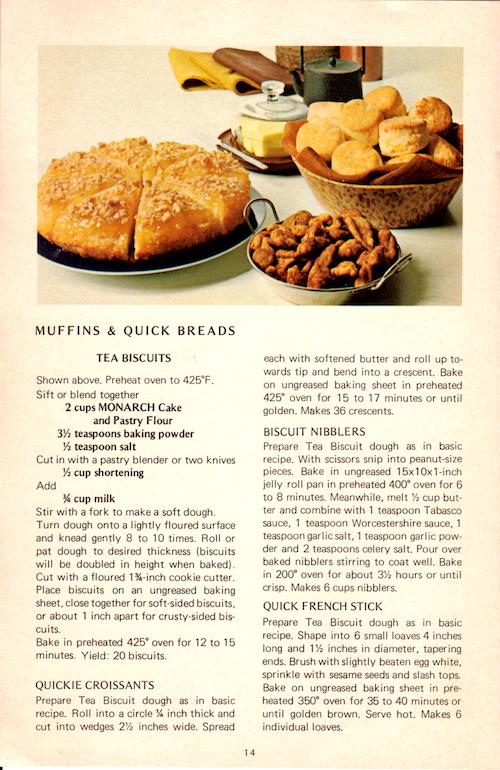
Salt, Biscuit Dough, and a Slow Oven

The gendered norms are evident in the call out: The Soft Way to your Husband’s Heart.

Monarch Cake and Pastry Flour - The Soft Way to your Husband's Heart - cover

Interestingly one way is through producing something crunchy to nibble on: nibblers.

Monarch Cake and Pastry Flour - The Soft Way to your Husband's Heart - recipes from Tea Biscuit basic dough

Twice baked marvel.

monarch Cake and Pastry Flour - The Soft Way to your Husband's Heart - recipes for nibblers

Monarch Cake and Pastry Flour is still available in Canadian supermarkets.Though the keepsake recipe book from 1962 published by Maple Leaf Mills Limited might be harder to find it is likely to appeal to many hearts regardless of matrimonial status or camp sensibilities …

And so for day 2555
11.12.2013

Posted in Food Writing | Leave a comment

The Rituals of the Evening

I thought sundowning was a synonym for winding down. Actually it refers to the agitation of Alzheimer’s patients at the end of the day as their environment shifts. My take on the term to refer to prepping for sleep is idiosyncratic. But I like it and will find it hard to let go the meaning I affixed to it … Or I could resort to the French “le coucher” — the actions of preparing for bed.

I have a playlist for the half hour or so leading to the brushing of teeth and the setting of clocks. Here’s the play list for the evening wind down…

Playlist

  • For A Friend – The Communards
  • These Are The Days Of Our Lives – Queen
  • Being Boring – Pet Shop Boys
  • Proud – Heather Small (Peter Presta Mix for Queer As Folk Final Season)
  • To Love Somebody – Bee Gees
  • Why – Annie Lennox

You might be surprised to see a beat-driving piece in the list. The lyrics lead one to reflect on the day – what have you done today to feel proud? There is always a little something to carry into dreaming.

Thinking of adding Lully Trios pour le coucher du Roi to the playlist. I’ll sleep on it.

And so for day 2554
10.12.2013

Posted in Uncategorized | Tagged , | Leave a comment

Cooking or Games of Stage & Set

Via Naomi Duguid
http://naomiduguid.com/twitter/

Nigella Lawson “Home Cooking Can Be a Feminist Act”
https://www.lennyletter.com/story/nigella-lawson-home-cooking-can-be-a-feminist-act

Real cooking is what happens in the home. Restaurant cooking can be fabulous, inspiring, transcendent, and oh-so-marvelous in many ways, but for me it will always partly belong to the realm of theater. Furthermore, the restaurant kitchen insists and relies on conformity; the spontaneity of the home cook is by contrast gloriously anarchic. Don’t apologize for that: revel in it.

That anarchic feeling is not alien to plating. Arranging the food beautifully. Appreciating the bowl that presents the mashed potatoes…

Nigel Slater has always been an inspiration for plating ideas for the home cook. See

https://www.instagram.com/nigelslater/?hl=en

I first became aware of micro-theater via the work of Samuel R. Delany… and have been delighted by Brian McHale’s analyses…

My second example is really double, for in Samuel Delany’s novel Trouble on Triton (originally published as Triton, 1976) there are two conspicuous structures en abyme, each differently oriented. One of these occurs near the end of the first chapter, when Delany’s protagonist, Bron Helstrom, stumbles upon a “micro-theater” performance on the street of his domed home city of Triton, and becomes its sole spectator; later he will be recruited, without his knowledge, into the cast, and will help to stage a micro-theater spectacle for someone else. Extrapolated from contemporary (mid-seventies) performance-art and street theater, micro-theater is designed for an audience of one. Like “Flawless Play Restored” in Sorrentino’s Mulligan Stew, it seems to reinvent aspects of the Stuart court masque — not only, as in Sorrentino, the masque’s ontological heterogeneity, but also its literal and figurative orientation toward a single privileged spectator. In the case of court masque, that privileged spectator was typically the monarch. Delany’s micro-theater democratizes masque, in the sense that anyone including a nobody like Bron Helstrom, can occupy the privileged spectatorial position. Micro-theater, then, models en abyme one aspect of a reader’s engagement with the text: it models reading as an individual, solitary experience. Moreover, that experience is an immersive one; like Gibson’s cyberspace in this respect, micro-theater models reading as absorption, as losing oneself in fiction.

Trouble on Triton‘s second structure en abyme makes its initial appearance at the beginning of the second chapter, significantly juxtaposed with the micro-theater of the first. This is the complicated hologrammic board-game called vlet […]

From Brian McHale “En Abyme: Internal Models and Cognitive Mapping” in A Sense of the World: Essays on Fiction, Narrative, and Knowledge edited by John Gibson, Wolfgang Huemer, Luca Pocci.

Which is to return to complicate the relations of “home” and “theater”; “cook” and “game”. Ever deviate from a recipe? You were practicing a kind of game. There is brinksmanship there. Certainly a coup de théâtre.

And so for day 2553
09.12.2013

Posted in Food Writing | Tagged , | Leave a comment

To Cook, To Write, To Control

Jane Kramer
The Reporter’s Kitchen

The cooking that helps my writing is slow cooking, the kind of cooking where you take control of your ingredients so that whatever it is you’re making doesn’t run away with you, the way words can run away with you in a muddled or unruly sentence.

One wonders what she was cooking when she wrote that sentence with its controlled pace that is moreish without being run on.

And so for day 2552
08.12.2013

Posted in Food Writing | Tagged | Leave a comment