Care of the Small

The cover is special. It is of a felt that feels like peach fuzz.

Diana Henry
How to Eat a Peach
Introduction (its conclusion)

Meals, no matter how simple, are made better by small things […] They’re also made bad by small things: salami served in the plastic package in which it comes, poor bread. I don’t like the suggestions — prevalent these days — that cooking is all about “lifestyle.” I think it’s about taking care of the small, seemingly unimportant things.

The idea for this book came to me years ago; nearly all of my books have been in my head for a long time. In a single moment I realized how much other people, when cooking, care about these small things. At a restaurant in Italy (on my first trip there), the diners at the next table didn’t have a fancy dessert, they just had a bowl of peaches and a bottle of cold Moscato. Everyone sliced their peach and dropped it in the wine. After a while they drank the wine — now imbued with the flavor of the peach — and ate the peach slices, which now tasted of the wine. This was not a complicated dish, but it was lovely way to end a meal — seasonal, straightforward, caring, even a little magical — and it illustrated an approach to food and cooking that I already understood but hadn’t yet articulated. I’ve never forgotten this. More than a memory, those peaches became a symbol of what good food is all about.

Details matter. Like the special tactile attention to covers. This one feels like fuzz.
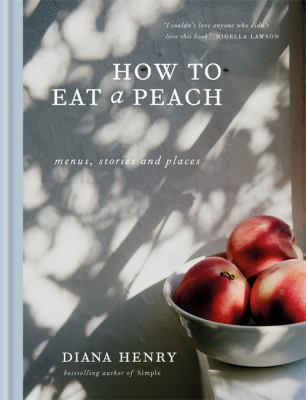
Diana Henry - How to Eat a Peach - cover

And so for day 2531
17.11.2013

Posted in Food Writing | Leave a comment

Whither the Bed

It is interesting to listen to Foucault reads a piece about heterotopia on radio. For the space of about a half hour we are led through these spaces

https://archive.org/details/LesUtopiesReellesOuLieuxEt

Les utopies réelles de Michel Foucault : “On ne vit pas dans un espace neutre et blanc”

1966 – Qu’est-ce qu’un cimetière, une salle de cinéma, un jardin, un asile psychiatrique, une maison close ou encore une prison peuvent-ils bien avoir de commun ? En 1966, le philosophe Michel Foucault tentait de répondre à cette question.

The audio became the basis of a written text.

https://foucault.info/documents/heterotopia/foucault.heteroTopia.fr/

In its migration to print it loses the wonderful opening romp in the parents’ big bed and the concluding “lit” compared to a “bateau” … giving the image of the corsair a dream-like shimmer. We are left with a less whimsical meditation on the boatless:

Dans les civilisations sans bateaux les rêves se tarissent, l’espionnage y remplace l’aventure, et la police, les corsaires.

And so for day 2530
16.11.2013

Posted in Uncategorized | Leave a comment

Noise or Song: Neither

Roger Deakin
“The Rookery”
Wildwood: A Journey Through Trees

The more they flew, the more noise the rooks made. Whether you can call it melody is the question I lay pondering. Gilbert White goes so far as to say ‘rooks in the breeding season attempt sometimes, in the gaiety of their hearts, to sing, but with no great success.’ Most of the old bird-books attempt some version of ‘rude harmony’, ‘sweet thunder’ or ‘musical discord’, but I prefer to think of their utterances as conversation, or the roughest of folksong. Rooks speak in the strongest of country burrs. They are rasping, leathery, parched, raucous, hoarse, strangled, deep-throated, brawling, plaintive, never reticent and, like all good yokels, incomprehensible.

I just love that roving enumeration. And the conclusion that we know not.

And so for day 2529
15.11.2013

Posted in Uncategorized | Tagged | Leave a comment

Foodie Renovation

Tamar Adler
Something Old, Something New: Classic Recipes Revisited

Leftover [shrimp] pâté is also miraculous stirred into hot polenta or risotto or congee or grits.

I love the enumeration — it speaks to an internationalism and to cross-cultural familiarity.

And so for day 2528
14.11.2013

Posted in Food Writing | Tagged | Leave a comment

Farmers and Stories: Products and Producers

David Mas Masumoto in The Perfect Peach

If foods are not paired with stories, no one hears the farmer’s voice and the farmer is easily dismissed.

More context:

Without stories, peaches become a commodity and consumers are attracted by their cheap prices. Gone are the words that help commit experience to memory. When we lack a language of taste, we lose one of the main ingredients for creating lasting meaning. If foods are not paired with stories, no one hears the farmer’s voice and the farmer is easily dismissed.

— and so many of the stories we share involve scoring cheaply priced produce in season (and splurging out of season on that rare find) and we exchange stories about what to do with a glut — farmer stories are highly mediated often by marketing agencies in instances far from the food itself — “pairing” here signifies “connecting” and that doesn’t occur in “coupling” — the words aren’t gone … taste endures in its multiple forms … experiences are committed to memory and memories propagate into the future —

And so for day 2527
13.11.2013

Posted in Food Writing | Tagged | Leave a comment

Autour de la “jolie femme”

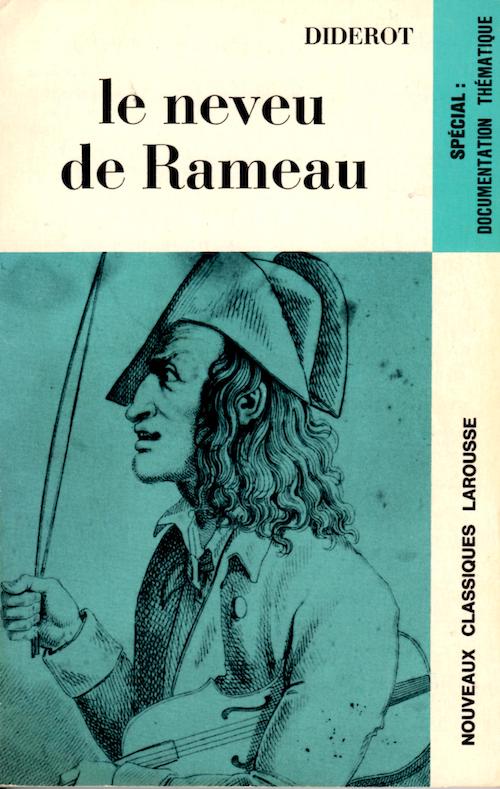
The 1972 edition in the series Nouveaux classiques Larousse reproduces on its cover an illustration of the 1821 edition

Le neveu de Rameau - Diderot - Nouveaux Classiques Larousse - cover

Smart. Compact.

But Incomplete.

The first excised section in this edition for schools of Diderot’s Le neveu de Rameau is marked by ellipsis:

J’ai un palais aussi, et il est flatté d’un mets délicat, ou d’un vin délicieux. J’ai un coeur et des yeux ; et j’aime à voir une jolie femme. […] Quelquefois avec mes amis, une partie de débauche, même un peu tumultueuse, ne me déplaît pas.

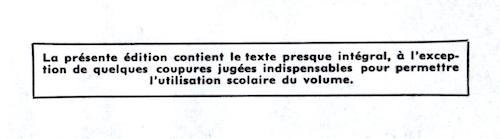
We have been given a nicely boxed notice that the text is not complete and given the rationale that this edition is destined for schools.

le neveu de Rameau - Diderot - Nouveaux Classiques Larousse - notice

The too-hot-to-handle section found thanks to

La Bibliothèque électronique du Québec
Collection À tous les vents Volume 236 : version 1.01
http://www.beq.ebooksgratuits.com/vents/diderot-neveu.pdf

J’aime à sentir sous ma main la fermeté et la rondeur de sa gorge ; à presser ses lèvres des miennes ; à puiser la volupté dans ses regards, et à en expirer entre ses bras.

That “gorge” is not only a “throat” (as most automated translators would have you believe). It is also a “breast” hence the passing over in the school edition. See how “throat” doesn’t cover (uncover) it:

I like to feel under my hand the firmness and roundness of her breasts; to press her lips with mine; to draw the voluptuousness from her looks, to the point of expiring in her arms.

Sorry if you were expecting more explicitness or greater debauchery.

And so for day 2526
12.11.2013

Posted in Booklore, Translations | Leave a comment

Enclosing Disclosing

The Truth in Painting
Jacques Derrida

— If police there is (and isn’t there always?) it would here be operating against another police, against another ideological arraignment, and

[…]

— You think people would accept that, that they’d receive it as an explication de texte or as a “close reading”? [In English in the original]

Translated by Geoff Bennington and Ian McLead

This juxtaposition is meant to suggest that explication de texte is a policing affair. But is it not a jail break?

Let us pause the reversal of this inversion.

First the justification of linking explication de texte to police activity. We read this reply, in sequence, appearing after the close reading remark:

— Everything comes down to one of those reading exercises with magnifying glass which calmly claim to lay down the law, in police fashion indeed.

The policing frames a before and an after. Jail breaking is always after the sentence. There is always room to consider it thus, more or less. Another réplique:

— It can always, more or less calmly, become police-like. It depends how, with a view to what, in what situation it operates. It can also arm you against that other (secret) police which, on the pretext of delivering you from chains of writing and reading (chains which are always, illiterately, reduced to the alphabet), hastily lock you up in a supposed outside of the text […]

Jail break avant la lettre. Jail break before a being-jailed.

And so for day 2525
11.11.2013

Posted in Uncategorized | Leave a comment

Longing to Belong

Warsan Shire

Summarizing a whole suite of erotic cartographies, the poet telescopes the reader’s attention in a most delightful entanglement of means and ends:

Your grandparents often found themselves
in dark rooms, mapping out
each other’s bodies,

claiming whole countries
with their mouths.

“Grandfather’s Hands”
Teaching My Mother How To Give Birth

And so for day 2524
10.11.2013

Posted in Metaphor, Poetry | Leave a comment

WHAM

Consider Gussie’s lines from the 1948 movie Mr. Blandings Builds His Dream House — it’s her culinary and linguistic creativity that saves the day. I’ve seen the movie; I now want to read the novel to see if the key plot point rests on the character of the black woman.

Gussie is played by Louise Beavers

***************

Shooting script

“MR. BLANDINGS BUILDS HIS DREAM HOUSE”

Screenplay by Melvin Frank and Norman Panama Based on a novel by Eric Hodgins

               Gussie's head appears from the kitchen.

                                     GUSSIE
                              (brightly)
                         Come and get it! Breakfast everybody.

                                     BETSY
                         Good! I'm starving! What are we 
                         having, Gussie?

                                     GUSSIE
                         Orange juice, scrambled eggs and you-
                         know-what.

                                     JOAN
                              (making a face)
                         Ham?

                                     GUSSIE
                         Not ham -- Wham!
                              (cheerily)
                         If you ain't eatin' Wham, you ain't 
                         eatin' ham!

               Gussie's head disappears.

               CLOSE SHOT - JIM.

               CLOSE SHOT - Jim.

                                     JIM
                         What did she say?

               He reacts with the sudden exhilaration of Balboa first seeing 
               the Pacific. He snaps his fingers.

                                     JIM
                         Darling, give Gussie a ten dollar 
                         raise!

Those lines that sound like a jingle

Gussie: If you ain’t eatin’ Wham, you ain’t eatin’ ham.

are appropriated for the ad campaign that is marked as wildly successful and bringing in the money to cover the by now extravagant new house. Earlier lines that set up the conclusion (but aren’t in the shooting script)…

Gussie : The children like Wham.

Jim Blandings: Well, there must be other things that we…

Gussie: Mrs. Blandings likes it, too.

Jim Blandings: Just the same…

Gussie: And I consider it very tasty!

Just like a snippet from a commercial — they all like it and so should you — no arguing with the arbitration. A case of she who rules the roast, rules the roost?

And so for day 2523
09.11.2013

Posted in Food Writing | Leave a comment

Hinge

Samuel R. Delany

interview with Terry Bisson in The Atheist in the Attic

You wrote a critical appreciation of SF, the Jewel-Hinged Jaw. […] I don’t recall what the title signified.

[…]

The title was not explained in the book. You just had to recognize it. It was from a line in Thomas M. Disch’s Camp Concentration: from Sacchetti’s poem “The Hierodule,” when Disch describes the black idol of language/knowledge/art, which is presumably suppose to speak the truth:

Behold! Behold the black, untrained flesh,
The jaw’s jewelled hinge that we can barely glimpse …

So, no, you probably didn’t and don’t recall what the title signified, unless you’ve been rereading Disch’s novel with your literary antenna alert to explaining precisely that conundrum.

Saccchetti is a character in the novel
https://en.wikipedia.org/wiki/Camp_Concentration

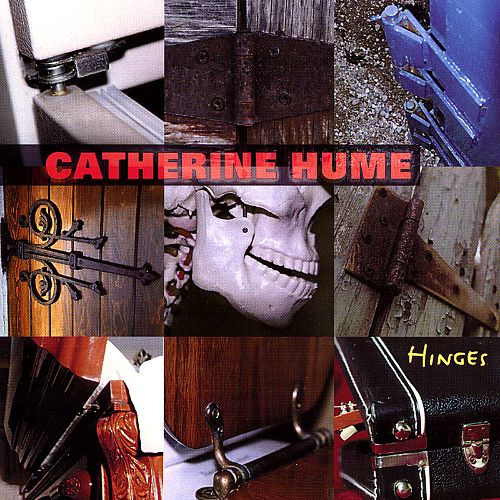
And the notion of hinge leads me to recall the cover art on Catherine Hume’s Hinges — a grid of representations of various examples of hinges.

cd cover catherine hume hinges

With a prominent jaw in its centre square, somewhat shiny like a jewel…

And so for day 2522
08.11.2013

Posted in Uncategorized | Leave a comment