Paillette

Eve Kosofsky Sedgwick
Kessler Lecture published in Queer Ideas

Last week Mary described me to myself as “scattering sequins over us all” — all the people I love. She’s right, she and they do seem so glamorous and numinous to me. I always see the light shaking out their wings. It does shock me when anyone view them in an ordinary light – or worse, when they see each other that way.

This formed a piece of A Dialogue on Love.

Casting some ordinary light on sequins: although they scintillate for the eye, they scratch the skin. They are worn on the outside.

Scratch my back …

Cindi Lauper, Shine

Shine I’ll stand by you
Don’t try and push me away
’cause I’m just gonna stay
You can shine I won’t deny you
And don’t be afraid it’ll all be ok

And so for day 2511
28.10.2013

Posted in Metaphor | Leave a comment

Interclass Intercourse & Infrastructure

Samuel R. Delany
“… 3,2,1, Contact”
Kessler Lecture published in Queer Ideas

Stand alone paragraph in the peroration

Tolerance — not assimilation — is the democratic litmus test for social equality.

This notion is earlier set out in critical theory mode reflection on interclass
contact which for good measure is repeated twice in the piece.

To repeat: given the mode of capitalism under which we live, life is at its most rewarding, productive and pleasant when the greatest number of people understand, appreciate, and seek out interclass contact and communication conducted in a mode of good will. The class war raging constantly and often silently in the comparatively stabilized societies of the developed world militates for the erosion of the social practices through which interclass communication takes place and the institutions holding those practices stable, so that new institutions must always be conceived and set in place to take over the jobs of those that are battered again and again till they are destroyed. While the establishment and utilization of those institutions always involves specific social practices, the effects of my primary and secondary theses are regularly perceived at the level of discourse. Thus, it is only by a constant renovation of the concept of discourse that society can maintain the most conscientious and informed field for the establishment of such institutions and practices – a critique necessary if new institutions of any efficacy are to develop. At this level, in its largely stabilizing/destabilizing role, superstructure (and superstructure at its most oppositional) can impinge on
infrastructure.

This set of insights is elaborated in the context of a piece about Times Square development (hence the remark about discourse and infrastructure).

And so for day 2510
27.10.2013

Posted in Uncategorized | Leave a comment

The Burble of Blurbs

Lynne Huffer, Mad for Foucault: Rethinking the Foundations of Queer Theory

Enchanted I composed a Google Books review (more of a blurb)

Tackles the misconception that Foucault endorses a linear time line from acts to identities. Does so with brilliance. Devoting attention to the history of the texts in their English and French versions. Linguistically savvy and ever careful to contextualize and contrast French and Anglo-American reception. Attuned to questions of style and irony. And is itself an incarnation of an ethical style.

I now note that neither “sodomite” nor “homosexual” nor “queer” are terms in this blurb. Or “erotic” ethical style. And until now I wouldn’t have known where to insert “queer” into the flow.

Tackles the misconception that Foucault endorses a linear time line from [sodomite] acts to [homosexual] identities. Does so with brilliance. Devoting attention to the history of the texts in their English and French versions. Linguistically savvy and ever careful to contextualize and contrast French and Anglo-American reception. Attuned to questions of style and irony. And is itself an incarnation of a [queer erotic] ethical style.

Bracketing the adjectives and toggling between the specificity and the unspecified makes one wonder if sometimes a queering is an unnaming …

And so for day 2509
26.10.2013

Posted in Uncategorized | Tagged | Leave a comment

A Maxim on the Minimal

One of the shorter pieces from the collection of aphorisms at the back of

Beneath My Feet: Writers on Walking edited by Duncan Minshull

It is good to collect things, but better to go on walks.

Anatole France as collected by Minshull in his literary ambulation.

And so for day 2508
25.10.2013

Posted in Uncategorized | Tagged | Leave a comment

What Passes the Passed

Edmund White

Setting the life-celebrating ephemeral arts, a simple suggestive listing …

[T]he new gay movement was generating a fresh take on gender politics. Simultaneously, the new gay sensibility was concocting extravagant inventions in the ephemeral arts of fashion, lighting, flower arranging, party design, window dressing, disco dancing, drug sequencing and sexual performance.

against a listing of another sort — the canon.

I myself am in favor of desacralizing literature, of dismantling the idea of a few essential books, of retiring the whole concept of a canon. A canon is for people who don’t like to read people who want to know the bare minimum of titles they must consume in order to be considered polished, well rounded, civilized. Any real reader seeks the names of more and more books, not fewer and fewer.

Both moments from a lecture, “The Personal Is Political: Queer Fiction and Criticism”
collected in the volume Queer Ideas: The David R, Kessler Lectures
from the Center for Lesbian and Gay Studies, CUNY

And so for day 2507
24.10.2013

Posted in Ephemera | Leave a comment

Infused with Glamour

kissing … missing

intersections

All I want to do is kiss you once goodbye

Now I sit with different faces
in rented rooms and foreign places
All the people I was kissing
some are here and some are missing
in the nineteen-nineties
I never dreamt that I would get to be
the creature that I always meant to be
but I thought in spite of dreams
you’d be sitting somewhere here with me

Pet Shop Boys
“Being Boring”

[note how loss is carried]

https://www.theguardian.com/music/musicblog/2010/aug/05/pet-shop-boys-being-boring

Stephen Emms writes in The Guardian

Perhaps, yet its themes are anything but. In the panoramic lyrical sweep from the 1920s to the 70s and, finally, the 90s, Being Boring really is about everything: innocence and experience, ambition and self-realisation (“I never dreamt that I would get to be/The creature that I always hoped to be”), love and (AIDs-related) loss (“All the people I was kissing/Some are here, some are missing”), friendship, nostalgia, ennui and, of course, defiance (“We had too much time to find for ourselves”). Tennant’s plaintive vocal style only adds to the pathos. And it’s all infused with the glamour and spirit of writer Zelda Fitzgerald (whose 1922 essay, Eulogy on the Flapper, contained the song’s ideological kernel: “She refused to be bored chiefly because she wasn’t boring.”)

Infused with Refusal.

And so for day 2506
23.10.2013

Posted in Uncategorized | Tagged | Leave a comment

A Commitment to Sufficiency

Wendell Piez

Pellucid Literature

http://pellucidliterature.org/PellucidLiterature.xml

* Likewise, incoming requests are never watched or tracked, to say nothing of counted or analyzed. This isn’t that kind of transaction either. Pellucid Literature does not take your name, watch your IP address or your browser, or litter your system with cookies.

* Among other things this means that while readers’ feedback is very much welcome, it must be provided in some old-fashioned way. There are no ratings forms or comments boxes.

* Instead, Pellucid Literature may be considered entirely self-sufficient and complete in itself, or at least treated as such. The same is also true of precincts within it, islands in an archipelago. Unlike most tangles of today’s web, works on Pellucid Literature may hope to be portable: something like a book, which you can put in your pocket, not quite as prone to break or become unreadable as most web sites tend to, over time (to take only the most salient example of a media technology where the goods seem prone to spoiling on the shelf).

The priority must always be the transparency of the reading experience, whether it be from a page, screen or tablet surface.

So there should never be holes in the page where stuff (what the media priesthood calls content) is dropped. In five years, or off line, a page on Pellucid Literature may look no better than it does today – but if we are fortunate, it will still be perfectly legible, and will look no worse.

Already looks pretty good for those fascinated with words and their deployment & déroulement. Look a the JavaScript rendition of Herbert’s Love III
http://pellucidliterature.org/LoveIII/

Food for thought for the patient.

Berneval has not avoided the temptation to link to media that might disappear (or has disappeared) — hence our fascination with ephemera — we may not be ever wholly holeless but hope there is enough context around those potential holes to not be wholly unreadable.

And so for day 2505
22.10.2013

Posted in Booklore, Ephemera | Leave a comment

thinking about thinking (about technology)

Samuel R. Delany

The Atheist in the Attic

[a certain little discourse on observational-induced defamiliarization]

As I looked around, I thought: Someone has put some thinking into how this had best be done, so that I, the presumed beneficiary of that thinking, need not think at all. But here I am, thinking anyway about the individual thoughts such thinking comprised, approving this bit, questioning that one, disapproving of another — well, thinking about what’s not supposed to require thinking, that is philosophy, no?

reading about reading …

And so for day 2504
21.10.2013

Posted in Uncategorized | Leave a comment

our own efforts. our own emotional lives. our own commonplaces.

Zenna Henderson
“Jordan”
Ingathering: The Complete People Stories

“Perhaps, perhaps. Who is to say which is better — to hunger and be fed, or to be fed so continuously that you never know hunger? Sometimes a little fasting is good for the soul. Think of a cold drink of water after an afternoon in the hayfield.”

On Transience
By Sigmund Freud
Translation by James Strachey

A time may indeed come when the pictures and statues which we admire to-day will crumble to dust, or a race of men may follow us who no longer understand the works of our poets and thinkers, or a geological epoch may even arrive when all animate life upon the earth ceases; but since the value of all this beauty and perfection is determined only by its significance for our own emotional lives, it has no need to survive us and is therefore independent of absolute duration.

Marielle Macé
Façons de lire, manières d’être

L’Expérience du proverbe recèle ces deux surprises : d’abord la surprise de constater la forces des lieux communs, la puissance de traction d’un langage extérieur; puis, dans un second temps — dans cet après-coup si caractéristique de Paulhan — celle de comprendre qu’il nous faut les assister dans leur force et pour leur efficacité et veiller sur elle.

common places. emotional lives. efforts.

And so for day 2503
20.10.2013

Posted in Uncategorized | Leave a comment

Crack, Beat, Cook, Exaggerate

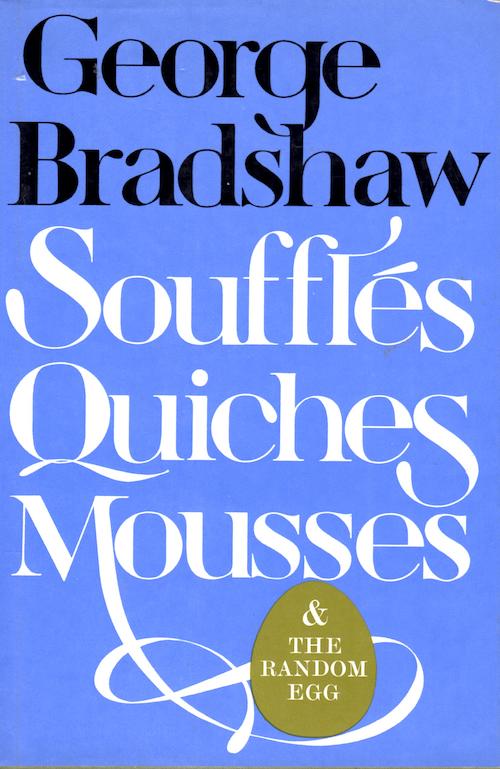
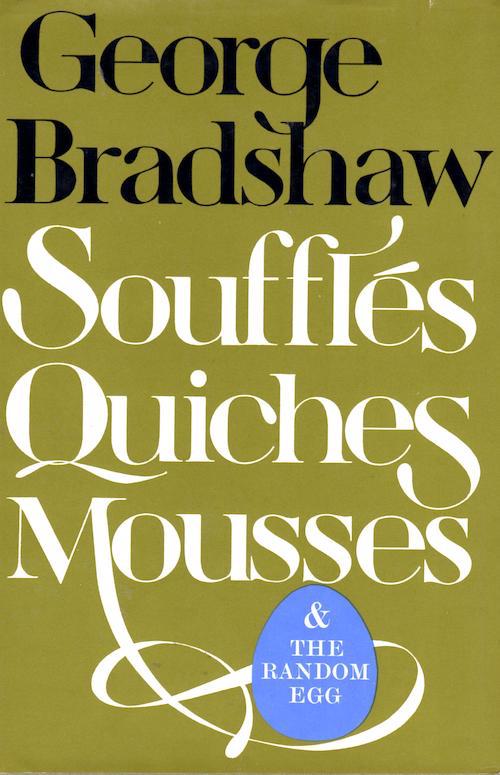
I like the contrasting and complementary colours on the front and back of the dust jacket… Soufflés, Quiches, Mousses and the Random Egg
George Bradshaw - front cover - Souffles Quiches Mousses and the Random EggGeorge Bradshaw - back cover - Souffles Quiches Mousses and the Random Egg

Our amusement continues inside.

George Bradshaw supplies an anachronism to make a recipe memorable in the section on quiches:

But, i you are not, and would like to know the way to make a rich and easy crust, here is one that was first written down by Sir Kenelm Digby three hundred years ago:

In a bowl place three ounces (a small package) of cream cheese […]

Project Gutenberg assists

https://www.gutenberg.org/files/16441/16441-h/16441-h.htm

The Closet of Sir Kenelm Digby Knight Opened

SHORT AND CRISP CRUST FOR TARTS AND PYES

To half a peck of fine flower, take a pound and half of Butter, in this manner. Put your Butter with at least three quarts of cold water (it imports not how much or how little the water is) into a little kettle to melt, and boil gently: as soon as it is melted, scum off the Butter with a ladle, pouring it by ladlefuls (one a little after another, as you knead it with the flower) to some of the flower (which you take not all at once, that you may the better discern, how much Liquor is needful) and work it very well into Paste. When all your butter is kneaded, with as much of the flower, as serves to make paste of a fitting consistence, take of the water that the Butter was melted in, so much as to make the rest of the flower into Paste of due consistence; then joyn it to the Paste made with Butter, and work them both very well together, of this make your covers and coffins thin. If you are to make more paste for more Tarts or Pyes, the water that hath already served, will serve again better th[a]n fresh.

Unlike Bradshaw’s recipe there is no cream cheese here let alone from a package.

And so for day 2502
19.10.2013

Posted in Food Writing | Leave a comment