We Marched for Love and Pride

For a Friend… “Somewhere else, someone else is crying too / Another man has lost a friend, I bet he feels the way I do”

The Communards – For A Friend (Official Video)
Songwriters: James Somerville / Richard Coles

And all the dreams we had, I will carry on
As I watch the sun go down, watching the world fade away
All the memories of you come rushing back to me
As I watch the sun go down, watching the world fade away
All I want to do is kiss you once goodbye, goodbye
As I watch the sun go down, watching the world fade away
All the memories of you come rushing back to me
As I watch the sun go down, a darkness comes to me
All I want to do is kiss you once goodbye

In memory of Mark Ashton

Jamie Doward writing in The Guardian about the film Pride speculates:

Pride shows how disparate groups of gay and lesbian people were inspired by Ashton, a gay man from Portrush in County Antrim, who was an active member of the Young Communist League, a fact overlooked in the film, apparently so as not to alienate American audiences.

As I watch the sun go down…

blue plaque - mark ashton - gay activist - lesbians and gays support the miners

LGBTQ+Comrade

And so for day 2431
09.08.2013

Posted in Uncategorized | Leave a comment

Two Takes on Two Cultures

Same material revisited at intervals — the C.P. Snow 1959 Rede lecture (The Two Cultures and the Scientific Revolution) and the F.R. Leavis 1962 Richmond lecture (The Two Cultures?).

Two concluding paragraphs

From a Parliamentarian on the 40th anniversary — Dr Ian Gibson — all about seeking consensus
https://www.theguardian.com/education/2002/feb/28/highereducation.uk

Agreements, even temporary, preliminary ones, will only be achieved if contributors have to play according to rules that reach beyond the different forms of knowledge. Just like MPs, everyone taking part in a public debate should be forced to declare any interests they might have that could influence their judgement. What we need to solve our dilemmas are not the so-called objective technicians CP Snow dreamt of, but improved rules of public discourse.

From a literary critic on the 50th anniversary — Stefan Collini — all about debunking
https://www.theguardian.com/books/2013/aug/16/leavis-snow-two-cultures-bust

From one point of view, Leavis might not seem an obvious recruit to any putative “slow criticism” movement. As he himself wryly notes, one Italian periodical described him as “puritano frenetico”, and the intense, combative address of his printed voice does not at first conjure up the process by which the patient accretion of alternative descriptions, almost geological in the pace of its operation, modifies existing sensibilities. Anger operates at a faster tempo, and the Richmond lecture is a deeply angry performance. But closer familiarity with his much-remarked upon syntax suggests that it should be seen as, precisely, a straining against the limits of sequential exposition in the interests of recognising the simultaneity and inter-relatedness of considerations that are flattened by others into blandly self-contained propositions, which in turn congeal into cliche. To be disturbed into an awareness (however uneasy or resistant) of this process is to start to register the power of his critical voice. In these terms, perhaps Leavis’s lecture, whatever its flaws, may still be thought to have a claim on our attention, even if opinion remains divided over whether it should be considered a minor classic of cultural criticism.

Public discourse needs improving — is that a cliche?

And so for day 2430
08.08.2013

Posted in Dichotomies | Leave a comment

Petrification

The stone speaks: a reverse Pygmalion effect since the sculptor is being sculpted.

Creative Relationship

When her words
strike
like the blows
from a sculptor’s hammer

trying to fashion
her inspiration
of me

I turn to stone

George Swede
Tell Tale Feathers

And so for day 2429
07.08.2013

Posted in Poetry | Leave a comment

Unplucked by the Copy Editor

The Gardens of Emily Dickinson by Judith Farr sports a close up of the stamens of a daylily on its cover and a fragment from Dickinson (1058) “Bloom — is Result” (in Emily’s hand?)

cover - judith farr - the gardens of emily dickinson

It is up close that some differences are noticed.

I was delighted in my reading to come across a paragraph (bloom) almost duplicated on the same page (p. 78).

With the rise of interest in highly specialized flower gardens of sophisticated cultivars, oil portraits of women both before and long after the Civil War depicted them in the presence of luxurious blooms.

[…]

With the rise of interest in highly specialized flower gardens of elegant cultivars, oil portraits of women immediately before and after the Civil War envisioned them in the presence of luxurious blooms.

This is a record of the reduplicative paragraph-blooms in situ.

inside - judith farr - the gardens of emily dickinson - p. 78

Dickinson (1058) ends with a dash —

To be a Flower, is profound
Responsibility —

One sports “sophisticated” where the other displays “elegant”. And can one detect a pruning hand where “long after” is reprised as simply “after”? Where “depicting” becomes “envisioning” here gardening/writing takes on the domain of music and variations on a theme.

And so for day 2428
06.08.2013

Posted in Booklore, Gardens, Poetry | Leave a comment

After Bashō

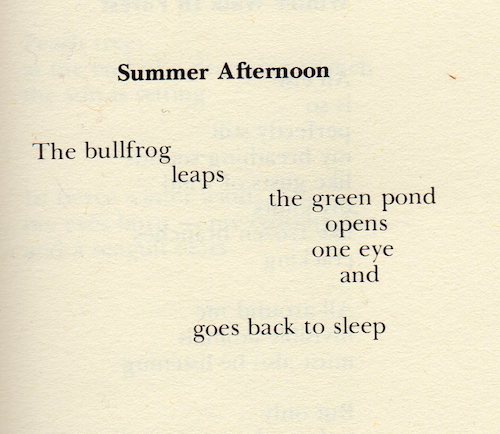
I believe this pond poem is after Bashō: George Swede from Tell Tale Feathers.

A scan.

scan - george swede - summer afternoon - frog poem after basho

A transcription.

         Summer Afternoon


The bullfrog
            leaps
                     the green pond
                           opens
                          one eye
                            and

               goes back to sleep 

A machine-readable string: Summer Afternoon The bullfrog leaps the green pond opens one eye and goes back to sleep

Keeping on rippling…

And so for day 2427
05.08.2013

Posted in Poetry | Tagged | Leave a comment

Building Taste

From a note to my niece who is now employed in the food industry.

I thought of you the other day and how your tastes have evolved. A friend’s report of their expanding set of grandchildren reminded me of my own father’s delight in his grandchildren. One of his favourite exercises of grandfatherly prerogative was introducing young palates to new foodstuffs (much to the consternation of my mother when very spicy items were involved — she feared for delicate stomachs). He helped build many happy memories of the first steps, first words and those first reactions to novel tastes. (I think I owe him my fondness for salted black liquorice.)

Wishing you many more food adventures.

I used to loathe cooked celery. Now I find its grassy note welcome. I also now like my coffee two ways: black and unsweetened or Vietnamese candy-style with sweetened condensed milk. I also with age tolerate bitter better even seek it out in endive. I have fallen heavily for the umami flavour of uni (sea urchin). And I remember to smell before and during tasting.

And so for day 2426
04.08.2013

Posted in Food Writing | Leave a comment

In Lights

Canadian Opera Company brochure: front and back.

ephemera - canadian opera company - a voice can break your heartephemera - canadian opera company - or it can show you the answer

ephemera - canadian opera company - or it can show you the answerephemera - canadian opera company - a voice can break your heart

Gertrude Stein’s last words are reputed to be “What is the answer?… In that case … what is the question?” What Is Remembered (1963) by Alice B. Toklas

And so for day 2425
03.08.2013

Posted in Ephemera | Leave a comment

Signatures, Covers, Samples

Style brought to you by the hand. By the ear. By the eye. By the mind.

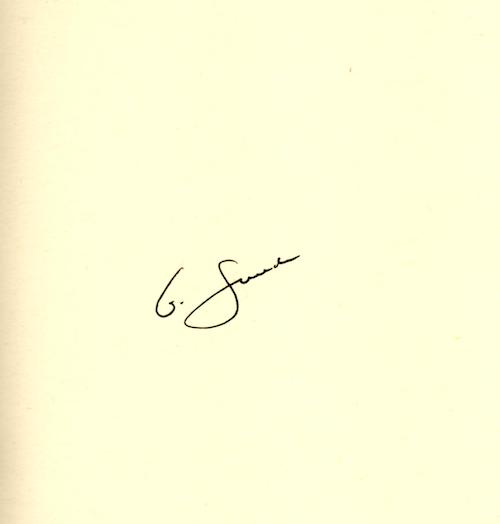
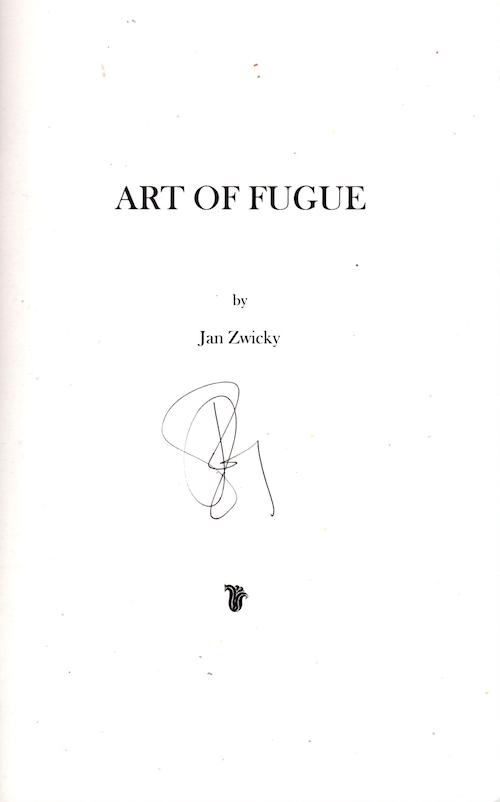
George Swede’s signature is tight and compact like his talent for short verse forms such as haiku and tanka. Jan Zwicky’s signature is aswish with an almost Renaissance flourish and signifies nicely her musicality.

george swede signature autograph jan zwicky - signature autograph
cover - george swede - tell tale feathers cover - jan zwicky - art of fugue

I am unwinding
like a ball
of red wool
between the paws
of a black cat

poked
from all angles
chased
this way
and that
I am leaving behind
a thin trail
of yarn
full of frays
and tangles

from Tell Tale Feathers – Fiddlehead Poetry Books No. 229, 1978

A room, a table, and four chairs.
The chairs are made of wood,
the floor is wood,
the walls are bare. But windowed.
West light, east light. And a scent
like cedar in the air. Here, the self
will sit down with the self.
Now it will say
what it has to say. It looks
into its own eyes. Listens.

from Art of Fugue – Vallum Chapbook Series No. 6, 2009.

And so for day 2424
02.08.2013

Posted in Booklore | Leave a comment

Strands and Tiles

Interlacing two strands the picture is explained by two lines below.

cover - Elena Schlenker - colouring book - Great things are done by a series of small things brought together

Great things are done by a series
of small things brought together.

Created during a residency at the Facebook Analog Research Lab by Elena Schlenker
and found on the cover of a colouring book wherein one finds among the offerings a repeating pattern of strawberries.

inside (strawberries) - Elena Schlenker - colouring book - Great things are done by a series of small things brought together

And so for day 2423
01.08.2013

Posted in Ephemera | Leave a comment

Tian

The poem’s title “天天” is evidently reduplicative. This much the English reader who knows no Chinese can observe. The poet plays with this — the explanation is proceed by the image of drawing a lake to save a jumping girl — the drawn lake is built of words and so is she…

[…]

bending to drink
this street like a river.
In Chinese, 天 means both

heaven & sky.
From a distance, a body
falling is nearing

[…]


Past Lives, Future Bodies
K Ming Chang

And so for day 2422
31.07.2013

Posted in Poetry | Leave a comment