Incandescent Feline

Robert Graves in the introductory note to his On English Poetry Being an Irregular Approach to the Psychology of This art, from Evidence Mainly Subjective concludes with the observation “that when putting cat among pigeons it is always advisable to make it as large a cat as possible.”

Rabih Alameddine writing in Harper’s.

We invade your countries, destroy your economies, demolish your infrastructures, murder hundreds of thousands of your citizens, and a decade or so later we write beautifully restrained novels about how killing you made us cry.

No escaping the claws of that pronoun “we”.

And so for day 2421
30.07.2013

Posted in Uncategorized | Tagged | Leave a comment

Gaping

Tanka First Person memento mori

Facial massage—
I feel my skin
stretch over holes
that will soon
define me

George Swede from First Light, First Shadows

Soon but not yet.

And so for day 2420
29.07.2013

Posted in Poetry | Leave a comment

Beginner’s Mind

Shoshin

Particularly for the novice practitioner, good data modelling is something to be done iteratively, interrogating and refining the model through a dialogue with both the source material and the operational context of tools.

Julia Flanders and Fotis Jannidis “Data modeling in a digital humanities context: an introduction” in The Shape of Data in Digital Humanities: Modelling Texts and Text-Based Resources

And so for day 2419
28.07.2013

Posted in Uncategorized | Leave a comment

Sileni

Epigraph:

the definite connection that exists
between ravishing meaning from her and
magic boxes

Nicole Brossard Daydream Mechanics translated by Larry Shouldice

Crux:

Northrop Frye in the preface to The Well-Tempered Critic (1963) writes that the lectures “are intended to fit inside one another, like the boxes of Silenus” [9]. Frye references** Silenus in a review of Robert Graves’s collected poetry (Hudson Review vol. 9 no. 2 Summer 1956) but the Graves poem “Warning to Children” that Frye points towards although constructed in a most marvellous mise en abyme does not mention Sileni of any sort nor play on the inside-outside associations of Sileni boxes. Frye’s reading characterizes the link between imbrication and the Sileni as a theme. The association of Sileni boxes and nesting appears throughout Frye’s career. It is also found in one of the notebooks from the early 1970s where Frye remarks “Also Egyptian is the boxes-of-Silenus mummy cases, of one inside another: Rabelais.”*

But there is no mention of nesting in Rabelais (Preface to Gargantua). Nor in Erasmus. Nor in Plato. My quandary: where does Frye get the image of nesting boxes? What can account for the leap from a multiplicity of boxes to nesting?

I have also located another reference to nesting Sileni: in Charles L. Griswold, Jr. Adam Smith and the Virtues of Enlightenment (1999) describing his own work with the figure of nesting Sileni: “my discussion here will resemble a series of Sileni, one nested inside the next.”

Andrew Ford in “Alcibiades’s Eikon of Socrates and the Platonic Text: Symp. 215a-222d” in Plato and the Power of Images (2017) has a pointed aside: “There is no archeological evidence for anything like the nested ‘Russian Dolls’ we may picture to ourselves.”

Frye’s figure of the nested Sileni is of course an instance of a model of text at work in generating readings. One that remains for me opaque: the origins of the connection between Sileni boxes and nesting remain a mystery.

* The “Third Book” Notebooks of Northrop Frye (Collected Works 9) The “third book” notebooks of Northrop Frye, 1964-1972 : the critical comedy edited by Michael Dolzani.

** Frye writes in his review of Graves “We notice that the central theme of a relatively early poem, ‘Warning to Children,’ is that of the boxes of Silenus, the image with which Rabelais begins.”

A theory:

Frye repeatedly references Rabelais. Although one doesn’t find direct reference to nesting Sileni boxes, one does encounter in the Prologue to Gargantua the mention of onion, the peel to be exact, and from this emblematic vegetable might we assume the notion arose of layer upon layer upon layer?

[…] Just such another thing was Socrates. For to have eyed his outside, and esteemed of him by his exterior appearance, you would not have given the peel of an onion for him, so deformed he was in body, and ridiculous in his gesture. He had a sharp pointed nose, with the look of a bull, and countenance of a fool: he was in his carriage simple, boorish in his apparel, in fortune poor, unhappy in his wives, unfit for all offices in the commonwealth, always laughing, tippling, and merrily carousing to everyone, with continual gibes and jeers, the better by those means to conceal his divine knowledge. Now, opening this box you would have found within it a heavenly and inestimable drug, a more than human understanding, an admirable virtue, matchless learning, invincible courage, unimitable sobriety, certain contentment of mind, perfect assurance, and an incredible misregard of all that for which men commonly do so much watch, run, sail, fight, travel, toil and turmoil themselves.

François Rabelais translated by Thomas Urquart (our emphasis)

The proximate image of the onion lodged in memory and the subsequent application to Graves’s poem cemented the association that we find decades later in link between Egyptian sarcophagi and Sileni boxes. Further comment: “peel” gives rise to the notion of layer. The French “copeau d’oignon” is more like a sliver or shaving and less connected to the image of a layer as to a piece.

“Warning to Children”

Children, if you dare to think
Of the greatness, rareness, muchness,
Fewness of this precious only
Endless world in which you say
You live, you think of things like this:
Blocks of slate enclosing dappled
Red and green, enclosing tawny
Yellow nets, enclosing white
And black acres of dominoes,
Where a neat brown paper parcel
Tempts you to untie the string.
In the parcel a small island,
On the island a large tree,
On the tree a husky fruit.
Strip the husk and pare the rind off:
In the kernel you will see
Blocks of slate enclosed by dappled
Red and green, enclosed by tawny
Yellow nets, enclosed by white
And black acres of dominoes,
Where the same brown paper parcel—
Children, leave the string alone!
For who dares undo the parcel
Finds himself at once inside it,
On the island, in the fruit,
Blocks of slate about his head,
Finds himself enclosed by dappled
Green and red, enclosed by yellow
Tawny nets, enclosed by black
And white acres of dominoes,
With the same brown paper parcel
Still untied upon his knee.
And, if he then should dare to think
Of the fewness, muchness, rareness,
Greatness of this endless only
Precious world in which he says
he lives — he then unties the string.

Notable not only for its nesting but also for the imperceptible (to the too quick reader) variations — those colours change positions… waiting for children like magic boxes.

And so for day 2418
27.07.2013

Posted in Poetry | Leave a comment

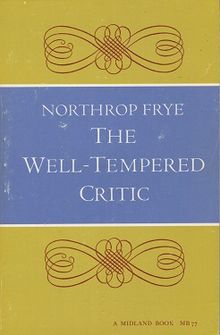
On Stock Responses

Northrop Frye
The Well-Tempered Critic

Again, stock response cannot read a poem, but can only react to the content of a poem, which it judges as inspiring or boring or shocking according to its moral anxieties. Stock response is apt to hanker after some form of censorship, for it cannot understand that works of literature can only be good or bad in their own categories, and that no subject-matter or vocabulary is inherently bad.

And would you judge this book by its cover?

cover - the well-tempered critic - northrop frye

Balanced? N’est-ce pas?

And so for day 2417
26.07.2013

Posted in Booklore, Reading | Leave a comment

More Intellectual Virtues

Black Trillium
Marion Zimmer Bradely, Julian May, Andre Norton

The quest both individual and collective is to achieve balance. It is a psychological quest. The key is knowledge: its possession and disposition.

“And when you have this knowledge, what do you do with it?”

“What do you mean?” Haramis asked.

“Would you use knowledge to hurt and destroy, to manipulate and bend others to your will?”

“Of course not!” Haramis replied indignantly. “That’s wrong. People are supposed to be free to make their own choices, not used as puppets for the amusement of those stronger or more intelligent than they are. But why should I have to do anything with knowledge? Why can’t I simply study and learn and rejoice in the knowledge and vision I achieve? Why should I have to use it?”

“Because you are what you are, and it shows. I can see it, Orogastus can see it, and any other with a knowledge of magic can see it.” The Archimage’s voice grew intense. “Haramis, you understand words. Most people never realize that words are important, that they matter, that to say a thing is to give it at least a shadow existence—and to name truly is to give it life. You hear, you listen, and you remember, and that is a rare gift. Without it, you would never understand magic, most of it would literally be inconceivable to you. Kadiya possesses great ardor and determination, and Anigel has compassion and a loving heart, but these gifts while they are great in their own right, are not what is required for the full use of magic. […]

The image of interlocking strengths and weaknesses reminds me of Veronica Roth’s factions.

And so for day 2416
25.07.2013

Posted in Uncategorized | Leave a comment

Mould, Canalize, Direct

Aldous Huxley
Words and Their Meanings
(Los Angeles: Ward Ritchie Press, 1940)

Courtesy of the Thomas Fisher Rare Book Library, University of Toronto

From the book flap on the dustcover:

This is the first publication of a new work by Aldous Huxley in a field in which he has long been interested. It is a consideration of the power of words “to mould men’s thinking, to canalize their feeling, to direct their willing and acting. Conduct and character are largely determined by the nature of the words we currently use to discuss ourselves and the world around us.”

From inside, on continuity and the presence of records:

There may be geniuses among the gorillas; but since gorillas have no conceptual language, the thoughts and achievements of these geniuses cannot be recorded and so are lost to simian posterity.

From further inside, an ascesis:

To learn to use words correctly is to learn, among other things, the art of foregoing immediate excitements and immediate personal triumphs. Much self control and great disinterestedness are needed by those who would realize the ideal of never misusing language.

I could remain silent and listen to Bach. I should.

And so for day 2415
24.07.2013

Posted in Uncategorized | Tagged | Leave a comment

Compressions

Cyrus Cassells
The Crossed-Out Swastika

“Riders on the Back of Silence”
end of section VI “Trains”
[the stationmaster is remembered]

storefronts of Kristallnacht
How it would’ve angered him to see

that his beloved trains
we’re used to betray us.

“Sabine Who Was Hidden in the Mountains”

and learners whose hair

would never thin or silver

“The Fit”
Section IV “Youth”

How two boys ignite,
fit together,

is a burst of summer fireworks,
a radiant cartwheel —

Note to “The Fit” points to the memoirs of Pierre Seel and of Gad Beck

Moi, Pierre Seel, déporté homosexuel

An underground life : memoirs of a gay Jew in Nazi Berlin

And so for day 2414
23.07.2013

Posted in Poetry | Leave a comment

Follow the Brush, Guide the Reading of Numberous

Thomas J. Harper
Afterward to Jun’ichirō Tanizaki In Praise of Shadows

One of the oldest and most deeply ingrained of Japanese attitudes to literary style holds that too obvious a structure is contrivance, that too orderly an exposition falsifies the ruminations of the heart, that the truest representation of the searching mind is just to “follow the brush”. Indeed it would not be far wrong to say that the narrative technique we call “stream of consciousness” has an ancient history in Japanese letters. It is not that Japanese writers have been ignorant of the powers of concision and articulation. Rather they have felt that certain subjects — the vicissitudes of the emotions, the fleeting perceptions of the mind — are best couched in a style that conveys something of the uncertainty of the mental process and not just its neatly packaged conclusions.

* * *

the gesture she makes — this is her way of attempting despite the sovereign prohibitions to find again a place to reflect open space favourable for calligraphy with marvellous drawings with numberous incursions (infractions) accomplished as such with arrogance then following the course of what is written fount of apprenticeship to pleasure and density — process of composition (vertically the pieces of chalk on the black board!) which she justifies field of action for new forms in the realm of consciousness

Nicole Brossard
Translated by Larry Shouldice
“Field of Action for New Forms, June 1971”
in Daydream Mechanics

Numberous – so many that it is numbing

And so for day 2413
22.07.2013

Posted in Uncategorized | Tagged | Leave a comment

Externalities, More Than

In the series The FUTURE of WORK

“Dollars in the Margins”

[intro blurb – a quotation from the article]

The $15 Minimum Wage Doesn’t Just Improve Lives. It Saves Them. A living wage is an antidepressant. It is a sleep aid. A diet. A stress reliever. It is a contraceptive, preventing teenage pregnancy. It prevents premature death. It shields children from neglect.

By MATTHEW DESMOND

https://www.nytimes.com/interactive/2019/02/21/magazine/minimum-wage-saving-lives.html

And so for day 2412
21.07.2013

Posted in Uncategorized | Tagged | Leave a comment