Fantastic Cells

Library catalogue subject headings for Fantastic Voyage:

Brain–Diseases–Diagnosis–United States–Drama.
Leucocytes–Drama.
Medicine–Specialties and specialists–United States–Drama.
Scientists–United States–Drama.

I believe and others have noted that Dr. Who “The Invisible Enemy” is indebted to the Fantastic Voyage.

And so for day 2411
20.07.2013

Posted in Uncategorized | Tagged | Leave a comment

Drawing the Line

Nafissa Thompson-Spires
Heads of the Colored People
“A Conversation about Bread”

Junior was always trying out white folks stuff and brining it to school for us to try. […]

When he brought potato bread to school for lunch, we were all like, what’s up with the yellow bread? For it was surely some white folks stuff and the dumbest thing we’d ever heard of until we tasted it. Once that yellow soft hit our mouths, though, it was like Apple Jacks; it didn’t even have to taste like apple, or potato.

Croissants, too, not those pop-can crescent rolls our mamas and the lunch ladies tried to feed us. Junior had real croissants—the kind where you aren’t supposed to pronounce the “r”—from a little bakery at the edge of the Fondren District. We ate the flaky edges of those croissants like they were Pop Rocks, just doing all their work in our mouths.

But most of us drew the line at brioche.

There follows a whole story devoted to ethnography and perspective and focalization and story telling and drawing the line.

The emboîtement of narrative elements is a feature of many of the stories in Heads of the Colored People and it is fitting that the endpapers pick up this notion in their design.

endpaper faces from Nafissa Thompson-Spires Heads of the Colored People

Head outline or profile cascading and seeded throughout the page space. Telling and told.

And so for day 2410
19.07.2013

Posted in Booklore, Food Writing | Leave a comment

Desideratum

Scott Ferguson
Declarations of Dependence: Money, Aesthetics, and the Politics of Care

Critical theory must, therefore, loosen its historical attachments to power’s shifting vicissitudes and risk the embarrassments of care’s apparent guilelessness. Without this affective labor, its conceptual tools remain inert.

Packed into these two sentences is a bold invitation to think otherwise. And to renegotiate perception and feeling… dare to imagine money as a boundless public reserve. Through imagination, to contest.

And so for day 2409
18.07.2013

Posted in Uncategorized | Tagged | Leave a comment

Horsing Around

Yoland Villemaire
Présentation critique
French Kiss: étreinte/exploration by Nicole Brossard

Les intrigues se chevauchent et se confondent, les protagonistes frenchkissent au point de disparaître dans l’étreinte. Ça danse tellement que l’armature du récit n’est plus qu’une radiation du sens et des sens. Ça bouge tout le temps comme une langue, comme une langue dans une autre bouche. «Ça n’est arrivé ni en français ni en anglais» et ça s’écrit dans une toute autre langue! C’est pire que joual; c’est un cheval de Troie […]

See the galloping: chevaucher, joual, cheval de Troie […] A form of metonymic enrichment.

And so for day 2408
17.07.2013

Posted in Introductions | Leave a comment

Leaves

The Book of Green Tea
Diana Rosen

The copy I acquired had a very smooth excision.

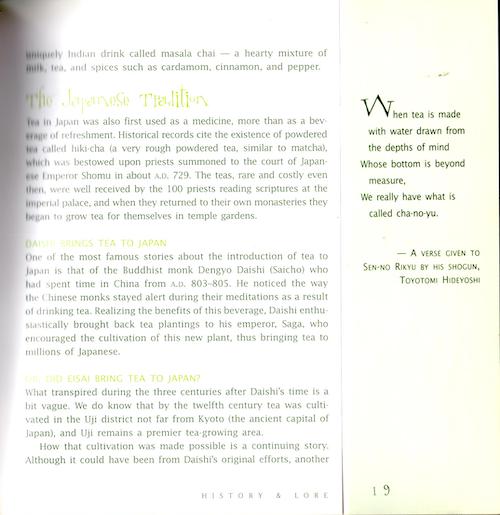
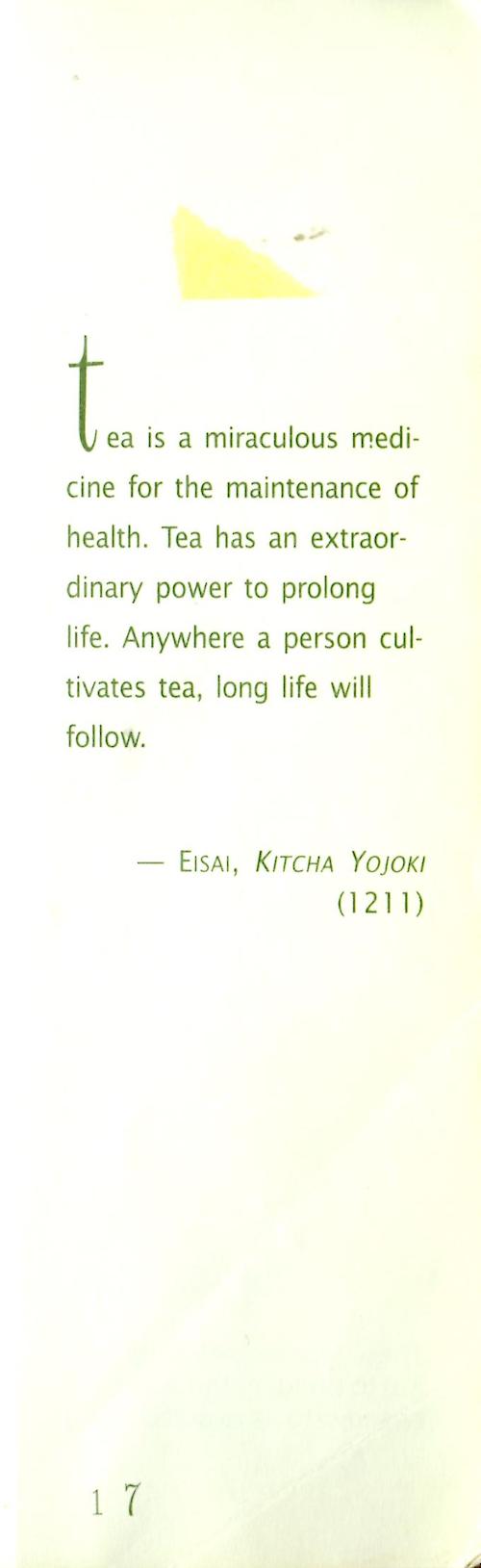
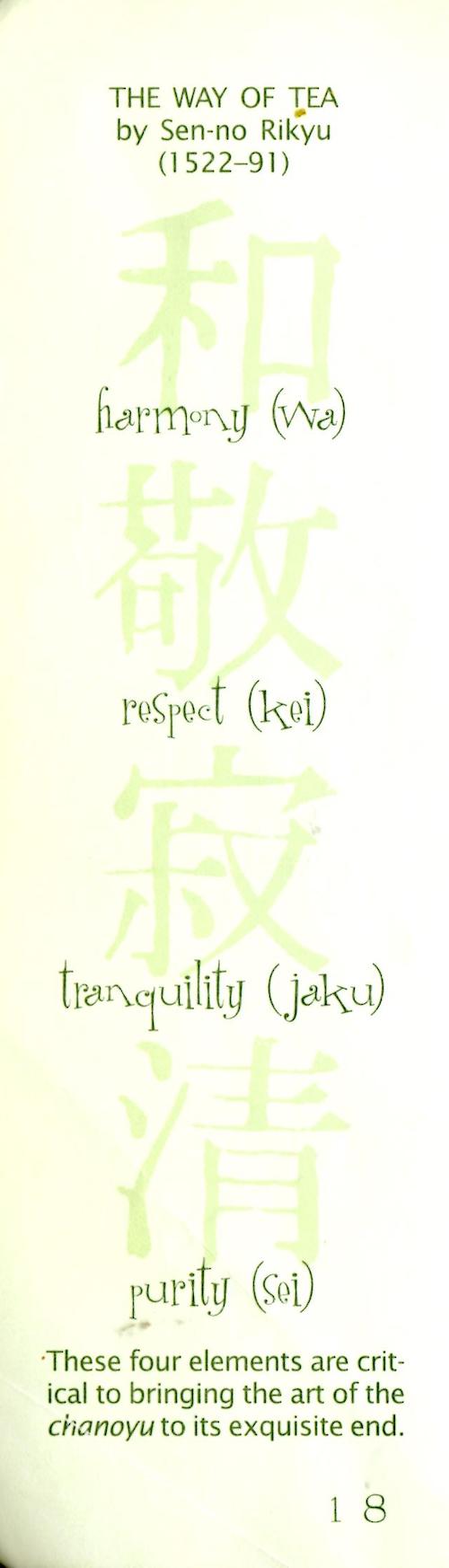
The book is designed with wide margins coloured in light green and adorned with various quotations. Very enticing for someone in search of bookmarkers. Or so at least this is the rationale I give to the disappearance of the design elements from page 17 and page 18. The absence is almost invisible until one goes to turn the page.

spread from Diana Rosen - the book of green tea

Consulting the library copy, I was able to see what attracted the scissors.

side bar - rosen - the book of green tea - quotation from eisai p. 17 Tea is a miraculous medicine for the maintenance of health. Tea has an extraordinary power to prolong life. Anywhere a person cultivates tea, long life will follow. — Eisai, Kitcha Yojoki (1211)
side bar - rosen - the book of green tea - four elements p. 18 The Way of Tea by Sen-no Rikyu (1522-91) harmony (wa) respect (kei) tranquility (jaku) purity (sei) These four elements are critical to bringing the art of the chanoyu to its exquisite end

The cutting offers a kind of reverse curation.

It reminds me of my favourite passage in The Book of Tea by Okakura Kakuzo. Where the emperor is greeted by a garden shorn of bloom but finds a single specimen in the tea house. Ironically our book was pruned to show a verse given by that very same emperor to the tea master: “When tea is made with water drawn from the depths of mind / Whose bottom is beyond measure, / We really have what is called cha-no-yu. – A verse given to Sen-no Rikyu by his shogun, Toyotomi Hideyoshi.”

And so for day 2407
16.07.2013

Posted in Booklore | Leave a comment

Encouraging Cooking

This set of observations came in response to a call out for assistance in encouraging the reluctant to cook …

When I look back on my own culinary explorations at few suggestions stand out:

– adopting a spice or an herb and scouring the cookbooks – this helped me develop confidence in seasoning – good place to start is with homemade tomato sauce which is quite forgiving if a wee bit more garlic is added or if the bay leaf is accidentily omitted.

– getting acquainted with equipment – wok, cast iron frying pan, steamer, omelette pan, bain-marie and the simple saucepan – good to known which cooking techniques are suited to the kitchen gear – recipes are often silent on such matters (I discovered that a bain-marie is good not only for custard but also for rice pudding; a video of Jacques Pépin and the good counsel of Julia Child led us to invest in an omelette pan which we now make regular use of – and of course knives! (I am now much more confident with chopping, slicing and dicing since having learnt to hone knives properly).

– using the library to rifle through cookbooks – good way to explore cuisines and chefs without investing in one’s own copy and seeing one’s shelves groan under the weight – there is one book that has no recipes but is a great resource for flavour combinations: Niki Segnit The Flavour Thesaurus (It has no pictures).

– asking the food purveyors for instructions – thanks to the butcher I discovered the way to cook duck breast to ensure its skin crisps up nicely and was encouraged to explore adding crépinette to my list of sought after pleasures

In short, there is no end to engaging with food – constantly something to learn and try.

And so we send all our best wishes in coaxing your cooking partner along.

And so for day 2406
15.07.2013

Posted in Food Writing | Leave a comment

Welsh for Carrot

This is a short piece from Adam Jacot de Boinod The Meaning of Tingo and Other Extraordinary Words from around the World p. 116

Menu Envy

In some cases, though, it’s the unfamiliar word rather than the food itself that may alarm the outsider:
flab (Gaelic) a mushroom
moron (Welsh) a carrot
aardappel (Dutch) a potato (literally, earth apple)
bikini (Spanish) a toasted ham and cheese sandwich
gureepufuruutsu (Japanese) a grapefruit

I guess the English for banana sounds funny too.

And so for day 2405
14.07.2013

Posted in Food Writing | Tagged | Leave a comment

Pastry & Pedal Power

Wickedly invoking the Queen chorus to Bicycle Race

Bicycle, bicycle, bicycle
I want to ride my
Bicycle, bicycle, bicycle
I want to ride my bicycle
I want to ride my bike
I want to ride my bicycle
I want to ride it where I like

and juxtaposing it here with an entry on Paris-Brest

A Paris-Brest is one of the finest of French pastries. […] I have been unable to pinpoint the origin of the name in any of the most reliable dictionaries or encyclopedias, but always assumed that it was named for the world renowned train that ran between Paris and Brest and was known as the Paris-Brest. As it turns out, it was an ill-educated guess. Several people wrote to point out that it was actually named for a bicycle race between Paris and Brest many years ago. One added that “to celebrate this event, a Parisian chef concocted the desert. If you visualize this dessert, You can see that it is in the shape of a bicycle tire.”

Craig Claiborne’s The New York Times Food Encyclopedia

Ever now associating the song with the traces of choux pastry and cream on a moustache …

And so for day 2404
13.07.2013

Posted in Food Writing | Leave a comment

Onomastic Fox

“By Way of Introduction’ in which a surprising appearance puts the reader off track, given it is a cookbook that is being read:

Chester County — that glorious rolling countryside in Eastern Pennsylvania whose hills and valleys, woodlands and streams and quiet ponds, whose clover meadows and tilled fields and green pastures with nearby red barns and silos and herds, and whose stone farmhouses and spotless dairy buildings all show what the best traditions of farming and husbandry can mean — it is in Chester County, fox hunting country of the East, that Cooking and Cookery come into their own!

Out of the enumeration of countryside features pops the fox. !!

West Whiteland, Pennsylvania: St. Paul’s Church, 1950. Compiled and edited by Virgina Penrose. Illustrated by Cécile Newbold Barnett. [Set up and printed by Princeton University Press]

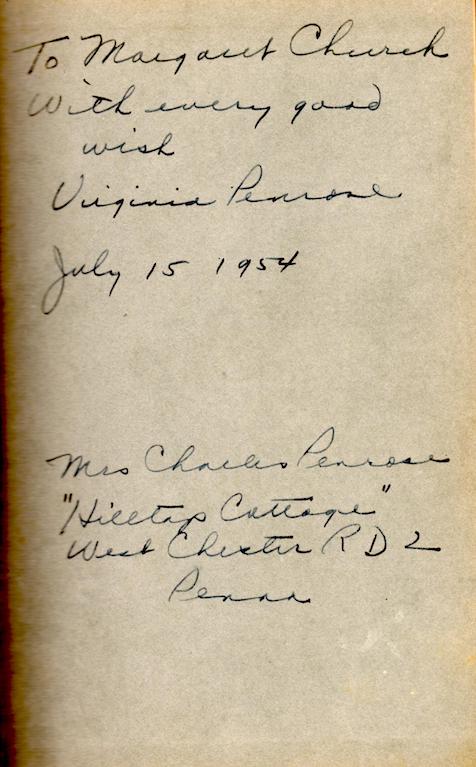
The copy I have examined is inscribed. In the same hand and the same ink there is a signature by Virginia Penrose and an address for a Mrs. Charles Penrose.

inscription - virginia penrose

To Margaret Church
With every good
     wish
  Virginia Penrose
  July 15, 1954


Mrs Charles Penrose
“Hilltop Cottage”
West Chester RD 2
    Penn

In consulting the list of contributors (identified by initials throughout), one discovers that “VP” is given as Mrs Charles Penrose and one would assume by the shared initials (and a little knowledge of the custom at the time on how to address married women) that this is the same person as Virginia Penrose, our compiler and editor and one so knowledgeable of fox hunting country.

And so for day 2403
12.07.2013

Posted in Uncategorized | Tagged , | Leave a comment

Whither

I once sent a posting to Humanist about objects and electronic text editing and as the thread progressed I was reminded of a formulation from Owen Feltham: “Contemplation is necessary to generate an object, but action must propagate it.”

The two ways (vita contemplativa and vita activa) bring to mind a statement by Jerome McGann in his essay “The Rationale of Hypertext”

To the imagination, the materialities of text (oral, written, printed, electronic) are incarnational not vehicular forms.

To be found in Electronic Text: Investigations in Theory and Method. Ed. Kathryn Sutherland. Oxford: Clarendon Press, 1997 (p. 19).

I am intrigued by the possibilities of recasting McGann’s exclusionary dichotomy into a pair of allied pursuits (incarnation-contemplation and vehicle-action). The question takes on a hermeneutical hue: just where does the encounter between the horizon of the reader and the horizon of the author take place?

The answer may require a whole (social) renegotiation of what it means to contemplate versus to act upon a text. I suspect that the vexed question of the relations between powers of abstraction and embodied knowledge is at play.

The relations are not likely to be a one-way street. And this has bearing on what is involved in the telos of editing. I turn to Julia Flanders, “The Body Encoded: Questions of Gender and the Electronic Text” (which we find p. 129 in Electronic Text: Investigations in Theory and Method) for a recovery of a history of what were deemed the stakes in editing. She draws on Stephanie H. Jed Chaste Thinking: The Rape of Lucretia and the Birth of Humanism (1989) to trace and critique a spirit/flesh dichotomy at play in textual editing:

The organizing terms of this relationship revolve around a familiar binary of body and spirit: each physical text, the manuscript or printed book, is a particular concrete carrier of a universalized and disembodied textuality, the “text of the author” which may be fully represented in one physical object, in many, or in none at all. Within this schema the physical object, in a manner familiar to any student of neoclassical aesthetics, is subject to corruption and debasement, its very physicality and particularity drawing it towards the realm of the monstrous and the deviant. The task of the scholar and editor, then, is to discern the universal text within the various documents which instantiate it, and by patient study and labour produce a new — but also originary and authoritative — witness which perfectly transmits the “text of the author”. In Jed’s example, these texts are the foundational documents by which republican Florence was to construct a public ideology based on an assertion of lineage from ancient republican Rome (p. 75)

Of course the story does not stop here.

And so for day 2402
11.07.2013

Posted in Dichotomies | Leave a comment