Function and Field and Group

Michel Foucault, The Archaeology of Knowledge
Translated by A.M. Sheridan Smith

On the notion of function (vs structure):

This is not the place to answer the general question of the statement, but the problem can be clarified: the statement is not the same kind of unit as the sentence, the proposition, or the speech act; it cannot be referred therefore to the same criteria; but neither is it the same kind of unit as a material object, with it limits and independence. In its way of being unique (neither entirely linguistic, nor exclusively material), it is indispensable if we want to say whether or not there is a sentence, proposition, or speech act; and whether the sentence is correct (or acceptable, or interpretable), whether the proposition is legitimate and well constructed, whether the speech act fulfils its requirements, and was in fact carried out. We must not seek in the statement a unit that is either long or short, strongly and weakly structured, but one that is caught up, like the others, in a logical, grammatical, locutory nexus. It is not so much one element among others, a division that can be located at a certain level of analysis, as a function that operates vertically in relation to these various units, and which enables one to say of a series of signs whether or not they are present in it. The statement is not therefore a structure (that is, a group of relations between variable elements, thus authorizing a possibly infinite number of concrete models); it is a function of existence that properly belongs to signs and on the basis of which one may then decide, through analysis or intuition, whether or not they ‘make sense’, according to what rule they follow one another or are juxtaposed, of what they are the sign, and what sort of act is carried out by their formation (oral or written). One should not be surprised, then, if one has failed to find structural criteria of unity for the statement; this is because it is not in itself a unit, but a function that cuts across a domain of structures and possible unities, and which reveals them, with concrete contents, in time and space.

Foucault on the archive

Between the language (langue) that defines the system of constructing possible sentences, and the corpus that passively collects the words that are spoken, the archive defines a particular level: that of a practice that causes a multiplicity of statements to emerge as so many regular events, as so many things to be dealt with and manipulated. It does not have the weight of tradition; and it does not constitute the library of all libraries, outside time and place; nor is it the welcoming oblivion that opens up to all new speech the operational field of its freedom; between tradition and oblivion, it reveals the rules of a practice that enables statements both to survive and to undergo regular modification. It is the general system of the formation and transformation of statements.

In a nutshell: “The a priori of positivities is not only the system of temporal dispersion, it is itself a transformable group.”

And so for day 2361
31.05.2013
Posted in Uncategorized | Leave a comment

Nitpicking “Picnic”

Hélène Matteau
Les mots de la faim et de la soif

Sets us to rights about the origin of pique-unique in case you thought it came from the English …

[L]e pique-nique est un repas constitué de plusieurs plats dans lesquels on se sert un petit peu à la fois. Dans lesquels, donc, on… pique, on picore, des niques, c’est-à-dire de petites choses, de petits riens. On a dit que pique-nique avait été piqué à l’anglais. Or, c’est l’inverse, pick-nick étant plus jeune d’une bonne cinquantaine d’années.

I do like the image of picking at little morsels. Like the entries of a lexicon.

And so for day 2360
30.05.2013

Posted in Food Writing | Leave a comment

Pot, Pan, Skillet – Gas, Electric, Charcol

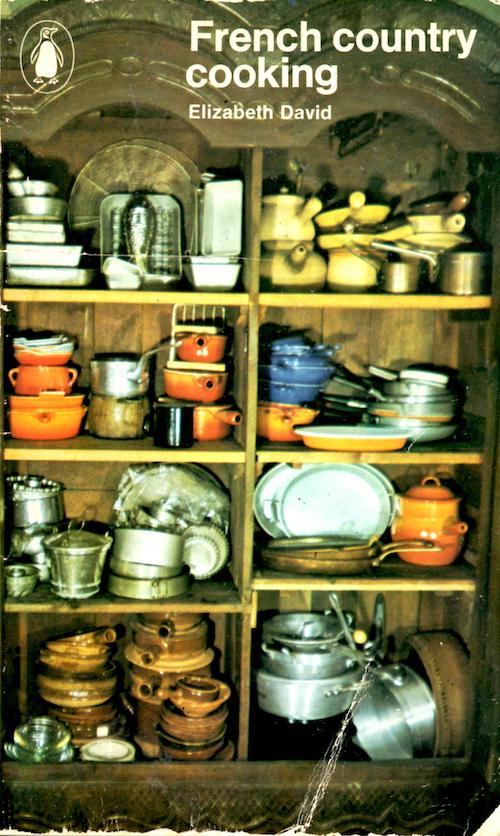
I always thought the cover was quite fetching with its photography by Anthony Denney depicting a cupboard well-stocked with pots and pans, copper, enamel, ceramic.

cover - elizabeth david - french country cooking - penguin edition -- illustration of a cupboardful set of pots and pans - photo by Anthony Denney

I kept returning to a phrase that granted permission for substitution. (with in my mind the plethora of cooking gear and the whole opening section on batterie de cuisine). In the game-bird recipe for “Les Palombes à la Béarnaise” Elizabeth David with a note of reluctance concedes that something else might do as an appropriate bed:

Failing artichokes, a purée of broad beans or of Jerusalem artichokes or of celery will serve quite well.

I was initially captivated by the permutations that were possible. But upon further reflection it is the form that they assume that makes the passage memorable. It is all structured around an If-Then relation which lends the statement the indubitable air of a logical deduction. If none, then any of this. This concluding sentence with its enumeration flows in an opposite direction to the opening of the recipe where a variety of birds are described but only one method worthy.

The wild doves and the wood pigeons of the Landes and the Béarn are particularly delicious little birds. The ordinary pigeons which one buys in England are rather dull and dry, but cooked à la Béarnaise they can be excellent.

The poise is in the prose.

Elizabeth David French Country Cooking

And so for day 2359
29.05.2013

Posted in Food Writing | Leave a comment

Picking Up the Drop Off

Jericho Brown twists reader expectations in “I Have Just Picked Up a Man”. First you believe this is a homoerotic hookup. Then the scene shifts to a dinner and one believes the speaker is committing an act of charity. But the bill of fare is “some poems”. Then it just gets superbly weird since this is narrated in the first person the reader experiences split identification with both the reciter and the listener.

What is being read is not only the poems but also the man. The three final stanzas:

But either way, I’ll read him
Some poems, glance at myself

In his eyes, and in the moments
Before I drop him anywhere

He wants to go
Neither of us will be alone.
We just might not be with each other.

The poem in question is to be found in Jericho Brown’s Please and deserves to be anthologized widely. All those glanced moments pile up and deserve some outlets.

And so for day 2358
28.05.2013

Posted in Poetry | Leave a comment

Magnifying Portions or Reading The Red Blind

I needed a magnifying glass because the weight of the typeface lent a blurring affect given the tight leading.

spread from Greg Evanason - The Red Blind

Some lines that take on a metatextual twist.

Them’s the brakes. Care gives in to bebop pleasure.

Use a concept to pull the hat out of the rabbit.

Don’t be a harness for your own dreams.

cover - greg evanston - the red blind

Greg Evason
The Red Blind
Toronto: The Pink Dog Press, 1991

True printing craftsmanship in producing a chapbook on the long end of 8 1/2 x 11 paper in one signature stapled in the middle. Book design by Kevin Connolly, the founder of Pink Dog Press.

And so for day 2357
27.05.2013

Posted in Booklore, Poetry | Tagged | Leave a comment

Fresh

Curononsky died in 1956. This bit comes from a volume edited by Jeni Wright published in English in 1989.

A menu, however, is not an abstract exercise. Its composition is based on whatever shopping has been done. A chef or a housewife with an eye for the quality of produce does not shop according to preconceived ideas, after first listing the ingredients needed for some arbitrarily chosen recipe. It is undoubtedly useful, however, to have some general plan in mind for the meal […] All the great chefs and “cordons-blues” confirm that obvious advantage of “cuisine du marché” (cooking according to the market), which gives preference to seasonal or early produce and allows the best relationship between quality and price.

Curnonsky, Larousse Traditional French Cooking (1989, French 1987)

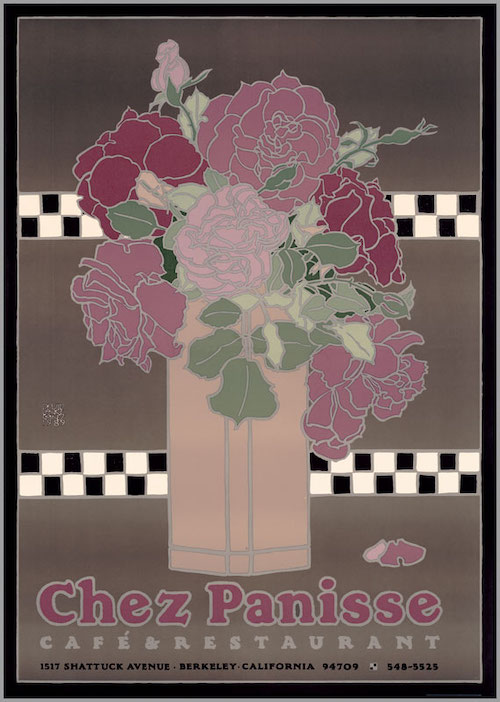
Chez Panisse was 18 years old in 1989 (poster by David Lance Goines) and had a similar sensibility.

chez panisse poster 1989 - david lance moines

And so for day 2356
26.05.2013

Posted in Food Writing | Leave a comment

Cartographies à la carte

Jennifer Moxley
“The Honest Cook’s Insomnia
Druthers

Brimful of good advice on not only cooking but also reading (by way of analogy).

Don’t be smug about outdated foods.
Remember, even iceberg lettuce
was once thought elegant. However
much of an innovator you imagine
yourself to be, our time’s tastes will
express themselves through you,
and cooks who come after will
scratch their heads. The 1970s was
mad for Swiss-style cheese fondue,
the 1980s for Italy’s sun-dried tomatoes,
such reaching after European dash
looks rather quaint against
the current mania for Asian fusion.
You will always feel nostalgic
for your first exposure to revelatory
flavors. Though you later realize
that your “discovery” was part
of a culture-wide zeitgeist,
your memory will grant you
authorship rights and a pat on
the back for your “innate” good taste.
Taste, like experience, feels individual
but is more often than not shared.
Food is culture. Eating or cooking
[…]
will fill the soul with lasting nourishment.

Which whets the appetite and returns us to the opening: “It’s best to start with desire.”

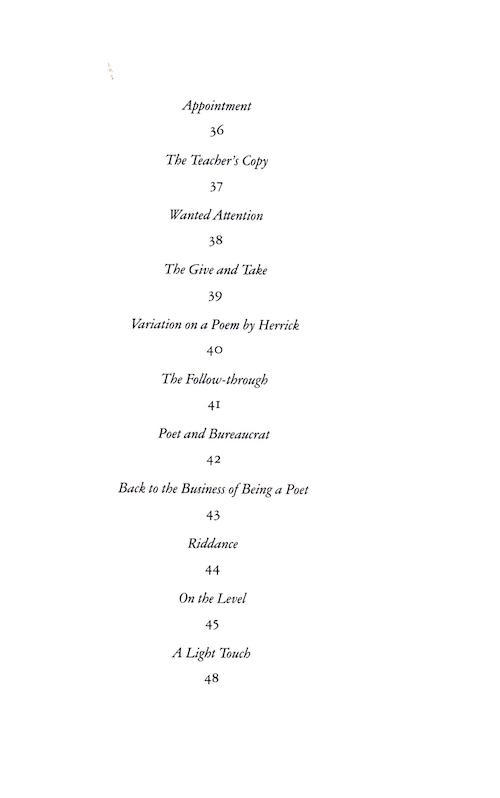
Even the table of contents looks like a menu.

moxley menu - table of contents

And so for day 2355
25.05.2013

Posted in Food Writing, Poetry, Reading | Leave a comment

Connotations Constellations

If I were to create a thesaurus I would call it an “aurifodina”.

A word-hoard gold mine that would contain this nugget “marcescent“.

Leaves kept. Gilded.

Deterred feeding.

Minos-effect.

And so for day 2354
24.05.2013

Posted in Uncategorized | Leave a comment

Writing and Intimations of Mortality

Robert Bringhurst
The Solid Form of Language: An Essay on Writing and Meaning
Gaspereau Press, 2004

The final section worth quoting in full with its carefully stacked repetitions of keywords:

A script is not a language — and the classification of scripts is as different from the classification of languages as the classification of clothes is from the classification of people. Writing, nevertheless, is many things, used by different people in many different ways. In itself, it is both less and more than language. More because it can develop into rich and varied forms of graphic art. Less because, much as we love it, it is not an inescapable part of the human experience or the perennial human condition. If language is lost, humanity is lost. If writing is lost, certain kinds of civilization and society are lost, but many other kinds remain — and there is no reason to think that those alternatives are inferior. Humans lived on the earth successfully — and so far as we know, quite happily — for a hundred thousand years without the benefit of writing. They have never lived, nor ever yet been happy, so far as we know, in the absence of language.

Script is extra. But such a vital vibrant extra.

And so for day 2353
23.05.2013

Posted in Uncategorized | Leave a comment

Envisioning the Olfactory

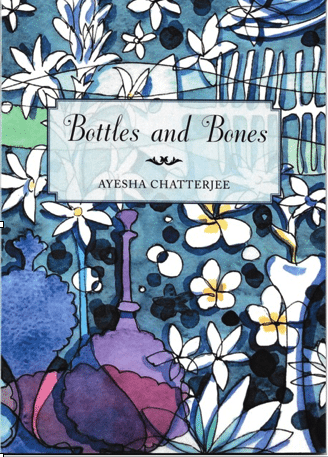
The cover is by Prashant Miranda and appears as a close up partially covered by the title in one edition

cover - bottles and bones by Ayesha Chatterjee

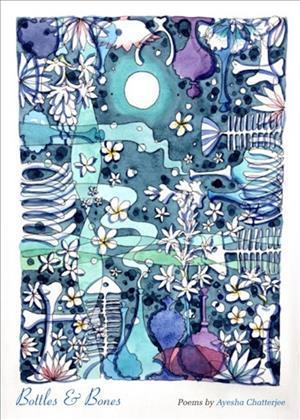
but is more expansive in another view in the edition available from the UK

cover - bottles and bones by Ayesha Chatterjee - uk edition

Like two different states of the same perfume. Suitable for a book whose sections are divided into “Top notes, Middle notes and Dry down.”

There is a deftness in the words and their positioning … the image is allowed to waft before a piquant counter-tone is encountered. Take for instance the beginning and end of “Lessons from the First Anglo-Afghan War”

Yesterday, I could have given you
statistics crisp with freshness
[…]
every detail, except for the camel
that carried the eau de cologne.

Ayesha Chatterjee
Bottles and Bones

And so for day 2352
22.05.2013

Posted in Booklore, Poetry | Leave a comment