Before the Painting: After the Event

It is a long poetic sequence dedicated to Monique Van Genderen. It is

       Feeling panicky about going on so long I show
this to Steve in draft form. “So this is your 9/11 poem?”

To be fair there is no description of the tone of the question. It is sandwiched with other material between a meditation on cravings and substitutes and some sharp remarks on the offensiveness of thinking about your looks.

From Section VII

when cravings come, and will not stand for
substitutes. I get them for seeing art, not virtually
but in person. Online your paintings lose their gloss
to become as flat as these words, which can’t even
manage to dent the page or bump along the fingers.
I cannot recall the feeling I get when looking
at art I love. I must return to face it. To stand
before it. to feel its effect. Like the longing for a food
you cannot reproduce. The patty melt, for example,

From Section IV

       the late sixties and early seventies flipped
everything around. They banned the hats and gloves
once used to hide aged pates and liver spots,
exposing adults as the affronts they are to the illusion of
eternal youth. The Southern Californian sidewalks
swarm with the surgically altered, dressed like children
twenty-four seven in brightly colored clothes,
walking ads for corporate aestheticism
masquerading as personal taste. Here in New England
it is an offense to God to think about our looks.
Try it and winter—Protestantism’s greatest ally—
will take you down a notch

What these snippets fail to convey is the sprawl which reminds one of the conversational-descriptive style of James Schuyler. Pages and pages later, you want to go back and begin the walk through all over again. Return to face it.

“Coastal”
The Open Secret
Jennifer Moxley

And so for day 2351
21.05.2013

Posted in Poetry | Leave a comment

Respect, Care, Cooking

Signe Johansen in the introduction to Solo: The Joy of Cooking for One cites Nigel Slater and provides good company for the cook.

Consider Solo: The Joy of Cooking for One as a sisterly companion, a book that celebrates those moments when you make the time to cook a simple dish for yourself. As Nigel Slater once wrote: ‘Cooking for yourself is simply a matter of self-respect’ — an act of kindness to yourself that nourishes both mind and body. So, rather than asking why you should bother cooking for yourself, try reframing your thinking: start with the assumption that looking after yourself is an essential act of kindness, and suddenly cooking a few simple dishes doesn’t seem like such a chore.

Nigel’s piece in The Guardian appears under the title “Table for one” with a subhead “Cooking for yourself isn’t a chore – it’s a licence to wallow in culinary desire”.

https://www.theguardian.com/lifeandstyle/2000/nov/05/foodanddrink.recipes

And how a solo goes duo and even a trio — Nigel Slater references Delia Smith’s One is Fun.

And so for day 2350
20.05.2013

Posted in Food Writing | Leave a comment

Vertical Virgule Veridical

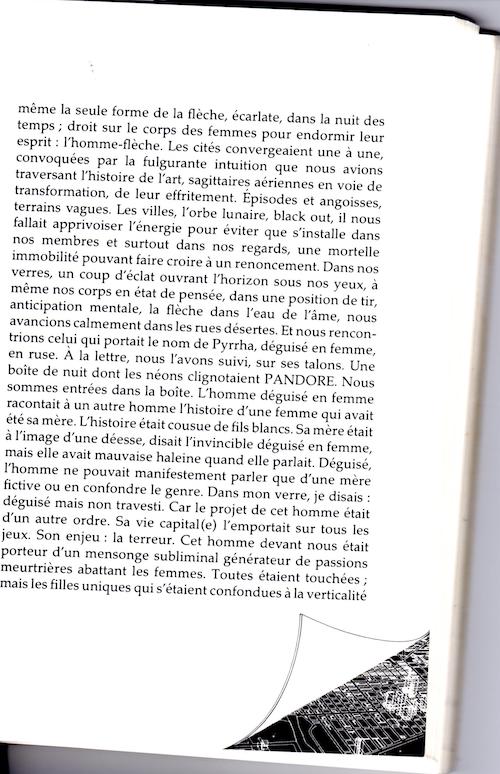
On page 97 of Picture Theory by Nicole Brossard in the 1982 edition (Montréal, Éditions Nouvelle Optique, coll. « Fiction », 1982) there is an image at the corner of the page. It renders a 3D illusion as if behind the page there was a city, a grid of vertical structures. All at the invitation of the turn of a page…

the upturned corner in the novel Picture Theory by Nicole Brossard

Toutes étaient touchées ; mais les filles uniques qui s’étaient confondues à la verticalité

Pages later (p. 151) there is a reference to the fold (upturned corner) in the paper

La cité calquée dans les plis du papier continu reconduisait l’émotion.

Translated by Barbara Godard

The city traced in the folds of continuous paper was bringing back emotion.

Jumping out of the book into other places/spaces in the oeuvre … French Kiss: étreinte-exploration [English translation available in The Blue Books (Coach House Press, 2003)]

Red, I open my eyes: a state of mind. By day and by night a cirque ringed in red where centripetal and centrifugal forces make round Camomille and Lucy not just a motion of emotion but a vortex of desires: an ocean, ‘a womb where death and life transmute one into the other.’ And all this hidden in the cubicled spaces of a tall insalubrious box wedged between two similar blocks, lethal cubes. Tall building / kakémono, translation for verticality with drifting shadows and junks mooring by the shore, early-morning fantasy, a membrane, hovering fog woven in silk. Ideogramme to be deciphered, blacks and whites on over-toasted toast.

Kakemono – a Japanese unframed painting made on paper or silk and displayed as a wall hanging.

Brossard also uses a Japanese term in “Ma Continent” in Amantes which poses a challenge to the translator hoping to capture the play between French ma and Japanese ma *** Barbara Goddard translates in Lovhers this line as “detonation. (mâ)* it’s a space/an hypothesis” with the note that “mâ” is Japanese for space and “ma” is a possessive pronoun of feminine gender in French.

Back to “kakemono”

Google translate draws on Oxford Dictionary to provide examples:
‘On awakening he found the figure on the kakemono seemed to be alive.’
‘A kakemono is intended to be displayed vertically as part of the interior decoration of a room.’
‘Rainbows and reptiles at the same time, the compositions rub against each other like kakemonos in a stormy wind.’
‘The same is true with his collection of kakemono, which are hung, along with other pictures, in some sort of rotation.’
‘Two kakemono hung in the library of the Ho-o-den, and one hung in Silsbee’s dining room.’
Very suggestive — was Brossard interested in a Japanese ghost story [The Kakemonon Ghost of Aki Province]? “On awakening he found the figure on the kakemono seemed to be alive.”

Let us turn to some French vectors. The entry on Wikipédia for Kakemono references Tanizaki, Éloge de l’ombre

« Les reflets blanchâtres du papier, comme s’ils étaient impuissants à entamer les ténèbres épaisses du toko no ma, rebondissent en quelque sorte sur ces ténèbres, révélant un univers ambigu où l’ombre et la lumière se confondent. »

But the dates don’t align the earliest version of Tanizaki’s Praise of Shadows in French that I can find dates to 1978; French Kiss appeared in 1974.

Dead end? The passage in Brossard continues…

Une architecture urbaine reflétée sur la pupil-
le. Les cristaux s’échangent l’arc-en-ciel sur les gla-
ces longues luisantes des édifices. Points de jaillis-
sement. Des formes circulant autour de soi ainsi
que des arguments en faveur des ombres chinoises
plus décousues qu’un roman sans fil. Parasites trr,
ça ruse et et se poursuit comme une vaine liido
pigmentation sur la lu pupille.

One thinks of a typo for “libido” but one may be open to a play on the signifier.

French Kiss, p. 33 which in the English translation by Patricia Claxton p. 28 renders “Interference trrr, plays trick on trick like a ji-jiggling waterbed, a liido, crowded beach pigmentation through the pupils as re(a)d.”

Claxton picks up the possible allusion to the Lido in Venice and goes further inserting a “waterbed” — a “lit d’eau” — into the text.

And she has done her homework…

Occasional typographical errors, have needed correcting in the translation process. Some of these have prompted recourse to the manuscript, which resides in Québec’s Bibliothèque nationale along with the pages and pages of orderly notes from which the French text was constructed. One such correction arises from a contradiction between the book’s first and second editions; both the manuscript and typescript vindicated the first, by Les Editions de l’homme [? 1974 Édition du jour], which give liido, as opposed libido in the Quinze edition [1980].

And so we build and so we turn.

And so we build a relay, a convergence… Brossard teaches us that texts reach down not like icebergs but like the glass and steel cubes of skyscrapers connected through their foundations into the grid of the city’s infrastructure — to the mass of social and cultural associations — trusting that there is some sort of connection though indirect between Brossard and the tradition that Tanizaki conveys.

*** hypothesis – via late Latin from Greek hupothesis ‘foundation’, from hupo ‘under’ + thesis ‘placing’.

To which notes, I, paying attention to space, add “spacean” pertaining to voyager through foundations. Also “space/an”.

And so for day 2349
19.05.2013

Posted in Translations, Uncategorized | Leave a comment

Bone Perches

pulls at the gut and pokes at the brain

I came to the poetry of Kristin Chang via the appearance of “Letter From My Grandmother in Tsingtao” in Poetry Daily which republished the piece from Adroit Journal Issue 26.

http://www.theadroitjournal.org/issue-twenty-six-kristin-chang

One particular image from the poem struck me, seared itself into my consciousness: “I taught you to butcher / a bird & convert its bones / into perches”. There is of course a very visceral dimension to evoking bones and butchering. But there is also a cerebralness in the notion of use value signalled by the perches, one is poised like the words on a line, not sure for how long. Rest my weary bones.

Details: that’s Kristin not Kirstin

And so for day 2348
18.05.2013

Posted in Metaphor, Poetry | Leave a comment

No Place for Dullness

Edward W. Said
Humanism and Democratic Criticism

p. 11 drawing on Vico

For my purposes here, the core of humanism is the secular notion that the historical world is made by men and women, and not by God, and that it can be understood rationally according to the principle formulated by Vico in New Science, that we can really know things according to the way they were made. His formula is known as the verum/factum equation, which is to say that as human beings in history we know what we make, or rather, to know is to know how a thing is made, to see it from the point of view of its human maker. Hence Vico’s notion also of sapienza poetica, historical knowledge based on the human being’s capacity to make knowledge, as opposed to absorbing it passively, reactively, and dully.

p. 111 quoting at length Auerbach

With the eclipse of the divine that is presaged in Dante’s poem, a new order slowly begins to assert itself, and so the second half of Mimesis painstakingly traces the growth of historicism, a multiperspectival, dynamic, and holistic way of representing history and reality. Let me quote him at length on the subject:

Basically, the way in which we view human life and society is the same whether we are concerned with things of the past or things of the present. A change in our manner of viewing history will of necessity soon be transferred to our manner of viewing current conditions. When people realize that epochs and societies are not to be judged in terms of a pattern concept of what is desirable absolutely speaking but rather in every case in terms of their own premises; when people reckon among such premises not only natural factors like climate and soil but also the intellectual and historical factors; when, in other words, they come to develop a sense of historical dynamics, of the incomparability of historical phenomena and of their constant inner mobility; when they come to appreciate the vital unity of individual epochs, so that each epoch appears as a whole whose character is reflected in each of its manifestations; when, finally, they accept the conviction that the meaning of events cannot be grasped in abstract and general forms of cognition and that the material needed to understand it must not be sought exclusively in the upper strata of society and in major political events but also in art, economy, material and intellectual culture, in the depths of the workaday world and its men and women, because it is only there that one can grasp what is unique, what is animated by inner forces, and what, in both a more concrete and a more profound sense, is universally valid: then it is to be expected that those insights will also be transferred to the present and that, in consequence, the present too will be seen as incomparable and unique, as animated by inner forces and in a constant state of development; in other words, as a piece of history whose everyday depths and total inner structure lay claim to our interest both in their origins and in the direction taken by their development.

I turn to the cover and the ticket stub used as a book marker with the clever inversion of the usual “Admit One” — into the very democratic “Admit All”.

cover - edward said - humanism and democratic criticism

Admit Vico. Admit Auerbach. Admit You.

And so for day 2347
17.05.2013

Posted in Uncategorized | Tagged | Leave a comment

The Return

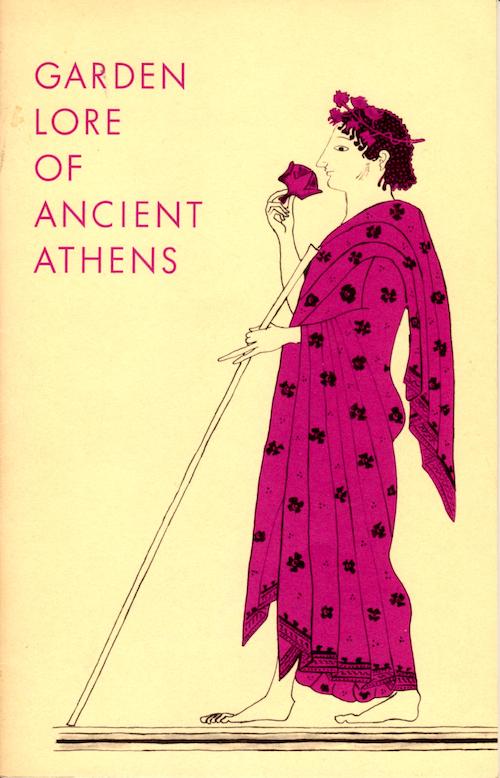
Garden Lore of Ancient Athens (1963)
Excavations of the Athenian Agora Picture Books No. 8
American School of Classical Studies at Athens

cover -garden lore of ancient athens

I am captivated by the story of the origin of the Corinthian order of columns in the section devoted to “Poetic Weeds”.

Also tall, but mauve white, is the spire of the acanthus (bear’s foot) which rises from a calyx of large foliate leaves. In Greece the spinosus grows wild, in Italy the more common type is the mollis; both species were cultivated in Greece. A sculptor of fifth-century Athens, Kallimachos, once saw an acanthus growing over a basket that had been set on the grave of a Corinthian girl by her devoted nurse. Struck by the rich plasticity of the curling leaves, he created the column capital that is still called ‘Corinthian’.

The tale’s source is Vitruvius.

And so for day 2346
16.05.2013

Posted in Gardens | Leave a comment

The Turn

Sunil Gupta in conversation with Saleem Kidwai in Gupta’s Queer, (Munich: Prestel Verlag, 2011)

SK: What about gay politics in NY?

SG: It had become purely gay. It was 1976, post-Stonewall and before AIDS. Everything was about hedonism and that was great. It was like the whole liberationist sexual politics had come to life. Everybody appeared to be practicing it.

SK: As documented in the film we saw.

SG: yeah, Gay Sex in the 70s. All of which I observed but was personally less involved in. Maybe I was using the camera to satisfy my curiosity.

SK: Yes, it was so much in your face, which was a shock for me three months out of Delhi. You didn’t have to go to a gay bar. Gay men everywhere — in the bank and in grocery stores. They had created this sub-culture which you caught in your pictures of Christopher Street — all those men with neat moustaches and in tight jeans.

SG: It was very white.

SK: Yes, but there was also a black gay presence.

SG: But that was very little of it. It was hardly there at that time.

SK: Well there were many black men in the bars.

SG: Yes, that’s true. But I didn’t really encounter any personally. None or hardly any. I guess, in retrospect, New York had more absolute numbers of people of colour and the end result was more segregation. I didn’t know then but I realize now that they were doing their own thing in a different place. But we never saw them. I think Indians by and large, and I was no exception, got assimilated into what we saw as the mainstream white culture. by doing the photography courses and not the business school I became even more cut off from immigrant culture.

SK: Which was all white?

SG: Which was largely white.

SK: But that changed, which was a new beginning.

And so for day 2345
15.05.2013

Posted in Uncategorized | Leave a comment

S/Z

Comparing interests, interesting comparison

Drawn from Microsoft Office thesaurus

ORGANIsATION ORGANIzATION
synonym list for organisation with an s synonym list for organization with an z
system of government
government
administration
civil service
officialdom
establishment
association
group
club
society
institute
union
party
business

Variant spelling leads to adjacent semantic space.

And a quick peek at Roget’s International Thesaurus Third Edition which has the one spelling:

organization

composition
arrangement
classification
establishment
structure
organism
association
sect

And so for day 2344
14.05.2013

Posted in Uncategorized | Leave a comment

Tufts

From Wordsworth Tintern Abbey poem

These plots of cottage-ground, these orchard-tufts

Emily Dickinson #321

Then quiver down, with tufts of tune –

Both I take it looking down upon the scene; both caught by the sight of the tough stuff …

And so for day 2343
13.05.2013

Posted in Poetry | Leave a comment

Companionship: Between Wading and Plunging

Molly Peacock
Prologue
The Best Canadian Poetry in English 2008

She points out a concern to reach and embrace:

What I see, from poets from diverse backgrounds, provinces, ages and personal categories, is a unity, a core, something identifiable as a gesture in Canadian poetry itself, not in the poets’ backgrounds or personalities, but in the poems they produce, poems that presume a kind of companionship with their readers and assume their readers’s willingness to undertake a tandem adventure.

And she goes on to offer an analogy to swimming

Think of this volume as a swimming pool. Poet and reader go in together. Finally they hit the place where their feet leave the bottom and then they swim, experiencing something they both know is over their heads. That is what poetry is trying to stay afloat in a element in which you might sink, and which is surely over your head.

In our imaginations, diversity is reintroduced: back stroke, breast stroke, butterfly.

And so for day 2342
12.05.2013

Posted in Introductions, Poetry | Leave a comment