At the Meeting of Three Faculties

Lorne Pierce
An Editor’s Creed
(Toronto: Ryerson Press, 1960)

In the fourth and last section “Respect for the decencies, the individual, the intangibles” appears an anecdote who’s theme is considerably enlarged:

At the reception following Convocation at one of our universities, a small cluster gathered. They represented the Arts, Science and Divinity faculties. One of the Science professors asked me what one word stood out in all my reading, I replied that, if I had to choose one word, and not a phrase or a sentence, I would choose the word wonder. Does not wonder lie at the core of the arts and letters, of science and invention, and even of philosophy and religion? It is compounded of reverence and imagination, and every man must find the essence of it for himself. When found he will know it, for, confronted with it, he will instinctively uncover the head and bow the knee. It is the one great thing, beyond price and worthy of all honour.

It seems to me that this is where the publisher most truly joins hands with the university and with religion, for all three hope to set a lighted candle in the window of the world agains darkness and despair. A passionate interest in the world and insatiable curiosity about it — this the Greeks called wonder. Wonder is the threshold to fundamental feelings and ideas about ourselves, about the world around us, and about our destiny as individuals and as a race. It is the one sure way by which our sensibilities may be extended and enlarged.

Wonder remains a key operative word and concept.

The extension of reverence may take on less the trappings of veneration and yet remain a pause inflected by awe.

To inquire about the source of this awe, it is worthwhile to return to the beginning of the creed. To organize his talk, Pierce recalls setting down what Egerton Ryerson stood for

He hoped to build a covered bridge between East and West; between French and English; between Catholic and Protestant; between the learned and the unlearned.

He insisted upon respect for the decencies — all of them; respect for the value and dignity of the individual, and a man’s right to be heard; respect for the intangibles — the things that money cannot buy.

Today we would for Protestant-Catholic think of Christian-Muslim, for French-English think of Indigenous-settler reconciliation, for East-West the sea-to-sea-to-sea invocation that reminds us of Arctic sovereignty threatened by climate change.

Still the word “decency” is fitting to cover the altered bridgings.

Respect: to look back at. With a regard of reverence. With a sense of wonder.

And so for day 2341
11.05.2013

Posted in Uncategorized | Leave a comment

Seared & Cauterized

Jack Kornfield
A Path With Heart

Sometimes when the demons are most difficult, we can use a variety of temporary practices that function to dispel them and act as antidotes. For desire, one traditional antidote is to reflect on the brevity of life, on the fleeting nature of outer satisfactions, and on death. For anger, an antidote is the cultivation of thoughts of loving-kindness and an initial degree of forgiveness. For sleepiness, an antidote is to arouse energy through steady posture, visualization, inspiration, breath. For restlessness, an antidote is to bring concentration through inner techniques of calming and relaxation. And for doubt, an antidote is faith and inspiration gained through reading or discussion with someone wise. However, the most important practice is our naming and acknowledging these demons, expanding our capacity to be free in their midst. Applying antidotes is like using Band-Aids, while awareness opens and heals the wound itself.

The brand name leads me to contemplate alternatives: dressing, bandage, plaster. And the French translations as pansement and its Middle French homophone pensement. The Thinking Wound. Like a pharmakon. A name. A brand.

And so for day 2340
10.05.2013

Posted in Uncategorized | Tagged | Leave a comment

Poetry After Freud

A. Alvarez
Introduction
The New Poetry
1962

The introductory essay outlines a set of negative feedbacks operating in British poetry in reaction to the work of T.S. Eliot. This is what it concludes:

What poetry needs, in brief, is a new seriousness. I would define this seriousness simply as the poet’s ability and willingness to face the full range of his experience with his full intelligence; not to take the easy exits of either the conventional response or choking incoherence. Believe in it or not, psychology has left its mark on poetry. First, the writer can no longer deny with any assurance the fears and desires he does not wish to face; he knows obscurely that they are there, however skilfully he manages to elude them. Second, having acknowledged their existence, he is no longer absolved from the need to use all his intelligence and skill to make poetic sense of them. Since Freud, the late Romantic dichotomy between emotion and intelligence has become totally meaningless.

I may venture to surmise that emotion and intelligence are connected by feedback loops.

And so for day 2339
09.05.2013

Posted in Dichotomies, Introductions, Poetry | Leave a comment

Scientism of the Dismal Science

Notice how the mention of “worldly philosophers” (and I am assuming an allusion to Robert L. Heilbroner’s book) triggers a contemplation of the consequences of resisting hegemonic discourse.

Fellow economists, as you can imagine, get very angry with me when I tell them that we face a choice: we can keep pretending we are scientists, like astrologers do, or admit that we are more like philosophers, who will never know the meaning of life for sure, no matter how wisely and rationally they argue. But were we to confess that we are at best worldly philosophers, it is unlikely we would continue to be so handsomely rewarded by the ruling class of a market society whose legitimacy we provide by pretending to be scientists.

From the epilogue to Talking to My Daughter About The Economy Or, How Capitalism Works — and How It Fails by Yanis Varoufakis.

And so for day 2338
08.05.2013

Posted in Uncategorized | Leave a comment

Social Prescriptions and Protopia

The Royal Ontario Museum reports on social prescriptions in action

About Social Prescriptions

Social prescriptions are a means for healthcare, community, and social service professionals to refer people to non-clinical and non-medical services that, along with existing treatments, can be a therapeutic tool for improving health and well-being.

In Ontario, the Ministry of Health and Long-Term Care funded a one-year pilot project with The Alliance for Healthier Communities in September 2018. This program offers social prescriptions in 11 community health centres to address the growing problems of loneliness and social isolation, particularly among older adults. The ROM will be collaborating with the Alliance throughout the year to better understand the impact of museums on health and well-being. Research resulting from this collaboration will help inform the ROM Social Prescription Program as it evolves.

This encounter with the notion of “social prescriptions” in a message from the ROM made me wonder about “digital social prescriptions.” What would they look like?

I’m slowly making my way through Kevin Kelly‘s The Inevitable: Understanding the 12 Technological Forces That Will Shape Our Future. This material is way better than his previous work. I remember being put off on his hive mind riffs. This seems more measured and asks the reader to be attentive to the bits of the future that are already here and he clears away any tension between utopia and dystopia by coining the term “protopia.”

[N]either dystopia nor utopia is our destination. Rather, technology is take us to protopia. More accurately, we have already arrived in protopia.

Protopia is a state of becoming rather than a destination. It is a process. In the protopian mode, things are better today than they were yesterday, although only a little better. It is incremental improvement or mild progress. The “pro” in protopian stems from the notions of process and progress. The subtle progress is not dramatic, not exciting. It is easy to miss because a protopia generates almost as many new problems as new benefits.

Sounds as if he is inspired by Eastern philosophy. Perfect prescription to balance out unchecked teleological inclinations.

And so for day 2337
07.05.2013

Posted in Uncategorized | Tagged | Leave a comment

Frag Meant Meat

http://www.bpnichol.ca/archive/audio/not-what-siren-sang-what-frag-ment

Not What the Siren Sang But What the Frag Ment (for Margaret Alison)

From the 7 ¼ floppy record borders included in the box bp, published in February 1967 by Coach House Press (Toronto, Ontario).

Appeared in

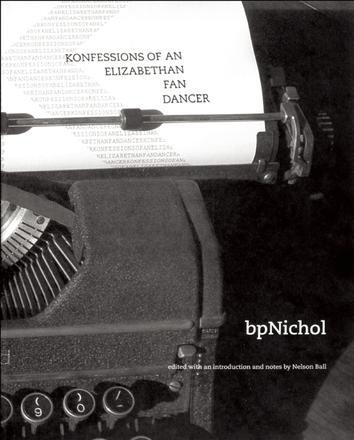
Konfessions of an Elizabethan Fan Dancer

Konfessions of an Elizabethan Fan Dancer is Nichol’s very first book. Originally published in England by Bob Cobbing in 1967, and then in Canada in 1973 by Nelson Ball’s Weed/Flower Press

New edition with introduction and notes by Nelson Ball, Coach House Press, 2004

bpNichol - Konfessions of An Elizabethan Fan Dancer reprint edited by Nelson Ball

A pdf copy of the 1969 second edition made from the copy housed at the University of Victoria Library is available through the bpNichol archive

http://www.bpnichol.ca/archive/documents/konfessions-elizabethan-fan-dancer-1969

Note how the Title Lines align.

NOT WHAT THE SIREN SANG
BUT WHAT THE FRAG MENT

The first stanza is built up out of anagrams.

leaf autumn sky
flea umantu kys

“umantu” looks like “ubuntu” https://en.wikipedia.org/wiki/Ubuntu_philosophy — a trick of a sky kiss

And so for day 2336
06.05.2013

Posted in Poetry | Tagged | Leave a comment

Implosion

bill bissett
what fuckan theory: a study uv language

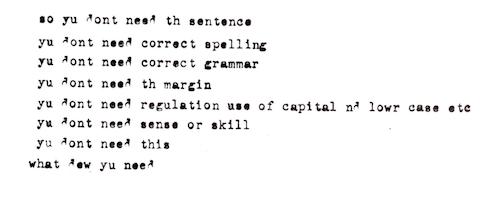
so yu dont need th sentence
yu dont need correct spelling
yu dont need correct grammar
yu dont need th margin
yu dont need regulation use of capital nd low case etc
yu dont need sense or skill
yu dont need this
what dew yu need

What the transcription doesn’t show is the broken “d” throughout.

scan from bill bissett what fuckan theory: a study uv language -- the don't with broken letter

The deontological beckons to the ontological — the broken “d”

so yu -ont nee- th sentence
yu -ont nee- correct spelling
yu -ont nee- correct grammar
yu -ont nee- th margin
yu -ont nee- regulation use of capital n- low case etc
yu -ont nee- sense or skill
yu -ont nee- this
what -ew yu nee-

Moral: language is the basis of morality — this sense and skill beyon

And so for day 2335
05.05.2013

Posted in Poetry | Leave a comment

Kindness – Organization – Resistance

He seems to have a bug-a-boo about online relationships…

Christopher Hedges
America, The Farewell Tour

We have a brilliant peroration close to the end of the CBC Ideas show he quotes from his book and this is what he says about the topic of resistance at 52.07

Those who fight against cultural malice […] have discovered that life is measured by infinitesimal and often unacknowledged acts of solidarity and kindness. These acts of kindness like the nearly invisible strands of a spider’s web spin outward to connect our atomized and alienated souls to others. This belief held although we may never see empirical proof is profoundly transformative. But know this, when these acts are carried out on behalf of the oppressed and the demonized, when compassion defines the core of our lives, when we understand that justice is a manifestation of love, we are marginalized and condemned by our sociopathic elites. Those who resist effectively in the years ahead may not be able to stem economic decline, the mounting political dysfunction, the collapse of empire and the ecological disasters but they will draw from acts of kindness and the kindness of others, the strength and courage to endure. It will be from these relationships, ones formed the way all genuine relationships form, face to face, rather than electronically, that radical organizations will rise from the ashes to resist.

https://www.cbc.ca/radio/ideas/christopher-hedges-farewell-america-1.4911396

Intrigued I went to the book (aided by an index where the term “kindness” appears — no entry for “electronic”). I noticed that the aside is starker in the book (my transcribing commas here are dashes there)

But they will draw from acts of kindness, and the kindness of others, the strength and courage to endure. It will be from these relationships — ones formed the way all genuine relationships form: face to face, rather than electronically — that radical organizations will rise from the ashes to resist.

Genuine/fake

p. 22

Political rhetoric has been replaced by the crude obscenities of reality television, the deformed and stunted communication on Twitter, professional wrestling, and the daytime shows in which couples discover if their husband or wife is having an affair. […] These electronic hallucinations […] have replaced reality.

p. 39

Pireaus was filled with taverns and brothels. […] Pireaus was where elaborate spectacles and bawdy entertainment diverted the population from the sober vocation of citizenship. It was what the arena was to ancient Rome, what electronic screens and huge sporting events and concerts are to modernity.

p. 40

These distorted images of reality — our array of electronic images were beyond Plato’s imagination — provoked irrational desires. It was a visionless life.

p. 83

Many people, especially young people, sit far too long in front of screens seeking friendship, romance, affirmation, hope, and emotional support. This futile attempt to achieve a human connection electronically, a connection vital to our emotional and psychological well-being, especially in a society that condemns so many to the margins, exacerbates the alienation, loneliness, and despair that make opioids attractive.

p. 217

This is more about mood modulation. Affect modulation. Using technologies to dampen anxieties and exit the world. We don’t just see it in Las Vegas. We see it in the subways every morning. The rise of all of these screen-based technologies and the little games that we’ve all become so absorbed in. What gamblers articulate in a desire to really lose a sense of self. They lose time, space, money value, and a sense of being in the world.

p. 232

The disparity between the glittering world that people watch and the bleak world they inhabit creates a collective schizophrenia. It manifests itself in diseases of despair — suicides, addictions, mass shootings, hate crimes, and depression. We are to blame for our own misfortune.

Hope means rejecting the thirst for public adulation. It means turning away from the maniacal self-creation of a persona that defines social media. It means searching for something else — a life of meaning, purpose, and, ultimately, dignity.

pp. 250-251

“We have to listen to people unlike ourselves,” [Michael] Gecan said, observing that this will be achieved not through the Internet but through face-to-face relationships. “And once we’ve built a relationship we can agitate them and be willing to be agitated by them.”

[…]

The corporate state, he said, has learned how to manipulate protests and render them impotent. He dismissed as meaningless political theater the boutique activism in which demonstrators coordinate and even choreograph protests with the police. Activists spend a few hours, maybe a night, in jail are “credentialized” as dissidents. Pecan called these “fake arrests.” “Everyone looks like they’ve had an action,” he said. “They haven’t.” […] “There things have to be happening in great organizations: people have to be relation, people have to be learning, people have to be acting,” he said.

pp. 308-30

There is no shortage of artists, intellectuals, and writers, from Martin Buber and George Orwell to James Baldwin, who warned us that this dystopian era was fast approaching. But in our Disneyfied world of intoxicating endless images, cult of the self and willful illiteracy, we did not listen. We will pay for our negligence.

Cult of the self / care of the self
Nuance.

When I first heard the kindness passage on CBC, it seemed to me that Hedges’s demonizing of electronic communication was a tick that betrayed a return of the repressed. Having read the whole book I would suggest that it is a form of nostalgia. In his railing against magical thinking, Hedges risks missing the thinking that does occur online.

That said, the socialist programme he summarizes (pp. 304-305), is set in the context of constant struggle:

There will be a never-ending battle of ideas, those spun out by the elites to justify their privilege and power and the radical theorists who will expose the ideas as tools of repression and hold up an alternative.

We cannot pick and choose whom among the oppressed it is convenient to support. We must stand with all the oppressed or none of the oppressed. This is a global fight for life against corporate tyranny. We will win only when we see the struggle of working people in Greece, Spain, and Egypt as our own struggle. This will mean a huge reordering of our world, one that turns away from the primacy of profit to full employment and unionized workplaces, inexpensive and modernized mass transit, especially in impoverished communities, universal single-payer health care and banning for-profit health care corporations. The minimum wage must be at least $15 an hour and a weekly income of $500 provided to the unemployed, the disabled, stay-at-home parents, the elderly, and those unable to work. Anti-union laws, like the Taft-Hartley Act, and trade agreements such as NAFTA, will be abolished. All Americans will be granted a pension in old age. A parent will receive two years of paid maternity leave, as well as shorter work weeks with no loss in pay and benefits. The Patriot Act and Section 1021 of the National Defence Authorization Act, which permits the military to be used to crush domestic unrest, as well as government spying on citizens, will end. Mass incarceration will be dismantled. Global warming will become a national and global emergency. We will divert our energy and resources to saving the planet through public investment in renewable energy and end our reliance on fossil fuels. Public utilities, including railroads, energy companies, [internet providers?], the arms industry, and banks, will be nationalized. Government funding for the arts, education, and public broadcasting will create places where creativity, self-expression, and voice of dissent can be heard and seen. We will terminate our nuclear weapons programs and build a nuclear-free world. We will demilitarize our police, meaning that police will no longe carry weapons when they patrol our streets but instead, as in Great Britain, rely on specialized armed units that have to be authorized case by case to use lethal force. There will be training and rehabilitation programs for the poor and those in our prisons, along with the abolition of the death penalty. We will grant full citizenship to undocumented workers. There will be a moratorium on foreclosures and bank repossessions. Education will be free from day care to university. All student debt will be forgiven. Mental health care, especially for those now caged in our prisons, will be available. Our empire will be dismantled. Our soldiers and marines will come home.

The week and the vulnerable, especially children, will no longer be sacrificed on the altars of profit and the needs of empire. The measure of a successful society will not be the GDP or the highs of the stock market but human rights. Children will never go to be hungry. They will live in safety and security, be nurtured and educated, and grow up to fulfill their potential.

Opportunities for a genuine care of the self: both face-to-face and through computer-mediated communication. Not either-or.

And so for day 2334
04.05.2013

Posted in Uncategorized | Tagged | Leave a comment

Dreams of Vengeance Trap One in Hell

Damn It All
Stephen Greenblatt
review of The Penguin Book of Hell
edited by Scott G. Bruce

One of the prime motives of these texts is rage, rage against people occupying positions of exceptional trust and power who lie and cheat and trample on the most basic values and yet who escape the punishment they so manifestly deserve. History is an unending chronicle of such knaves, and it is a chronicle too of frustration and impotence, certainly among the mass of ordinary people but even among those who feel that they are stakeholders in the system. Hell is the last recourse of political impotence. You console yourself — you manage to stay asleep, as Freud might say — by imagining that the loathsome characters you detest will meet their comeuppance in the afterlife.

But Voltaire and the Enlightenment carried a different message: wake up. Throw out the whole hopelessly impotent fantasy; it is, in any case, the tool not only of the victims but also of the victimizers. We must fight the criminals here and now, in the only world where we can hope to see justice.

Heaven is reading The New York Review of Books

Good.

And so for day 2333
03.05.2013

Posted in Uncategorized | Leave a comment

Like Elegance in Mathematics

A short accessible piece by Joe Morgan on the question of whether to teach coding to children has appeared in Slate. One of its themes is about cultivating an appreciation for quality.

Of course, getting something working is just the first step of building software. The next step is to make code clear, reusable, and neat. Once, early in my career, I wrote a feature and gave it to a senior developer for review. He took one look at my sloppy spacing, mismatched lines, and erratic naming conventions and just said, “Do it again.” It was working. The syntax was valid. It was still wrong. Good coders don’t just get something to work. They want it to be good.

That feeling of quality is the hardest thing for many developers to master. Well-designed code feels good to work with, and ugly code will make developers involuntarily cringe. The best developers learn to fuse abstract logic with the sensitivity of an artist. Learning to trust that aesthetic feeling is as much a part of development as any algorithm or coding pattern.

Keen sense of the apt anecdote. Like Zen tales.

My wife and I recently made sugar cookies with our son. […] Every step—precisely measuring ingredients, gauging mixed dough for smoothness and consistency, placing precision cuts to minimize waste—taught him something about quality. It’s hard to teach the difference between merely executing steps, such as following a recipe, and doing something well. It can only be passed on through feel and experience. And every time you involve your kids when you work on something you value, you are teaching them how to do things well. You are preparing them to write code.

Transferable skill. Attitude. Approach.

Good.

And so for day 2332
02.05.2013

Posted in Food Writing | Tagged , | Leave a comment