traversée du texte traversé de textes

In the Robarts Library copy of Louis Marin Utopiques : Jeux d’spaces (page 182) marginal note in pencil by a previous reader

Picture
Theory

de
Brossard
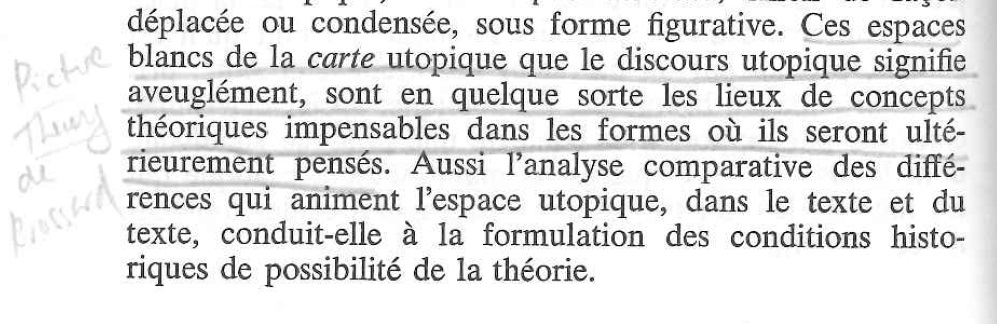
scan of marginalia from Robarts Library copy of Nicole Brossard Picture Theory -- reference to Marin Utopiques

Next to this marginal note, this is what is underlined:

Ces espaces blancs de la carte utopique que le discours utopique signifie aveuglément, sont en quelque sorte les lieux de concepts théoriques impensables dans les formes où ils seront ultérieurement pensés. Aussi l’analyse comparative des différences qui animent l’espace utopique dans le text et du texte, conduit-elle à la formulation des conditions historiques de possibilité de la théorie

.
I like the snippet that precedes this without being underlined and so emphasized by a sort of inversion: “déplacée ou condensé, sous forme figurative.”

p.182
Louis Marin
La ville : espace du texte et espace dans le texte
Chapitre 6
Utopiques : Jeux d’espaces
Minuit, 1973

A few pages later (p.184) this footnote by Marin

D’où sans doute également le système d’interdictions et de réglementations concernant les voyages des Utopies dans leur île : voyager c’est rompre les alternances ritualisées de repos et de travail en lieu déterminé, c’est introduire l’imprévu. C’est au fond frayer, dans le temps et dans l’espace, de nouveaux chemins. Là encore, il y a dans le voyage une forme de rupture et de violence à l’égard des totalités, qu’il s’agisse de l’habitude du rite ou de l’espace.

There are in this copy of Marin’s book other instances of marginalia referencing lesbian authors: Brossard again with Mauve Desert and Wittig’s Les Guérillères. Someone was constructing a relay between lesbian imagination and utopics.

(( route via exstasie ))

Marin’s notion of travel as a form rupture and as the founding moment of Utopian space certainly is taken up in Brossard’s notions of relays and the access to abstraction in Picture Theory which are accessed through the erotic contact of women with women. Three excerpts:

la lumière éclipsant sur le livre
le titre sans l’ombre d’un doute
je traduisais réellement par le nombre
puis venait la transparence les corps portés
comme des relais je disais aussi
bras de femmes l’espoir

Claire Dérive retrace exactement le circuit
des espaces conditionnés nôtres
et les zones libres tout autour
spiralées, ce sont les musiques sans lesquelles
il n’y aurait ni utopie, ni abstraction
ni aucune lèvre à jouir

Ce mot ne pouvait non plus servir à élaborer quelque utopie qui aurait rendu les femmes à leur genre. Je disais, avec dans la bouche un goût de sel, à propos de l’utopie en commençant par le mot femme que l’utopie n’allait pas assurer notre insertion dans la réalité mais qu’un témoignage utopique de notre part pouvait stimuler en nous une qualité d’émotion propice à notre insertion dans l’histoire.

Translated by Barbara Godard

This word could not be used either to elaborate some Utopia that would have restored women to their gender. I said, with a taste of salt in the mouth, on the subject of Utopia beginning with the word woman that Utopia was not going to ensure our insertion into reality but that a Utopian testimony on our part could stimulate in us a quality of emotion favourable for our insertion in history.

Travel is textual.

p. 154

Where one expects “Dérive” one finds “Drive”.

Is this a typo that is corrected in the 1989 revised edition text?

Picture theory ; Hologramme
Montréal : Nouvelle Optique, c1982.

Picture theory : théorie/fiction
Nouv. éd. rev., corr. et augm.
Montréal : L’Hexagone, 1989.

Language drives the drift. Text traces the access to the impossibilities of utopia and from there to the possibility of theory.

And pictures in our eyes to get
Was all our propagation.

John Donne, The Extasie.

And so for day 2331
01.05.2013

Posted in Uncategorized | Tagged | Leave a comment

Ever Wonder About Looking Up?

A piece of technohistory from a piece of ephemera…

SURTITLES™ were first developed and introduced worldwide by the Canadian Opera Company in 1983.

From the University of Toronto Faculty of Music program notes to Kurt Weil’s Street Scene.

And so for day 2330
30.04.2013

Posted in Uncategorized | Leave a comment

Turning “total” to “to all”

Huizinga “Play and War” in Homo Ludens

We can only speak of war as a cultural function so long as it is waged within a sphere whose members regard each other as equals or antagonists with equal rights; in other words its cultural function depends on its play-quality. This condition changes as soon as war is waged outside the sphere of equals, against groups not recognized as human beings and thus deprived of human rights – barbarians, devils, heathens, heretics and “lesser breeds without the law”. In such circumstances war loses its play-quality altogether and can only remain within the bounds of civilization in so far as the parties to it accept certain limitations for the sake of their own honour. Until recently the “law of nations” was generally held to constitute such a system of limitation, recognizing as it did the ideal of a community of mankind with rights and claims for all, and expressly separating the state of war – by declaring it – from peace on the one hand and criminal violence on the other. It remained for a theory of “total war” to banish war’s cultural function and extinguish the last vestige of the play-element.

*********

Last lines of The Kingdom. Cutting between Saudi Arabia and the USA.

Adam Leavitt: Fleury. Tell me what you whispered to Janet, in the briefing, to get her to stop crying about Fran, you know, before all this, before we even got airborne. What’d you say to her?

Aunt: Tell me, what did your grandfather whisper in your ear before he died?

Adam Leavitt: You remember?

Ronald Fleury: I told her we were gonna kill ’em all.

15-Year-Old Grandson: Don’t fear them, my child. We are going to kill them all.

“We” is problematic for the viewer — it’s an invitation to identification that can be resisted through memory — the Ronald Fleury character is depicted at least three times interacting with male children trying to explain the unexplainable. In all three instances the scene is expected to elicit the viewer’s sympathy. The conflict is individualized and the figure of the good man laminated to that of the good soldier and by that adulterated.

But note that between the tenses, past and future, is the present. Jetzeit. Where and when you remember.

It is in that time of the viewing that the viewer can recall a moment earlier in the film that underscored the recognition of universal mortality as a impetus to action. In a scene in the corridors of power far from the theatre of war.

Attorney General Gideon Young: I’m gonna bury you.

FBI Director James Grace: You know, Westmoreland made all of us officers write our own obituaries during Tet, when we thought The Cong were gonna end it all right there. And, once we clued into the fact that life is finite, the thought of losing it didn’t scare us anymore. The end comes no matter what, the only thing that matters is how do you wanna go out, on your feet or on your knees? I bring that lesson to this job. I act, knowing that someday this job will end, no matter what. You should do the same.

*********

Dr. Who
Genesis of the Daleks

(Sarah and Harry pull at the gelatinous thing and finally get it off the Doctor’s throat. Harry throws part of it back into the incubation room, the Doctor does the same with the remainder and closes the door. They move a little way down the corridor, and the Doctor holds the two wires. Then he hesitates putting them together to close the circuit and detonate the explosives.)

SARAH: What are you waiting for?

DOCTOR: Just touch these two strands together and the Daleks are finished. Have I that right?

SARAH: To destroy the Daleks? You can’t doubt it.

DOCTOR: Well, I do. You see, some things could be better with the Daleks. Many future worlds will become allies just because of their fear of the Daleks.

SARAH: But it isn’t like that.

DOCTOR: But the final responsibility is mine, and mine alone. Listen, if someone who knew the future pointed out a child to you and told you that that child would grow up totally evil, to be a ruthless dictator who would destroy millions of lives, could you then kill that child?

SARAH: We’re talking about the Daleks, the most evil creatures ever invented. You must destroy them. You must complete your mission for the Time Lords.

DOCTOR: Do I have the right? Simply touch one wire against the other and that’s it. The Daleks cease to exist. Hundreds of millions of people, thousands of generations can live without fear, in peace, and never even know the word Dalek.

SARAH: Then why wait? If it was a disease or some sort of bacteria you were destroying, you wouldn’t hesitate.

DOCTOR: But I kill, wipe out a whole intelligent life form, then I become like them. I’d be no better than the Daleks.

SARAH: Think of all the suffering there’ll be if you don’t do it.

The ambiguity is preserved. He doesn’t launch the explosion later on…

(The Doctor comes out of the room and picks up the bare wires again, but before he can put them together, two Daleks come round the corner and fire. He drops the wires and gets out of the way just in time.)

[…]

(Inside, the Doctor reaches out from his hiding place for the wires, and the Dalek fires. Then it starts moving forward, and the Doctor runs away. The Dalek trundles over the wires, completing the circuit. The KaBOOM! is heard at the entrance.)

*********

If we know that our “we” is constructed, not given, then what are we to make of the other?

And so for day 2329
29.04.2013

Posted in Uncategorized | Tagged | Leave a comment

Two Takes on Terror or Resisting Being Terrorized

Sara Krulwich

The people with AIDS had very little time left and most were filled with fear. Fear of the disease. Fear of coming out. When someone would actually let me take their picture, it was an act of enormous generosity, and I always felt very grateful. I hope they could feel that, because being a photographer is so secondary to being the kind of person that subjects can trust.

Loss and Bravery: Intimate Snapshots From the First Decade of the AIDS Crisis

**********

Jenny Holzer produces display text from one of her interviewees, Gary Garrels, who reflects:

It was this swelling of people together feeling the loss. Feeling the frustration. The terror.

Reflecting on AIDS in New York City: Jenny Holzer in Collaboration with Surface

**********

And there was the solidarity.

And so for day 2328
28.04.2013

Posted in Uncategorized | Tagged , | Leave a comment

Bivalve Lingualism

The sybil of unreadability outrun by f(r)iction…

From Picture Theory by Nicole Brossard

La fiction déjoue alors l’illysybilité, dans le sens où elle insinue toujours quelque chose de plus qui te force à imaginer, à dédoubler. A y revenir.

Translation proceeds by a series of condensations and displacements. There is always a surplus beyond.

Typo = coquille

Coquille: Imprimerie. Substitution d’une lettre à une autre, par erreur, dans la composition d’un texte. (Larousse)

Nicole Brossard
“La Matière harmonieuse”
Typhon Dru
translated by Caroline Bergvall
(Reality Street Editions, 1997)

tout n’est pas dit car je le sais, c’est absolument que j’aime dans les langues, les coquilles roses de sens

all isn’t said, I do known, since it’s absolutely that I love in tongues coral shells of meaning

That “coquilles roses” is for me a sensual image. See the last section of “La Matière harmonieuse”

à cette heure tardive où nommer est encore fonction de rêve et d’espoir, où la poésie sépare l’aube et les grands jets du jour, et que plusieurs fois des femmes s’en iront invisible et charnelles dans les récits

at this late hour where to name is still a function of the dream of the hope, where poetry splits daybreak from great gushes of daylight, and women will walk a number of times, invisible carnal into the storylines

Carnal. Consider. Cockle is both a bivalve and a flower that comes in pink

There is the children’s rhyme.

Mary, Mary, quite contrary,
How does your garden grow?
With silver bells, and cockle shells,
And pretty maids all in a row

There is the common expression “warm the cockles of the heart.” The cockles of the heart are its ventricles, from the Latin “cochleae cordis”, from “cochlea” (snail), alluding to their shape.

Let’s keep Bergvall’s coral which translates as much by sound as by sense: pink cochlear coral.

Let’s return to the plurality of “coquilles roses” and lend a carnal ear to the many surpluses.

pink cochlear choral senses

Translating as a shell game of listening.

And so for day 2327
27.04.2013

Posted in Poetry, Translations | Tagged | Leave a comment

Applied Imagination and Reason

In the Lab with the Poets

Once upon a time poetry and science were one, and its name was Magic. Magic, for our earliest ancestors, was the most effective way of understanding nature and their fellow-men, and of gaining power over them. It was not till some three centuries ago that science finally broke away from magic: the scientific revolution of the seventeenth century withdrew from the ‘supernatural’ as a field of study; and if science since then has led to other varieties of superstition, we must blame, not the scientists, but the layman, who finds superstition a difficult thing to live without. The course of poetry has been different. If the first great pre-scientific method was imitation, then poetry, in so far as it still rests upon imitation and animism, must seem a very primitive procedure.

Nevertheless, I believe poetry to be a possible way of gaining and imparting knowledge — a son of the same father as science: the brothers may quarrel from time to time, but each in his own field they are working towards compatible ends. To define the field of poetry should make it clear in what sense we may claim that poetry is concerned with knowledge. This I shall try to do. And I shall also suggest that there are remarkable affinities between the method of the scientist and the method of the poet — between the ways their minds work, particularly at one crucial stage of their investigations.

[…]

The poet, on the other hand, must not only imagine but reason — that is to say, he must exercise a great deal of consciously directed thought in the selection and rejection of his data: there is technical logic, a poetic reason in in his choice of the words, rhythms and images by which a poem’s coherence is achieved.

From C. Day Lewis The Poets Way of Knowledge 1957 [The Henry Sidgwick Memorial Lecture, delivered in Newnham College, Cambridge, 1956]

And so for day 2326
26.04.2013

Posted in Poetry | Leave a comment

Narration-Direction-Memory

Will Self: Are humans evolving beyond the need to tell stories?

This is the part of brain concerned with way-finding, but it’s also strongly implicated in memory formation; neuroscientists are now discovering that at the cognitive level all three abilities – memory, location, and narration – are intimately bound up. This, too, is hardly surprising: key for humans, throughout their long pre-history as hunter-gatherers, has been the ability to find food, remember where food is and tell the others about it. It’s strange, of course, to think of Pride and Prejudice or Ulysses as simply elaborations upon our biologically determined inclination to give people directions – but then it’s perhaps stranger still to realise that sustained use of satellite navigation, combined with absorbing all our narrative requirements in pictorial rather written form, may transform us into miserable and disoriented amnesiacs.

3 comments:

Story:
Will Self contrasts (wrongly) picture and story. (See me pointing to Aborigine song lines).

Direction:
I don’t drive but I have been present in a vehicle when satellite navigation was operating. I recall there being voice as well as graphic elements. It is an occasion of mixed media. Pictures are rarely consumed in monosensual environments.

Memory:
To give direction one must also be able to know how to receive directions.

And so for day 2325
25.04.2013

Posted in Storytelling | Tagged | Leave a comment

Celebrating the Celebrant

Robert Priest poet. Robert Priest food lover. Robert Priest celebrant.

And I picture this outflow of publications not only with images of beautifully designed books but with the concomitant imagery of beautiful celebratory meals, generously put on and attended by then president (owner) Jack David and, his wife, Sharon. I love celebratory meals and luxuriated in the sense of ceremony that went with them. And now as I follow the cuisine, I begin to salivate with salacious memories of the finest finger food in all of literature laid on time and again, party after party.

Recollection recorded in 40 ECW Press edited by Michael Holmes.

And so for day 2324
24.04.2013

Posted in Uncategorized | Tagged | Leave a comment

Seduction-Memory-Writing

Reminder: memory is collective.

Just what is different about face-to-face and online interaction? A posting to the Humanist Discussion List asked: How is this situation no different than what Plato worried about, and how is it different?

I could repeat the synapse view of the relations between computer-mediated to in-person communication: sparks jump the gaps between the social and electronic networks. Instead I want to raise a consideration of a triplet-at-play in our reading tradition stemming from Plato where writing stands in for technology. We have three elements at play: seduction, memory, writing.

Memory mediates between the other two and serves as the ground for adjudication. It is with memory that we judge the fitness of the writing and the goodness of the seduction. The question as to whether writing damages memory is often the starting point of discussions. This is in effect a move that lands us in media res — right smack in the middle of a narrative of decline. Trying to keep the seduction-memory-writing triad in mind as a circuit problematizes any narrative be it of triumphant technology or social decadence.

Seduction seems to be perennially under theorized. I would suggest that there is an art to being seduced as much as there is to seducing (being a good guest as much as being a good host). Plato via Socrates puts a premium on seduction as a means of education, if I recall correctly.

And so for day 2323
23.04.2013

Posted in Uncategorized | Leave a comment

Water and Oats: Bilingual Letters

Nicole Brossard
A Tilt in the Wondering
Vallum Chapbook Series No. 15

at this point language shifts as we read
persil brebis and ontology
for I was not refraining myself
about the water needed in beauty
la folle avoine des sens the floating reliability

I love how water/eau is inscribed in beauty. And the reliable repetition in reverse direction when oat/avoine is set floating.

And so for day 2322
22.04.2013

Posted in Poetry, Translations | Leave a comment