Sugar, Sugar, Honey, Honey

A certain song rings in my head when I contemplate the over-consumption of sugar — how it sneaks in everywhere like an earworm. Useful to be reminded:

But while parents can say no, and theoretically so can children, I’m not sure a realistic solution to a flood is just reminding people to swim.

[…]

Over our past decade as nutrition guerillas, my wife and I have learned a great deal about ourselves and our community. Most importantly, we now understand that politicians’ short mandates and the food industry’s unwillingness to curtail its own sales, when coupled with the misguided belief that individuals can easily opt out of our pervasive junk food culture, smothers change. Indeed, like with any health-improvement program, change must begin with our own words and actions—by way of thoughtful nutrition and creative, often collaborative, solutions spreading from one home to another and then another and then to our schools, arenas, camps, and communities. We can work directly with the sugar pushers among us to change our sweetly toxic food culture.

Candy Crushed
The Walrus
Yoni Freedhoff

And so for day 2321
21.04.2013

Posted in Food Writing | Tagged | Leave a comment

Hat Trick: Knock, Shush, Soothe

The triple triumph:

Chilli & Coconut: Coconut milk enfolds Thai ingredients in a sweet forgiving embrace. It knocks the sharp edges off lime, shushes foul-mouthed fish sauce and soothes the heat of chilli, whose active component, capsaicin, is soluble in fat but not in water.

Niki Segnit
The Flavour Thesaurus

And so for day 2320
20.04.2013

Posted in Food Writing | Leave a comment

Tummy Trouble?

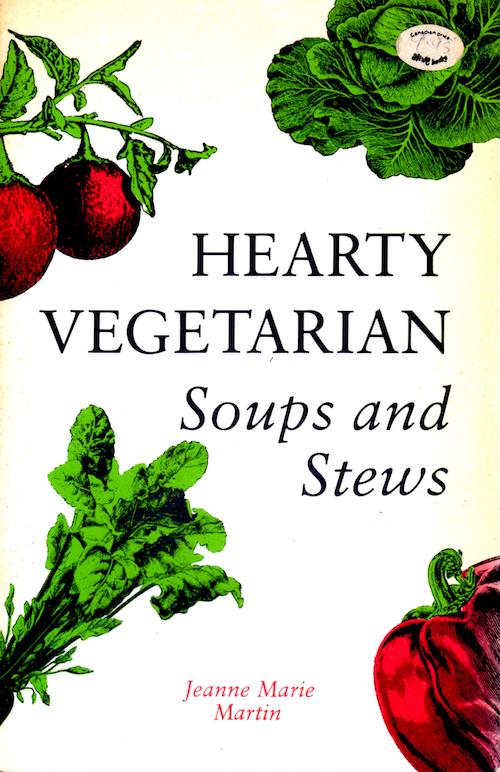
Jeanne Marie Martin
Hearty Vegetarian Soups and Stews (revised edition, 1991)

No doubt written before the advent of the popularity of Ayuervedic medicine in the West, this seems to trash how I like to make dal (unimaginable without turmeric) …

Spices: Are usually barks, roots, and strong seeds. Examples are: cinnamon, nutmeg, mustard, black and white pepper, turmeric, cardamon and coriander. Spices are avoided in most of these recipes as they are irritants to the body (especially the stomach) and deter healing. Small amounts are acceptable if used only occasionally.

Ironically followed by a detailed description of the benefits of cayenne pepper.

Pretty cover though

cover - Jeanne Marie Martin - hearty Vegetarian Soups and Stews

Do love a scrape of nutmeg in my potato soup which would be sacrilege to Ms. Martin.

And so for day 2319
19.04.2013

Posted in Food Writing | Leave a comment

Pulse and Poetry

I came across a list of ingredients with names in French. Black eyed peas was given as haricots oeil de perdrix which in back translation gives partridge eye beans.

Thanks to Dixon Long in Markets of Provence for the compilation.

Also known as the cowpea or pois des vaches.

And so for day 2318
18.04.2013

Posted in Food Writing, Transcriptions | Tagged | Leave a comment

Facile Dichotomies

Bret Stephens
How Plato Foresaw Facebook’s Folly
“Technology promises to make easy things that, by their intrinsic nature, have to be hard.”

Tweeting and trolling are easy. Mastering the arts of conversation and measured debate is hard. Texting is easy. Writing a proper letter is hard. Looking stuff up on Google is easy. Knowing what to search for in the first place is hard. Having a thousand friends on Facebook is easy. Maintaining six or seven close adult friendships over the space of many years is hard. Swiping right on Tinder is easy. Finding love — and staying in it — is hard.

I don’t think this fair. Nor do I trust the dichotomies that are marshalled here. To tweet well is an art of concision that takes practice. To text with any touch of brilliance requires a knack for combining words that will tickle attention — providing connectors for conversation. Searching is often a race against the algorithm pushing its own response which sacrifices precision — the art of searching depends on learning to bank on the aleatory. Friendship is often nourished by acquaintance — from those superficial encounters I sometimes bring back tidbits to share with those I have a deep and abiding relationship with — like the posting to a discussion list that led to my reading Stephens’s opinion piece and my own little rant here. And it has been easy (but not instantaneous).

And so for day 2317
17.04.2013

Posted in Dichotomies | Tagged | Leave a comment

Faites Vos Jeux

Thinking in and through a group…

Subject: Re: [Humanist] 32.177: releasing the hares

Willard

Interesting how the releasing hares question harbours another: to hunt or not to hunt. The question morphs into one of chasing.

You cast the problem as one about the maturity of the discipline:

Consider, for example, literary studies, mathematics, the creative arts, engineering and digital humanities. Would it be the case that the more mature (or conservative?) the area of questioning, the more directed to successful application, proof or result and the more vulnerable to fraud the less releasing hares willy-nilly would be regarded as wise?

Susan Ford casts it as the robustness of the community of practice:

When you start a hare you don’t know whether it’s catchable – but others on the list might. That is the point of the list (and the hare).

Would this discussion benefit from considering the distinction between “game” and “play”?

It just so happens that a fellow reader of Humanist, Dr. Herbert Wender, alerted me (in another context) to the reception of Umberto Eco’s forward to the 1973 Italian edition of Homo Ludens. He pointed out a passage from Léon Hanssen “Games of Late Modernity: Discussing Huizinga’s Legacy” in Halina Mielicka-Pawłowska (editor) Contemporary Homo Ludens:

Umberto Eco, another important critic of Huizinga’s thesis, elaborated his view in a forward to the 1973 Italian edition of Homo Ludens, a very intriguing text that, however, has not received any attention in the Huizinga literature for a long time. According to Eco, Huizinga was unable to distinguish between game and play, because the Dutch language has just one word for both: “een spel spelen,” whereas the English say “let’s play a game.” A game consists of a matrix of combinations and is constituted by a certain amount of rules. Basically, it offers the players a number of options to act, so the eventually one player can win the game. A play, on the other hand, is the role one plays to express the situation at a certain stage of the match. Huizinga showed interest only in the performance, as linguists say, and not in the competence, that is, the game as regulating system, in which a certain matrix of combinations is produced. According to Eco, the crux of the matter is the fact that for Huizinga the element of “play” remained, in the final analysis, an “aesthetic” category. From his aestheticizing perspective, Huizinga was unable to admit that the “decay,” the wars and the “crisis,” were, in fact, also moments of play in a played culture.

As members of a given community of practice, the sport of hare coursing may not be the (language) game we wish to play. As adherents to a discipline, the release may be the play we wish to make in a (Glass Bead) game.

And thanks to Humanist and its readers, one can allude to both Wittgenstein and Hesse in one paragraph. And digress down the rabbit hole and out the looking glass.


Francois Lachance
Scholar-at-large
http://www.chass.utoronto.ca/~lachance

Captivated by capture.

And so for day 2316
16.04.2013

Posted in Uncategorized | Leave a comment

La Durée vs La Drogue

The Psychopharmacology of Everyday Life
Jamieson Webster

I am indeed a Freudian psychoanalyst, that strange anachronism maligned by psychiatry for not being as scientific as medication supposedly is, by virtue of the control studies that can be done with drug treatments. Modern psychopharmacology goes hand in hand with a psychiatric diagnostic system that has, over time, been redefined to rely on medicating symptoms away rather than looking at the structure of the mind and its complex permutations in order to work with a patient in a deeply engaged way over the long haul. Modern psychiatry is hailed as a scientific success story, and drug companies have profited from the fact that talking therapies are often thought to take too long, their results frequently dismissed as unverifiable. I question, though, whether we should demand verified results when it comes to our mental life: Do you believe someone who promises you happiness in a pill?

Interrogating the discourse of efficiency by an appeal to time and to attention to complexity.

And so for day 2315
15.04.2013

Posted in Uncategorized | Leave a comment

Flagging

From Humanist

32.138 Fish’ing and the words in front of us
Re: 32.135 Fish’ing and the words in front of us

Willard

I know you as one to problematize “words”. I too want to set aside for the time being the question as to what is a word.

I want to dwell on the plural : “words before us”. Two plurals: one of the words; the other of the readers.

Not only are there words but also the relations between the words. And these relations between words would receive different weightings by different readers. I stress this for two reasons. One to underscore that the semiotic material (the words) is read through not only the syntax of one after the other but also through the web of relations. Two to underscore that readings are in flux as readerly attention fluctuates between various sets of relations.

Nothing yet of intention. Intention is merely the privileging of one set of possible relations. A result of weighting.

There have been responses that place the “us” before the “words” and call for supplementary material to explain textual matters. I love a good palindromic structure.

You will have noticed that I substituted “in front of” with “before” in a bid to introduce a temporal element. Time is ever at our back.

The interesting part here is the notion that intentions arise out of weighting possible relations. The other interesting part is a turn towards temporality. Points to the cumulative nature of reading.

And so for day 2314
14.04.2013

Posted in Reading | Tagged , | Leave a comment

What Is Remembered: The Long View

Lorna Finlayson

There is no sense in which my great-uncle, who died at the Somme along with hundreds of thousands of others, gave his life for my freedom. He was cannon fodder in a needless imperial war which created fertile conditions for the rise of totalitarian regimes that killed millions, and which millions more would lay down their lives to defeat.

An Exercise in Forgetting
London Review of Books

And so for day 2313
13.04.2013

Posted in Uncategorized | Tagged , , | Leave a comment

Men’s Bodies Explored By Men

The golden ending set in media res

Andrew McMillan physical “urination”

you wake to the sound of stream into bowl
and go to hug the naked body
stood with its back to you     and kiss the neck
and taste the whole of the night on there
and smell the morning’s pale yellow loss
and take the whole of him in your hand
and feel the water moving through him
and knowing that this is love     the prone flesh
what we expel from the body and what we let inside

prone flesh — “likely or liable to suffer from, do, or experience something unpleasant or regrettable” rather than “lying flat”

I am prone to like the version that ends as above; the truncation of some thoughts about breath causes a slight pang and yet is welcome     the mind pauses and it is the form that speaks

in the longer version the tautness is gone

I had forgotten that loving could feel so calming
telling you that your body was beautiful     sighing out
the brittle disappointments from the bones     having no judgement
of what the body may want to be doing     where the breath may fall

imagine all that freight of philosophy is carried by the one word “expel”     and cast is the spell     we know where the breath may fall     neck     kiss

French has the beautifully suggestive verb humer     long vowels     most appropriate to mark morning encounters

And so for day 2312
12.04.2013

Posted in Poetry | Leave a comment