Radius of Radiance

We set here as a prelude to a page from Ronald Johnson Radi Os (Berkeley: Sand Dollar, 1977) what are the concluding lines of T.S. Eliot’s “Little Gidding”, the last of the Four Quartets.

Not known, because not looked for
But heard, half-heard, in the stillness
Between two waves of the sea.
Quick now, here, now, always—
A condition of complete simplicity
(Costing not less than everything)
And all shall be well and
All manner of thing shall be well
When the tongues of flames are in-folded
Into the crowned knot of fire
And the fire and the rose are one.

I have always thought that the rose and fire become one in the rose window of a cathedral whatever architectural splendours lie at Little Gidding. Regardless of my adolescent imagination, the lines serve me well here for not only the conjunction of fire and rose but also for the half-heard in the stillness.

Radi Os is a poem produced by erasure of the 1892 (Crowell) edition of Milton’s Paradise Lost. Some gentle soul has nicely paginated the library copy and on page 31, in a tiny hand, refers the reader to the front page. A transcription does not do justice to the spatial dynamics produced by the erasure:

in the shape / as of / above the / rose / through / rose / rising / the radiant sun
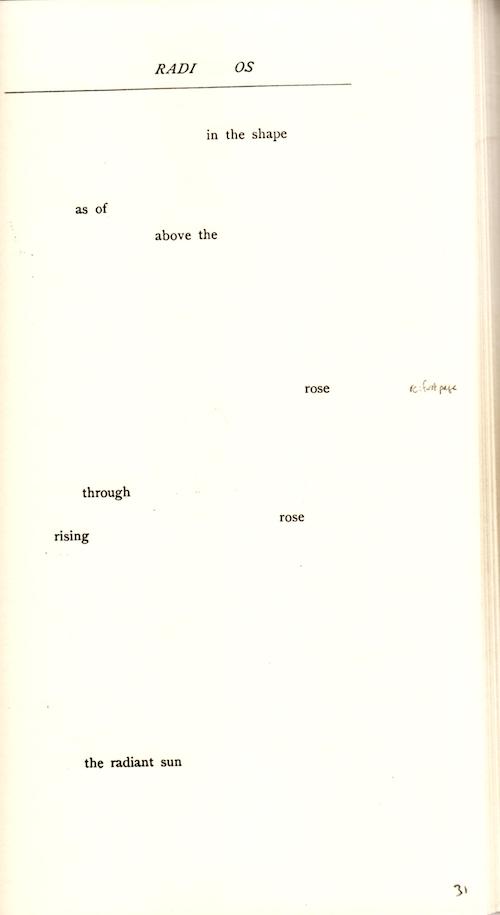
page from ronald Johnson - radi os - rose

And so to the front page: where “rose” is a verb: tree / into the World. / Man / the chosen / Rose out of Chaos: / song,
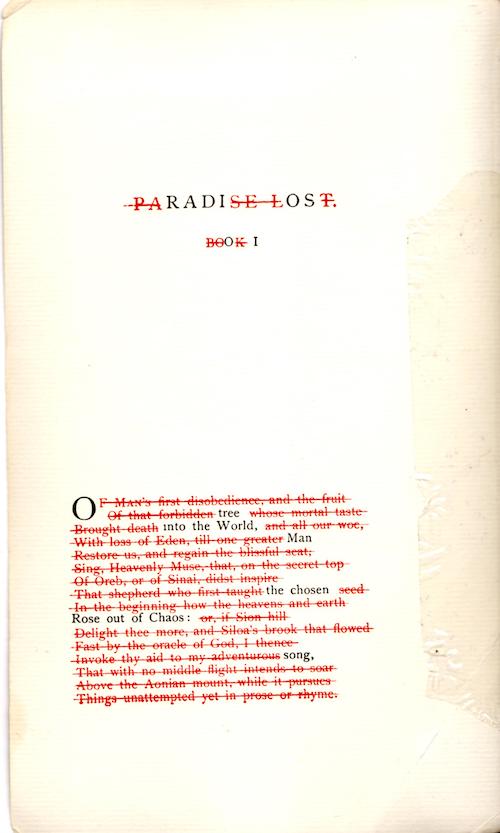
page from ronald Johnson - radi os - first page

The kind reader’s linking of the front to the rose page echoes some of the observations observed in Guy Davenport’s afterward

From book to book he has grown more responsive to light and pattern in nature; he believes that light evolved the eye to see itself […] These pages at first glance look haphazard (as a Cubist painting seemed to first viewers to be an accident). They are not. There is a page that has the word man at the top, flower in the middle, and star at the bottom. There are other words on the page, and they help us see the relationship between man, flower, and star. One order of word gives: man passed through fire / His temple right against The black. It is, for instance, electro-chemical energy in brain cells derived from photosynthetic sugars in vegetables whereby we can see a star at all, and the fire of the star we call the sun thus arranged that it could be seen and thought of by nourishing the brain. Is that system closed? Did the sun grow the tree the made the paper you are holding, and the ink on it, so that it can read this book through your eyes?

With a bit of rearranging the cycle fits the stream on screen.

And so for day 2241
31.01.2013
Posted in Poetry | Leave a comment

The Fullness of Words

Adrienne Rich
Sources
The Heyeck Press, Woodside, 1983

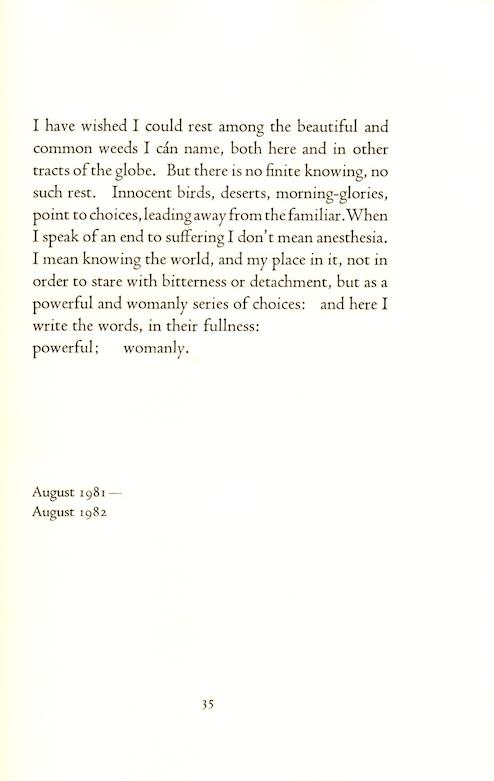
The poem ends with the expressed desire to rest “among the beautiful and common weeds” but recognizes there is no such rest.

A phrase has occurred at intervals throughout the sequence: an end to suffering. We are informed in a note as to its origins:

The phrase an end to suffering was evoked by a sentence in Nadine Gordimer’s Burger’s Daughter: “No one knows where the end of suffering will begin.”

We come back to Rich’s conclusion: “When I speak of an end to suffering I don’t mean anesthesia.” She turns to the specificity of place and identity, themes she has carried throughout.

When I speak of an end to suffering I don’t mean anesthesia. I mean knowing the world, and my place in it, not in order to stare with bitterness or detachment, but as a powerful and womanly series of choices:    and here I
write the words, in their fullness:
powerful;        womanly.

page from Adrienne Rich - Sources

A block of prose gives way to poetry. A line break falls on “I” and spacing between “powerful” and “womanly” return us to the typography of the preceding sections to conclude that the speaking self is powerful and mediated through the fullness of words.

Meditating on the spaces between words, I came back to Olsen’s 1950 observations in “Projective Verse” on breath (and spirit) and the place of the typewriter in the disposition of the words on the page.

What we have suffered from, is manuscript, press, the removal of verse from its producer and its reproducer, the voice, a removal by one, by two removes from its place of origin and its destination. For the breath has a double meaning which [L]atin had not yet lost.

The irony is, from the machine has come one gain not yet sufficiently observed or used, but which leads directly on toward projective verse and its consequences. It is the advantage of the typewriter that, due to its rigidity and its space precision, it can, for a poet, indicate exactly the breath, the pauses, the suspensions even of syllables, the juxtapositions even of parts of phrases, which he intends. For the first time he can, without the convention of rime and meter, record the listening he has done to his own speech and by that one act indicate how he would want any reader, silently or otherwise, to voice his work.

Time is what Rich chooses to mark. Dates we take to be the span of composition — a year. There is in these poetics no place without time. No words without a fullness of history.

And so for day 2240
30.01.2013

Posted in Poetry | Tagged | Leave a comment

Interstitial

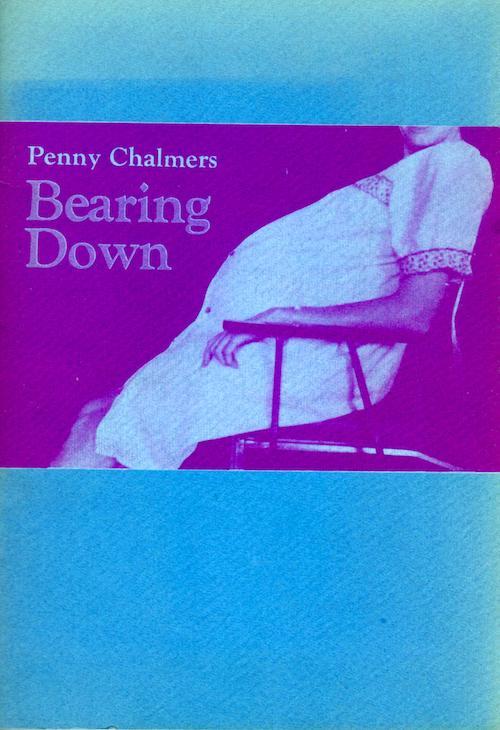
If there is any doubt about the technical term “bearing down” it would be dispelled by one look at the cover of Penny Chalmers (Penn Kemp) Bearing Down (Coach House Press, 1972).

cover -penny chalmers - bearing down

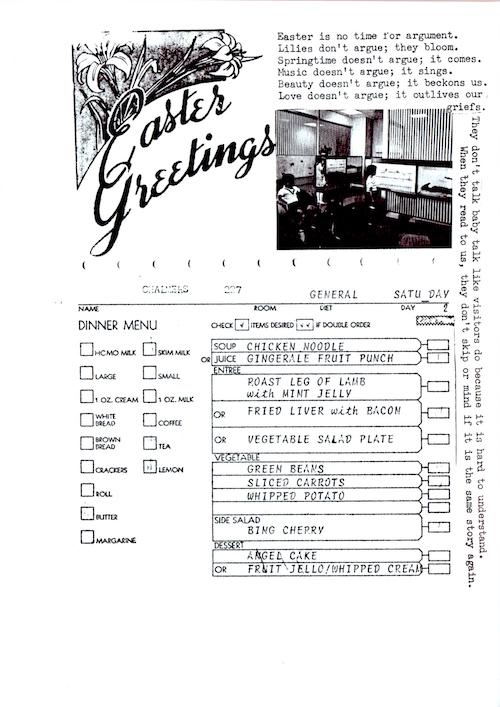
It is of course about the joys and tribulations of giving birth. But it is birthing in a particular space: the institution of the hospital. At the end of the book, there is a reproduction of a menu. It is obviously Easter time.

inside - penny chalmers - bearing down - hospital menu - easter greeting

In the upper right corner are some thoughts of the season (unattributed)

Easter is no time for argument.
Lilies don’t argue; they bloom.
Springtime doesn’t argue; it comes.
Music doesn’t argue; it sings.
Beauty doesn’t argue; it beckons and points.
Love doesn’t argue; it outlives our griefs.

Which thanks to the World Wide Web we can ascribe to Frederick B. Speakman, author of sermons, in fine fettle for presenting an argument (“Easter is no time for argument” is itself an argument).

Down the right margin in landscape orientation is the a comment (we are uncertain in whose voice) it appears elsewhere as attributed to Patsy Gray (Age 9) from a piece about grandmothers:

They don’t talk baby talk like visitors do because it is hard to understand.
When they read to us, they don’t skip or mind if it is the same story again.

There are are more reproductions of hospital literature from the chaplain this time in which are interpolated other bits of unattributed sentimental poetry. For example

Said the Robin to the Sparrow:
“I should really like to know
Why these anxious human beings
Rush about and worry so.[“]

[which we trace to Elizabeth Cheney]

Both the hospital literature and the interpolations are in Courier, the ubiquitous typewriter typeface. We are faced with the question: did the poet place these in the spaces or were they found there? The one clue, layout of the interpolations in a perpendicular position, doesn’t apply to all the space cramming instances. All do share a crowding effect. There is quoting going on. Who is doing it remains uncertain. I vouch for ironic insertions by the author given the wry wit exhibited in a number of the birth poems all the while bearing down.

And so for day 2239
29.01.2013

Posted in Poetry | Leave a comment

Expansive Minimalism

Ronald Johnson
Eyes & Objects (Catalogue for an Exhibition: 1970-72)
Jargon Society, 1976

The beginning from “The Inside-out Sphere”

I offer this sphere I found,
like water held
in a rind of light.

And an ending from the end of “Windwindow”

ascent descent and accident

Eye and ear are pleased and the mind set adrift.

And so for day 2238
28.01.2013

Posted in Poetry | Leave a comment

Joy is Not Happiness; It is Happy – A Matter of Luck

George Johnston in “Convocation Address: Queen’s University, 29/5/71” distinguishes between happiness and joy.

Love is very dear.
     Happiness,
unhappiness,
getting our own way
and so forth
cost the Earth.

But joy
     is free,
unasked-for, unexpected, undeserved
     as an honorary degree.
These are the last rhymes this morning
     from me.
And a joy it is to mark the occasion with such mirth.

George Johnston. Endeared by Dark: The Collected Poems.

And so for day 2237
27.01.2013

Posted in Poetry | Leave a comment

Liminal

At the end, on the last page of A Poem As Long As The Highway by Douglas Barbour there is a set of lines that mark the ongoing nature of the poem as an act of cognition (learning). Set off-centre close to the right margin, the lines look like a ribbon of highway, with plenty of room for passing that is if you drive on the right.

Learning is not
direct

in ratio to distance
travelled

we cannot learn
enough

               journey
too far.

On the road again always.

And so for day 2236
26.01.2013

Posted in Poetry | Tagged , | Leave a comment

In the Earth’s Shadow

Eclipse. Iris.

All night the blood moon measures the dilation
of your pupil, pinprick or dinner plate
in this plenum where our attention fails to die.

A stanza from one of the poems (there are many) entitled “Standard Time” in Liz Howard Infinite Citizen of the Shaking Tent. This one occurs on page 9.

And so for day 2235
25.01.2013

Posted in Poetry | Leave a comment

Leaf by Leaf by Colour

It could have been laid out as a pair with a caesura:

bronze by bronze, crimson by reft crimson

or stacked via line breaks:

bronze by bronze,
crimson by reft crimson

but instead we have a stress on “reft” resulting from a “cut” enjambement:

bronze by bronze, crimson by reft
crimson

“Swept Sky” in George Johnston’s Endeared by Dark: The Collected Poems.

And so for day 2234
24.01.2013

Posted in Poetry | Tagged | Leave a comment

Majestic Is Often Used

Words are insufficient: the mountains “remain to be described” And yet the poet establishes a sort of grandeur “in whatever mode”:

They wait to be described […]

geologist, surveyor, artist:
crowsfeet on a map, the heavy
colours cut and carved, numbers
and weight, percentages, all
methods to paraphrase
certain immensity.

They remain
to be seen:

Douglas Barbour A Poem As Long As The Highway

It’s the waiting and the remaining that get stressed as they hug the left margin.

And so for day 2233
23.01.2013

Posted in Poetry | Leave a comment

Granite and Glaciers

In memory one puts a period.

All we have in this country is landscape,
Granite shivering with light[.]

That is where memory stops.

But there is more (always more):

All we have in this country is landscape,
Granite shivering with light,
Winter sun, brightness that never
hints of the dark.
This place is inhabited by dreams,
The movement of glaciers.

Good to remember what exposed all that granite.

M.T. Kelly. “All We Have” Country You Can’t Walk In

And so for day 2232
22.01.2013

Posted in Poetry | Leave a comment