Erratics

“Odd Blocks” — it’s the opening poem to Kay Ryan’s The Best of It: New and Selected Poems.

[…]
glacier-scattered
thousand-ton
monuments to
randomness become
fixed points in
finding home.
[…]
And why not
also in the self,
the odd blocks,
all lost and left,
become first facts
toward which later
a little town
looks back?

Self and landscape — also applicable to the elements of the poem and the poems of the book. Embedded in the middle of “Odd Blocks” is the statement that marks both a beginning and an ending: “Order is always / starting over.” A set of lines that sticks out in its own way with a different lithology.

Erratic: An erratic is a boulder transported and deposited by a glacier having a lithology different than the bedrock upon which it is sitting. Erratics are useful indicators of patterns of former ice flow.

And so for day 2210
31.12.2012
Posted in Metaphor, Poetry | Leave a comment

Tools & Letters & Spaces

Nelson Ball has a poem “for and after bpNichol” in The Continuous Present (Coburg: Proper Tales Press, 2012). He notes that “The visual poems were written while I was editing the Coach House Books edition (2004) of bpNichol’s Konfessions Of An Elizabethan Fan Dancer“.

The poem is entitled “Basic Construction Materials” and consists of a single line (and twenty-six letters).

a bed e fgh i jklmn o pqrts u vwx y z

There are in Konfessions Of An Elizabethan Fan Dancer no punctuation marks. Just letters and spaces except for # sign in a few titles and one place where there is underscoring. Perfect homage.

And so for day 2209
30.12.2012

Posted in Booklore, Poetry | Leave a comment

Anatomy Meets Typography

I was examining the copy in the Thomas Fischer Rare Book Library from back to front and remember seeing this page in the BookThug 2012 edition of André Alexis essay My Vagina. It struck be as a colophon. And the layout of the name appeared like a headstone given the context.

André Alexis

I was born in Trinidad, in 1957. My mother’s name is Adrian Ena Borde. If, after my death, anyone should wish to reprint this essay, Would be grateful if the date of my death were added, so that my time from my mother’s womb to the “great cold” (that other womb) may be known.

Turns out this was no colophon but the conclusion of the essay for the previous page introduces the segment with the words “my name is”.

For readers accessing the essay via In the Flesh: Twenty Writers Explore the Body edited by Kathy Page and Lynne Van Luven there will be no such misapprehension; there is no such page break.

However, there is a palpable effect that is reproduced in both editions — thanks to the essay’s position in the In the Flesh collection (in almost the middle of the book). Alexis plants a footnote midway in his essay which derives some of its charm in how the book or pamphlet falls away in two equal halves. He writes, “This, the exact centre of my essay, seems as good a place as any to talk about the clitoris.” The effect is uncanny. The note flows on over the two facing pages.

And so for day 2208
29.12.2012

Posted in Booklore | Leave a comment

Bravura

There is a very swish “d” dancing on the title on the cover of The Rose Concordance (BookThug, 2009) by Angela Carr.

cover - angela carr - the rose concordance - dance

Here is my own little concordance of lines from The Rose Concordance:

[22] cartilage of the reader, the book’s completion is a softness
[14] existence is an aromatic crease
[14] credulous and rich secretions

small attentions to cartilage, to crease, to secretion, take on a full deployment in a poem exploring the sensation of slight syntactical turns and it happens to form a happy helix round a tour de force

still in the what happens middle of never
still in the what middle happens of never
still in the middle what happens of never
still in the middle what of happens never
still in the middle of what happens never

still in the middle of what never happens

in still the middle of what never happens
in the still middle of what never happens
in the still of middle what never happens
in the of still middle what never happens
in of the still middle what never happens
of in the still middle what never happens

“of the still middle” — of course never being still for the iris of eye or the rose of ear

And so for day 2207
28.12.2012

Posted in Poetry | Tagged | Leave a comment

Reading Round the Rosebud

Yvonne Blumer. Landscapes and Home: ghazals. (Lantzville, B.C.: Leaf Press, 2011)

From the ninth, this sher stands out. It stands in the middle of the ghazal.

The neighbour wants to kill deer that come down from the woods.
They nip sweet rosebuds. Going home, a truck flattens two racoons.

And like an unfolding bloom, I propose the two adjacent sher be read now:

This child stands, legs braced against the pain in her ears.
She screams at her mother. Screams at her father.

The neighbour wants to kill deer that come down from the woods.
They nip sweet rosebuds. Going home, a truck flattens two racoons.

Think: buy a gun; kill a man with five shots. The past followed me.
Animals who are destructive have no right to love.

And now the two outer sher are added to complete the ghazal.

Africa: a word in my mouth; buried place in my memories.
A dog has to be put down. A best friend dies at sixteen.

This child stands, legs braced against the pain in her ears.
She screams at her mother. Screams at her father.

The neighbour wants to kill deer that come down from the woods.
They nip sweet rosebuds. Going home, a truck flattens two racoons.

Think: buy a gun; kill a man with five shots. The past followed me.
Animals who are destructive have no right to love.

Walking toward a funeral procession, I begin to understand things.
My letters come back unopened.

This rippling reading is like memory work or so I imagine it and a good test of the thematic carriage of any given ghazal. Inspired no doubt from having read Ted Chiang’s “Story of Your Life” and its explorations of Semagraphic Thought.

And so for day 2206
27.12.2012

Posted in Poetry, Reading | Leave a comment

A Chuckle of LongLugged Books

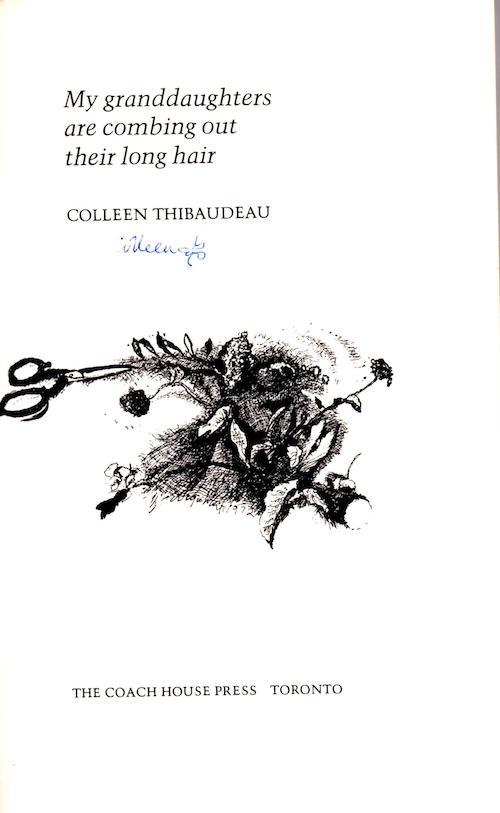
Colleen Thibaudeau. My granddaughters are combing out their long hair. “As if in code …”

It’s a poem about chucking out stuff. Jettisoning. There is a keeper — a line to keep in memory:

chuckle of longlugged books, carvings, embroidery,

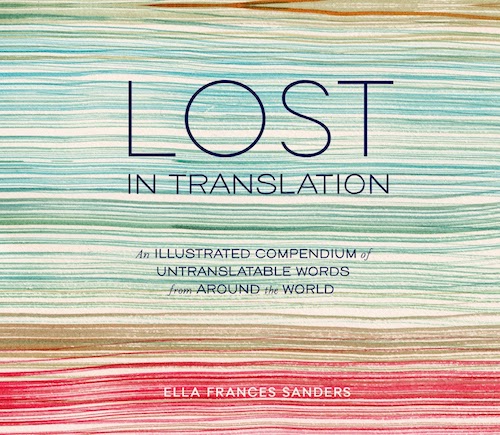
It is a line that brings to mind a Japanese word I encountered in Ella Frances Sanders’s book Lost in Translation

cover ella frances sanders - lost in translation

The word is Tsundoku. It’s a noun from the Japanese meaning “leaving a book unread after buying it, typically pile up together with other unread books.”

illustration - Tsundoku

And this book of poems by Colleen Thibaudau sat in a pile unread. But no longer so. I read and relished the image of a “chuckle of longlugged books”. And now I have sent both image and word back into the world. The book will find other hands and other piles in which to rest.

Lost in Translation is to be gifted to a friend fond of words and their textures.

half title page - colleen Thibaudeau (signed) my granddaughters are coming out their long hair

And so for day 2205
26.12.2012

Posted in Booklore, Poetry | Leave a comment

Enhancing Vocabulary

SUVENDIBLY

“The Brown Family” in My granddaughters are combing out their long hair by Colleen Thibaudeau (Coach House Press, 1977).

In the same manner as her Old man: For Mr. Brown’s heart was pure glossy gold
By tender handling, of all that’s drossy, slowly, suvendibly, rendered down.

Not in the Oxford English Dictionary. Found it in a listing of Trillick dialect.

suvendibly [adj.] – exceedingly (with malice)

and in the American Sentinel of December 13, 1894 (a parable of attempts to force dogs to act as sheep (and eat grass) which originally appeared in 1821 as an article against compulsory Sabbath observance)

they inveigled him or compelled him into the fold, then they surrounded him and “thumped him suvendibly” until the poor dog took a few mouthfuls of grass, which sat so badly upon his stomach, he soon served an ejectment upon it.

Back to Mrs. Brown. She declares “What I can touch and take up in these two hands is what I trust.” And the poet supplies a listing which leads to the concluding image of the repeated gesture: “All lovingly hers tangled. And all could be taken up, stroked, cajoled / In the same manner as her Old Man […]”. In the vicinity of “cajoled” and “stroked”, “suvendibly” takes on a miserly hue…

And so for day 2204
25.12.2012

Posted in Poetry | Leave a comment

A Visual Intertext

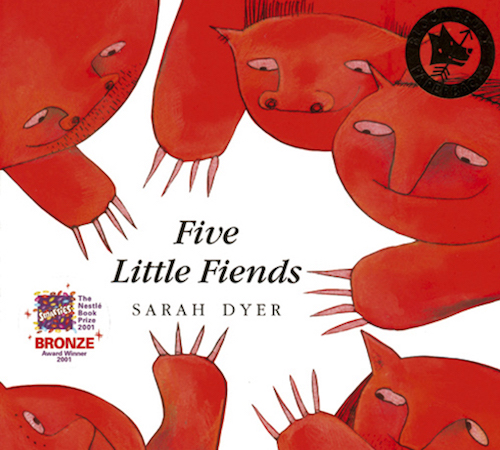
Sarah Dyer has lodged in Five Little Fiends a treasure for the discerning eye — almost as if in imitation of the fiends there is a hoarding of a favourite object.

cover - sarah dyer - five little fiends

The story line…

Everyday the five little fiends stand on a hillside and marvel at the world. Then one day they decide this isn’t enough. Each fiend wants to take it’s favourite thing home, to look at whenever it wants. One by one the moon, sun, sky, land and sea are claimed until nothing is left. But do they pick wisely?

Their homes (and hoarding places) are within sculptures which look like versions of the work of Barbara Hepworth.

sarah dyer - illustration from Five Little fiends - hepworth sculptures ?

The fiends find out they are happier without actually possessing what they treasure. So too Dyer’s intertextual gifts belong to free imaginations.

And so for day 2203
24.12.2012

Posted in Booklore | Tagged | Leave a comment

Two Different Allusions; Two Letterforms

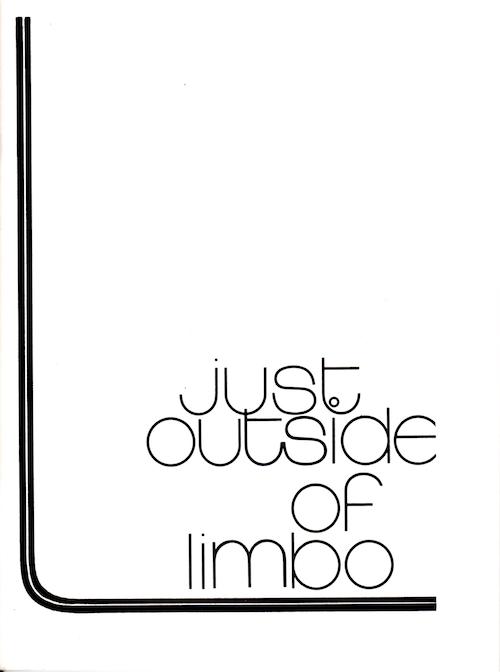
The design of the cover is striking. It’s by Jodi Ballet. There are two shapes for the “i”. One is with its dot the same height as the “l” in “limbo”. The other is capped by a round nestled just inside the crook of the “t” “just” above.

cover - just outside of limbo - anthology - design by jodi ballet

There is in this anthology a poem by Wayne Woodman called “dangerless” which has a beginning which alludes strangely to the character of Duncan, the haunter of laundromats and watcher of the machine ballet in Margaret Atwood’s The Edible Woman.

strange poets in laundromats
washing clothes
watching them tumble dry

And later in the poem an allusion to Desiderata by Max Ehrmann … like a lost sock.

going placidly
mind the noise and dirt;

There is other company in just outside of limbo Abbe Edelson, Eve-Lynn Grill, Lillian Necakov and Alan Resnick, editors. (1980). Milton Acorn, Maria Jacobs, Cary Fagan make appearances.

And so for day 2202
23.12.2012

Posted in Booklore, Poetry | Leave a comment

Symmetry: He Said, I Told Him

Section 5 of “The Fausto Poems”

On Thanksgiving I took him home
to my reservation and he wanted to ride horses.

I don’t know how to ride, I told him.

He said, I thought all Indians rode horses.

On Christmas, we watched ESPN surfing
and I asked him how well he rode the waves.

He said, I don’t know how to surf.

I thought all Hawaiians surfed, I told him.

from Sherman Alexie The Business of Fancydancing

I neither surf nor ride but I read poetry.

And so for day 2201
22.12.2012

Posted in Poetry | Tagged | Leave a comment