
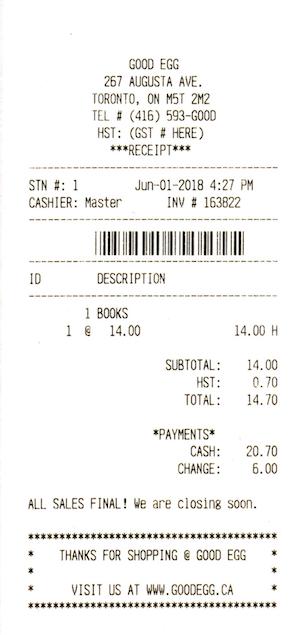
From the bookstore Good Egg in Kensington Market, a receipt that provides a little graphic oval. A nice touch.
And so for day 2200
21.12.2012
From the bookstore Good Egg in Kensington Market, a receipt that provides a little graphic oval. A nice touch.
And so for day 2200
21.12.2012
Gay Allison in “How to Gather Love” dedicated to Lorna Crozier concludes an extended description of the image of a woman espoused to country living with a contemplation of what could be (and what in other circumstances will be) …
She loves simplicity, the shape
of oval that fits neatly in her palm
an utter faith that could be crushed
in a minute and run yellow
down her arm.
from The Unravelling
Pat Bolger in Volume 16 Number 6 of CM: A Reviewing Journal of Canadian Materials for Young People comments on the cover
Allison writes that “change comes in the form of a woman / holding a raven with breasts. . .,” an idea embodied in Lynne Fernie‘s cover art, a line drawing of a nude with a decidedly odd-looking raven. [And wryly adds] The collection’s primary appeal will be to women, including those of senior high school age (although some of them would probably shy away from the cover).

And so for day 2199
20.12.2012
Found at the end of an article on the Vitruvius Program in Pamphlet Architecture 16 Architecture as a Translation of Music (Princeton Architecture Press) edited by Elizabeth Martin is this intriguing reference to Rosen, Michael, editor. “Ears, Eyes, Legs and Arms” [a story from Mali] in Oxfam Book of Children’s Stories: South and North, East and West (Massachusetts: Candlewick Press, 1992), pp. 50-52.
The reference is not explicitly connected to the article about students creating sculptural instruments. But if you look at the illustrations and read the story you see a theme: how unconnected parts come to work together. In the story from Mali the teller recounts how the separate parts of the body were counselled by a mosquito to visit a wise chief to settle how to distribute an antelope. The wise man inflicts judgement:
Then the chief spoke. “I listen to your story and decided that I would punish all of you for being so mean and selfish. First I punished you by eating all of the antelope without sharing any of it with you. Now I am going to punish you all once more by joining you together so that something like this never happens again.”
And he did
The parts of the body were furious with the chief for doing this, but they were even angrier with the mosquito for bringing them to see the chief. And that’s why whenever the ears hear the whine of a mosquito, the eyes search for it, and the arms try and slap it. If, as often happens, the mosquito still whines even after the arms have slapped and smacked all over the place, the legs join in the hunt.
The theme of assemblages resonates with the pictures and comments on the work of the workshop participants.
When I look through it I can see the other side of my instrument but when I blow, it echoed! Does that mean I’m hearing the other side?” (Elisabeth [Vitruvius program workshop participant])
John Cage would have been amused. Pamphlet Architecture 16 is dedicated in memoriam to Cage.
And so for day 2198
19.12.2012
I like how Shani Mootoo condenses history in a moment — here an exchange about not cutting down a tree which symbolizes nothing more than itself.
[…]
My father’s argument
is not for sound landscaping
but a simple plea for a useless treeOr is it something more
from the perennial opponent
of capital punishment?Remember that season, years back when it flowered,
and was magnificent?[…]
Now the damn thing stands,
none the wiser,
and surely won’t flower next year.
“Poui’s Hero” from The Predicament of Or.
And so for day 2197
18.12.2012
History dreams. Misplaced urges. Just as you think you can grasp a kernel the poem moves on in a kind of eddying reflective of the wanderings of thought and and its return to wander more. I quote at length the opening section of one set…
The Shape of Things
i
The idle days of autumn close. The planet moves itself
to a place where the thought of everything resides.This is a place where history lies on its back and dreams.
This is a place where nature has misplaced its urgeto compose itself. The leaves tremble with the shifting earth.
The cooling wind turns itself inside and out.We lie here beside the open window and wonder what
on earth can keep us from each other. Our sex is a shapethat finds itself taking the shape of the other. In coming
together there is no shape of things to keep in mind,as if we knew the difference between this way and that.
First comes the hot invention of love, and then the silky strokeof your bedclothes against me. There is the urgent need to make
sense of our inarticulate breath, our cold sweat, our absent fears.What makes shape around us is a reflection of words, an island
of knowing one silence, pressed up, hard, agains another.
Edward Carson. from Taking Shape.
I like the skillful enjambement. Everything seems suspended for a moment before rushing on: urge / to compose ; coming / together there ; island / of knowing.
And so for day 2196
17.12.2012
The dancing comes as a break from mystical lovemaking and encounters with a marvellous city: New York-Atlantis.
I arrive late for my African dance class at Pineapple
but the rhythm of the drums quickly seduces my feet
the obscure god takes possession of my body
I flutter my hands to heaven and earth
let my head roll
thrust out my chest and move my pelvis
the salt of my own sweat excites me
all this telluric energy tears down my anger
and I know I am savouring the pleasure of being
Yoland Villemaire. Quartz and Mica translated by Judith Cowan.
And so for day 2195
16.12.2012
Stan Persky. Lives of the French Symbolist Poets.
He is in a vast field of white flowers. His name is Cocteau. A white horse is grazing under a cottonwood tree. He is writing something on white paper. A message.
Cocteau gets ups & walks 17 paces to the East. In the middle of the field of white flowers he sees a porcelain shiny bathtub filled with blue water. The lovely white flowers are in the dirty boy’s hair. The dirty boy has brown eyes & is washing his gangly legs. He is of course as always naked.
[…]
There is a boy sitting on the white bed scooping out chunks of red watermelon. He is getting the bed wet with the juice of the melon. Cocteau comes over & plucks a watermelon seed from where it got lodged in the boy’s bellybutton.
One boy? Two boys?
And so for day 2194
15.12.2012
Stan Persky. Lives of the French Symbolist Poets.
Apollinaire is in a chair outside the dentist’s office. His teeth hurt. He is going to have a tooth pulled.
There are 4 chairs there. They are brown chairs. Apollinaire is waiting. Patient.
“God it hurts,” he says.
In the other 3 chairs is Gertrude Stein singing her last golden opera to the hysterically giggling multitudes; Montparnasse cafe nocturne, Hummingbird smelling the Real Thing. And Modig. There are hundreds of reporters using real questions.
Modig = Anglo Saxon for brave, courageous. Descendent: moody
And so for day 2193
14.12.2012
On the left White Rabbit Press (Stan Persky, Lives of French Symbolist Poets). On the right Gallimard (standard design as illustrated by André Breton, Nadja).

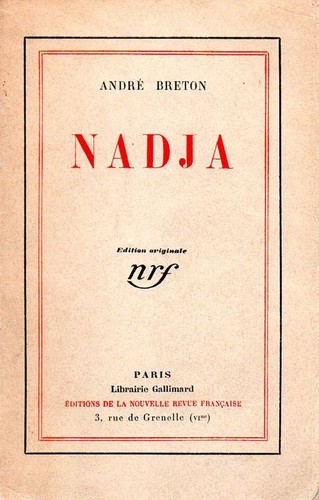
Fittingly signifying Frenchness.
And so for day 2192
13.12.2012
W.H. Auden’s essay on Loren Eiseley (The New Yorker, 1970) serves at the introduction to Eiseley’s collection The Star Thrower.
After celebrating the levelling influence of Carnival, Auden muses on the balanced life.
A satisfactory human life, individually or collectively, is possible only if proper respect is paid to all three worlds. Without Prayer and Work, the Carnival laughter turns ugly, the comic obscenities grubby and pornographic, the mock aggression into real hatred and cruelty. (The hippies, it appears to me, are trying to recover the sense of Carnival which is so conspicuously absent in this age, but so long as they reject Work they are unlikely to succeed.) Without Laughter and Work, Prayer turns Gnostic, cranky, Pharisaic, while those who try to live by Work alone, without Laughter or Prayer, turn into insane lovers of power, tyrants who would enslave Nature to their immediate desires — an attempt which can only end in utter catastrophe, shipwreck on the Isle of the Sirens.
Prayer was referenced earlier as going beyond begging.
[…] the habit of prayer, by which I mean the habit of listening. The petitionary aspect of prayer is its most trivial because it is involuntary. We cannot help asking that our wishes may be granted, though all too many of them are like wishing that two and two may make five, and cannot and should not be granted. But the serious part of prayer begins when we have got our begging over with and listen for the Voice of what I would call the Holy Spirit, though if others prefer to say the Voice of Oz or the Dreamer or Conscience, I shan’t quarrel, so long as they don’t call it the Voice of the Super-Ego, for that “entity” can only tell us what we know already, whereas the Voice I am talking about always says something new and unpredictable-an unexpected demand, obedience to which involves a change of self, however painful.
This attentive listening could be secularized as “attunement”. “Voice” as “other”. Always something new (or forgotten and then come to the fore).
And so for day 2191
12.12.2012