Small Argument with Small Arguments

There are two versions of “Water”

2001 – Still Life
2003 – Small Arguments

takes shape / uncertain of its own / in the palm, in glass / lifting to drain

and takes shape / uncertain of its own: // in the palm of a hand / a glass lifted to drain

I like the version better from the chapbook Still Life which was

Distributed in Canada by the author
Published without assistance
Typeset Book Antiqua, 6 point, photocopied

in the palm, glass

is succinct and evocative — an envious combo

the version in Small Arguments seems by contrast cluttered
the version in Still Life wavers on the theme of uncertainty and succeeds in conveying stillness in the midst of movement; an accomplishment

In 2002 “Water” by Souvankham Thammavongsa won the Lina Chartrand Award. One wonders in which version. (another*)

One would have to go look at the CV2 issues in the previous year [Writers are chosen for this award from women published in CV2 during the previous year]. There just may be another fluid version of “Water” out there.

in palm, in glass

*contemporary verse 2 winter 2003 pp. 65-66 “water”
takes shape / uncertain of its own: / in the palm of a hand, a glass / lifting to drain

And so for day 1462
14.12.2010
Posted in Booklore, Poetry | Leave a comment

Thermometer Metrics

It’s been animated by Kat Burns.
http://souvankham-thammavongsa.com/thermometer.html

What I miss in viewing the animation is the columnar display of the poem on the page.

Thermometer, A Diagram of

The human body
is marked

between
two points

The point
water boils

The point
water freezes

This
is where

it lives
and how

Somewhere
between two points

Who & Where: Souvankham Thammavongsa. Residual (2006, Greenboathouse Books, Victoria, B.C.)

What I admire in this poem is the restraint and the ghosting of “where”. See the two points. These stanzas omit the expected “where”: The point/ water freezes. Its omission here gives added strength to its appearance later: This / is where. It’s an effect trained by attentive staring at a thermometer and the meniscus of the mercury. And how.

And so for day 1461
13.12.2010

Posted in Poetry | Leave a comment

Genetic Litterbug

If you find yourself referring to babies as sperm sculptures, you might like section four (“The First-Born”) in James Merrill’s Peter where you can find a beautiful line about the subject of the poem who is no slouch in the paternity department. “Fact is, you’ve children everywhere.” The subject is not inclined to muster ongoing support for the products of procreation. “But figure you help them more in the long run / By not helping now.” The poet late in the poem exclaims “Genetic litterbug!” Apt turn of phrase for the man uninterested in curating his output.

And so for day 1460
12.12.2010

Posted in Poetry | Leave a comment

Cadence

Robert Creeley in conversation with Ekbert Faas (Towards a New American Poetics: Essays & Interviews) reminisces about Beckett — his voice and his way of speaking, selecting words while moving along with pauses etc.

He spoke in this very, not tentative way, but at times there’d be pauses, he’d begin to say something and then he’d sort of test it in his mind, then return to its continuance, say a little more, check it out, you see. He spoke, not haltingly as though he were impeded in some physical way, but constantly checking what he was saying so that I had no idea what time it was. I mean I realized finally it was six in the morning, so the thing I most specifically remember is that extraordinary creation of a word that should have no other cause but itself.

A passage in Thomas Meyer “Isis’ Memory” in The Umbrella of Aesculapius captures a similar pitch…

& the most astonishing fact on which poetry thrives is that every sentence (or projected unit of utterance) once begun CAN stop, not complete itself & begin again as a new sentence related or unrelated to its own initial impulse or sound. No where else in the cosmos is this aspect of will & magic so clearly & precisely manifest.

Intriguing to note that the option of carrying on depends totally on the ability to not carry on. Leave off.

And so for day 1459
11.12.2010

Posted in Uncategorized | Tagged | Leave a comment

Precision Proofing

Billy Bragg “Rotting on Remand” on Workers Playtime 1988

I said there is no justice
As they led me out of the door
And the judge said, “This isn’t a court of justice son
This a court of law.”

Interesting that the liner to the CD elides the “is” in “This a court of law” but it pops up again in the lyrics available all over the World Wide Web. The missing copula is indeed pronounced on the sound track. I kind of relish the magistrate swallowing a word. But it would spoil the beat. And that would not be doing justice to the song.

And so for day 1458
10.12.2010

Posted in Uncategorized | Tagged | Leave a comment

Feline Escapades

The Peripheral. William Gibson.

Voice being piped from within. A bone voice.

It made dragging your fingernails across a chalkboard seem like stroking a kitten.

A kitten with claws of course. And this test run of a cognitive bundle implant that produces art world jargon.

West’s oeuvre obliquely propels the viewer through an elaborately finite set of iterations, skeins of carnal memory manifesting an exquisite tenderness, but delimited by our mythologies of the real, of body. It isn’t about who we are now, but about who we would be, the other.

Designed to make you want to scratch — and fitting for describing an artist who gets tattoos and collects flayed epidermis to exhibit the narratives captured by those very tattoos. Quite the coup to produce the discursive inflections of a neoprimitivist curator with just the right dose of bafflement and believability.

I have been quoting these in reverse order from their appearance in the novel. All the better to sharpen a set of claws on this take on periodization and historical awareness.

Eras are conveniences, particularly for those who never experienced them. We carve history from totalities beyond our grasp. Bolt labels on the the result. Handles. Then speak of the handles as though they were things in themselves.

Of course the character listening to this states having no idea how anything could be otherwise. The kitten has grown into a Cheshire cat.

And so for day 1457
09.12.2010

Posted in Uncategorized | Leave a comment

Reader as Camera

George Steiner expresses with beautiful precision “At their finest, the criteria of orality and the cinematographic fuse perfectly” in his review of Christopher Logue’s War Music [Times Literary Supplement 15 February 2002]. The directions emerge from the action.

[Achilles has just made his speech about withdrawing his forces.]

Silence.

Reverse the shot.

Go close.

Hear Agamemnon […]

That first “silence” could be a description of the reaction to the speech of Achilles. It comes to assume the force of an injunction to be quiet on set as the directions unfold.

The deliciousness of the passage is underscored by the fact that what is being exchanged are shots albeit verbal.

And so for day 1456
08.12.2010

Posted in Poetry | Leave a comment

Go Little Book

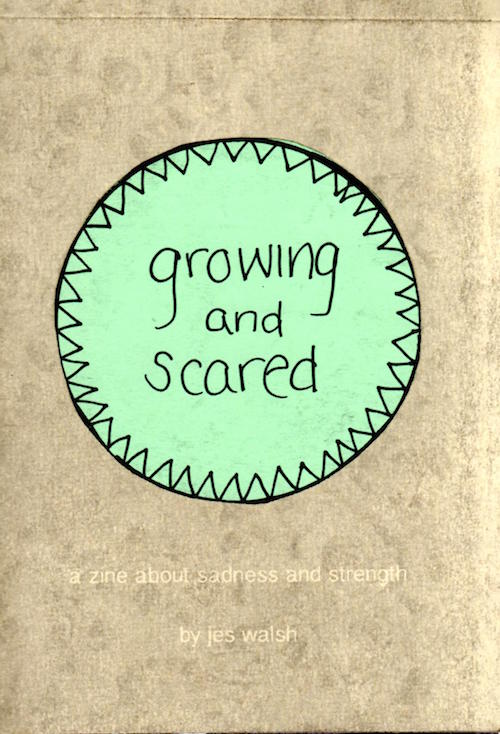
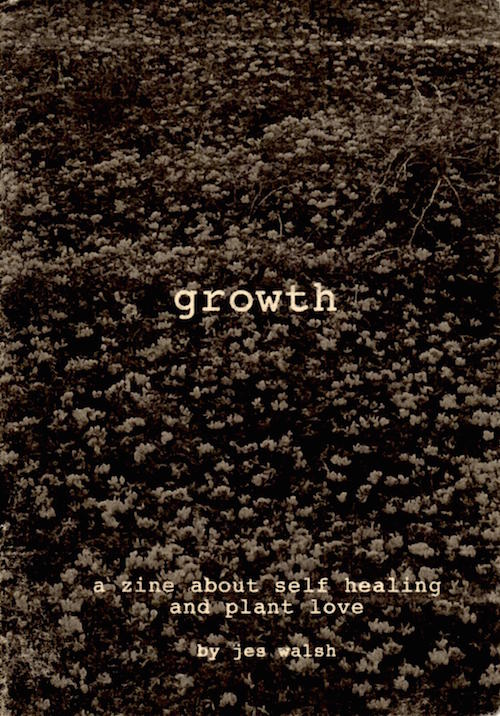
Zines are even more ephemeral than chapbooks. I wonder how this from Jes Walsh made its way from Berlin to Toronto. Jes used Etsy to get product out — this may be a route for how these small [approximated 4 inches by 5 1/2 inches ] creations to have reached our shores.

jes walsh zine - growth

jes walsh zine - growing and scared

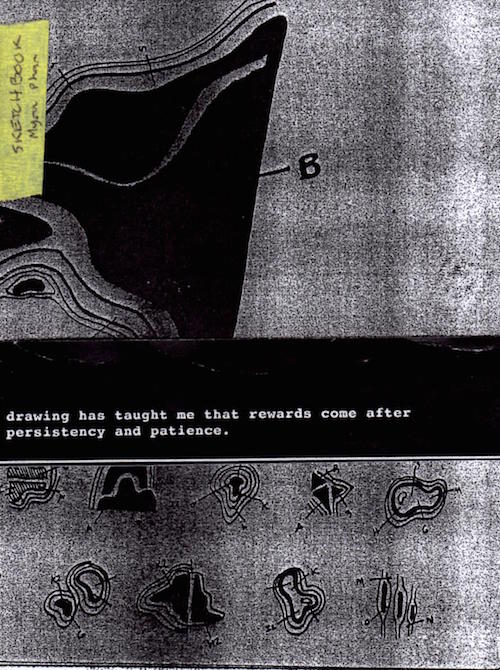
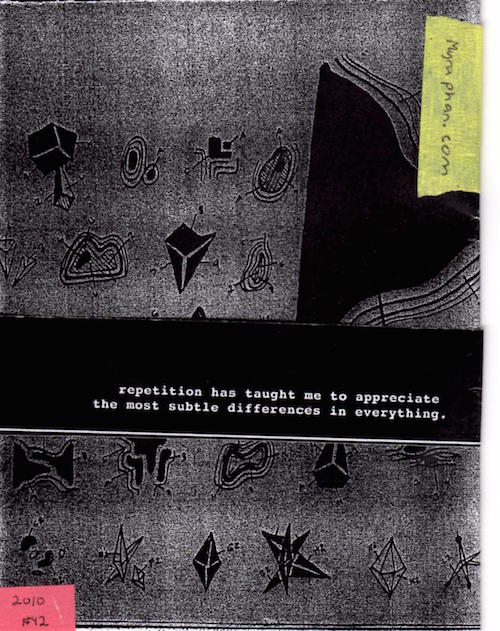
Myra Phan proves more illusive. Some online presence relating to OCAD. The URL artfully inscribed by hand on a small piece of tape on the cover her zine sketchbook is now defunct. The WayBackMachine at the Internet Archive records a posting captured Dec 11 (2008) presenting and promising “Another anatomically incorrect drawing: I’m going to make a series of them and bind them all together”. Myra’s zine comes with a strip of paper wrapping round the covers providing the only words to accompanying photoreproduced sketches inside.

ephemera - myra phan side 1

drawing has taught me that rewards come after
persistency and patience.

ephemera - myra phan side 2

repetition has taught me to appreciate
the most subtle differences in everything.

The fate of small books let loose into the world has inspired poets since at least Martial to apostrophize and wish them well. One of my favourites is Byron at the end of Canto 1 of Don Juan quoting Southey [and satirizing him by the way].

‘Go, little book, from this my solitude!
I cast thee on the waters—go thy ways!
And if, as I believe, thy vein be good,
The world will find thee after many days.’

Little books have a long history. See the online exhibition Go, Little Book: Portable Medieval Manuscripts from the Beinecke Library which nicely puts hands in the picture to give a sense of scale.

And so for day 1455
07.12.2010

Posted in Booklore, Ephemera | Leave a comment

Global Joke

Play on an expression figée nets an interesting double take.

GAME VS. REAL

There are typos
all over the word.

Jason Christie. Canada Post. (Snare Books, 2006)

And so for day 1454
06.12.2010

Posted in Poetry | Tagged | Leave a comment

Deictic Delights

It’s a typographic joy with all its whitespace and judicious mix of fonts.

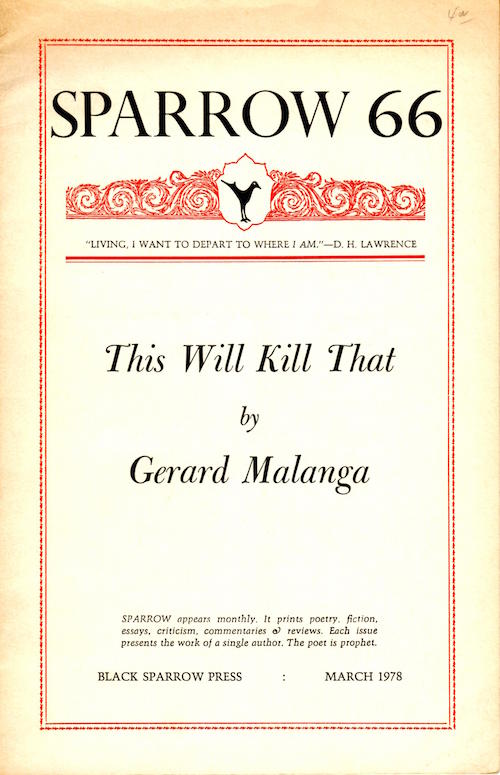
Sparrow 66
Black Sparrow Press, March 1978

Cover Sparrow 66 This Will Kill That by Gerard Malanga

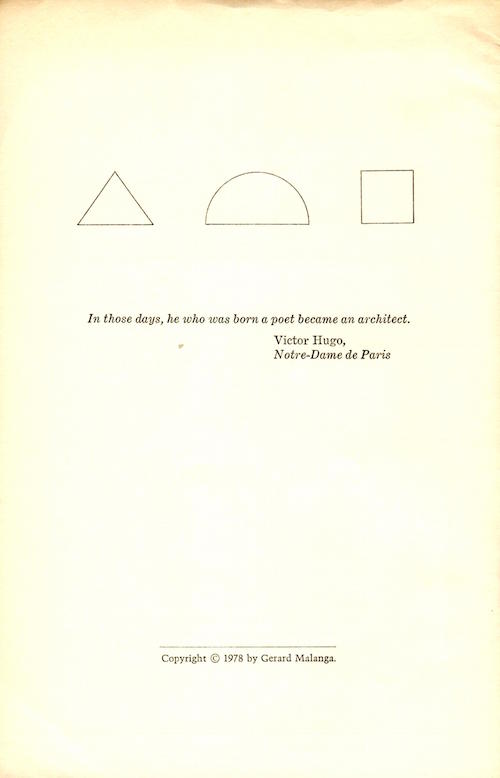
It features a poem by Gerard Malanga “This Will Kill That”. As with many paratextual matters, not sure if the frontispiece is meant to be part of the poem. It can certainly stand alone.

1978 Gerard Malanga - epigraphs to This Will Kill That

The triangle, semicircle and the square remind me of the three base shapes of kindergarten gifts. [See Inventing Kindergarten by Norman Brosterman: sphere, cylinder, cube].

The last page turns from architecture to mirrors. Floating on the page are two simple but forceful lines:

This will kill that.
You are that.

Challenging to evade the threat. Not however impossible. Casuistry to the rescue.

The “you” is part of the “that” if one takes as referent of “that” to be the two lines on the page. The day will arrive when this is indeed the case. And on that day “this” will die. Of course the dead this may be made more lethal by its dying.

And so for day 1453
05.12.2010

Posted in Poetry | Tagged , | Leave a comment