GMO Enviro

Next entry will be devoted to translation as trafficking

This is the next entry.

In her Translator’s Preface, Catherine Porter indicates that Avital Ronell had a hand in revising the English-language draft. She “frequently made small changes in the language.” I thought these were limited to her part in the interviews collected in Fighting Theory. Turns out that she also tampered with the rendering of the interventions by Anne Dufourmantelle.

It took me a long time to understand why such prohibitions were established, for genetically modified plants, for example. Beyond the fact that they are tampered with (but everything is tampered with, and this has been true for a very long time — in antiquity plants were already being tampered with), why does this cause such anxiety all of a sudden? I finally understood that, if transgenic corn is planted in ordinary soil, the harvest is twice as resistant, and it’s certain that no disease will attack it, but the seeds don’t reproduce themselves, and the next crop has to be started from newly purchased seed. The plant exhausts the soil and doesn’t reproduce itself. Something may be gained, but at what price? When one begins to think about it philosophically, it seems completely terrifying.

“Tampered” is a strange, somewhat mutant, rendering for “trafiquer” which means to trade in. Commerce is the target. Its short-sightedness particularly.

Il m’a fallu longtemps avant de comprendre pourquoi, par exemple pour les plantes transgéniques, de telles interdictions étaient posées. Outre le fait qu’elles soient trafiquées (mais on trafique tout et depuis très longtemps, depuis l’Antiquité on trafique les plantes), pourquoi tout à coup cela soulève une telle angoisse? J’ai fini par comprendre que, si on plante du maïs transgénique dans une terre normale, la récolte est deux fois plus résistante, on est sûr qu’aucune maladie ne l’attaquera, mais les graines ne se reproduisent pas, et on est obligé de tout replanter. La plante épuise le sol et ne se reproduit pas. Si on y gagne quelque chose, c’est à quel prix? Quand on se met à y penser philosophiquement, cela semble tout à fait effrayant.

“Effrayant” also means “dreadful” which in its etymology is indeed close to “terrifying” but also connotes an aesthetic reaction as in “extremely bad, unpleasant, or ugly”.

And so for day 1452
04.12.2010
Posted in Translations | Leave a comment

Moon Sun Owl Crowing

Avital Ronell first brought this Wordsworth poem to my attention in a conversation with Anne Dufourmantelle (see Fighting Theory].

[T]his corrosive “thing” that was not legible before and then abruptly emerges or is provoked out of its hiding place. Wordsworth’s texts on idiocy are a perfect example. In his time, these were marginal texts that distressed his friend Coleridge, the eminent drug addict. The later, the great philosophical erectus, tried to convince Wordsworth not to write such indigestible texts; he said that such writing was pure regression, and he was sincerely horrified by poems like “Idiot Boy,” the one of which Wordsworth was fondest and which those around him found altogether disgraceful. […] However, one day, something in them is going to become readable, for all sorts of reasons and historical availabilities. And Wordsworth for his part adored his own poem on idiocy, though we don’t know why. He could never let it go; he never regretted having written it. Worse still, he chose to publish it.

The Idiot Boy ends with in the voice of boy himself relating what he heard and saw after spending the night outdoors amid owls and moonlight. The addressee is the boy’s mother.

(His very words I give to you,)
“The cocks did crow to-whoo, to-whoo,
And the sun did shine so cold!”
— Thus answered Johnny in his glory,
And that was all his travel’s story.

Inversion. At play. Nocturnal transmissions. Daylight images. What’s the potential for corrosion? Finding poetry?

And so for day 1451
03.12.2010

Posted in Poetry | Leave a comment

Auden on Audacity

From one experience, an astute set of observations on college life.

AJA: I didn’t know that you had taught a Bennington

WHA: Yes, for one term, while someone else was away on a Guggenheim fellowship. Bennington is positively a brothel, you know. Around eleven o’clock one night I heard a knock on my door. A girl came in and simply refused to leave — insisted on staying the night. Oh, they’re nice girls, all right. But they talk. The next morning they rush to the telephone and tell everyone all about their night. It used to be that people were more reluctant to tell than to do. Now it’s the other way round.

At this point I rose to take leave.

From The Table Talk of W.H. Auden by Alan Ansen.

And so for day 1450
02.12.2010

Posted in Uncategorized | Leave a comment

after life traces

Four Ages of Man: The Classical Myths by Jay Macpherson is a tour through Greek and Roman mythology for high school students. The last chapter is devoted to “The Passing and Afterlife of the Gods” and ends thus — almost as an invitation to study nursery rhymes.

The Pied Piper who can draw rats by his piping is ony one of many magical musicians whose gifts recall those of Orpheus. Psyche’s task of sorting a heap of seeds occurs in many familiar stories, and she herself and her mysterious lover meet us again in the tale of Beauty and the Beast. And where was it that we first met Endymion, the sleeping shepherd?
Little boy blue, come blow your horn,

The sheep’s in the meadow, the cow’s in the corn.
Where is the boy who looks after the sheep?
He’s under the haystack, fast asleep.
Will you wake him? No, not I;
For if I do, he’s sure to cry.

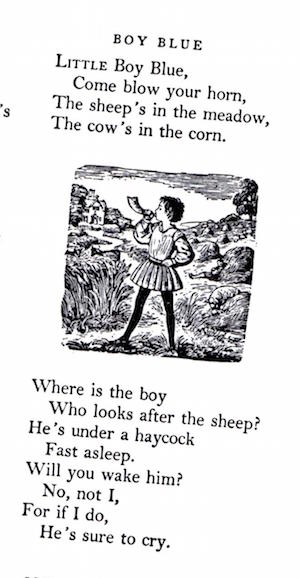
The disposition of the lines is a bit different in the example collected by Iona and Peter Opie in The Oxford Nursery Rhyme Book illustrated by Joan Hassall.

boy blue nursery rhyme

With a magnifying glass one can make our the cow on the right in the corn (grain) and on the left foreground the sheep and behind on the left the little boy asleep near a haystack.

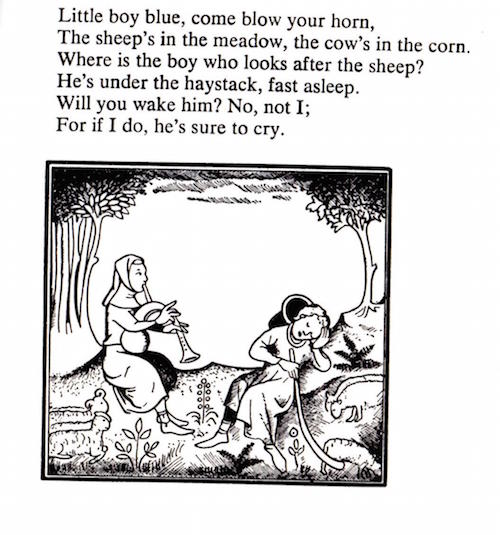
Jay Macpherson chose an illustration that proves her point about longevity and transmutation of stories.

jay macpherson - sleeping shepherd

In her notes she explains: “The sleeping shepherd (illustration): this is actually a French mediaeval illustration to the tale of Hermes and Argus. Both are dressed as peasants, and Hermes plays, instead of the classical shepherd’s pipe, a simple form of bagpipe.” These two different visual treatments of the same poem remind me of emblem books where there is also much borrowing and lasting life.

And so for day 1449
01.12.2010

Posted in Poetry | Leave a comment

Word and Ding

Avital Ronell intro to Verso edition of Valerie Solanas SCUM Manifesto.

Valerie Solanas, who took no prisoners, took pleasure in the injurious effects of language and, with Lacanian precision, understood that words are bodies that can be hurled at the other, they can land in the psyche or explode in the soma.

Later

Before one becomes overly confident about arresting her outrageous development in terms of psychotic aberration, it is important to note that psychosis speaks, that it often catches fire from a spark in the real, it is fuelled and fanned and remains unsettling because, as wounded utterance, it is not merely or solely demented.

Ronell points out the Solanas was taking aim at women too — as collaborators. This is a point she also expresses in an interview with Anne Dufourmantelle [in American philo]. It serves as a bridge to talking about Catharine MacKinnon.

Elle est très radicale, parfois un peu comme Valerie Solanas, mais plus universitaire et même raffinée — elle pourrait donner l’impression d’être puritaine, mais elle ne l’est pas. […] Elle a mené dernièrement une étude sur la peur du viol dans la guerre, où elle dit que, bien qu’on ne puisse pas nier que les femmes soient violées pendant la guerre, on ne dit jamais, en revanche, à quel point les hommes se violent entre eux.

In Fighting Theory where the interviews are translated by Catherine Porter, there is a bit more offered to contemplate. Porter notes in her translator’s preface: “As Avital Ronell read through my final English-language draft, she occasionally added material to clarify or extend an argument, once in a while deleted passages she had come to deem superfluous, and frequently made small adjustments in the language.” And this collaboration nets the following result:

She is gripping, sometimes in terms of insight even a bit like Valerie Solanas, but more academic and even refined — she could come across as a puritan, but that’s not what she is. […] Recently, she carried out a study on the fear of rape in war. In it she says that, even thought it is undeniable that women are raped during wars, in contrast no one ever mentions the extent to which men rape one another, performing rituals of mutual or hierarchized debasement that remain hidden from discourse of view.

In light of the revelations about Abu Ghraib, the keyword here is “extent”.

And so for day 1448
30.11.2010

Posted in Translations | Leave a comment

To V.W.

It comes to me in the form of a pamphlet put out by The National Trust in 1972 with a lovely frontispiece photograph of the author by Cecil Beaton. In it she holds a garden implement and a cigarette holder with a German shepherd looking on. The photograph is dated 1958 and was given to the National Portrait Gallery by Sir Cecil himself in 1969.

She is of course Vita Sackville-West. And the pamphlet in question reproduces a poem first published by the Hogarth Press in 1931. The poem is called “Sissinghurst” and is dedicated to Virginia Woolf.

It opens

A tired swimmer in the waves of time
I throw my hands up: let the surface close:
Sink down through centuries to another clime,
And buried find the castle and the rose.
Time travel by near drowning.

And so for day 1447
29.11.2010

Posted in Uncategorized | Leave a comment

Theory of Punctuation

Laurie Anderson. Homeland “Another Day in America”

And by the way here’s my theory of punctuation. Instead of a period at the end of each sentence there should be a tiny clock that shows you how long it took you to write that sentence.

Notice the subtle pronoun shift from a speaking I to an addressed you. And the responsibility of the sentence creation is off-loaded to the reader. Read/write become synonymous.

And we can bring to the fore the Irish influence. Refer to Pause and Effect: Punctuation in the West by M.B. Parkes [see page 23]. The Irish in adopting Christianity pursued a vigorous study of the Latin language. They tended to regard Latin as primarily a written or “visible” language. And introduced innovations in the display of texts.

These graphic conventions were derived from the processes by which the Irish had acquired their knowledge of the Latin language. They relied heavily on the works of ancient grammarians, which were based upon the perception of the word as an isolable linguistic phenomenon, and employed morphological criteria to establish a set of word-classes (which the grammarians called ‘parts of speech’). When Irish scribes copied Latin texts they soon abandoned the script continua which they had found in their exemplars. Instead they adopted as the basis for their scribal practices the morphological criteria which they had encountered in the analysis of the grammarians: they set out the parts of speech by introducing spaces between words.

Someneattrick!

And so for day 1446
28.11.2010

Posted in Booklore | Leave a comment

bad boys cont’d

In the nineties while the sex wars were raging, those of us on the pro-sex side tried our hand at writing erotica.

a hand reached for the frayed crotch. it was a gnarled hand. rough. it met soft denim faded and weakened so often had hands and faces rubbed there. it was an experienced hand. forefingers slid down behind the buttons of the fly and using the powerful square thumb as a guide parted the cloth brushed knuckles against the curls. no underwear. cock still trapped in the jeans. heat rising. the hand was steady sure and in no hurry to tackle the belt buckle.

yanking gently but firmly his pubes twisting and coiling them round his fingers he moved to ensnare more. his eyes rose to meet the fluttering eyelids and the lips slightly tensed of the man he held entwined. the tugging stopped. the eyes opened more fully. a recognition and a beckoning.

This reads like Andy Warhol (Blow Job) meets Samuel R. Delany (Neveryóna, or: The Tale of Signs and Cities). But that might be wishful thinking given that I have crossed a 1964 film with a 1983 novel around the kernel an email timestamped Sat, 12 Mar 1994. As the title of this blog entry reproduces the subject line of the email, there may be more, but this is all the archive yields. cont’d elsewhere. teasing like Warhol and like Delany, detourné.

And so for day 1445
27.11.2010

Posted in Uncategorized | Leave a comment

Shrapnel

An Exploded Sestina
Myrmurs
by
Shannon Maguire

Post-plague reading, reassembling the Myrmidons — a selection of ant troops/tropes

winter is a virus that July hosts in her blue moon software

jostling syllables not like not at all like collagelision

each word
is an individual fruit
with her own seed

the best tasting
are grown wild

For “fruit” I almost read “form”. And so is effected a “collage & elision” as I almost read “jousting” for “jostling”. Almost. At most.

And so for day 1444
26.11.2010

Posted in Metaphor, Poetry | Leave a comment

Law

Robert Duncan in an interview with Ekbert Faas (Towards A new American Poetics: Essays and Interviews) is talking about his teaching at Black Mountain College and relates this little tale In response to the question “What do you mean by law?”

Well, that was exactly the question they were to address. And that poem, The Law I Love Is Major Mover, came because Jon [sic] [Joe] Dunn, who had that project felt that the law was just the law, you know, cops and robbers. I remember one day going into the library at the school there and he was pouring [sic] [poring] over everything trying to get it into his head. And nothing could have been more garbled than the account he finally gave. And when he finished I said to him: Well, Joe, when you write a sentence beginning with the word “the,” aren’t you already under the law of “the”? No matter what you do from here on, you are under its law. And I think that’s part of what a law is. In other words, lawful action to me is total responsibility to what is present. So I began to realize that at the time.

In the poem referenced above, Duncan writes: “Responsibility is to keep / the ability to respond.” ** It’s Joe Dunn. According to memoir by Martha King in Jacket Magazine “Three Months in 1955: A Memoir of Black Mountain College” which reproduces a class list, on which appear the names “Joe Dunn — with wife Caroline” which I understand is spelt “Carolyn“.

And so for day 1443
25.11.2010

Posted in Poetry | Leave a comment