Kiwi Attitudes

On engagement:

“typically at the core of the their motivation is a wish for their ideas to prevail”

State Services Commission. The Policy Advice Initiative: Opportunities for Management. (Wellington, New Zealand, 1993; rpt. 1995). page 41.

On detachment:

“analysts need to internalize the value of mobilising knowledge held by many, and that displaying advice to robust scrutiny is a good practice.”

State Services Commission. The Policy Advice Initiative: Opportunities for Management. (Wellington, New Zealand, 1993; rpt. 1995). page 45.

http://www.ssc.govt.nz/policy-advice-initiative

And so for day 1432
14.11.2010

Posted in Uncategorized | Leave a comment

Realms of the Real

Kant. Foundations of the Metaphysics of Morals. Translated by Lewis White Beck. P. 55, n. 17.

Teleology considers nature as a realm of ends; morals regards a possible realm of ends as realm of nature. In the former the realm of ends is a theoretical idea for the explanation of what actually is. In the latter it is a practical idea for bringing about that which is not actually real but which can become real through our conduct and which is in accordance with this idea.

Somehow this mapping of a realm of ends from the actual to the possible may be a way of broaching the appearance of the “force” entity in the possible world semantics of fiction as explained by Doležel (See Heterocosmica: Fiction and Possible Worlds). Needs some thought but there is something here to consider about a relation between actual and fictional: the real.

Doležel places discussion of these felicity conditions and performatives under the heading “World Construction as Performative Force”. World construction is inflected towards questions of authority and authentification.

It is the characterization of a process, world construction, in terms of force that attracts my attention. I am intrigued by this aspect of the model. And I recall earlier in the monograph, a certain tension between the chronological and the logical is played out in the presentation of force as entity and its appearance in the catalogue of entities in the construction of a world. In a “starter terms” section, Doležel introduces first a world of states “where nothing changes, nothing happens”. Then appears the nature force as a new entity and the result is that “[w]e have now constructed a dynamic world, where changes orginate in one, inanimate source.” Finally, “[i]n the third stage, the world is augmented by a new category, the person”. (Doležel 32)

Possible Intersections – Poeticity, Theatricality, Narrativity

Would it be possible to mediate the move from “force” to “person” via Kant?

And so for day 1431
13.11.2010

Posted in Uncategorized | Leave a comment

Eventualities

word route or math path

lotto = taxed dreams
biodestiny = you die

And so for day 1430
12.11.2010

Posted in Uncategorized | Tagged | Leave a comment

Abstractable Time Lines

Seymour Chatman. “What Can We Learn from Contextual Narratology?” Poetics Today 11:2. p. 312

[Chatman is arguing against an undermining the discourse-story distinction.]

All that narratology argues is the difference between the act of telling (or showing) and the object told, and between their different temporal orders. All that it presumes is that these time-orders are abstractable for discussion.

This distinction, for me, can be considered as one of the theory-building primitives (as in not developed or derived from anything else) of systems of interpretation. I tend to think that such a split is not merely a feature of story telling but also a metadiscursive dimension of language applicable to other contexts:

As demonstrated by Émile Benveniste in his essay “Sémiologie de la langue”, the sign system of verbal language possesses not only a communicative function, it exists also in a relation of interprétance to other semiotic systems. He links the metalinguistic element of verbal language to its ability to form interpretative relations between semiotic systems.

Whatever is presented is open to interpretation: analysable.

And so for day 1429
11.11.2010

Posted in Uncategorized | Leave a comment

Cinema Capturing Chance: Constructing the Event

From the 1995 English Institute Conference, Language Machines (1997) Editors Jeffrey Masten, Peter Stallybrass & Nancy J. Vickers, in which appears Mary Ann Doane, “Screening Time”, from page 147 of which I quote

What comes to be known eventually as “deceptive” in the reenactment is made harmless as “illusion” in the narrative film. Clearly, the progressive domination of the industry by narrative is overdetermined (culturally, economically, technologically), but from this point of view, narrative would constitute a certain taming or securing of the instability of the cinematic image. In the same way, narrative becomes the model for the apprehension of the legal unity of film.

The role of “narrative” in taming (I almost wrote “training” in transcribing the passage) is set up by the thematic of event earlier in the piece. See p. 141

The confusion of construction and contingency around the concept of the event is crucial in the historical elaboration of a cinematic syntax. At the turn of the century, contingency is both lure and threat, and this double valence is played out in the rapid representational transformation of the cinema. The embarrassment of contingency is that it is everywhere and that it everywhere poses the threat of an evacuation of meaning. The concept of the event provides a limit — not everything is equally filmable — and reinvests the contingent with significance — The contingent is in effect, tamed.

Story. Shot. Cut.

And so for day 1428
10.11.2010

Posted in Uncategorized | Tagged | Leave a comment

Twinnings

From Coach House Press. Both from 1988. Cover designs by Gordon Robertson.

cover to Robin Blaser Pell Mell cover to d.j. jones Balthazar and other poems
from p. 76 from p. 62
someone stopped suddenly    someone dreamed

you’re somewhere less than perfect
but reading the story

the white boletus
grows like a cherub, scented
with defunct cedar
from the back cover: from the back cover:
These poems follow a principle of randonnée ‐ the random and the given of the hunt, the game, the tour. the lyric impulse, suspends

the machine of the real
to feed on the possible

Robin Blaser D.G. Jones

And so for day 1427
09.11.2010

Posted in Uncategorized | Leave a comment

Armenian as Lingua Franca

Mary Catherine Bateson
With a Daughter’s Eye: a memoir of Margaret Mead and Gregory Bateson
New York: William Morrow & Company, 1984
pp. 85-86

She worked for years to improve international and cross-cultural communication, so at one time she was interested in the adoption of a world language and organized a conference on the question. At that time, it was becoming increasingly clear that two or three languages would emerge as the principal vehicles of cross-cultural communication, on the United Nations model. She worried that whether we relied on one or several major world languages, this would still enforce a line between those who were using their own native language and those who were trying to follow and express themselves in a second language learned in school, a continuation of colonialism. Instead, she argued, one of the world’s minor languages, not associated with any great power, should be taken as a common world second language. In this way, all the effort of translation could be channeled in a single direction and the task of language learning distributed equally, while the other languages of the world would continue to be treasured as carriers of cultural diversity instead of being swamped.

When she produced this theory, my husband and I suggested that Armenian would make a good candidate because there are reservoirs of cosmopolitan and multilingual Armenian speakers all over the world and in both Eastern and Western camps. Afterward she referred to the idea in several speeches, along with other possible candidates. This made her a great favourite of the Armenian community who did not realize how their language would be changed in such a process and what it would mean for Armenian culture if the language ceased to be a private refuge.

In any case, the key element in her thinking was the notion that a real natural language would have to be used — not Esperanto, not Interlingua, not some computer construct — for only a real human language has the redundancy necessary for human communication. Artificial languages are designed by taking a set of abstract principles, observed universals or logically necessary components, and then using these as the basis for an efficient, consistent, and unambiguous system. In general, the task has been done badly, with the logic flawed and the characteristics of particular languages or language families treated as if they were logically necessary. The mistake is in the enterprise itself, however, as if human communication could be served by a system with no puns, no ambiguities, no lullabies, as if a human pattern could be constructed from first principles. In New Guinea she had observed the use of Pidgin English, now properly called Neo-Melanesian, which serves as a vehicle of communication among many different peoples who learn it as a second language, as Swahili does in Africa. She was more sympathetic to Pidgin than to artificial languages for it does provide an effective common ground, but it carries far to many of the marks of servitude and lacks the historical resources for nuanced communication.

Only a real human language has the redundancy necessary for human communication – puns, lullabies and historical resources – and variations on refuge.

And so for day 1426
08.11.2010

Posted in Uncategorized | Leave a comment

Dream Source, Dream Process

From Richard Howard, “Oracles” in No Traveller.

       but who knows how such décor,
queer as it is, affects us? Between
       ”it came to me in a dream”
and “I dreamed” lie ages of the world,
       but which is truer: spirits-
who-send-dreams or an-ego-that-dreams?
       We are not awake because
we have done away with the dream but
       only when we have swallowed
the dream once more, and digested it. . . .

interesting oneiric take on interior design

And so for day 1425
07.11.2010

Posted in Poetry | Leave a comment

Writing Face Painting

Malinda Lo. Ash.

There’s a scene where daughter and mother are preparing for festivities. It involves costuming and the application of make-up. And of course questions.

“But how will I know if I see a fairy?” Ash asked again. “If they look like ordinary people, I won’t be able to tell.”

“You’ll be able to tell,” her mother told her, “because wherever they touch, they’ll leave a bit of gold dust behind.” She put down the brush and turned her daughter to face the mirror. “Now look — there’s the prettiest fairy I’ve ever seen.” Ash stared at herself, spellbound. Her eyes had been outlined in silver paint, and the color trailed down her cheeks in wondrous curls of gleaming light.

“It is like magic,” Ash whispered.

Her mother smiled at her, her hand touching her hair. “Yes, my love, it is.”

Perfect mise-en-abyme. For here we have a flashback that could very well be a commentary on the art of storytelling itself.

And so for day 1424
06.11.2010

Posted in Metaphor, Storytelling | Leave a comment

Cardio Amplification

Helen Guri
Microphone Lessons for Poets
Illustrated by Cara Guri
Book Thug

cover - helen guri - microphone lessons for poets

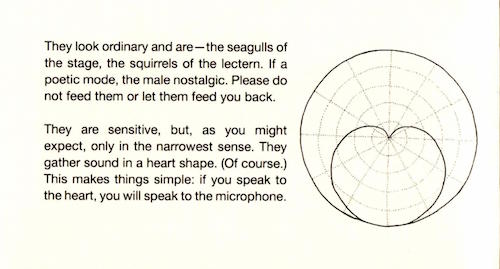
They look ordinary and are — the seagulls of the stage, the squirrels of the lectern. If a poetic mode, the male nostalgic. Please do not feed them or let them feed you back.

They are sensitive, but, as you might expect, only in the narrowest sense. They gather sound in a heart shape. (Of course.) This makes things simple: if you speak to the heart, you will speak to the microphone.

from helen guri - cardio microphone

Testing, testing. 1, 2, 3, testing.

And so for day 1423
05.11.2010

Posted in Poetry | Leave a comment