Two Basket Cases

This from a long 2006 missive to my friend Willard:

The horn basket [cornucopia] is emptied and usually in its emptying it does not suffer damage. The container subject to dehiscence loses its capacity to act as a container in the same fashion. From the cornucopia I can take the bean pods, once the beans are shelled, the material from the pods only becomes pod-like again after a long detour process involving a route that may travel through animal feed on its way to compost.

Humanist 20.078 minding the gap

Now alongside some stray bit:

the quality of the reading depends on the quality of the basket

Or the precision of the pod.

And so for day 1382
25.09.2010

Posted in Uncategorized | Tagged , | Leave a comment

Matricial Musings

New meaning to stack overflow…

Spell

the never filled () runs over

::: the stack that is a scattering ::: responding to form to begin a journey into speech with the likes of Michelle Cliff prefacing The Land of Look Behind recalling Ted Chamberlain in the experience and knowledge of ceremonies of belief that are the recounting of accounts :::

an abacus of world strung with beads of word and spanned by the abscissa of dreams :::

riddle: charm filter

charm: riddle feeder

~~

The concluding chiasmus relies on the crossing of technical terms and common understandings in a nicely deployed matrix.

And so for day 1381
24.09.2010

Posted in Uncategorized | Tagged | Leave a comment

Bullet Point Reading

Don’t quite know how the German got in except as a neat way to express a yearning for the skies…

Slab

Reading with the paradigm in view of the combinations is reading with syntagm ladders.

Die Himmelsgegenden. All points bulleting. Stars.

But ingathering. The hand held over some attraction point in the chain and the moment remains indeterminate for there is always the possibility of termination, any time anywhere.

Maximalism.
~~

Do know that a proliferation of points pricks the sublime imagination into a breathlessness.

And so for day 1380
23.09.2010

Posted in Reading, Transcriptions | Leave a comment

Trauma Truce

Trauma Truce From a letter to a young scholar.

Menachem,

I was rereading a preface by Adrienne Rich. The preface is collected in On Lies, Secrets and Silence: Selected Prose 1966-1978. The preface is dated 1976 and it entitled ”Conditions for Work: The Common World of Women”. She quotes from Simone Weil:

A clear view of what is possible and what impossible, what is easy and what difficult, of the labors that separate the project from its accomplishment — this alone does away with insatiable desires and vain fears; from this and not from anything else proceed moderation and courage, virtues without which life is nothing but a disgraceful frenzy.

The passage is from Weil’s “ Theoretical Picture of a Free Society” collected in Oppression and Liberty trans. by Arthur Wills and John Petrie (1973).

I am wondering if Weil and Rich might not provide a bridge back to considerations of the popular as the work of social reproduction and a way of conducting the work of memorialization without re-inducing trauma. Rich suggests that “[f]or spiritual values and a creative tradition to continue unbroken we need concrete artifacts, the work of hands, written words to read, images to look at, a dialogue with brave and imaginative women who came before us.” She then cites a passage from Hannah Arendt’s The Human Condition and continues to firmly situate this work in a gendered context: “Hannah Arendt does not call this ‘women’s work.’ Yet it is this activity of world-protection, world preservation, world-repair — the million tiny stitches, the friction of the scrubbing brush, the scouring cloth, the iron across the shirt, the rubbing of cloth against itself to exorcise the stain, the renewal of the scorched pot, the rusted knifeblade, the invisible weaving of a frayed and threadbare family life, the cleaning up of soil and waste left behind by men and children — that we have been charged to do ‘for love,’ not merely unpaid, but unacknowledged by the political philosophers. […] Arendt tells us that the Greeks despised all labor of the body necessitated by biological needs.”

The radical american feminist critique of the 70s regarding the repression of the body in western thought might be worth keeping in the background of your explorations of the debates over the proper relation between the popular and the Holocaust. Incidentally, Rich does in her later prose and poetry explore her Jewish roots.

Moderation. Courage. The Quotidian.

And so for day 1379
22.09.2010

Posted in Uncategorized | Tagged | Leave a comment

AWCG

I like to categorize these fixtures in the Alex Wilson Community Garden as vernacular architecture.

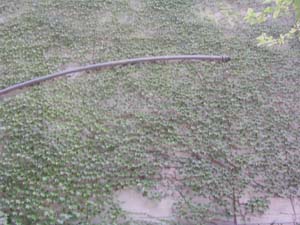
A visitor to the community garden can look up and see against the wall of the building adjacent to the garden a pipe.

Alex Wilson Community Garden - water collection pipe

Following the pipe down its curve leads to stacked tubs.

Alex Wilson Community Garden - water collection tubs

An ingeniously simple system to capture runoff for watering the garden.

I particularly like the stacking of the tubs and can imagine the overflow from the top one filling the bottom two.

There is a piece of urban legend associated with the AWCG water system reported by Gayla Trail: “Apparently when the system was first constructed, and before it had a protective mesh top, a friend of a friend arrived at his plot one day to find a nude man emersed in the “tub” taking a bath!” http://yougrowgirl.com/water-for-all-occassions/

And so for day 1378
21.09.2010

Posted in Gardens | Leave a comment

Nature Parks Can Not Do

The Alex Wilson Community Garden has a sign at its entrance. On that sign is an Ojibway proverb (“The bush is sitting under a tree and singing”), a quotation from the writing of Alex Wilson and Wilson’s date of birth (1953) and death (1993). The sign is reproduced in Public 41 Gardens (2010). The article in Public by Richard Brault concludes with quoting the passage and thanks to that I noticed that the sign is missing a sentence. It is a rousing call to action. Brault quotes:

We must build landscapes that heal and empower, that make intelligible our relations with each other and the natural world: places that welcome and enclose, whose breaks and edges are never without meanings. Nature parks cannot do this work. We urgently need people living on the land, caring for it, working out an idea of nature that includes culture and human livelihood. All of this calls for a new culture of nature, and it cannot come soon enough. [our emphasis]

Brault’s quotation has the bit that the sign omits (Nature parks cannot do this work). [Brault however unlike the sign is inaccurate: drops “connects” from “heal, connect and empower”; substitutes a “this” for a “that” in “All of that call”.]

The “nature parks” reference is important because in his book The Culture of Nature Wilson is at pains to emphasize that creating more wildlife preserves is not the best way forward to forge new relationships with the land. Here is the lead in to the call to action:

In an era of ecological crisis, it’s no surprise that many of these contradictions are being worked out on the land itself. My own sense is that the immediate work that lies ahead has to do with fixing landscape, repairing its ruptures, reconnecting its parts. Restoring landscape is not about preserving lands — “saving what is left,” as it’s often put. Restoration recognizes that once lands have been “disturbed” — worked, lived on, meddled with, developed — they require human intervention and care. We must build landscapes that heal, connect and empower, that make intelligible our relations with each other and the natural world: places that welcome and enclose, whose breaks and edges are never without meanings. Nature parks cannot do this work. We urgently need people living on the land, caring for it, working out an idea of nature that includes culture and human livelihood. All of that calls for a new culture of nature, and it cannot come soon enough.

R E S T O R A T I O N
Nature parks cannot do this work.

And so for day 1377
20.09.2010

Posted in Gardens | Leave a comment

Inventing Interventions

Alex Wilson
The Culture of Nature: North American Landscape from Disney to the Exxon Valdez (1991)

My own notes to a passage align on one side terms from my then current interests and on the other side keywords from a passage I read.

producing framework
reproductive system of rituals
translations phase of cultural evolution

What was I reading? This:

Restoration projects actively investigate the history of human intervention in the world. Thus they are at once agriculture, medicine, and art. William R. Jordan of the University of Wisconsin Arboretum writes:

[…]
I now see restoration as providing the framework for a system of rituals by which a person in any phase of cultural evolution can achieve a harmonious relationship with a particular landscape.

These are not new ideas, but they are ideas newly current in the culture.

Wilson proposes “a new environmental ethic”.

Restoration actively seeks out places to repair the biosphere, to recreate habitat, to breach the ruptures and disconnections that agriculture and urbanization have brought to the landscape. But unlike preservationism, it is not an elegiac exercise. Rather than eulogize what industrial civilization has destroyed, restoration proposes a new environmental ethic. Its projects demonstrate that humans must intervene in nature, must garden it, participate in it. Restoration thus nurtures a new appreciation of working landscape, those places that actively figure a harmonious dwelling-in-the-world.

As a gay man reading a gay man, then and now, I can say that the take on the elegiac exercises chimes in with the collective response to AIDS — the very cultivation of new modes of being there for each other. Building gardens was one of those ways. See the work of Douglas Chambers chronicled in Stonyground: The Making of a Canadian Garden. It did encompass preservation – the oral history of memory traces – and the creation of a working landscape.

And so for day 1376
19.09.2010

Posted in Gardens | Leave a comment

Street Furniture

A block of a bench.

street furniture - bench with split to deter lying down

Designed against surfboarding — note the lip.

Close-up street furniture - bench with split to deter lying down

Shutters protecting chalk image against night time erasure or graffiti tags. (Worth observing in situ at 577 Queen Street West, Toronto).

signage: bird - "i'd sell you to satan for one corn chip"

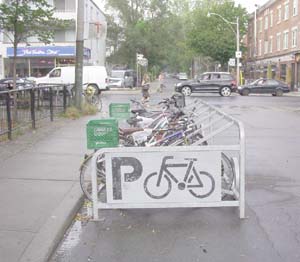
And displacing car parking with a whole row of city-friendly transportation is the coral for bikes near the location of the Bloor-Borden Farmers Market.

street furniture - parking zone for bicycles

Sit. Read/View. Park.

These utilitarian affordances both invite and repel. Liveable in this urban vocabulary is synonymous with useful. With a good dose of refinement and allure.

And so for day 1375
18.09.2010

Posted in Uncategorized | Leave a comment

Central Heating and Cloud Computing

Where is “hearth”?

Kenneth Frampton. The Status of Man and the Status of His Objects: A Reading of The Human Condition. (1979)

Furthermore, the word “edifice” relates directly to the verb “to edify,” which not only carries within itself the meaning “to build” but also “to educate,” “to strengthen,” and “to instruct” — connotations that allude directly to the poetical restraint of the public realm. Again the Latin root of this verb — aedificare, from aedes, a “building,” or, even more originally, a “hearth,” and ficare, “to make,” has latent within it the public connotation of the hearth as the aboriginal “public” space of appearance. This aspect persists even today in the domestic realm, where surely no place is more of a forum in the contemporary home than the hearth or its surrogate, the television set, which as an illusory public substitute tends to inhibit or usurp spontaneous emergence of “public” discourse within the private domain.

Cecelia Tichi. Electronic Hearth: Creating an American Television Culture. (1991)

For the decentralized TV environment, promulgating dispersal, always risks betraying the hearth by exposing tensions and divisions between generations and between sexes. […] One cartoon of 1956 suggests this very tension by spoofing its resolution. The cartoon shows a family of three gathered before three lined-up televisions, mother, father, and son happily watching different programs while the audio comes through headphone sets that each wears. Gathered together as a nuclear family, each member inhabits a separate on-screen world. […] The family’s contentment comes from not having to gather to watch the same thing. Technology lets them escape the tyranny of the hearth.

Frampton highlights (as manipulative and apolitical)

Robert Venturi’s Complexity and Contradiction in Architecture, wherein the author asserts that the Americans don’t need piazzas, since they should be at home watching television.

Mobility may restore to urban populations power. Energy storage & transportation take the “hearth” for a walk… A return to nomadic tents? As Frampton quotes Arendt: “Without being talked about by men and without housing them, the world would not be a human artifice but a heap of unrelated things to which each isolated individual was at liberty to add one more object; without the human artifice to house them, human affairs would be as floating, as futile and vain, as the wanderings of nomad tribes.” One more word: pitched. Channel surfing.

And so for day 1374
17.09.2010

Posted in Uncategorized | Tagged | Leave a comment

Puns and Nonesuch

Signage that is memorable.

There are the magnificent murals of Pour Boy. Where one assumes that a poor boy (or girl) can quaff a modestly priced brew.

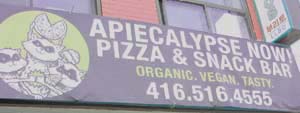
Apiecalypse Now! – That’s pie as in pizza in case you missed the pun and it’s animal friendly vegan hence the cute racoons sharing a pie.

Signage: apiecalypse pizza

When you need some building maintenance done right go to the fancy spellers at DunRite with a long top on the T.

Signage: dunrite danger work overhead

Which on the company web site looks slick thanks to the Mississauga designers at Reaction Grafix still retaining that swish T.

signage: dunrite building maintenance

And the non-verbal

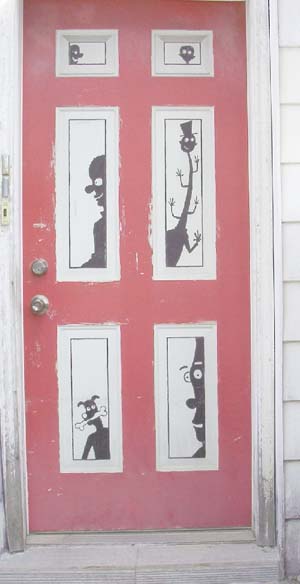
painted door

Silhouettes on Bathurst

A door to domestic space on Bathurst street south of College looking smartly like the frames of a graphic novel devoted to canines.

Such collecting is inspired by the Dictionary of Words in the Wild at http://lexigraphi.ca

And so for day 1373
16.09.2010

Posted in Uncategorized | Tagged , | Leave a comment