Push Pull

A character with the same name as the author observes

I think telling stories is like pushing something. Pushing against uncreation itself, maybe. And one day while you were doing that you felt something pushing back.

Stephen King
Song of Susannah
Dark Tower VI

Flip side of Cronenberg’s characters being sucked in in Videodrome

And so for day 1372
15.09.2010

Posted in Storytelling | Leave a comment

Little Fish Big Fish

John Varley
Wizard

[…] and Nox, the Midnight Sea. It shimmered in the silvery light. Embedded in the water were nebular drifts of luminescence, cold blue beneath the brighter surface reflections. There were harder, more compact light sources, some a warm yellow and others deep and green.

“The light clouds are colonies of fish about this long.”

Chris looked up and found that Hornpipe was walking beside Valiha. Cirocco was holding thumb and finger a few centimeters apart.

They’re more like insects, actually, but water-breathing. They’re true colonies, with a hive brain like ants or bees. But they don’t have a queen. They apparently hold free elections from what I’ve been able to learn. Complete with primaries and campaigns and propaganda in the form of pheromones released into the water at election time. The winner is allowed to grow to be a meter long and holds office for seven kilorevs. His function is mainly morale. He releases chemicals that keep the hive happy. If the leader is killed, the hive stops eating and dissolves. At the end of the term the hive eats him. Sanest political system I ever saw.

Big Fish Little Fish

And so for day 1371
14.09.2010

Posted in Uncategorized | Tagged | Leave a comment

Potluck Luck

Broken. Assembled. Deciphered.

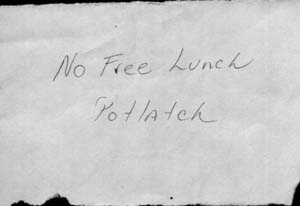
Note - No Free Lunch / Potlatch

No Free Lunch
Potlatch

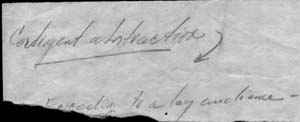
Note: contingent abstraction

contingent abstraction
Encoding to a lay audience

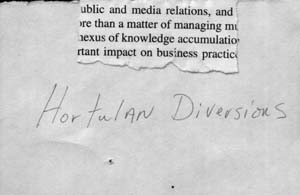
Note: hortulan diversions

media relations
a matter of managing
nexus of knowledge
impact on business

Hortulan Diversions

And so for day 1370
13.09.2010

Posted in Ephemera | Leave a comment

Better Barter

Some lore from the Medieval Ages that pertains to camels and the nature of exchange:

If the owner of a camel sells it, the camel mourns and grows ill, not for loss of his master, but because he thinks the price was too low.

The Metropolitan Museum of Art: A Cloisters Bestiary prepared by Richad H. Randall Jr. (New York, 1960)

And so for day 1369
12.09.2010

Posted in Uncategorized | Tagged | Leave a comment

Euthermia

Marilyn Dumont. green girl dreams mountains

There are two poems that are juxtaposed in memory after reading. The first is entitled “kindling” and amounts to a detailed description of the speaker’s mother’s handwriting and concludes that the writing was left as

broken twigs on the page
as kindling
for me

It echoes later in the sequence of poems with the ending of “I am five” which ending arrives after a run through of a dry weather landscape (grasses that move like flames, grasshoppers “snapping their hot wings” and “adolescent pines wrestle the wind”). This is an evocation that seems full of an innocent indulgence of a five-year old in the sheer physicality of the vegetation and insect life but the ending almost upends the sentiment:

but I am five and
don’t know that this burning inside is
loneliness

And you go back to the beginning of the poem to see that this loneliness is inscribed in beauty much as the broken twigs too were in their setting. I Wandered as Lonely as a Cloud with its contemplative recollection in the mind’s eye of the thousand daffodils provides a Wordsworthian touchstone for the “burning inside” — good old animal body heat, sign of life.

And so for day 1368
11.09.2010

Posted in Poetry | Leave a comment

Motions, Stones, Motions

A garland of ruins.

Alan Marshfield
The Electra Poems

from “Sleep, Silhouette”

from crotch to chin our sweaty bodies held
and we arrived, gyrating breast to breast,
at motion like the motions of a stone
wherein we learned duration, beyond grief.

from “Genesis at Up Marden”

Stone cherubs, blind with time’s gangrene

from “Centaurs”

when we have been two centaurs from the start
and all night’s forest screams were waterfalls.

from “An Age Turns”

It’s a shame Brunelleschi’s stoa
survives as a blueprint to vex me:

Ruined garlands.

And so for day 1367
10.09.2010

Posted in Poetry | Leave a comment

Fluff

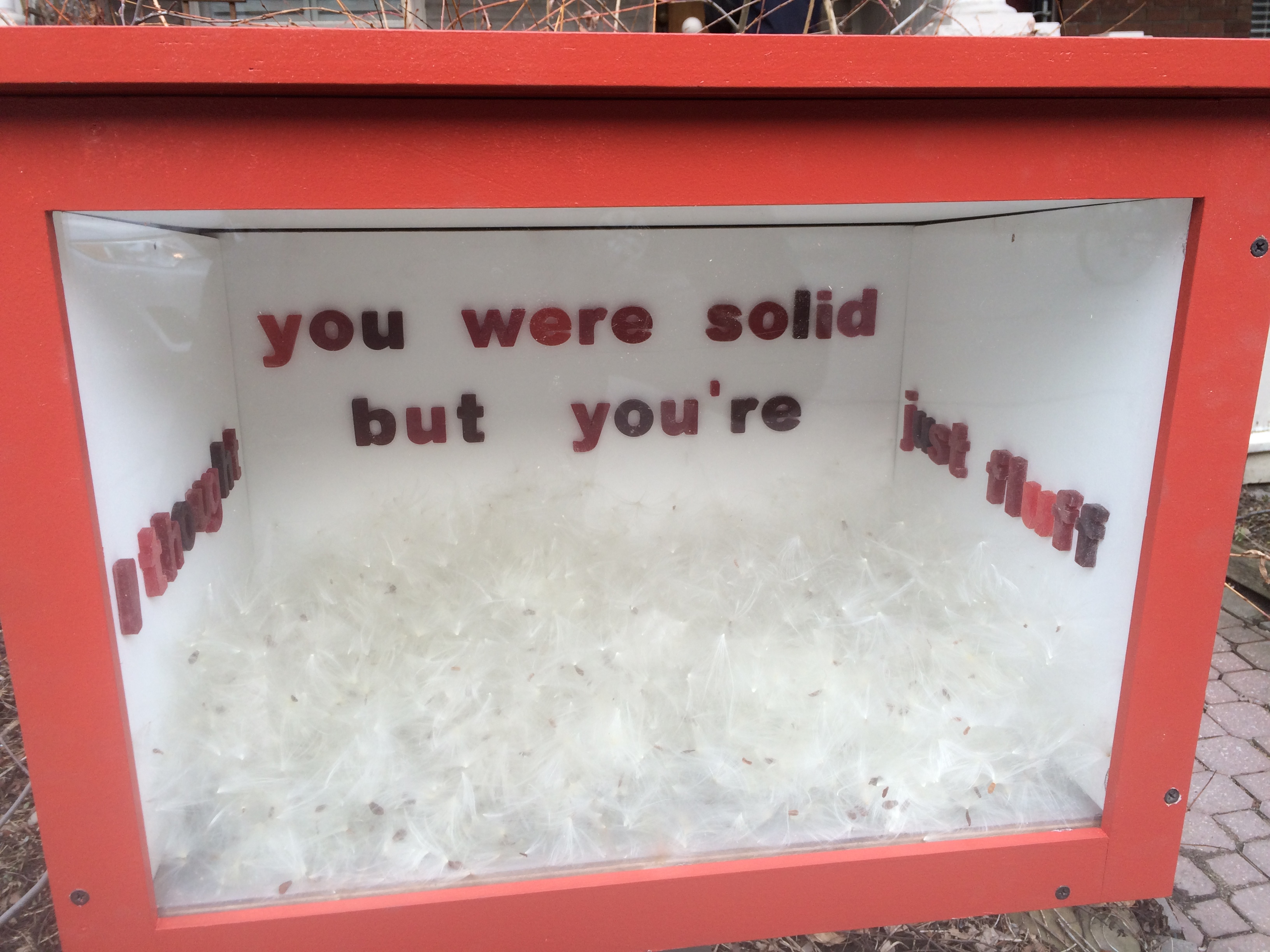
It reads like a parody of the Little Free Library outposts.

Erika James installation grace street toronto

Welcome to the installation. With text and fibre.

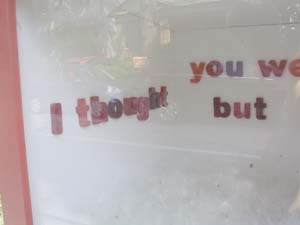
erika james installation grace street toronto - i thought

Beginning “I thought”

Erika james installation grace street toronto - you were solid

Back panel: you were solid / but you’re

The picture here captures the shutter-bug and brings to mind the title of a show of Allen Ginsburg snapshots: “We are continually exposed to the flashbulb of death” (Curated by Barbara Fischer and John Shoesmith at the University of Toronto Art Centre).

The finale — the bed of milkweed [?] seeds and the third wall — is best visited in the documentation provided by the Open Field Collective. “I thought // you were solid / but you’re // just fluff”

Erika james installation grace street toronto - fluff box

Ending: fluff. Beginning again: box bottom covered with fluff/seed.

The piece is by Erika James and was viewed on Grace Street below Bloor in Toronto. And for some reason reminds one of Hamlet: O that this too sullen flesh —- oops that should be “solid flesh” — or should it?

O, that this too too solid flesh would melt
Thaw and resolve itself into a dew!
Oh, that this too, too sullied flesh would melt,
Thaw, and resolve itself into a dew,

Many scholars ask whether Shakespeare intended “solid” to be actually “sallied”, a form of the word “sullied.” The second quarto of Hamlet contains “sallied”, but the First Folio prints it as “solid.” Modern editors have been quite divided on the issue. Editors of The Arden Shakespeare choose to use “sullied”, while editors of The New Cambridge Shakespeare have decided upon “solid.” The reasoning for the use of “solid” is fairly evident, as it logically corresponds to “would melt” (131). However, there are good arguments to support the claim that Shakespeare did mean “sullied.” With “sullied” we have the “suggestion of contamination” (Jenkins, 437), which is apparent throughout the soliloquy.

References Shakespeare, William. Hamlet. Harold Jenkins, ed. London: Methuen, 1982.

http://www.shakespeare-online.com/plays/hamlet/soliloquies/solid.html

O so easy to fluff one’s lines …

And so for day 1366
09.09.2010

Posted in Uncategorized | Leave a comment

The True Sharing Economy Embraces Decadence

Inspired by the work of Gilles Clément, I am attuned to not just recycling but the decadence of rot, an embracing of decay.

From L’homme symbiotique , commentaire de six dessins (La Vallée le 1er juin 2009)

En tant qu’êtres hétérotrophes (prédateurs) les animaux humains , incapables de synthétiser leur nourriture doivent la prélever dans l’environnement . La possibilité de replacer dans l’environnement l’énergie prélevée et transformée suppose la mise au point d’une économie opposée à celle qui régit la planète aujourd’hui . Le nouveau modèle s’oriente vers une non-accumulation des biens matériels : déchets occupant maladroitement le territoire et polluant les substrats au détriment de la vie .
[…]
Une feuille morte tombée au sol n’est pas une souillure , c’est une nourriture .

Note: there is a space before the terminal punctuation marks. Just like aerobic compositing , this aerates the text .

Translated by Catherine Lavoie and Colette Tougas in Public 41 “Gardens” (2010)

As heterotrophic beings (predators), human animals are incapable of synthesizing their own food resources and must take them from the environment. The possibility of returning to the environment the energy taken and transformed implies the creation of an economy that is the opposite of the one now governing our planet. This new model is aimed at the non-accumulation of material goods — waste that only takes up space, polluting substrates at the expense of life itself.
[…]
A dead leaf that has fallen to the ground is not waste but nourishment.

Decay in audio terms … listen . . .

And so for day 1365
08.09.2010

Posted in Gardens | Leave a comment

Lounging With Lorca

I am disappointed in Lorca who never ceasing for one moment to see the beard of old beautiful Walt Whitman full of butterflies — mariposas — such a fetching image (see the cover of the City Lights 1988 edition) — turns the poetic voice to decry the

Maricas

Ben Belitt in the Grove Press edition of Poet in New York renders them “perverts”. Carlos Bauer in the City Lights Ode to Walt Whitman and Other Poems renders them “faggots”. Jack Spicer in his adaptation renders them “cocksuckers” in After Lorca.

Disappointment and intrigued (sly one for the slang of mariposa is akin to the referent of marica), for after the salute to the grand old man, the poem turns the hated name into an epic catalogue:

Fairies of North America,
Pájaros of Havana,
Jotos of Mexico,
Sarasas of Cádiz,
Apios of Sevilla,
Cancos of Madrid,
Floras of Alicante,
Adelaidas of Portugal

And this is the intriguing part — there’s a shift in addressee (the faggots are called out) — and then the poem returns to the apostrophe to Whitman.

The good poet is unsullied. And yet that catalogue could have been lifted from Leaves of Grass *wink*

Whatever, Lorca’s listing of the many names, reminds me of the title of Larry Mitchell‘s The Faggots & Their Friends Between Revolutions (Calamus Books, 1977) — the reappropriation of terms of disapprobation. Mitchell captures the glee of a certain historical juncture: “The women who love women wrote a song for the faggots. It was called, “Anything you do that the men don’t like is o.k. by us.” For more fun, take the beginning of a piece called “Disruption: Tactics”

The faggots never tire of fucking with the men’s minds. Once all the faggots let their hair grow long, wore necklaces made of silver and shells and clothes colorful, elaborate fabrics. They looked so stunning that the men over-looked their principles and began to look stunning also. […]”

This was ages before Queer Eye for the Straight Guy (2003). So too was Lorca.

Lorca of the locked gates. Whitman of the open arms of comrades.

For a closer and more nuanced reading of the ambiguous pose of the poem that explains Lorca’s look at the homosexual “ranging from bitter condemnation to veritable idolatry” see the article by Ruth Tobias “Beauty and The Beast: Homosexuality in Federico García Lorca’s ‘Oda a Walt Whitman'” in Mester, 21(1) [1992] See permalink: http://escholarship.org/uc/item/5dv8f3hg. [Mester is the journal of the graduate students of the Department of Spanish and Portuguese at the University of California, Los Angeles.] You might relish Tobias’s concluding speculations on the motivations of the poet — she moots the possibility of jealousy.

And so for day 1364
07.09.2010

Posted in Uncategorized | Leave a comment

Atomic Library Numbers

The circulation card in this old discarded copy informs me that the author’s initials expand to “Edward Estlin” which none of the paratext shows in this 1965 Harvest Book edition of a selection from the poetry of e.e. cummings.

library circulation card - due date reminder

In addition the card shows due dates ranging from the late 70s to the early 80s and is graced by a Dewey Decimal in the corner.

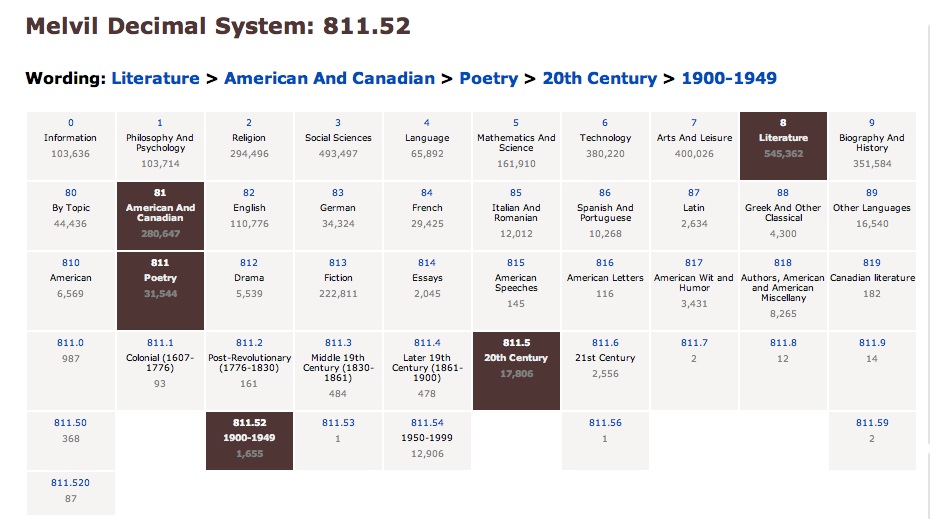
811.52

The table below shows a family resemblance between library classification and the atomic numbers from the periodic table of elements.

chart of the dewey decimal system

It might now a days be called Melvil.

Melvil stands for “Melvil Decimal System,” named after Melvil Dewey, the famous librarian. Melvil Dewey invented his Dewey Decimal System in 1876, and early versions of his system are in the public domain.

More recent editions of his system are in copyright, and the name “Dewey,” “Dewey Decimal,” “Dewey Decimal Classification” and “DDC” are registered trademarked by OCLC, who publish periodic revisions.

On the OCLC

OCLC is a global library cooperative that provides shared technology services, original research and community programs for its membership and the library community at large. We are librarians, technologists, researchers, pioneers, leaders and learners. With thousands of library members in more than 100 countries, we come together as OCLC to make information more accessible and more useful.

The OCLC (Online Computer Library Cente) operates WorldCat which I am sure e.e. cummings and his ilk would have purr fun with.

And so for day 1363
06.09.2010

Posted in Ephemera | Leave a comment