Whirligig Jig

Monique Wittig provides a hint of how to approach Djuna Barnes‘s short stories collection Spillway. Wittig insists on the role of sarcasm and irony in making manifest that which tends to pull in multiple and separate directions. In her forward to her translations she remarks

C’est pourquoi à l’époque où il s’opère une énorme poussée pour évacuer le sens des pratiques de langage il nous faut insister du côté du sens et par le sarcasme et l’ironie rendre manifeste ce qui tire à hue et à dia.

It just so happens that the first story in Spillway is called “Aller et Retour” in English (which title is preserved in the French translation) which references a round trip. It is a story that has the reader leaping through time and space much like the to and fro of a railway excursion. We begin with the protagonist on a train from Marseilles to Nice. We learn that she lives in Paris or rather “lived in Paris” which is exquisitely ambiguous as to whether she still resides in the City of Light. From there the story informs us with the irony and sarcasm signalled by Wittig that

In leaving Marseilles she had purchased a copy of Madame Bovary, and how she held it in her hands, elbows, slightly raised and out.

She read a few sentences with difficulty, then laid the book on her lap, looking at the passing hills.

We next experience a wee bit of disorientation (the narration had set up travel towards Nice but we find ourselves in Marseilles): “Once in Marseilles, she traversed the dirty streets slowly […]”. One experiences a little shock of dislocation for that “once” means not “arrived” but “once upon a time” or “upon one occasion”. We are brought face to face with the story as story.

Wittig’s French version “A Marseille, elle a parcouru […]” becomes with back translation “In Marseilles”. But had it not been for the Wittig rendering we may have never bumped up against the English’s dislocations. There is to and fro between versions that set up a spinning.

Emblematic of these motions is the description of the flow of water in the title story.

L’eau quand elle est dans la main est sans voix, pourtant en passant par-dessus les chutes elle rugit bien. Elle chante contre les petits cailloux dans les ruisseaux mais quand elle est caputrée et se bat et coule le long des mains, elle n’a goût que d’eau. Water in the hand has no voice, but it really roars coming over the falls. It sings over small stones in brooks, but it only tastes of water when it’s caught, struggling and running away in the hands.

Water tasting of water and the curve of a tautology. Water escaping. Hands that cannot clutch its fluid journey à hue et à dia. But words do hold it still for the mind to taste.

And so for day 1362
05.09.2010
Posted in Translations | Leave a comment

What is poetry?

Echoes of William Blake “The road of excess leads to the palace of wisdom.” The Marriage of Heaven and Hell

bp nichol. The Martyrology Book II.

oh fuck it’s raining

stick my hand into the sea

that’s poetry

it’s a peculiar combination : sea, rain, hand. peculiar, cuz it’s poetry. but note the syntagm: rain, hand, sea, poetry: something falls, something reaches, something crashes its waves into something else.

And so for day 1361
04.09.2010

Posted in Poetry | Leave a comment

Pronoun Plenitude

bp nichol. The Martyrology Book II.

you scream his name against the stars
he does not answer
i answer turn
i answer turn
away
away

play with the pronouns. map the you to a male interlocutor. map the i to a male speaking voice. turns out that what you may have here is a wise old queen telling a young buck, “you’ll get over him and find another.”

* * * * *

permutations, fantastical

* * * * *

Félix Guattari. A Liberation of Desire: An Interview by George Stambolian in Homosexualities and French Literature (1979).

[P]oetry is a rhythm that transmits itself to the body, to perception. A fantasy when it operates does not do so as a fantasy that represents a content, but as something that puts into play, that brings out something that carries us away, that draws us, that locks us onto something.

And what sexualities does “us” bear?

And so for day 1360
03.09.2010

Posted in Poetry | Tagged | Leave a comment

Staging Silence

From 2000, from some notes towards a proposal:

It can be easily noted that Hofmannsthal’s Elektra builds its plot upon who sees, who hears, who appears, who is heard. There is a thematic movement from sight to hearing, from appearance to words. At one point Elektra declares that her unheard word is inscribed in her appearance. It is easy to read this as a figuration of the work of language upon the body of the hysteric. But, can we read here two silences? The one of the living: the usual silence that awakens the psychoanalyst’s attention, i.e. the silence of the repressed (The hysteric does not speak but shows). Can the other, the truly other, silence be the listening of the dead? Elektra answers the dying Aegisth that Agememnon hears him. Agememnon is of course dead.

There is a silence which comes from the body of the speaker and there is a silence to which that body tends. Elektra enacts both.

Some further meditations, a decade on:

Of course many critics have focused upon Elektra’s cry at the end of the play (and of the libretto) with its call to be silent and dance. But that is not the end of the sequence. Elektra collapses. Chrysothemis calls out “Orest, Orest”. The brother’s name fills the silence. In the voice of the surviving sister invoking the brother, the living are at last addressing the living. The dance and the silence are displaced. They are in some sense mere prelude to the uttering of the name of the brother. Representative of the Law of the Father?

And so for day 1359
02.09.2010

Posted in Uncategorized | Leave a comment

Lists Become Plot Lines

Insurgent, the film adaptation of the second novel in the Divergent Trilogy by Veronica Roth impressed me by the enchaînement of the sequence of trials by simulation. The progress through the factions (societal divisions similar to clans): dauntless, candor, abnegation, erudite, amity. The order matters. The protagonist cannot achieve success in the latter stages without passing through the previous trials. For example, the amity trial depends upon candor — there can be no peace without frankness.

And each of the five factions has a symbol similar to a Japanese crest.

The skill with which the screenplay was shot, has me wondering if there is someone who could treat the 12 Shaker virtues to a similar plot rendering. The Shakers come to mind so many times and so many ways:

They may be denominated and arranged in the following order; Faith, Hope, Honesty, Continence, Innocence, Simplicity, Meekness, Humility, Prudence, Patience, Thankfulness, and Charity.

A SUMMARY VIEW of the MILLENNIAL CHURCH or United Society of Believers, commonly called SHAKERS. General Principles of their Faith and Testimony. Published by the Shakers in 1823; Reprinted in 1848. [Excerpt Transcribed from the 1848 Second Edition]

Why the Shakers? I have just been fascinated by the listing of twelve virtues ever since I read it in Edward D. Andrews The Gift to Be Simple: Songs Dances And Rituals Of The American Shakers. The challenge of linking cinematic action to the listing is like shaping a story around the timeless but sequential. (And frankly I think some of the aesthetic elements in the Divergent film universe have Shaker inspiration.)

And so for day 1358
01.09.2010

Posted in Storytelling | Leave a comment

N-ation N-obody N-igger

First the note on the persona

As “red nigger”, the lower-class counterpart to the “mulatto”, Shabine comes from the ranks of the ordinary man in Caribbean society. [Patricia Ismond, Abandoning Dead Metaphors: the Caribbean Phase of Derek Walcott’s Poetry (Kingston, Jamaica : University of the West Indies Press, 2001) p. 230.

Next the celebration of the lyrics through an interview with Nalo Hopkinson quoting her in its title [‘I’ll take my chances with the 21st century’ The Globe and Mail]

Whose sentences are your favourite, and why?

[…]

You may not be allowed to print the fourth, but it’s the final four lines of the second stanza of Derek Walcott’s poem The Schooner Flight. The last line of those four brings the whole thought home in a triumphant mic drop that for me embodies the essence of the ingenuity of my birth region, the Caribbean. It gives me chills, every time.

The words of Shabine

I’m just a red nigger who love the sea,
I had a sound colonial education,
I have Dutch, nigger, and English in me,
and either I’m nobody, or I’m a nation,

The last four lines continue on into the next stanza hence the comma after “nation”, which lines move on to reflect upon Maria Concepcion, object of a love-hate relationship.

And so for day 1357
31.08.2010

Posted in Poetry | Leave a comment

Slice Acceleration

In our neighbourhood there is a practice of leaving books and household articles at curbside, free for the picking. Some have turned this recycling practice into an art.

The other day, I stumbled upon a pile of books which amounted to an ingenious gag.

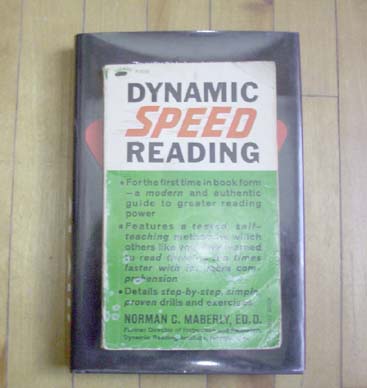
On top was a Signet paperback with bold colours and offering to guide the reader to Dynamic Speed Reading.

cover book - dynamic speed reading

Under the speed inducing paperback was a hardcover edition of Carl Honoré In Praise of Slow with its yield sign shaped layout on the cover.

cover book - in praise of slow

There is a quotation from Bill McKibben, author of The End of Nature on the cover of the Honoré book that reads “Try reading this book one chapter a day — it is worth allowing its subversive message to sink in so it has a chance of changing your life.” Now I am not a radical believer that reading, slow or otherwise, can change your life (I am of the school that discourse (writing or talking) about what is read can, maybe, along with other actions, change the world). In any event, I found in my daily reading a passage in e.e. cumminngs that is intriguing for its word-slicing speed and its injunction not to hurry, intriguing because of its echo with the book stack gag — it requires some combination of both stopping to pay attention and some acceleration to browse quickly over the offerings to pull out the gems.

is always beau

tiful and
that nobod
y beauti

ful ev
er hur

ries

The paradox being if the eye doesn’t hurry over the breaks no meaning emerges.

And so for day 1356
30.08.2010

Posted in Poetry | Tagged , | Leave a comment

Bowel Lore

Whether it’s glister or clyster it’s up the keister, mister.

From the Diary of Samuel Pepys, The Joys of Excess in the Great Food series from Penguin, the entry for February 11, 1663, begins

Took a glister in the morning and rise in the afternoon.

The Penguin Pepys is based on the edition by Robert Latham and William G. Matthews (1970). The text for the Pepys Diary online is from the Henry B. Wheatley 1893 edition available through Project Gutenberg and reads

Took a clyster in the morning and rose in the afternoon.

Search engines will give a rather modern and glittering meaning for “glister” unless one looks up the complete phrase “to take a glister” which leads to an interesting set of references at the English Language and Usage Stack Exchange. Meanwhile (before thinking to look up “to take a glister”), a quick look up offline in the Oxford English Dictionary confirmed that “glister” is the equivalent of “clyster” and means “enema”. The consultation of the OED occurred before examining the online Pepys for a gloss or clue which is indeed nicely supplied there and given the reading of clyster for glister led one to look at the editions at play and our dual citation here. Oh, “keester” is an alternative spelling of “keister”. And “rise” is indeed emended to “rose” in Wheatley.

And so for day 1355
29.08.2010

Posted in Uncategorized | Leave a comment

Contentions

I contend that fundamental to human interaction is narration: attentiveness to how stories are related. Stories are for sorting and storing.

A while ago (1996), I explored recursivity and narrativity. My starting point was the ability to ask questions (and learn from one’s bodily reactions).

Pedagogical situations are sensory. They are also interpersonal. Because they are sensory this makes even learning by oneself interpersonal. Egocentric speech is like a dialogue between the senses. In Vygotsky’s and Luria’s experiments, children placed in problem-solving situations that were slightly too difficult for them displayed egocentric speech. One could consider these as self-induced metadiscursive moments. The self in crisis will disassociate and one’s questionning becomes the object of a question.

Not only is the human self as a metabeing both fracturable and affiliable in itself, it is also prone to narrativity. That is, the human self will project its self-making onto the world in order to generate stories from sequences and to break stories into recombinant sequences. Its operations on signs are material practices with consequences for world-making.

The fracturable affiliable self calls for reproductive models suitable to the interactions of multi-sensate beings, models that render dyads dialectical, questionable, answerable. Narrativity understood dialectically does not merely mean making sequences or strings of events into stories but also stories into things, strung together for more stories. From such an understanding, emerge non-dyadic narratives of reproduction, narratives where a thing-born transforms itself into an event, comes to understand itself as a process.

http://homes.chass.utoronto.ca/~lachance/S6D.HTM

I am intrigued about how in 1996 my considerations connected a human self that could be modelled as a split subject (the fracturable self) with one modelled as an (anaclytic) subject with the potential for connections (the affiliable self). Both arose from the take on narration (and of course exposure to psychoanalytic theory) as both an engine of analysis and a motor for social relations. Yet dealing with language and feedback, I was focussed on storage and sorting (machine operations) and not at all concerned with networks, their genesis and maintenance. I failed to theorize an economy. What I gained remains to be told. Always the subject of a certain rattrapage.

And so for day 1354
28.08.2010

Posted in Storytelling | Leave a comment

From A Spill Over Note

It is an observation culled from a note that carries over from one page to the next and in its spilling over displays some of the processes at work in the description.

It is perhaps worth noticing that as soon as a different text is brought into the discussion […] it acts as an opening of the floodgates and admits a host of other related texts. This is in part testimony to certain continuing concerns in Beckett’s work which almost become motifs, yet it also proses problems for the critic. If one were to follow every associative link across a large array of texts one would be closer to providing a concordance than an interpretation. As a critic, one feels that one either writes too little or too much, and never, simply, enough.

Of course associative links require interpretation to be established. Would a concordance be a simple listing of the location of markers for the interpretations? Aren’t interpretations built up from concordance? The arrow may work the other way. How else to identify motifs? Never single. Always multiple. Sometimes simple.

Quotation from Paul Stewart Zone of Evaporation: Samuel Beckett’s Disjunctions. Who in my reading writes simply enough to elucidate the complexities of flood control.

And so for day 1353
27.08.2010

Posted in Uncategorized | Leave a comment