Surplus Surplus

From the collector of definitions.

Flâneur: dandy, stroller, person at ease in a kaleidoscope of turns.

From the philosopher-poet.

In the paradise of ceaseless commerce and consumption, where nothing can ever be lacking, some things are nonetheless impossible to find. One of them is cumulative thought; another is the unhurried privacy on which all thought depends. It is curious that mental independence should wither away in the face of constant surplus — but in the shopping mall, that is what occurs.

Robert Bringhurst. “A Poet and A War” in Everywhere Being Is Dancing

From the satirist, two anecdotes. Related here in reverse order of their appearance. Both hilariously funny.

But I really think this has gone too far, this worship of choice. I take my mum out for a cup of coffee and I say, “What would you like?” and I get quite impatient if she says, with surprise, “Um, a cup of coffee?” I want her to specify what size, what type, whipped cream or no whipped cream, choice of sprinkle, type of receptacle, type of milk, type of sugar — not because either of us cares about how such stuff, but because I’m expecting all these questions at the counter, and you look daff if you dither.

“I would have whole-heartedly agreed with you, Ms Truss, if you had not fatally undermined your authority by committing a howler of considerable dimensions quite early in the book, on page 19. I refer, of course, to the phrase ‘bow of elfin gold’. Were you to consult The Letters of J.R.R. Tolkien (Boston: Houghton Mifflin, 1981), you would find in letter 236 that Professor Tolkien preferred the term ‘elven’ to ‘elfin’, but was persuaded by his editors to change it. Also, it was the dwarves who worked with gold, of course; not the elves. Finally as any student of metallurgy would instantly confirm, gold is not a suitable element from which to fashion a bow, being at once too heavy and too malleable. With all good wishes, enjoyed your book immensely, keep up the good work, your fan.”

Lynne Truss. Talk to the Hand: The Utter Bloody Rudeness of the World Today, or Six Good Reasons to Stay Home and Bolt the Door

For me Bringhurst’s images bring to mind the figure of the forager who also encounters a cornucopia and makes a judicious choice in harvesting: it is not so much that the surplus is the cause of all the trouble but our attitude to the surplus.

Truss is splendid when these disparate passages are connected to bring to mind the relation between abundant offerings and the art of the connoisseur. The link between choices on offer and the making of choices is tenuous. Imagine if you will riffling through pages of a book (sadly missing an index: no “Tolkien”, no “coffee”) to track down the appropriate anecdote and compare that to a leisurely amble through its pages. Different ways of consuming.

In both of these instances, I am reminded of the work of Jane Jacobs and the evolution of city neighbourhoods and would like to emphasize that the choices on offer may disappear.

And so for day 1332
06.08.2010
Posted in Ephemera | Leave a comment

Once, Out of Night, Unbidden

She has a cycle of poems under the rubric “Home: A Calendar” in which “March thaw, March snow” features a descriptions of crocuses.

their white tongues poking
unbidden from the loam:
pale children, tentative and lean,
summer’s hope a linen napkin
held to the lips, once, softly

I recall that another species of crocus (Colchicum autumnale) blooms in the fall and although its presence is not evident in “October” which ends the home/calendar sequence — the poem, indeed the book, is spacious enough to admit the reader’s wandering — and the March image of the crocuses as napkins held, once, to the lips is part of the whole catalogue of “these moments of luminous grace” holding beauty and grief and set as a sign “here” indicating “this is the way to come home”. These moments call out beyond the immediate sequence to the preceding sequence in honour of Bronwen Wallace who died of cancer of the mouth. That sequence is called “The Sound of the Birds”. There the last poem of the sequence ends with the line “the dark heart of a night without song”. That is the beginning point of the calendar, the round of time, that is a route to a final resting. This is the way of Carolyn Smart in The Way to Come Home. Or to read softly, it once was, because home may become a night without song and initiate another journey.

And so for day 1331
05.08.2010

Posted in Poetry | Leave a comment

Held Hold A Hearing

Lisa Gordon offers poems constructed out of a series of couplets almost like ghazals in Moving in with the Dalai Lama. Often they, the couplets, float off and dissipate with the onrush of the next set. This one is an exception from the title poem.

The oak sawed away at this morning never held a tree house.
I could love a leaf.

I regularly misremember the line about the tree house. I invariably have the oak personified and never “hearing about a tree house”.

And so for day 1330
04.08.2010

Posted in Poetry | Leave a comment

Reordering: Crossing Open Ground

I once copied out and added line endings to a passage from Crossing Open Ground — Barry Lopez writes in “Landscape and Narrative”

Inherent in story is the power to
reorder a state of psychological
confusion through contact with
the pervasive truth of those
relationships we call “the land.”

From these newly disposed lines, I went on to ponder the mechanism of story.

Story as a means of sorting. What strikes me here in this discourse of balance and harmony is the equivalent role of story as disturbing — confusing perception to arrive at greater psychological order; l’épreuve. I think of this especially since Lopez invokes the song/ritual ways of the Navaho which I’ve encountered textually in Rothenberg’s anthology. What I recall from that reading, is the great mass or repetition with very careful and minute repetition that plays upon symmetry — remembering longer patterns esp. The Enemy Way.

19/02/98

Not only the power to reorder but also the reordering of power.

And so for day 1329
03.08.2010

Posted in Storytelling | Leave a comment

Halting Point & Tetrahedron Spin

e.e. cummings
“no then of winter equals now of spring”

Helen Guri
“It is hard to know the difference between body / and story, even though I have one” (“Some Containers and Ways to Make Them Spill” in Here Come the Waterworks)

These aperçu of the passage of time and the intertwining of body and story are worth keeping in mind when reading this bit about the Narcissus-themed approach to subjectivity in T.S. Eliot.

As Narcissus knows, to love oneself is to dream oneself away: “I would that my love were absent from me.” To write is to inscribe one’s absence from oneself: temporal division, for the self that was eludes the self that is, while the written and the writing selves can never coincide; spatial division, for writing externalizes memory and halts the flux of subjectivity.

Maud Ellman. “The spider and the weevil: self and writing in Eliot’s early poetry” in Post-structuralist Readings of English Poetry edited by Richard Machin and Christopher Norris.

I am intrigued here by the punctuation. A colon before the temporal division and a semi-colon before the spatial division. A typographical trick sitting along different borders that hints at different temporalities and dimensions at play in these divisions along the writing/written axis. And so we turn to the editors in their introduction to recall the very malleable notion that is subjectivity.

And just as the developmental history of the subject is defined by developmental changes in what the subject knows, so our notion of subjectivity is itself produced, and threatened, by what we know and by how we account for our knowledge. In a subject-centred universe knowledge, understanding and personal identity are held in a disconcertingly fine balance. This is perhaps why it seems so important for us to maintain a coherent picture of literary history, with a firm if diffuse basis in the past and a sharp relevance in the present. Take away that coherence, and we are in danger of falling off the top of the pyramid.

I am puzzled by the figure of the pyramid. It stems from the three sides that are understanding, personal identity and knowledge. I am more of the mind that one holds the pyramid in hand and turns it to view its facets. It is not so much a question of being on top but one of vis-a-vis. In the tetrahedron under question I can make out three sides (personal identity, knowledge, understanding) and one unnamed side. I risk to venture that that unnamed side is accounting or the telling or the narration. How then to turn to the question of halting and externalizing memory except to bring into conjunction this externalizing of memory with narration? We have here something more complex than a written-writing pair. There is at play on these surfaces signified-signifier relations. Halting and coherence are temporary site-specific moments.

And so for day 1328
02.08.2010

Posted in Uncategorized | Tagged | Leave a comment

Book Mark Gateway

A while back Doug Miller Books in Toronto put out some lovely book markers that depict characters from among the bookseller’s favourite works.

Bookmarker - Doug Miller Books - characters from children's books

Doug Miller Books – Toronto

From left to right

I must admit to having misidentified Lyle as Barney the Dinosaur and (with help) succeeded in correctly matching names to faces and in presenting the cast to you. Human search engines can be so nice.

And so for day 1327
01.08.2010

Posted in Booklore | Leave a comment

Ward/Word

BookThug has published a chapbook by Robert Anderson entitled The Hospital Poems. On the back cover there is a blurb by Julie Joosten “the ward becomes world, becomes the word, becomes the war.” Beauty is drawn from struggle.

The brilliance of a haiku-like beginning to “Plato’s Ward”

Morning is singular
Tangerines on the table

The image is so arresting that the mind almost blocks out what comes next. You cart away an impression of the unique moment of viewing fruit assembled on a table.

Anderson is sharp in his rendering of the moment of perception even in the midst of obliteration there is a holding on. This is how he ends “Interlude”

All the trees
you could see yesterday
from the hospital window
were cut to the ground

But he is not only a poet of the stance. He also sets the words (and numbers) dancing. The third section from “Days of Betrayal” is a set in a step-wise fashion “DSM-IV Codes of Diagnoses / 296.34 / 300.02 / 300.4 / 301.82 / 301.83”. That’s it. No comment. Just the references to labels. Looking pretty on the page.

And so for day 1326
31.07.2010

Posted in Poetry | Leave a comment

Osmosis & Self

Diffusion.

The semi-transparent envelope is not merely an aesthetic metaphor: it is the perceptual envelope that constantly surrounds us, the fluid plane of demarcation between what is outside us and what is inside, between object and the brain’s sensation/interpretation of that object. The shape of the envelope constantly alters, so that from one moment to the next we do not know how far we extend into the external world, how close we have come to touching or understanding an object, or how plastic and insubstantial our subjective world may be. It is an osmotic envelope of sensitive uncertainty, casting only the vaguest of shadows where our self is presumed to be.

Thomas C. Caramagno. The Flight of the Mind: Virginia Woolf’s Art and Manic-Depressive Illness.

And so for day 1325
30.07.2010

Posted in Perception | Leave a comment

Houses and Wares

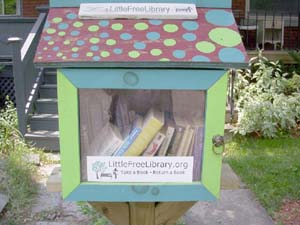
Some are registered through the Little Free Library Org. Some are autonomous.

They are agents of circulation. Experiments in collective currating.

little free library clinton street toronto

This one located on Clinton Street in Toronto has a lively polka-dotted roof.

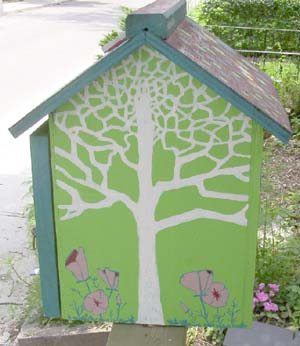
Its side view

side view - free little library - clinton street toronto - depicts tree and poppies

offers an image that recalls the tall trees nearby and the blousey poppies that grow in gardens on the street.

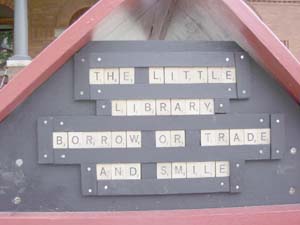
For scrabble lovers …

free little library howland street toronto - scrabble lettering

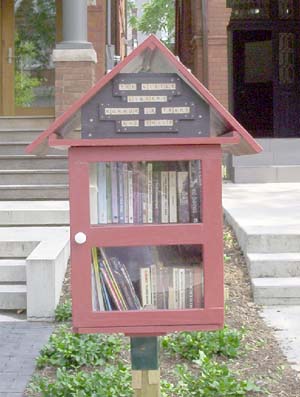
This niche on Howland has a fine range of choices on its shelves.

free little library howland street toronto - scrabble lettering - medium shot

A variation on releasing books into the wild through Book Crossing which is more focussed on migration than rotation. Both the little libraries and the releases into the wild are captivated by circulation. Both depend upon an abundance of print matter. And a certain insouciance.

And so for day 1324
29.07.2010

Posted in Booklore | Tagged | Leave a comment

Diagnosing Tree Death

I walked regularly by them when they first graced the street. They would give cachet to the street. They didn’t. They died.

At first they thought the trees along Toronto’s Mink Mile died because they were planted at the wrong time.

The dead London plane trees, mostly located on the block between Yonge and Church, died because they were planted at the wrong time of year, against the advice of city arborists, following numerous construction delays and a strike. The Globe and Mail counted several more dying or dead street trees still standing west of Yonge, a few as far west as Avenue Road.

The Globe and Mail now reports

The first set of trees [London planes] died because a contractor used a low-quality fill that trapped salt while preventing the roots from growing beyond the root ball. Construction crews are now pulling up the dead trees by their trunks so they can suck out the backfill and replace it with appropriate soil.

The London plane trees have been replaced by disease-resistant elms and Kentucky coffee trees. A new generation of walkers and passers-by may never know what the designers had intended.

All this in a city that prides itself on its tree canopy.

And so for day 1323
28.07.2010

Posted in Gardens | Leave a comment