Floral Gender-Bending

Vita Sackville-West. Some Flowers. Plates by Graham Rust.

The entry on Tulipa Clusiana, the Lady Tulip, ends

[…] the slim little Lady Tulip who is more like a boy.

which recalls the beginning

She is familiarly called the Lady Tulip, but actually reminds one most of a regiment of little red and white soldiers […] I suppose her alleged femineity is due to her elegance and neatness, with her little white shirt so simply tucked inside her striped jacket, but she is really more like a slender boy, a slim little officer dressed in parti-coloured uniform of the Renaissance.

The preface by Stephen Dobell references Vita’s lovers “including Virginia Woolf, who modelled her Orlando on Vita”. I am put in mind of Sally Potter’s film with Tilda Swinton in the title role — in one scene the hero carries tulips to central Asia from England. An inverse journey to their propagation.

The Faber and Faber (1994) issue of the screenplay omits some of the description of Orlando’s arrival in Khiva (faulty printing pp, 30-31) [but does provide a still from the film]. We are lucky that the Sally Potter Archive makes accessible the relevant page

ORLANDO is sitting in a small swaying carriage on a camel. His is wearing stiff, tight, elaborate clothing that is quite unsuitable for the heat, and is sweating profusely. He is holding some now wilted and dying tulips.

As Sophie Mayer points out “In the film, Woolf’s Constantinople (whose Asiatic half was the only place outside Europe that the novelist ever visited) becomes Khiva. Why? As Anna Pavord points out in her history of the flower, Uzbekistan is, in fact, famous for its valleys of wild tulips. The bulbs were brought to Europe from its native Turkey, smuggled in the bags of a Belgian diplomat in the sixteenth century.” Pathway: Travelling Shots: Travel, Movement and Empire in Orlando

In the film, the fate of Orlando’s tulips, an ambassadorial gift, is to fall into the hands of small female twins, who were among a cortege of children teasing and tweaking the hero in his finery. “Finally, in desperation, ORLANDO hands over the tulips and the twins run off shrieking with laughter.”

And so for day 1292
27.06.2010
Posted in Uncategorized | Leave a comment

One and Many

e.e. cummings

I’d rather learn from one bird how to sing
than teach ten thousand stars how not to dance

What happens here when the negation gets introduced? What does it do to the stated preference to learn how to sing from one bird? The form “I would rather X than not Y” creates a tension because the relation “rather than” implies a choice but here the alternative is not to do something which implies doing its opposite. We are left the the image of dancing stars and the lingering of bird song. The difference between learning and teaching annuls itself. See what happens with a bit of transposition to another sphere of activity (and with a fractional movement of the negation): “I’d rather read bird song / than not write star dances”. We rub away the choices that e.e. cummings offers and return to the possibility of bearing with the less liked to indulge in the more liked. It’s a calculus that becomes more absolute if we move the negation from verb to object as it was in the parallel construction of the lines from e.e. cummings. We get an obliteration of the twinkling: “I rather read bird song / than write no star dances”.

Wonder if that one bird would be Keats’s Nightingale … another constructor of fleeting music.

And so for day 1291
26.06.2010

Posted in Poetry | Leave a comment

Dual Duels

Would that English have a nice dual that was not first person plural which collapses the difference of the two (or more) into a collective identity. Even if there were a lexical means for referencing a dual, the verb inflexions are, well, inflexible. Just how does a dual conjugate? Some evolution of a conflation of singular and plural verb forms? isare dancedance Reduplication does nicely. Pidjin savy. gogo eateat laughlaugh

Occupy
Spend time in a space.

Pronouns are invitiations to spend time in a space. A language’s set of pronouns tells much about the subjectivties it may be ready to entertain. Even more telling is the relation between the set of pronouns and the verbal inflections.

So where do the subjectivities whose time is not …

So what dimension do the subjectivites with other temporalities occupy?

The point • first person
The line — second person
The angle > third person

The dual.

And so for day 1290
25.06.2010

Posted in Uncategorized | Tagged | Leave a comment

Sonarless

Apocalypse in diminuendo.

there are sounds the planet will always make, even
if there is no one to hear them.


From the last lines from the last poem in Sea Change by Jorie Graham.

And so for day 1289
24.06.2010

Posted in Poetry | Leave a comment

Tracing Spacing

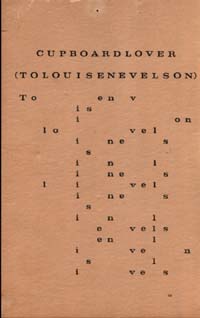
Who is GS whose initials are in tiny type at the base of this poem in praise of the American sculptor Louise Nevelson?

concrete poem in honour of louise nevelson

The title and dedication are made of bunched up letters and subsequent letters rain down in lines which with a bit of patience can be read along the horizontal.

CUPBOARDLOVER
(TOLOUISENEVELSON)

The following lines with some reassembly give

To envision loveliness
in lines
liveliness in levels
enlivens lives

Of course my line breaks are a wee bit arbitrary. So is my stab at identifying GS — Gilbert Sorrentino? But he’s not known as a concrete poet. Could it be George Stiles who is annotated as G.S. in a number of bibliographic references to art criticism that appeared in Pictures on Exhibit?

ADDENDUM: GS could be Geoffrey Summerfield. This small card with the poem Cupboardlover was given to me by Douglas Chambers who also gave me a poster-sized concrete poem “The Watts Tower Poem” by Geoffrey Summerfield – identified thanks to an inscription in Douglas Chambers’s hand on the back. Unfortunately his memory no longer serves him well. There is no asking.

There is possibly a connection via Thom Gunn (he appears in an anthology edited by Geoffrey Summerfield). Gunn and Chambers had an active and extensive correspondence. One of the items listed in the finding guide to the Chambers and Gunn papers in the Thomas Fisher Library is correspondence from Geoffrey Summerfield (Box 1, Folder 15). And there are art cards in other boxes and folders. The archive beckons.

And so for day 1288
23.06.2010

Posted in Uncategorized | Leave a comment

It’s spelt c-a-p-i-s-c-e, capeesh?

I was seized of the Italian origins of “capisce” when I recently encountered it in print. Throughout my years on earth I had thoroughly thought of it as a proper English expression with Anglo-Saxon roots for “do you understand?”

http://en.wiktionary.org/wiki/capisce

“Capisce” now takes pride of place with “arrivederci” for “later, alligator” from the 1950s tune.

Get it? Got it. Good.” from the 1955 Danny Kaye vehicle The Court Jester.

Prediction: “capisce” will likely appear in some mashup coming to you soon.

Roger.

And so for day 1287
22.06.2010

Posted in Uncategorized | Leave a comment

Everything is to be gained there

Phoebe Hoban in Basquiat: A Quick Killing in Art reminds us that

It is significant that one of his favorite source books included a dictionary of hobo signs — and from it he took not only symbols but poetry. (“Nothing to be gained here.”)

Hobo sign = nothing

Henry Dreyfuss. Symbol Sourcebook

Greg Tate in “Nobody Loves a Genius Child: Jean Michel Basquiat, Flyboy in the Buttermilk” alerts us to the importance of the words and symbols painted by Basquiat.

In the rush to reduce the word games found in Basquiat works to mere mimicry of Cy Twombly’s cursive scrawls, we’ve expected to forget that Basquiat comes from a people once forbidden literacy by law on the grounds that it would make for rebellious slaves. Expected to overlook as well that among those same people words are considered a crucial means to magical powers, and virtuosic wordplay pulls rank as a measure of one’s personal prowess. From the perspective of this split-screen worldview, where learning carries the weight of a revolutionary act and linguistic skills are as prized as having a knockout punch, there are no such things as empty signifiers, only misapprehended ones.

Flyboy in the Buttermilk: Essays on Contemporary America pp. 238-239.

Later in this article, Tate makes the point that “Black visual culture suffers less from a lack of developed artists than a need for popular criticism, academically supported scholarship, and more adventurous collecting and exhibiting.

Run search on “Black Visual Culture”.

hobo sign = hit the road

And so for day 1286
21.06.2010

Posted in Uncategorized | Leave a comment

rorrim

nathalie stephens (Nathanaël).

Mirror. Book. Page. Turn.

If by chance we speak to mirrors, it is perhaps less for narcissistic reasons than out of a desire for dead time separating us from the battering voices we carry. I turn the page of a book and entire civilization harasses me. If I must accuse myself, I can only do so by drawing you with me into my minds’ maze where I love of a love worthy of misanthropy.

Turn. Page. Book. Mirror.

Absence Where As (Claude Cahun and the Unopened Book) p.48

Have I here a transcription error “entire civilization harasses me” for civilizations in the plural or a dropped article for an entire civilization? Or are we true to the mirroring text? The maze one will note is the possession of a collective of minds. A trip to the library seems to be in order … to check out page 48 and any minor mirror errors.

And so for day 1285
20.06.2010

Posted in Poetry | Tagged | Leave a comment

Lessons in Diversity

A little Hassidic Tale, a little knotwork.

p. 146

Learn from All

They asked Rabbi Mikhal: “In the Sayings of the Fathers we read: ‘Who is wise?’ He who learns from all men, as it is said, ‘From all my teachers I have gotten understanding.’ Then why does it not say: ‘He who learns from every teacher’?”

Rabbi Mikhal explained: “The master who pronounced these words is intent on having it clear that we can learn not only from those whose occupation is to teach, but from every man. Even from one who is ignorant, or from one who is wicked, you can gain understanding as to how to conduct your life.”

Martin Buber Tales of the Hasidim: The Early Masters trans. Olga Marx (New York: Schocken Books, 1947)

And from a signature block that my email messages once sported, a turn from me.

some threads tangle in tassels, others form the weft

I also am very fond of saying “connect sometimes by disentangling” to describe some of the analytical work that goes into assisting a client.

And so for day 1284
19.06.2010

Posted in Uncategorized | Leave a comment

To Be Read to the Tune of Telemann’s Cricket Symphony

A group way into an irrational number. Always approaching.

(Mar 25 15:46) From Irc: polite
(Mar 25 19:09) From Light: rude
(Apr 1 18:50) From Irc: awakening
(Apr 2 15:12) From Light: enlightenment
(Apr 2 18:49) From Yred: karma
(Apr 4 04:34) From Irc: instant
(Apr 7 18:54) From Light: coffee
(Apr 7 19:53) From Yred: cake
(Apr 9 19:43) From Light: pie
(Apr 10 15:24) From Irc: circle
(Apr 14 19:15) From Yred: pi

Part of the further fun is extracting a series. For example the contribution from IRC: polite awakening instant circle.

Mad House Talker — telnet madhouse.dune.net 5550

Previous Run

And so for day 1283
18.06.2010

Posted in Uncategorized | Leave a comment