Picks of Pics

Les Murray.
Poems the Size of Photographs

Here are excerpts presented in reverse order of their appearance in the book.

The Test

How good is their best?
And how good is their rest?
The first is a question to be asked of an artist.
Both are the questions to be asked of a culture.

I like how in such a short space the context widens.

The next is a two-line stanza from a poem made up of two-line stanzas entitled Portrait of a Felspar-Coloured Cat.

All her intelligence
is elegance.

Gentle reader, the comment about the cat could be one about the poems but our author is far too modest.

The humour of the next serves to ward off any turn to the metaphysical.

The Knockdown Question

Why does God not spare the innocent?

The answer to that is not in
the same world as the question
so you would shrink from me
in terror if I could answer it.

Where it all began.

Big Bang

If everything is receding
from eveything, we’re only
seeing the backs of the stars.

Hope you liked the tour of the album. And if you have time read them bottom up to see how their wit first appeared to me.

And so for day 1282
17.06.2010

Posted in Poetry | Leave a comment

Blossoms Scattered, Eyes Scratched

The 2005 Griffin Poetry Prize Anthology has a selection from nominated poet Fanny Howe. Her On the Ground which I continuously misquote as Open Ground by some concatenation with Opened Ground: Selected Poems, 1966-1996 of Seamus Heaney. In any event I was caught by these lines

Maybe the end of the world happened long ago
A whirl as quick as Judas breaking his neck
and every sound is an echo

There is of course the end rhyme (ago – echo) and the internal rhyme (quick – break – neck). And the subtle shift in tense.

I dwell on this suggestion of what might have happened if events had not led to Judas hanging himself. The “maybe” here is picked up by a later question : can I?

Can I toss them aside
like an armful of sticks and set out as a feeling
to find Hana and Issa across the night

Never mind the referent of “them” for the moment. Let us concentrate on objects of a search: Issa could be the Japanese haiku poet but there is no poet in the tradition that readily responds to the name Hana. (We could be dealing here with pets — household felines.) We can find hana in the poetry of Issa. It is not a proper name but the word for “blossom”. We are here deforming on a search of our own not quite tossing aside brain and skeleton which are the immediate referents to the notoriously slippery “them”.

Why I like the blossom-connection regardless of authorial intention:

hana saku ya me wo nuwaretaru tori no naku

cherry blossoms–
chickens with eyes stitched shut
are clucking

David Lanoue highlights this poem and its translation and provides commentary in his Master Bashô, Master Buson … and Then There’s Issa appearing in Simply Haiku Autumn 2005, vol 3 no 3.

Jean Cholley notes that in the poultry market in the Muromachi district of Edo (today’s Tokyo), the eyes of the doomed birds were sewn shut to keep them immobile while being fattened in their cages (237). Issa sketches this not-pretty scene with blunt honesty. And though he utters no emotional words, one feels his heart going out to the birds who cannot see, and never again will see, the cherry blossoms.

Reference: Cholley, Jean. En village de miséreux: Choix de poèmes de Kobayashi Issa. Paris: Gallimard, 1996.

Can I now return to where the echo began to reverberate? But I have lost a world. Gone like a “single bubble in steeping tea” the meaning according to Robert Hass of Issa’s name. But accessible again to more complicated readings when one considers that Judas is Greek for Judah which in Hebrew means “thanksgiving, praise”. Worth pursuing? Feeling one’s way across the night? Finding scattered on the ground? Inventing like a way to read with eyes stitched shut and mind wide open?

And so for day 1281
16.06.2010

Posted in Poetry | Tagged | Leave a comment

Prue and Clive (and not and)

A quick portrait of a marriage from of the verse letters in Clive James Fan Mail (1977).

I don’t know what my wife’s at, half the time:
Locked up with microfilms of some frail text
Once copied from a copy’s copy. I’m
Dead chuffed as well as miffed to be perplexed,
Contented neither of us has annexed
The other’s field. Though it’s conceit-sounding,
We Jameses think each other quite astounding.

http://www.prueshaw.com/ She, a Dante scholar; he, a translator of the Divine Comedy. http://www.clivejames.com/

But linked as they have been they are no longer living under the same roof.
In the introduction to his translation, which is really a love letter to his estranged wife, James recalls the first time, long ago in Florence, that she explained to him the complex subtlety of the Paolo and Francesca episode in canto 5 of Inferno. “Though it was assembled from minutely wrought effects,” he writes, “the episode really did have rhythmic sweep. Every moment danced and the dance was always moving forward.”

From The Guardian http://www.theguardian.com/books/2013/jul/05/clive-james-dante-translation

Worth remarking as we draw the curtain that Dante, moved upon hearing Francesca tell her story, faints.

And so for day 1280
15.06.2010

Posted in Poetry | Leave a comment

Rejoicing Wit: Clever By More Than Half

Shakespeare. Love’s Labour Lost.

HOLOFERNES, the pendant, celebrates the princesses hunting prowess. He does so with hilarious aplomb.

I will something affect the letter, for it argues facility.

The preyful princess pierced and prickt;
a pretty pleasing pricket;
Some say a sore; but not a sore,
till now made sore with shooting.
The dogs did yell: put L to sore,
then sorel jumps from thicket;
Or pricket sore, or else sorel;
the people fall a-hooting.
If sore be sore, then L to sore
makes fifty sores: O sore L!
Of one sore I an hundred make
by adding but one more L.

Explanatory Notes for Act 4, Scene 2 from Love’s Labour’s Lost. Ed. William Rolfe.

A buck of the first head. According to The Return from Parnassus, 1606 (quoted by Steevens) “a buck is the first year, a fawn; the second year, a pricket; the third year, a sorrell; the fourth year, a soare; the fifth, a buck of the first head; the sixth year, a compleat buck.”

Pun by way of number, pretty Roman numerals (fifty = L and one hundred = C). But what have we here? A doubling of the L would give us not “sorell” but “sorec” — a nonsense word by our accounting. But the doubling of 50 (L) to 100 (LL) by Holofernes’s could with the addition of a suffix “s” indicate the plural be “sorells” which is an anagram of “sollers” which is Latin for “clever” and just by chance the nom de plume of a French man of letters who has been much taken by Joycean language games of which Holofernes is a precursor. By the way, Philippe Sollers was born Philippe Joyaux — a gem.

And so for day 1279
14.06.2010

Posted in Uncategorized | Leave a comment

Leitmotiv Cache

From a literary salon chez des amis, I walked away with a phrase in my head from Diane Enns. I mangled it a bit when I replayed it “consolation of squirrels” when it was “commiseration of squirrels”.

Endowing squirrels with human sentiments enables Dickinson to show them as ideal counterparts, which in turn allows her to explore issues such as loss, the need for companionship, and loneliness. In Poem 131, in which the coming of autumn causes the feeling of an acute sense of loss, the speaker finds some comfort in the possibility that “a Squirrel may remain – / My sentiments to share” (P62, no. 131, 13-14). In the squirrel, the poet finds solace; the squirrel is not just any companion, but one capable of commiseration. Correspondingly, Dickinson herself is able to sympathize with the squirrel […]

“Squirrels” entry by Jan Michelle Andres in All Things Dickinson: An Encyclopedia of Emily Dickinson’s World edited by Wendy Martin.

Purely by the signifier “squirrel” (and the residue of “commiseration”) am I led to the multi-layered opera / film Fig Trees (Libretto: John Greyson, Music: David Wall) which features an albino squirrel modelled after those creatures that inhabited the CAMH property at Queen and Ossington (which also lent their likeness as logo of a caffeine dispensary as well as White Squirrel Way). The opera Fig Trees began life as an installation at the Oakville Galleries (Exhibition dates : 19 Nov. 2003 – 25 Jan. 2004) and a handsome catalogue with accompanying soundtrack has been produced. The squirrel doesn’t appear to have been a figure in the video installation at the Oakville Galleries — it of course appears in the 2009 film.

AIDS + Activism + Africa
http://www.yorku.ca/greyzone/figtrees/index.html
http://en.wikipedia.org/wiki/Zackie_Achmat

So we squirrel away.

And so for day 1278
13.06.2010

Posted in Uncategorized | Leave a comment

Minimalist Monuments

Answer: Lawren Harris.

Problem Statement: by way of John Berger on Magritte found in About Looking. Beginning with a few lines from the conclusion of Notes on Conceptualisms by Vanessa Place and Robert Fitterman:

This is the difference between Narcissus and Medusa. This is the difference between the barren and the baroque. This is the problem.

Indeed the problem morphed into a search for the “barren baroque”. And so it was a turn with Berger on the readable evinced in Margritte’s painting that gave us a hint, a strong hint in a parenthesis.

(I use the word readable metaphorically: his language is visual, not literary, though being a language, it signifies something other than itself.) Yet what he had to say destroyed the raison-d’être of the language he used; the point of most of his paintings depends on what is not shown, upon the event that is not taking place, upon what can disappear.

It was at a used book stall and leafing through a monograph about Bernini with copious illustrations — I came to understand that all the flowing scrollwork was the “barren baroque” because I was reading the record as it went by. Stationary as I was, I was ambulating. It was at that moment that I thought of the late Harris landscapes. Sublime. Barren. Baroque. In one space. Still. Thrusting upwards. Flick through a book of these and a similar readable flow is present and gone.

And so for day 1277
12.06.2010

Posted in Perception, Uncategorized | Leave a comment

Ascribing We Will Go

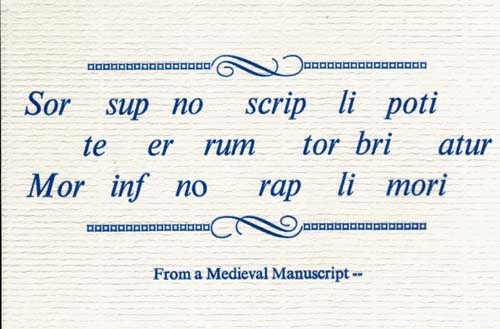
Either incipit and colophon, it came to me from my friend the translator and editor Diana Kuprel. A piece of ephemera in a package produced by the St. Michael’s College Press. Without attribution. Nicely set.

medieval curse against stealing books

A border of two destinies touching upon each other almost interwoven.

Sor	 	sup	 	no	 	scrip	 	li	 	poti	 
 	te	 	er	 	rum	 	tor	 	bri	 	atur
Mor	 	inf	 	no	 	rap	 	li	 	mori	 

Which reconstructed with the overlapping bits, reads

Sorte supernorum scriptor libri potiatur
Morte infernorum raptor libri moriatur

Englished

 	   wrote	  procure     joys	 life supernal
May he who	 this book	  the	    of	 
 	  steals	  endure      pangs	 death infernal

This version is care of David Harvey, University of Exeter, via personal communication to Mark Drogin (pages 90-91, Anathema!) which came to me via “Bibliomania and the Medieval Book Curse” by Sandra Anderson which paper was written for the LIS 586 – History of the Book course at the University of Alberta. It was posted to the web in March 2003 as part of a capping exercise for the completion of a Master of Library and Information Studies degree.

Still no idea what manuscript this curse/blessing comes from. I have in my searches found some variations:

Morte superborum …
Morte reproborum …
Morte malignorum …

For those interested in tracing down the manuscript sources for some these intertwined inscriptions from anonymous scribes, please consult the multivolume Colophons de manuscrits occidentaux des origines au XVIe siècle. Bénédictins du Bouveret. (Fribourg, Suisse : Editions Universitaires, 1965-1982). And many happy searches beyond (such is my curse and blessing).

And so for day 1276
11.06.2010

Posted in Booklore | Leave a comment

Carrion Call

Almost as if taken from a Parsi description of exposure in the Tower of Silence, Robert Bringhurst brings us to a new appreciation of feasting when he mediates upon the carcass of a dead fawn.

In terms of meat, there is not very much to a young fawn, but the eagles had opened her up, and the ravens had joined them. I reminded myself that being buried bit by bit in the guts of birds is at least as good as going into a hole in the ground, and that fueling an eagle’s flight or the voice of a raven is as fine a resurrection as anyone, human or deer, could hope for.

“The Silence That Is Not Poetry — And The Silence That Is” E.J. Pratt Lecture, Memorial University of Newfoundland, St. John’s 14 October 2005

In this collection of thirteen talks (The Tree of Meaning), I turn to an earlier lecture that also rifts on an ecological perspective. This time in the mode of culture and its artefacts.

So the cultural floor is a killing floor, and it’s littered with smithereens. Reach down and you might pick up some fragments of a Presocratic philosopher, a Zen master’s wink preserved in amber, a story or two told by an aboriginal elder, or a sheaf of poems by one of the great poets who go by the name Anonymous. You’ll have to sift through a lot of rubbish to find these treasures, but plenty of treasure is there: much more lying in the dust than you are likely to find in the superstructure. That’s why every true intellectual alive in the present day is a garbage picker.

“Poetry and Thinking” Luther College, University of Regina, 25 January 2001

For the visually-minded garbage picker there is the example of the catadores of the Jardim Gramacho chronicled in the movies Waste Land. For the booklover, there is detritus.com, the online home of Jeff Maser, Bookseller, through whose catalogues one can idle many an hour.

And so for day 1275
10.06.2010

Posted in Booklore | Leave a comment

Homophonia

It’s arresting. It appears (among other places) on page 66 of The New Yorker February 7, 2005.

It is drawn and captioned by Matthew Diffee.

It’s a single panel cartoon. A person sits by a begging cup holding a sign that reads “homeless”. Walking by is person carrying a brief case. Below is a single word which we ascribe to the sitting person: “Hobophobe!”

Wicked on so many levels.

And so for day 1274
09.06.2010

Posted in Uncategorized | Tagged | Leave a comment

Found Poem and Two Pastiches

Borrowed from e.e. cummings a selection of poems

Here they are set in American-style haiku à la Kerouac

the very skillful strangeness of your smile
the sweet small clumsy feet of April came
into the ragged meadow of my soul

And now set in an Anne-Carson-like fragment from some Sappho

[…]
[…]
[…]
[…]
[…]
[…]
the very skillful strangeness of your smile
[…]

[…]
[…]
[…]
[…]
[…]
the sweet small clumsy feet of April came

into the ragged meadow of my soul

Christopher Patton at The Art of Compost reproduces under the aegis of erasure practice a page from Carson and introduces (me) to the work of Jen Brevin on Shakespeare’s sonnets (Nets): “Against my love shall be, as I am now” is greyed out except for the found poem “I am / vanishing or vanished / in these black lines”.

And so for day 1273
08.06.2010

Posted in Poetry | Tagged | Leave a comment