Dream Net Sound Shaping

To bend twigs, to compose.

The Music of Warren Benson CRI SD433 [1981]. The Dream Net [18′ 10″] [Recorded at Eastman School of Music, 1978]. Frederick Hemke, saxophonist. Kronons Quartet, strings.

Notes from the album sleeve

The title, The Dream Net, came to me through the gift of a book from my friend, the composer Alec Wilder. The book was by Sigurd Olson, a naturalist who has written a number of times about canoeing the white-water rivers of North America. The particulars of the title relate to Indians gathering wild rice in Lake Superior and leaving their young children on the shore while they worked in canoes nearby. [There follows a description of the making of a contraption to amuse babies and the stories told to older children about the dream net and its filtering effects.] The fundamental composition problem was that of balancing the timbral distortion and tuning the saxophone multiphonic sonorities with the normal sounds of a string quartet. I attempted to do this through the use of variable vibrato, mixed vibrato speeds in the ensemble, quarter-tone intonations, glissandi, air noises in the saxophone and whispering noises in the strings, which are accomplished by bowing on pieces of paper. It was foremost in my mind that the significant effect of a multiphonic sonority was not necessarily the number of tones produced, but rather the change in timbre that seemed to occur during its production. I attempted to interpolate similar timbral resources in the string writing.

Compare the attention to “timbre” to care in positing the “dream net” so that its rotation yields the utmost “play” of light and shadow.

Note on the term “dream net” versus “dream catcher”: in the Olson account as retailed by Benson the net lets the good through and filters out the negative; it doesn’t trap.

And so for day 1202
29.03.2010
Posted in Introductions | Tagged | Leave a comment

Disposing of Dispersal

Margaret Atwood (playing out the thematics of Victory Gardens) in the forward to A Breath of Fresh Air: Celebrating Nature and School Gardens (having cultivated the ground of morals and food production) snaps from the vine this set of observations on the period of post-War affluence:

There was an undeniable emotional charge to throwing stuff out. Scrimping, saving and hoarding make a person feel poor […] filling up your garbage can with junk you no longer want makes you feel rich. Saving is heavy, discarding is light. Why do we feel this way? Once we were nomads, and nomads don’t carry around grand pianos. They don’t hoard food; instead they move to where food is. They leave a light footprint, as the green folk say. Well it’s a theory.

But we can’t all be nomads anymore. There isn’t enough space left for that.

I like how the very notion of nomad-influence gets discarded. The writing is composting itself.

A couple of observations: she doesn’t say we cannot be mobile. A Red Queen type of mobility sur place awaits us in our densed-up urban settings. Indeed at some level what we dispose of needs to develop velocity — needs to convert quicker (and in less space). The infrastructure of compost-creation leaves a heavy footprint. Industry plugs into local food.

Energy calculus. At play in the system will be a surplus of consumables — there will be food to waste (only so much hydroponic lettuce will find its way into our personal digestive track; a fair bit will provide roughage to the corporate waste management system). Cities will look to lock into their hinterlands their muck. Look up the history of “night soil”.

Future civic deliberations will focus upon the feeding of The Machine and the speed of cycling with factions vying for the accumulation of value through speed up meeting the resistance of calls for equilibrium though respect for traditional time lines. Will we have to take the time to become light footprint leavers? Become not nomads but partakers of the potlatch — a coastal people in the islands of our metropolises?

And so for day 1201
28.03.2010

Posted in Gardens | Leave a comment

Index Card Passport

In green ink on an index card

From The New Yorker Oct 6, 2003 p. 31

in the Auctions and Antiques section

Art Deco

posters of Paul Colin, whose works appear as part of a show of French Art Deco posters from the collection of Jean Chassaing, spanning the years 1925 to 1932. The machine-driven energy of the age is the theme of posters by the great A.M. Cassandre; his theory that “travel is a geometric experience” is demonstrated in striking illustrations of trains, steamships, and (in an advertisement for “Cycles Brillant”) a cyclist merging with his bicycle.

Loved his take on ingesting and becoming in the Dubonnet poster: the character becomes more colourful as he imbibes more … dubo dubon dubonnet.

Sad to learn that in his final years he suffered from severe depression and killed himself in 1968. But the same biographical note that conveyed that fact also identified him as a designer of type.

I snuck over to the Linotype site and in a moment of narcissism test ran the font family Cassandre designed and ran my name through Peignot Light. Truly calligraphic in its play between “L” and “h” so like handwriting … I was intrigued not so much by a narcissistic lapse but because the default text presented upon accessing the site is the name “Light” itself with its so ever elegant h. A remarkable display font. Whatever colour the ink.

And so for day 1200
27.03.2010

Posted in Booklore, Ephemera | Leave a comment

Black Leather Jacket Hanging in a Closet

Found in an accordion file while listening to Vertigo by Groove Armada

Could-have-beens are an intensity to shape between men with eyes. Possibilities pushed. The best tops are sceptics. Brush your body. Fuck your mind.

Blinded. He can still see.

1/4/94

Living in a fish bowl during the plague years. Living. Unpacking the caches.

And so for day 1199
26.03.2010

Posted in Uncategorized | Leave a comment

Beasts and the Nature of Prayer

Robert Bringhurst

A typographic mind is just as alert to the invisible as to the visible. It is a mind with at least four feet: one in the visual, one in the manual, one in the lingual and one in the logical. Each of these feet has several toes: abstract, tactile, aural. Crickets, as you may know, have taste buds in their toes and ears in their front kneecaps. Typographers are equally bizarre. Their ears are in their eyes; their tongues are in their hands. It is their fingers more than their lips that constantly threaten to move as they read.

[…]

In simple terms, what drives the typographer is the existence of something to say. Or of something that speaks, if you like to put it that way. Typography is the sound of one hand speaking, vivid in the mind’s eye, vivid in the mind’s ear, and silent as a prayer.

The Typographic Mind issued as The Devil’s Whim No. 16 by Gaspereau Press in 2006.

A typographer’s prayer is of course addressed to the reader. And a pamphlet is an old form for a new idea — the hybrid sensory-swapping mind. What is here at play in world of typography reminds me of architectural renewals such at the Gladstone Hotel which has produced a nice postcard quoting Jane Jacobs (beautiful but marred by an unmodest claim of “Only at the Gladstone”): Old ideas can sometimes use new buildings. New ideas must use old buildings.

Consider silent prayer as idea-building as four-footed as the beasts of the typographic imagination.

And so for day 1198
25.03.2010

Posted in Booklore, Metaphor | Tagged | Leave a comment

Snap Shot

Cliché : Phototype négatif servant au tirage des épreuves. (Larousse)

[T]he camera is not a machine, except when used mechanically.

Clarence John Laughlin in New World Writing #15

Last lines from David O’Meara “Loot” in A Pretty Sight

Every day soldiers come / to have their pictures / taken from the top / of the bullet-notched ziggurat, each click / an exhibit of the I was here, desert cam / lost in silhouette against the level, / ochre panorama of sand.

This is the difference between the barren and the baroque. This is the problem.

Notes on Conceptualisms. Vanessa Place & Robert Fitterman

Cliche: The word cliché is drawn from the French language. In printing, a cliché was a printing plate cast from movable type. This is also called a stereotype. When letters were set one at a time, it made sense to cast a phrase used repeatedly, as a single slug of metal. “Cliché” came to mean such a ready-made phrase. (Wikipedia)

And so for day 1197
24.03.2010

Posted in Uncategorized | Leave a comment

Brotherly Exposure

Bonnie Devine in the appreciation written for Daphne Odjig‘s 95th Birthday and included in the catalogue of the exhibition at Phillip Gevik’s Gallery describes the painter’s style:

Calligraphic, rhythmic in line, the forms emerge as if the artist’s brush has never left the page but travelled in an unbroken movement across its face.

Devine notes that upon achieving this style, Odjig signs her birth name to her paintings. “She had found a compelling reason to paint and a profound source of inspiration. She began to sign her work with her birth name, Daphne Odjig.”

One of my favourite pieces in the exhibition is a 1977 painting entitled The Brothers. Three smiling figures occupy the whole of the canvas. They look outward with big engaging smiles. And centred on each one is a stylized phallus built out of rippling waves echoing the ribbon of river that surrounds the three males. As a spectator one is captivated by the rhythmic joy of the moment. The painting reads as an exposure of benevolent power not only because of the presence of radiant smiles but also because the lines of the stylized phalluses cover the abdomens from the base of the perineum to the solar plexus thus depicting an expansive libidinal pleasure.

All this exuberance conveyed in acrylic on a 36″ x 34″ canvas. But with an artist’s hand to see the forms emerge and an artist’s eye to shape the dance of colour.

And so for day 1196
23.03.2010

Posted in Uncategorized | Leave a comment

Seep Age Drift Age

[…] l’être du language n’apparaît pour lui-même, que dans la disparition du sujet.

Michel Foucault “La Pensée du dehors” Critique No. 229 (June 1966)

Dispersal. Refiguration.

In the poetry of Edward Mycue, collected in Mindwalking 1937-2007, one comes to “Word Thumb” which is a paean to the songs and stories heard in a childhood family setting and lead the speaking voice to claim by poem’s end

I carry in me a singing man my father gave me.

Note that it is not a father that “I” is carrying but a “singing man”. Note too that as readers we have witnessed a performance of the singing man by reading the previous lines celebrating the “radiance of life’s simple pleasures”.

Inspired by Mycue, I look to my history with my own father to see what equivalent to a singing man I might have internalized. My fond memories turn to the beach. There I recall how I learnt to trust. Learning to swim alternated between trusting that my father would not only buoy me up should I begin to sink but also that he would in his wise way let go. It was an experience that repeated itself in learning to ride a bicycle.

The other condensable image that the beach trips gave me was the memorable experience of digging a hole and marvelling as it filled with water at its bottom. It’s fine introduction to the penetrating power of water and water-like thoughts.

And the long walks along the beach in search of driftwood, I like to think have made me a patient hunter of treasure tossed up. Life’s a beach.

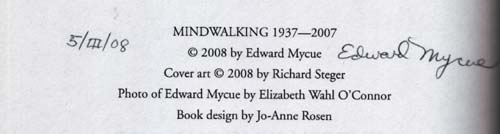
Indeed it is this careful searching along the littoral that allowed me to come across Mycue’s signature on the copyright notice page. Odd little bit that we set afloat again here like a note from a signing/singing man.

autograph of Edward Mycue

And so for day 1195
22.03.2010

Posted in Poetry | Tagged | Leave a comment

Given Stolen

Citation is a form of kleptomania.

gives, a note to envalue
the day, stolen

I like how the poet in these two lines balances out the beginning of giving with the concluding of stealing. Of course, what snagged my attention was the use of “envalue” and I was left hovering over what it is that contributed value and what it was that received it.

More context on either side is revealing but also conducive to less allusiveness…

around a gift the old stereo
gives, a note to envalue
the day, stolen

from notions of winter

George Bowering. Another Mouth. “Last Lyrics: From the Mystery”.

Citations are a form of endowment.

And so for day 1194
21.03.2010

Posted in Poetry | Leave a comment

Little Red Reading List

It was Roald Dahl and his Revolting Rhymes that set me on the course to consult variations. What did me in — was his mash-up of the Three Little Pigs and Little Red Riding Hood and Quentin Blake’s illustrations capture the uproarious fun of [SPOILER ALERT] the fashion-conscious conclusion:

Ah Piglet, you must never trust
Young ladies from the upper crust
For now, Miss Riding Hood, one notes,
Not only has two wolfskin coats,
But when she goes from place to place,
She has a PIGSKIN TRAVELLING CASE.

And so I turned to the Virago Book of Fairy Tales Volume One edited by Angela Carter and found in the notes a useful reference to the work of Jack Zipes, The Trials and Tribulations of Little Red Riding Hood and a search by author led to Don’t bet on the prince : contemporary feminist fairy tales in North America and England edited by Zipes which contains the poem “Little Red Riding Hood” by Olga Broumas which is found in her 1977 book Beginning with O where one finds a whole set of fairy-tale inspired meditations on the love between women. And so one reads about Sleeping Beauty awakened by the kiss of a woman. The kiss is related in a mode of defiance and as a challenge to recapture the colonized quotidian.

a sign of betrayal, your red
lips suspect, unspeakable
liberties as
we cross the street, kissing
against the light, singing, This
is the woman I woke from sleep, the woman that woke
me sleeping
.

But back to Little Red Riding Hood. After an opening about the mother-daughter relationships mediated by placental imagery, Broumas concludes that poem with lines that jump from being on the look out for wolfmen to participating in a community of sexual intimates, the jump is there for the reader to see inscribed on the page

minded. I kept

to the road, kept
the hood secret, kept what it sheathed more
secret still. I opened
it only at night, and with other women

Broumas is a good place to begin in constructing a reading list devoted to women-women relationships and the fairy tale. One could add Malinda Lo’s contribution to young adult fiction Ash. And it could even be argued that (SPOILER ALERT) that the kiss at the end of Disney’s Maleficent recasts the intergenerational relation between women in a manner that is both more and less than a riff on mother-daughter patterns and certainly is a figure that arises from the nature of friendships propelled by initiation into a shared world. It would be interesting to see how “true love” translates to the novelization of the movie by Elizabeth Rudnick.

And so for day 1193
20.03.2010

Posted in Storytelling | Leave a comment