Lukewarm Releases Umami

It’s technical and precise but the process is simple to follow.

Another point is that the enzymes that break down the ribonucleotides into guanylate work most effectively at a temperature of between 30 and 40ºC, and when subjected to high temperature they become inactive. Thus if the dried shiitake is soaked in boiling water, the enzymes are inactivated and no more guanylate can be released. By contrast, if the shiitake is soaked in lukewarm water around 30-40ºC, then the enzymes can continue to produce guanylate from ribonucleotides, increasing the umami taste.

Advice from Dashi and Umami: The heart of Japanese cuisine

And so for day 983
22.08.2009

Posted in Food Writing | Leave a comment

A Summit of Summation

Your trust in the independent scholar increases as you read the article and come across a beautifully constructed sentence that carries you further along:

While futurism discarded mimetic representation in favor of fragmentation and wordplay, and symbolism depicted objects as vehicles to a higher sphere, acmeism espoused a poetics of palpability and precision: the acmeist poet depicts the earthly object with heightened clarity, attempting to view it as if for the first time, like Adam.

From Kirsten Blythe Painter, “Acmeism” in The Princeton Encyclopedia of Poetry & Poetics. Informing in a beautiful fashion.

And so for day 982
21.08.2009

Posted in Uncategorized | Leave a comment

Order of Words

Northrop Frye on what we do when we read in a certain way…

Everyone who has seriously studied literature knows that he is not simply moving from poem to poem, or from one aesthetic experience to another: he is also entering into a coherent and progressive discipline. For literature is not simply an aggregate of books and poems and plays: it is an order of words. And our total literary experience, at any given time, is not a discrete series of memories or impressions of what we have read, but an imaginatively coherent body of experience.

The passage is from Frye’s essay on Milton’s Lycidas collected in Fables of Identity: Studies in Poetic Mythology. It is not surprising that as he goes on to develop his theme, Frye links this “imaginatively coherent body of experience” to an archetypal structure.

It is literature as an order of words, therefore, which forms the primary context of any given work of literary art. All other contexts — the place of Lycidas in Milton’s development; its place in the history of English poetry; its place in seventeenth-century thought or history — are secondary and derivative contexts. Within the total literary order certain structural and generic principles, certain configurations of narrative and imagery, certain conventions and devices and topoi, occur over and over again. In every new work of literature some of these principles are reshaped.

And so we come to the myth of the protean universe alive with repeating patterns. Configurations constantly reconfigured. Old friends in new guises. What is remarkable is how much hinges on the simple phrase “order of words.” And how that phrase is cast in parallel to another “body of experience.” The latter makes the former shimmer and move. And yet somehow underneath, the rebellious spirits of seriality, of historicization, and a deep appreciation of flux, are complicating the timeless apprehension of structure. The derivative drives if not the reading then the reshaping.

Frye is correct. It takes progressive discipline to discern configurations.

And so for day 981
20.08.2009

Posted in Reading | Leave a comment

Catch and Release Something Lucretian

From VII in the sequence “Migrant” in The Lease by Mathew Henderson. The foxes have lapped the water from sloughs contaminated by cow shit and they are later

retching rabbit from their stomachs in the field
And even this water brings your mind to trout:
the first one you caught, slapped down, scales on sink,
and cut, still gulping, from belly to tail. Your fingers
probing like your father’s, hard against the gentle insides,
and finally the quiet as you felt a little salamander, still living,
wriggle his head free of the guts. Placed him gently
on the lawn, found him frozen the next morning.

For some reason (the mention of trout? the poetic use of technical vocabulary?) the poem in this part of the sequence and as a whole reminds me of Earle Birney’s “David“.

And so for day 980
19.08.2009

Posted in Poetry | Leave a comment

Colophon Quibbles

This reads as a parody by its excess and by the fact that it’s the colophon to a work of poems infused with the jargon of the oil patch. Someone at the Coach House Press was having fun with Mathew Henderson’s The Lease.

Typeset in Roos.

Printed in August 2012 at the old Coach House on bpNicol Lane in Toronto, Ontario, on Zephyr Antique Laid paper, which was manufactured, acid-free, in Saint-Jérôme, Quebec, from second-growth forests. This book was printed with vegetable-based ink on a 1965 Heidelberg kord offset litho press. Its pages were folded on a Baumfolder, gathered by hand, bound on a Sulby Auto-Minabinda and trimmed on a Polar single-knife cutter.

Wine snobs could not be more elegant. Except the accent is missing on “Québec” which would not be noticed if they were not present on “Saint-Jérôme”.

And so for day 979
18.08.2009

Posted in Booklore | Tagged | Leave a comment

Learning Patience

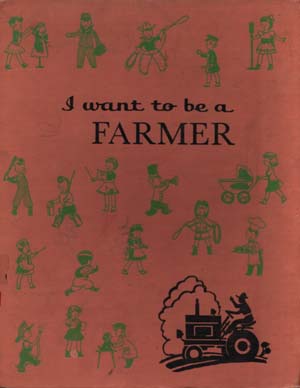
I want to be a FARMER by Carla Greene, illustrated by Irma and George Wilde (Childrens Press, 1959). The beginning sets out the mindset of the young protagonist:

Jim did not like
to make a garden.
Dig, dig, dig.
Work, work, work.
Wait, wait, wait.

Through the course of the story after a visit to Uncle Dick’s farm, the hero grows more appreciative. It helps that the narration is supported by good design from the front cover on.

Cover - I want to be a Farmer

I want to be a Farmer

And so for day 978
17.08.2009

Posted in Gardens | Leave a comment

Out Bound

In French one observes the link between to read (“lire”) and to bind (“lier”). Spellbinding. Leads one to ponder the etymology of “read”. And of course how one’s experience with the act of reading may be conditioned by one’s participation in a given linguistic community. Take the German expression for to learn by heart “auswendig lernen”. It is about uttering whereas growing up with the French equivalent “apprendre par coeur” was to store near one’s heart — very much an ingathering exercise. And the German is closer to the Latin “ediscere” where learning (discere) and saying (dicere) are close. And there is Brian Stock’s book that deals in part with forms of subjectivity fostered by the advent of silent reading (Augustine the Reader: Meditation, Self-Knowledge and the Ethics of Interpretation).

And I come to wonder how reading aloud is connected to speaking about. Are these transferable skills? A great actor may give a great reading but is it a great interpretation? Some languages have “interprétation” for both reading aloud and interpretation. “Lecture” (reading) is a usually solitary act which may lead to a “conférence” (a lecture).

Now I am thinking of the role of audience and how the presence of the other whether virtual (in the echo chamber of our mind) or actual in the reading group or seminar breaks the bindings and sets us free — as if reading were a type of willing enslavement, a disciplinary passage to freedom. And Wikipedia offers this piece of information about voluntary slavery:

In ancient times one of the most direct ways to become a Roman or Greek citizen was by means of a self-sale contract. For the laws surrounding Roman and Greek manumission made it quite possible for such erstwhile slaves to then become citizens or near-citizens themselves. See Citation Note 3.

Every binding is broken. Not breakable. But broken. In the mindset of manumission we come to the act of reading as menders. The book as broken object in need of repair. And ironically the only way to repair the binding spell is by unwinding the bound. But if the book is not a codex how do we apply our metaphorics? The game becomes one of intersecting at the boundaries, keeping the play in bounds. That is in the circle of awareness, within the attention. Or caching. Through one’s heart towards that of a future reader.

And so for day 977
16.08.2009

Posted in Reading | Tagged | Leave a comment

“Making Love to Myself”

“Bleak,” he said. What about the poem where he plays with himself? Actually it’s called “Making Love to Myself”. And it is poignant — which is not the same as “bleak.” Indeed in his introduction, Mark Doty devotes considerable space to this poem. He sums up for me something that my friend who cried “bleak” perhaps overlooks — the soothing aura of elegy:

Earlier, I called “Making Love to Myself” a proto-elegy. I’d like to suggest that it provides a sort of template for the sorts of poems that gay men were compelled to write a decade later, when the epidemic began to send a generation of lovers irrevocably to the Laramies of Elysium. It’s an elegiac mode that recognizes and identifies the difficult territory where eros and grief overlap, where tenderness is charged with physical fellow-feeling, where the absence of the body is inscribed as a charm for and an evocation of the vanished and lingering soul.

Bleak is the wrong word. Wrong for five reasons: 1) too short 2) too close in association with “blank” 3) it pecks at the poem from an outside perspective like a cruel beak 4) sadness is not the same as depression 5) i once gathered a number of poems under the title Tracking the Rememberance of Touch long before I found a kindred spirit in James L. White and The Salt Ecstasies (where “Making Love to Myself” can be found) and it takes a certain boldness to as the French say “afficher”.

My how feisty we have grown… Time to modulate and review what we wrote about Anne Carson and Paul Monette.

And so for day 976
15.08.2009

Posted in Poetry | Leave a comment

Printing Out and Slowing Down

Marie-Laure Ryan on reading Twelve Blue by Michael Joyce.

During my first pass through Twelve Blue I was so preoccupied with restoring a semblance of order in its informational chaos that I hardly took the time to slow down and properly savor a passage. The twelve lines on the left of each screen kept urging me to make use of my freedom to click, to move on and find out what lay beyond the screen. When I encountered passages that tempted me to take a deep breath and inhale the flavor of language. I cheated the electronic medium by printing them out. This allowed me to postpone their rereading and to move on in my elusive quest for narrative coherence. (Without printouts, and without a map of the network, who knows if I would ever get another look at a given screen?)

from Narrative as Virtual Reality: Immersion and Interactivity in Literature and Electronic Media

And so for day 975
14.08.2009

Posted in Booklore | Leave a comment

In Praise of Handwriting

Arthur Cooper in his notes to his translation of a poem by Tu Fu provides additional information about General Wang, a calligrapher of note.

It was said of him that his writing was “as light as floating clouds and as vigourous as a startled dragon.”

For a wonderful way to while away time — consider the Heilbrunn Timeline Of Art History offered by the Metropolitan Museum of Art. Searching for “calligraphy” nets not only Chinese but also Islamic and Coptic examples. The Heilbrunn Timeline also contains thematic essays such as the one by Dawn Delbanco on Chinese Caligraphy which provides a link to one of the items mentioned for further reading — Barnhart, Richard M. “Chinese Calligraphy: The Inner World of the Brush.” Metropolitan Museum of Art Bulletin 30 (April–May 1972), pp. 230–41. And then there is a host of sites devoted to Chinese calligraphy video. Slow Motion and Lightening Fast.

And so for day 974
13.08.2009

Posted in Uncategorized | Leave a comment