Dedication Deciphering

Adam Gopnik. Winter: Five Windows on the Season. The Massey Lectures.

For Gudrun Bjerring Parker

Filmmaker, feminist, lover of the world,
woman of the north,
who raised and loved and nurtured and then
let go of my own true love,
and, knowing too well how Demeter felt, never let her heart
grow cold to the borrower.

There is a lot packed into this little sequence shifting from the factual to the mythic. And it all falls into place for this bewildered reader when some helpful soul points out somewhere on the World Wide Web that the dedicatee is the author’s mother-in-law. And now one appreciates the statement that is being made by the reference to borrowing.

And so for day 963
02.08.2009

Posted in Uncategorized | Tagged | Leave a comment

unbodylike objects

Giles Deleuze’s Logique du sens brought me to Émile Bréhier. La théorie des incorporels. 1962. p. 44.

Ce qui fait le fond des arguments d’Aristote contre le vide, c’est que dans le vide en lui-même, on ne peut arriver à découvrir aucune déterminative positive, ni haut, ni bas, ni la vitesse d’un mobile qui le parcourrait. L’infini n’est donc pas placé en dehors, de la réalité, mais s’installe au sein même de la réalité sensible, comme principe de changement, de corruption et de mort.

My translation: What is at the root of Aristotle’s arguments against the void is that we cannot through the void in and of itself uncover any positive determination, neither height, nor depth, nor the speed of a mobile object that would traverse it. Infinity is thus not placed on the outside, outside of reality, but occupies a place within tangible reality as a principle of change, of corruption, of death.

p. 60

L’exprimable, le vide, le temps et le lieu, telles sont donc les quatre espèces d’incorporels admis par les Stoïciens. Ce n’est pourtant pas le néant absolu, puisque ces choses sont des objets de pensée; mais comme l’être véritable est ce qui agit ou subit l’action d’un autre être, on ne peut ranger dans les êtres ni les événements, ni le temps, ni le lieu puis qu’ils restent à la fois inactifs et impassibles.

You can easily run the paragraph through a machine translator. And arrive at “the expressible” for “l’exprimable” which is quite good. And a bit of further research with search engines and strings such as “Stoics void incorporeal four” and you will discover that John Sellars in Stoicism offers “sayables” and provides the Greek lekta. And the Greek term opens a door to a rich literature on Stoic philosophy and beyond to such texts as Umberto Eco, Semiotics and the Philosophy of Language.

And so for day 962
01.08.2009

Posted in Uncategorized | Tagged | Leave a comment

Cotrupi on Frye on Displacement

A quotation from Northrop Frye and the Poetics of Process. Caterina Nella Cotrupi. pp. 84-85.

What Frye understands by this term [displacement] is the gradual tendency observable in literature over time to move away from the pole of fiction and make-believe towards that of plausibility and ‘realism.’ The changes entailed in this movement involve the transition from the realm of fulfilled desire, of imaginative freedom to conjure the most ideal and visionary projections, to one where anxieties and concerns with time, contingency, nature, and fact are so pressing as to contrive a veritable imaginative prison or hell. […] so exaggerated that the plausible has been again left behind and the demonic side of the imagination makes its radical appearance through the nihilism of the most ironic and bleak satires and tragedies.

Captivating. The ordinary is somehow sandwiched between extremes. And the prose has us moving relentlessly.

And so for day 961
31.07.2009

Posted in Uncategorized | Leave a comment

Of The Endings of Games

Trying to decipher a thought process from 2001 or 2002. The entries are not dated but occur between entries that are. More mishaps. Misspelt author. Missing publication information. The notebook has “Callois” and page numbers. And no title. No translator’s credit. It plunges into questions and quotations. I’m sure the notebook records excerpts from Roger Caillois Les jeux et les hommes read in its English translation Man, Play and Games.

p. 17-18
It is possible to map agon & alea onto hermeneutic stances. I quote:

In the latter [agon] his only reliance is upon himself; in the former [alea], he counts on everything, even the vaguest sign, the slightest outside occurrence, which he immediately takes to be an omen or token — in short, he depends on everything except himself.

p. 19

Perhaps it is in the degree to which a child approximates an animal that games of chance are not as important to children as to adults. For the child, play is active.

This in the notebook provokes the remark “something to be said about the order of presentation agôn-alea-mimicry-ilinx”. What that something is is left unsaid. I can only hazard a guess at this late remove. And only by folding upon this the quotation about the interpretative stances (see above pp. 17-18) and bending it towards what follows (see below p. 23).

p.23

Mimicry is incessant invention. The rule of the game is unique: it consists in the actor’s fascinating the spectator, while avoiding an error that might lead to the spectator to break the spell. The spectator must lend himself to the illusion without first challenging the décor, mask or artifice which for a given time he is asked to believe in as more real than reality itself.”

And the comments from the notebook: “when the bubble bursts, players can get involved in the vertigo of yes-no, begin again or not. call and response and its termination become ‘digitalized’ that is alea can cancel ilinx”

Now reading these three excerpts, I am coming to a reading that posits the following: children have less of an interest in terminating any specific instance of a game than say adults might have; because they are not inclined to end the ongoing play, children have little need of the stroke of chance to mark endings — they have less need of omens and tokens — children are their own random event generators.

And so for day 960
30.07.2009

Posted in Uncategorized | Tagged | Leave a comment

Clioscope and HTML

I have come across the promo for a workshop on wordsmithing for the World Wide Web

Wednesday September 10/97, 7:30-9:30 pm

http://www.interaccess.org/weavers/panel2.html

Francois will be using the example of Clioscope to discuss authoring dynamic text. The presentation will focus on three areas:

Adequate Redundancy – comforting and surprising readers

Hybrid Audiences – accommodating the varieties of surfers

Contingent Closure – planning for future linking

What on earth did I mean? I had to revisit Clioscope to make sense of the remarks and so doing find myself reading the HTML markup as much as the other words in the source document.

Adequate Redundancy – comforting and surprising readers

E.g. using not quite icons but clues (such as graphic element with a vertical thrust with hyperlinks but without verbal reinforcements — counting on the browser to “Go to #top on this page”) Here’s the HTML markup
<a href=”#top”><img src=”clu.gif” border=”0″><img src=”cllu.gif” border=”0″></a>
And this is graphic element from Clioscope the graphic which appears to be repeated twice and with its twin “cllu.gif” plays with symmetry (and makes for faster loading in those days of dial-up connections).

Another little bit of decoration was the <HR> element — here improvised by the heading element (in the days prior to CSS): — See <h3 align=”center”>~~~</h3> — one is almost tempted to reach for a formula and describe this by analogy with the theatre of poverty as the “poverty of typography” which can used judiciously lend a richness.

Hybrid Audiences – accommodating the varieties of surfers

Play with comments <!– INSERT-COMMENT –>

As in this little bit at the top of SaPpHiStRy

<!– Yup, the boy – boy version is in the comments –>
<!– A gem in the markup –>

And if you to scroll to the bottom of the source of “SaPpHiStRy” you find some fun use of the comment space in the HTML markup. (Which reminds me of the chat room Bianca’s which had comments which characterized viewing the HTML markup as “peeking under the floorboards” of the shack.)

Contingent Closure – planning for future linking

<a name=”string”>

Using the HTML to create spots that are the target for links or more eloquently put by Ian S. Graham in the HTML 4.0 Sourcebook “Marks the anchored text as a possible specific destination of a hypertext link. The value of “string” identifies this destination.” And the hash tag is used to address such fragment identifiers. Fun to play with and very useful mark up. You can deploy fragment identifiers that could be used at some future date by some one intent on a specific spot…

It’s a wordsmith thing.

And so for day 959
29.07.2009

Posted in Uncategorized | Leave a comment

Scanning Net Work of Networks

I have lifted this from publication elsewhere and elsewhen to bring it to a novel space and time. Self-spamming?

Somewhere spam senders are paying for connectivity and somewhere that service is being taxed and somewhere revenues are being generated for kindergartens and old age homes. Ah, but you will ask, is it fair for the receiver to be reminded of veniality and incur expense in being reminded. What is the cost of forgetting?

Reminders of veniality include get rich quick schemes and aids to sexual performance. Neither produce great titillation (no transport) and every time I hit delete reminding myself there is no signal without noise.

And so for day 958
28.07.2009

Posted in Uncategorized | Leave a comment

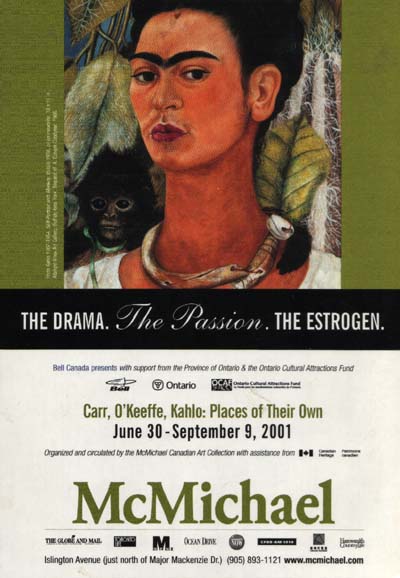
Carr, O’Keefe, Kahlo

The Drama. The Passion. THE ESTROGEN.
Reads the ephemera announcing the show.

Postcard - Carr, O'Keeffe, Kahlo show at the McMichael, 2001

Few North American women artists have achieved the legendary stature of Emily Carr (1871-1945, Canadian), Frida Kahlo (1907-1954, Mexican) and Georgia O’Keeffe (1887-1986, American). […] Places of Their Own, was inspired by Dr Sharyn Udall’s book of the same name.

From a brief description 2001 exhibit at the McMichael. More story but sans mention of estrogen. But trust the reviews to echo the bold statement from the publicity ephemera: Deidre Hanna in Now (July 26-August 2, 2001, Vol. 20 No. 47) Estrogen Art.

And so for day 957
27.07.2009

Posted in Ephemera | Leave a comment

Wow

I am amazed that I was able to think so coherently on an abstract plane. This is taken from MetaMimetics – HyperMnemonics

From With Towards

There in the book On the Origin of Objects by Brian Cantwell Smith, a passage fascinates me.

World-directedness takes many forms. […] subjects (their experiences, representations, documents, intentions, thoughts, etc.) point or are directed towards the transcendent-but-immanent world that surrounds them. A symmetrically realist account per se supplies two of the requiste ingredients in this pointing: (i) the fact that subjects are in an enveloping world, which gives them a place to point from; and (ii) the fact that they are made of that same enveloping world, which gives them the wherewithal to point with. What a theory of intentionality needs to add is the far-from-obvious third ingredient: (iii) a way for subjects to orient towards that enveloping world, the world of which they are constituted and in which they live.

What fascinates me is the way in which “from” is paired with “in” and “with” is paired with “made” and that “towards” remains unpaired. The trio of prepositions reminds me of the experience of modeling content or a way of writing in/with structured forms such as those offered by the Text Encoding Initiative Guidelines. Marking from…. marking with… marking towards. In a very fundamental fashion, writing is about how to segment and how to align. Pick a point. From that point there stem a before and an after. Pick another point and observe that part of one point’s after is part of another point’s before and observe a between that emerges with its own before and its own after.

Place a mark in a given space and with the given mark, place another mark [erasing is a type of marking] or stop.

Now I see “towards” in Smith’s phrase “orient towards” could be read sous rature. Peeking out of those italics is the phrase “a way for subjects to orient […] that enveloping world” which gives a hint of agency to acts of world-directed intentionality. And so I read again carefully and note a progression from the indefinite “an enveloping” towards a singularly demonstrative “that” through an attestation of “the same enveloping”. This rereading helps me better understand the medial position of the “with” between the “in” and the “towards”. It helps me comprehend that the connectedness of the made in and of the world might pass through an orientation for the world. Indeed the apperception of being in and of the world might depend upon the declaration of the thatness of the world. (Note, I am not arguing that the world depends upon either the apperception or the declaration.)

What fascinates me is the involutive relation to the actual. It is a relation that is not tautological. I am here because here I am. Contrast this with absolute circular assurance of the I-am-that-I-am.

Smith does not extensively treat the ontological status of the hypothetical, the counterfactual, the fictional. Yet the trio of ingredients in the theory of intentionality he sketches can offer a topological insight into the relations between the actual and possible worlds. And allows us to nuance his assertion that

You can hardly cook for dinner something that is fictional […]

with the indication that with every cook hovers a hallucinatory body. You cannot eat a story but a story can within limits alleviate the pangs of hunger. You cannot drink a sonorous sequence but within limits a sonorous sequence can quench thirst. You cannot but imagine and that is different from and not the same as the list of things you can do with fictional things that is offered by Smith: “refer to it, wonder about it, or entertain it in a hypothetical”. To be fair, one can hardly imagine without reference, wonder or entertainment.

In, with, towards the virtual
In, with, towards the textual
In, with, towards the interactive

A story can eat you.

And so for day 956
26.07.2009

Posted in Uncategorized | Tagged | Leave a comment

Nostalgia for Recycling

Thoughts on containers.

I recall a version of processed luncheon meat called Klick. A brand name very similar to the sound of the key used to open the can. A lever actually with one end like the eye of a needle and the other like the handle of a key to wind up a toy or a clock. The key came attached to the can. The key was detached and the eye-end hooked into a tiny tongue. A winding motion resulted in a wrapping of a strip of the tin and paper round the key. Considerable skill was required to avoid premature snapping.

There were containers that did not come with tools. Some books still require their pages to be slit.

The can opener on a Swiss army knife could also open bottles.

One kitchen tool was the bottle opener (for glass bottle with caps) at one end and a can opener (for cans of liquids) at the other. The can opener too was a lever. It was used to perforate the top of the can. For example, tomato juice cans would receive two holes before pouring. The holes would be placed at diametically opposed positions on the circle. Sometimes one hole would be a bit smaller, the air hole.

Tetra packs don’t quite have the same craft potential as an old tin can. However masses of them have been recycled into construction material.

A can not a tin. From the Old English for cup. Apt now when I think of cans as repurposed containers akin to the reusable mason jars. But unlike glass, a nail and hammer could tackle a can and produce amateur tinwork.

Prying caps with a bottle opener was also an art. You didn’t want to dent the cap too much. It could be added to a prized collection.

No fuss with milk bottles. No bottle opener was necessary. Fondly hoarded collection of cardboard milk bottle tops were, I believe, to inspire Pogs*, some time after glass bottles had been replaced by cartons. With the arrival of plastic spouts and foiled seals, the art of opening cartons now tackles a different set of fine motor coordination demands.

However much I like the design concept of a milk carton that unseals to form a spout (and produce no disjecta beyond its own shell and that has served on occasion to create candles or nuture seedlings), I am not nostalgic. I am merely sensitive to the memories of handling containers and how such memories might impact not only […] but also […], that is reading and writing [writ large]. Material culture counts.

from HyperMnemonics – MetaMimetics

* Pogs, Wikipedia informs me did not come milk bottles but a brand of juice. See Pogs

And so for day 953
23.07.2009

Posted in Uncategorized | Leave a comment

Portrait of the Artist with a Cigarette

Hockney, David.

from the brochure for “fresh flowers” which was on view at the Royal Ontario Museum in Toronto

With the iPhone I often drew with my thumb. I could hold it in my right hand and my thumb could reach every corner of the screen as it was small and the fulcrum of the thumb is within the thumb. I learned to type with my thumb as well, holding the phone in my right hand. I could then have a cigarette in my left hand to help me concentrate. I was one of the first to get an iPad simply because it was bigger and I assumed the drawings could be more complicated. I suggested to friends that they get one and I would send them the drawings. There was a new thing on the iPad. You could play the drawing back with the press of a button. I had never seen myself draw before, this also seemed fascinating to everybody I showed them to. The only thing seen like this before was Picasso drawing on glass for a film.

Drawing and drawing (as in drawing on a cigarette).

And so for day 952
22.07.2009

Posted in Uncategorized | Leave a comment