Of “uv”

The poetry of bill bissett is marked by non-standard spellings that make phonetic sense. This of course poses a bit of a challenge for machine processing. As observed by Christian Bök in “NICKEL LINOLEUM” (Published in Open Letter: bpNichol + 10, Series 10.4 [Fall 1998]: 62-74)

When Wershler-Henry uses his Microsoft program, for example, to correct the phonetic spelling in a poem by Bissett, the software fails to work on behalf of semantic lucidity, translating the desire for errata into a comedy of errors, so that, when confronted, say, with the word “uv,” the device does not read it as “of,” the correct variant, but as “ultraviolet” (1997a:[68]). Just as the gears of a printing-press drag Bissett, screaming, into their own mechanism, so also do the codes of a spelling-check drag the poem, gibbering, into their own formalism: “the machines were thundering on, turning fat ultraviolet” ([68])

The references is to Wershler-Henry, Darren. Nicholodeon: A Book of Lower Glyphs. Toronto: Coach House Books, 1997. And a copy of the referring text is available online via the Electronic Poetry Center at State University of New York at Buffalo http://writing.upenn.edu/epc/authors/bok/nickel.html

And so for day 941
11.07.2009
Posted in Poetry | Tagged , | Leave a comment

Disciplined Patience

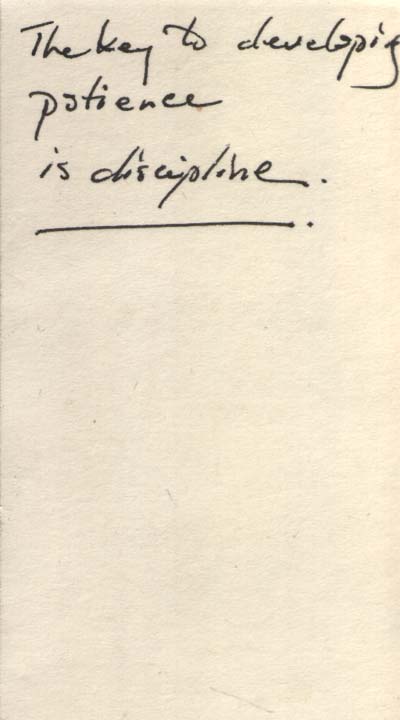
Sometimes how we write things is as important as what we write. I remember asking Marilyn Capreol about how to develop patience which she seemed to display abundantly. She said “The key to developing patience is discipline.” which I wrote on the back of her business card and I now see was given the space of a few line endings:

The key to developing
patience
is discipline
___________________.

Key to developing patience is discipline

Handwritten – Key to developing patience is discipline – made memorable

And so for day 940
10.07.2009

Posted in Ephemera | Tagged | Leave a comment

Interview Intervention

It’s catch 22. The poem is about an interview with a social worker type and the strange bid to portray oneself as just crazy enough to get benefits without being too crazy to get locked up. But the reader is left to surmise this from the opening lines “you are going to an interview / to prove you are crazy.” But the poem ends with gesture of refusal:

in a small room
     your inquisitor sits:
he serves up death
     like lemonade
perhaps you will forget
               to be crazy after all
;perhaps you will hand back
the lemonade with ice-cubes
     & ask him to drink.

Gwen Hauser. “The Interview” in May 1977 issue of Germination

And the placement of that semi-colon adds the appropriate touch of craziness.

And so for day 939
09.07.2009

Posted in Poetry | Leave a comment

Formalism and the Masses

Alan Liu. “The Power of Formalism The New Historicism” in Local Transcedence: Essays on Postmodern Historicism and the Database.

In the peroration to this piece about the space between text and context, the stakes are starkly positioned:

To read the world, after all, is not an ideologically neutral act. It is to appropriate the world from the masses of the less articulate and literate. It is a statement of privilege.

As stark as this may seem it doesn’t lead to impasse. It is not so much the case that privilege is to be surmounted as it is to be acknowledged. There is a moral obligation hinted at here that the intellectual moves from an “I can” to a “how may others do.” In a sense the reading becomes at some point self-reflexive if it is to avoid becoming self-absorbed. And so, the appropriation leads to a kind of alienation.

And so for day 938
08.07.2009

Posted in Reading | Leave a comment

Breeding Bread

Petite trouvaille.

Stephen Collis. “Another Duncan Etude: Empire and Anarchy” in in W [dix] a Duncan Delirium published by the Kootenay School of Writing

Dante’s thought can be seen to be a breading ground of democracy.

I imagine a lot of crumbs set out to mark a trail but somehow scattered by the wind or lost to the animals.

And so for day 937
07.07.2009

Posted in Uncategorized | Tagged | Leave a comment

Cowboy Miranda

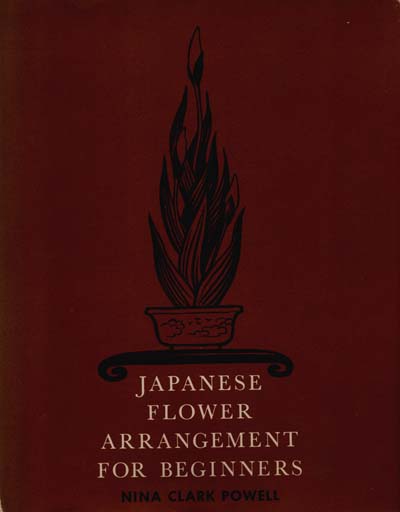
Some people tuck flowers and herbs into books. In my inherited (from Peter Blake) edition of Nina Clark Powell, Japanese Flower Arrangement for Beginners I have placed a picture of a uniquely poised bouquet.

Cover Japanese Flower Arrangement for Beginners

Nina Claire Powell

It is a photo of the late Peter Blake at a Spearhead run in 1993

Peter Blake at Spearhead Run

Peter Blake at Spearhead Run

I can vividly remember how we smiled together at the “Cowboy Miranda” picture. And now you can too.

And so for day 936
06.07.2009

Posted in Ephemera | Leave a comment

Top Five

How magazine’s 20th anniversary issue (February 2005) offers various listings in groups of 20. One of the listings is devoted to “20 tips to rev your creative engine”. My top five from the list (highlights as per original):

Collect. Maintain a reference file of raw material, such as photographs, magazine pages, fabric swatches, etc.

Take a long shower or bath. You’ll be surprised what comes to mind when you’re too soapy to write it down.

Allot 15 minutes for drawing or writing without distraction. No idea or concept is bad. Don’t judge, analyze or stop until the 15 minutes are up.

Record. Carry a sketchbook or digital camera wherever you go.

Use tools like clouded glasses and weighted gloves to experience processes as though you have the abilities of different users. This is an easy way to prompt an empathetic understanding for users with disabilities or special conditions.

The one of course that sticks out is the Record injunction since in the original the whole of it is in a bigger point size and has a wavy arrow leading to an illustration of someone using a sketchpad. And it is prominently in the middle of the list. What strikes me about most of the tips is the embodied nature of creativity. And, obviously the connection of mind and body and its importance for flow.

Extrapolating from this short list from the original 20, I would like to add a sixth:

Transcribe:

1. Collect
2. Take long showers or a bath
3. 15 minutes without distraction
4. Record (variation of collect)
5. clouded glasses, weighted gloves

Notice how a transcription can subtly shift perspectives?

And so for day 935
05.07.2009

Posted in Uncategorized | Tagged | Leave a comment

Recalling Sam The Record Man Spins

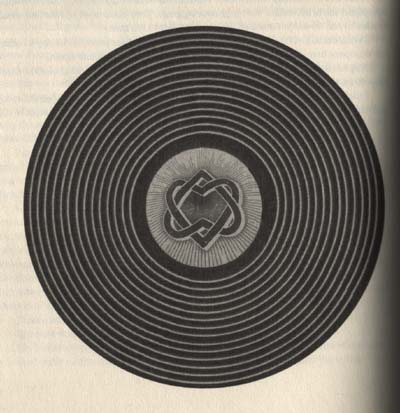
TOK: Writing the New Toronto, Book 7 presented by Diaspora Dialogues was designed by The Office of Gilbert Li whose page layout (lots of white space at the bottom and bunching of type at the top) took a little getting used to. However, striking are the illustrations that accompany the texts. In particular, the one for Irving Ellman’s “The Poet’s Voice” recalls in its design the huge signs that adorned Sam The Record Man and spun out their radiating light. The story of course features visiting the store. In lieu of a quotation from the story, here is a scan of the illustration that doesn’t quite do it justice since the book has illustrations on the left and the title/author on the right of the spread for each of the texts. Difficult to reproduce the pairing. Nonetheless, here is the visual homage to Sam’s.

Homage to Sam The Record Man

And so for day 934
04.07.2009

Posted in Booklore | Leave a comment

Post Enlightenment

The tenth vignette of the Ten Bulls by Kekuan is about returning to the world after a journey beyond and it reads

Inside my gate, thousand sages do not know me. The beauty of my garden is invisible. Why should one search for the footprints of the patriarchs? I go to the market place with my wine bottle and return home with my staff. I visit the wineshop and the market, and everyone I look upon becomes enlightened.

The Chinese story reminds me of a tradition with Hassidism. As related by Phyllis Gotlieb in an article about the work of A.M. Klein (“Hassidic Influences in the Work of A.M. Klein“, The A.M. Klein Symposium, Seymour Mayne editor, University of Ottawa Press, (Ottawa, 1975) pages 47-64).

The Lamedvovnik conceals his virtue behind a mask of silence, secrecy, poverty and ignorance. When danger threatens he emerges from concealment temporarily to defeat the enemy by his Kabbalistic powers. I do not think it is a coincidence that the Superman comic was invented by a couple of Jewish boys.

I chuckle at the image of super Buddhas that this juxtaposition proposes.

Bibliographic information re the English of the Ten Bulls: page 75 in Writings from the Zen Masters (Penguin, 2009) which is a selection from Zen Flesh, Zen Bones (Charles E. Tuttle & Co., 1957). The material was transcribed by Nyogen Senzaki and Paul Reps with illustration by Tomikichiro Tokuriki (b. 1902 – d. 2000).

The article by Phyllis Gotlieb has been marked up in an XML version using TEI encoding — http://homes.chass.utoronto.ca/~lachance/tei/gotlieb/gotlieb.xml and from that an HTML version has been generated — http://homes.chass.utoronto.ca/~lachance/tei/gotlieb/gotlieb.htm

A little bit of writing done on the way to market for those in search of some reading on their way to market.

And so for day 933
03.07.2009

Posted in Storytelling | Leave a comment

Smart Design

My library card sits in my wallet and peeking up is the top line from my Toronto Public Library card. It reads: “think read listen enjoy”.

think read listen enjoy = top line mantra from Toronto Public Library Card

And when I lift out the card it explodes into a drama of colour and lexical delight.

Toronto Public Library Card

And so I find my way.

And so for day 932
02.07.2009

Posted in Ephemera | Leave a comment