Cooking for the Barbarians

J.M. Coetzee Nobel Prize Lecture

But now, reflecting further, there begins to creep into his breast a touch of fellow-feeling for his imitators. For it seems to him now that there are but a handful of stories in the world; and if the young are to be forbidden to prey upon the old then they must sit for ever in silence.

One of those stories is that of demise. Given to us by Brillat-Savarin (trans. Anne Drayton).

On the appearance of the barbarians, the culinary art vanished, together with all the sciences of which it is the companion and consolation. Most of the cooks were massacred in their masters’ palaces; others fled rather than cater for their country’s oppressors; and the few who stayed to offer their services had the shame of seeing them refused. Those fierce mouths and scorched gullets were insensible to gentle charms of delicate fare. Huge haunches of beef and venison, immeasurable quantities of the strongest liquors, were enough to please them; and as the usurpers never laid aside their arms, most of their meals degenerated into orgies, and he banqueting-hall was frequently the scene of bloodshed.

There is a steak house in Toronto named aptly enough Barbarian’s Steak House. Where alas tartare is not on the menu.

And so for day 931
01.07.2009
Posted in Food Writing | Leave a comment

Harnessing Language Effects

Miriam Nichols in “Deep Convention and Radical Chance: The Two Postmodernisms of Robert Duncan and Robin Blaser” in W [dix] a Duncan Delirium published by the Kootenay School of Writing.

If theory taught us anything, it is that cognitive liberation is never enough: change has to take place in social institutions, not in texts. Blaser has repeatedly argued, for example, that the arts have a place alongside other practices like politics and philosophy; they cannot displace these others. This is to say that a change of consciousness is a necessary but not sufficient condition for a change in the world.

It begins with ways of reading. And moves on to practices of inscription. It is a form of engagement. The power of the textual is in the redundancies that it builds.

And so for day 930
30.06.2009

Posted in Reading | Leave a comment

Line Ups

Rachel Giese concludes her “The New Normal: The Mainstreaming of Mental Health” which appeared in The Walrus with an anecdote which not only humanizes the content but also offers us an object lesson. Her little story is about the service in the cafe staffed by clients of CAMH, service she received and service she witnessed being given.

The woman who served me was painstaking in her attention, reading me all the ingredients in every tea on offer. It took several minutes, but no one waiting behind me complained. After I got my drink, a man entered the café in a wheelchair, cutting to the front of the line. It was a cold day, but he was barefoot, and his clothes and beard were dirty. He was agitated and muttering loudly. There was a brief, slightly nervous pause in the noisy room. Then the woman who had just served me took control. She tended to him with the same level of care, interpreting his mumbled order, fishing into his pocket for his money and slowly counting it, then carrying his coffee to the table he pointed to outside. Everyone waited as she served him. Coffee in hand, he settled down to drink it. She returned to the cash register and took the next order. It was nothing more than a small moment of kindness and grace. But in this gentrified corner of the busy, changing city, it was its own kind of revolution.

Patience.

And so for day 929
29.06.2009

Posted in Uncategorized | Tagged | Leave a comment

Dark Stuff

What can you see in tiny steaming cups of mocha?

[…] shade
goes straight down, espresso
dense with intent […]

From “Shade” by Jan Zwicky collected in Songs for Relinquishing the Earth

I like the arrangement here producing endwords — shade, espresso, intent — they have their own depth. Zwicky has lodged an imagist poem in the heart of a larger piece like a small cup itself with provoking aroma.

And so for day 928
28.06.2009

Posted in Poetry | Leave a comment

The Eternal Semiosis of the World

Pat Cadigan. Synners. Local colour from the novel. More than mere colour, a contributor to the versimilitude effect.

She let the music wash over her, speed-thrash, cruise-metal, bang-rock, hard-core soul. It was almost like being back in one of those bad old Boston bars, Babe’s Beantown, Harborville, Kathye’s Klown, in the before-days, putting on a plain old tox — getting shitfaced, smashed, blasted, hammered — and then jumping all night to some group so hungry you got to starving yourself.

This a brilliant paragraph from so many perspectives. It is however the enumeration that first struck me and for some reason echoed with a reminder of Roland Barthes’s The Fashion System (Système de la mode). It was with the help of Jonathan Culler and his book on Barthes in the series Fontana Modern Masters that I was able to make the connection between fashion signification and realism in literature. Culler quotes from Barthes:

Fashion-writing thus comes back to the postulate of realist style, according to which an accumulation of small and precise details confirms the truth of the thing represented.

He adds “Fashion energetically and resourcefully naturalizes its signs because it must make what it can of small differences, proclaiming the importance of trivial modifications.” And quotes Barthes again but this time from Essais critiques “fashion and literature signify strongly, subtly, with all the complexities of an extreme art, but, if you will, they signify ‘nothing’, their being is in the signifying, not what is signified”.

Back to Cadigan — do you get drunker knowing more slang for shitfaced? Are you more knowing if you know?

And so for day 927
27.06.2009

Posted in Uncategorized | Tagged | Leave a comment

Home

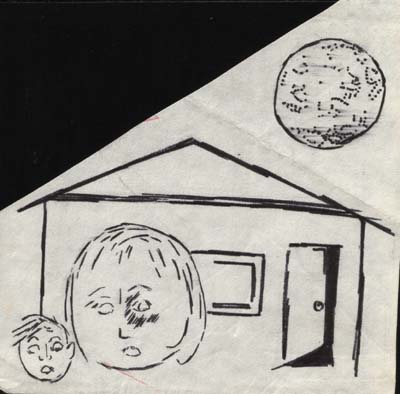
From sometime in the 80s, an illustration I produced for a poster for a fundraiser for an interval house or shelter.

line drawing - interval house

Interval House

Here juxtaposed with a poem by Li Po “Quiet Night Thoughts”

     Before my bed
there is bright moonlight
     So that it seems
like frost on the ground:

     Lifting my head
     Lowering my head
I dream that I’m home.

Translated by Arthur Cooper. Published by Penguin, 1973.

And so for day 926
26.06.2009

Posted in Ephemera | Leave a comment

Last of the Lost

Jean-Anthelme Brillat-Savarin quotes extensively from Doctor Richerand’s New Elements of Physiology on the order in which the senses shut down upon the approach of death.

Memory is extinguished next. The dying man, who in his delirium could still recognize those who approached his bedside, now fails to recognize his closest friends and members of his own family. Finally he ceases to feel; but his senses fail in a definite order: taste and smell give no further sign of their existence; a mist veils his eyes, which assume a sinister expression; but his ear remains sensitive to sound. This is doubtless why the ancients, to make sure that life was extinct, used to shout into the ear of the deceased. When the dying man can no longer smell, taste, see, or hear, there remains the sensation of touch, and he stirs restlessly in his bed, stretching out his arms, and constantly changing his position; he makes movements, as we have already remarked, analogous to those of the foetus in its mother’s womb. Death is about to strike, but it cannot frighten him, for he has no more ideas; and he finishes life as he began it, unconsciously.

Trans. Anne Drayton The Philosopher in the Kitchen.

Makes one believe that the fulness of eros resides in triggering all one’s senses together much like eating with one’s fingers.

And so for day 925
25.06.2009

Posted in Food Writing, Perception | Leave a comment

Chew. Spit. Ferment.

A worldwide tour of the powers of mastication.

To make liquor from grain or other starchy foods, the enzyme action of a substance such as malt or saliva must be used to change starch to sugar. When a very starchy food is chewed, either raw or after heating, diastatic enzymes in the saliva break down the starch into sugar. In this most primitive style of making alcohol from starch, the chewed mash is then spit out together with saliva, put in a container and fermented through the action of wild yeast. Liquor was made from chewed mash in Central and South America, including chicha beer made from maize or manioc, and in East and Southeast Asia. According to Chinese historical chronicles, liquor was made from chewed rice during the seventh century by the people of Primorsky Krai (the Siberian coastal region nearest to Korea and Japan), during the tenth century by minority groups of southern China, and during the Ming era (1368-1644) in Cambodia. Chewed-mash liquor survived up to the early twentieth century in Taiwan, where it was made by aboriginal peoples from their staple millet as well as from rice, and in the nearby mainland Chinese province of Fujian.

from The History and Culture of Japanese Food by Naomichi Ishige.

Reminds one of other beverages that pass through digestive passages such as Kopi Luwak coffee.

And so for day 924
24.06.2009

Posted in Food Writing | Leave a comment

Graphograph

chronograph
phonograph
photograph
chirograph

A list of words, all containing the suffix -graph, to set in relation to this from Shirley Neuman in Gertrude Stein: Autobiography and the Problem of Narration.

What interested Stein […] was [the] potential for replacing the linearity of the graph in autobiography (with its implications of cause and effect) by a multi-dimensional spatial configuration. […] In The Autobiography of Alice B. Toklas, the “space of time” which replaces chronological progression in narrative provides a multiplicity of vantage points from which to perceive the persons and events of a given moment of narrative.

Neuman begins her study with Stein’s experiments with the relation between the time being written and the time of writing. As she moves to the later works such as Paris, France and Wars I Have Seen she factors into account the time of readings. She concludes her book thus:

She transforms the genre into a profoundly impersonal one, a manifestation of the process of writing rather than an artifact of life. Her audience can no longer read as though it were standing invisibly “behind the scenes,” part “objective” observer with his “delicate shade of superiority,” part voyeur, part vicarious participant. Her readers must be her equals; their glimpses into the autobiography cannot be privileged but must be earned by the creative effort of their own minds recreating the process of Writing as they read.

This reminds one of Kaja Silverman’s exposition of the three subjectivies (the speaking subject, the subject of speech, the spoken subject). See Trapdoor.

chirograph
photograph
phonograph
chronograph

And so for day 923
23.06.2009

Posted in Reading | Leave a comment

Everything

The poet warns us not to “expect a catalogue of grace” which makes it weirdly difficult to quote one bit that doesn’t run into the specific particulars of some observed realty. But here goes with a bit of jumping:

Everything is in the light of everything […]
with an unfolding plenitude we are […]
Everything, before everything, is yours
and none an island — no, none, none, not one
but is the others’. We possess ourselves
only so far as others lean to us
and draw us, moving, into their stirred house
as easily as air, only so far
as everything remains itself and sings.

It is a poem that seems to transcribe mutability in its lines and yet there is a core of material resistance. If this sounds esoteric. It is. “Everything” is by the poem’s end almost a metaphysical principle. But it withdraws and “remains itself and sings.” We have Robin Skelton and his editors to thank for carrying this poem over into In This Poem I Am: Selected Poetry of Robin Skelton. Just close your eyes and repeat “everything” and you will get a sense of the effect. But you will miss the particulars. For that you need the poem as whole. But beware. You will begin to see everything as not just anything. Stein’s anyone and everyone, anyone?

And so for day 922
22.06.2009

Posted in Poetry | Leave a comment