Sodomy and Myth

Back in the days when I still engaged with the archetypes of Christian thought, I was having a rather inspired day when I typed out the following

Yet it was
the serpent’s spectrum
that led Adam to Sodomize Eve
and introduce pleasure into procreation.

I even had a technical explication off to the side about that capitalized “Sodomy”

Sodomize to create cities inimical to angels
agents, messangers of the myth of immortality

Yup that’s mess-angers for messengers.

At this late remove it is the hand written annotation above it all that pits “egotism vs grace” that strikes me as the real stake at hand. Still that is a mighty interesting definition of sodomy — at once appealing in its cleansing of illusion and yet those poor damned angels… Yet even more stunning perhaps is the little arrow from “cities” pointing to “growth –> organic superstructures”. Neither cities nor angels seem what they might appear to be. In a post-Biblical context it’s so very odd that they cannot occupy the same space (heavenly host and heavenly city) But in a universe where there is no heaven at all, the key is in that attitude to immortality — city is perpetually crumbling and requires work all the while… it carries on despite being the site of transience: a special sweet spot.

And so for day 861
22.04.2009

Posted in Transcriptions | Leave a comment

1492-1992

Ours and not ours. This is how I summarize the take on Columbus found in a smart little volume by Stefano Milioni about the foodstuffs that were adopted by Italians post contact. The volume is entitled Columbus Menu: Italian Cuisine after the First Voyage of Christopher Columbus and was published by the Italian Trade Commission out of New York. The figure of Columbus is the object of a complex gesture of appropriation and disavowal. Take the concluding paragraph from the section “To The Reader”

With the commemoration this year of the 500th anniversary of the first voyage of Christopher Columbus to the New World, a contest has erupted among European countries to claim credit for that enterprise, even if it means shouldering responsibility for some of the grave consequences of the historic undertaking.

There is further elaboration on the next page in the opening lines of the “Introduction”

It is not a question, here, of defending at all costs the Italian character of the explorer or his accomplishments, simply because Columbus was a native of Genoa. In addition, history also tells us that Italy, which was then divided into a multitude of small states, most of which were under the influence or domination of the major European powers of that time, played no role in the organization of the early voyages or the subsequent penetration and exploitation of the America continents by Europeans. Whether because of historical factors, incapacity, indolence or good will or bad, no Italian ship crossed the Atlantic in those years and certainly not with a cargo of armed soldiers ready to defy the unknown primarily in response to the mirage of wealth and power.

And the introduction rolls on to discuss the arrival and adoption of new foodstuffs. And various sections are given over to tomatoes, potatoes and chocolate among others with examples of first Italian recipes and modern recipes. And lots more interesting historical bits about food production since 1492.

And so for day 860
21.04.2009

Posted in Food Writing, Introductions | Leave a comment

Jug Jug

I am puzzled by one of the stories Martin Buber collects in Tales of the Hasidim: The Early Masters trans. Olga Marx (New York: Schocken Books, 1947)

Once the Baal Shem said to his disciples: “Just as the strength of the root is in the leaf, so the strength of man is in every utensil he makes, and his character and behavior can be gauged from what he has made.” Just then his glance fell on a fine beer jug standing in front of him. He pointed to it and continued: “Can’t you see from this jug that the man who made it had no feet?”

When the Baal Shem had finished speaking, one of his disciples happened to pick up the jug to set it on the bench. But the moment it stood there it crumbled to bits.

This seems like a piece of techno-determinism. Although it is difficult to see fault with a jug made by a man with no feet. Many a jug, after all, is footless.

On rereading the story it seems that it may be more about the bench than the jug : ) Never trust a disciple’s hand and a bench. You however gotta love the lame potter for providing such a good story.

And by some cultural interference, I am reminded of the lines in T.S. Eliot’s The Waste Land in which are rendered the cry of the nightengale: “Jug jug jug jug jug jug / so rudely forc’d. / Tereu”. And what use is there in a universe in constant metamorphosis for the need to be reading character and behaviour from objects? Is not the tale equally about attitudes towards objects — and the goodness of whether I preserve or destroy depends not only upon the object in question but to what purpose…

And so for day 859
20.04.2009

Posted in Translations, Uncategorized | Leave a comment

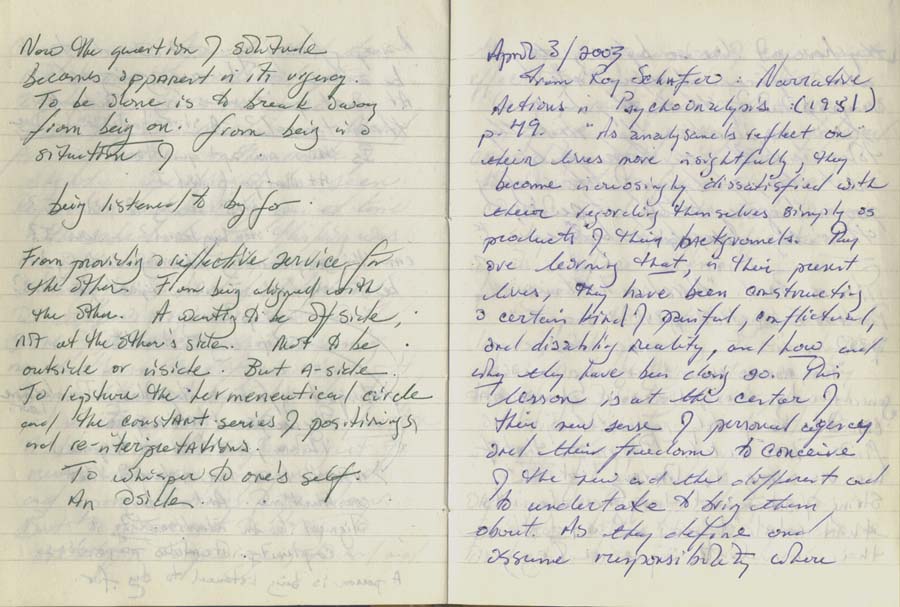
Solitude Transcriptions

A little journal entry from a end of March or beginning of April 2003.

Now the question of solitude
becomes apparent in its urgency.
To be alone is to break away
from being on. from being in a
situation of

being listened by for.

From providing a reflective service for
the other. From being aligned with
the other. A wanting to be offside,
not at the other’s side. Not to be
outside or inside. But A-side.
To rupture the hermeneutical circle
and the constant series of positionings
and re-interpretations.

To whisper to one’s self.
An aside.

Commonplace Book 2003

Commonplace Book 2003

It reminds me of Anthony Storr’s study on solitude. It also echoes for me a need to retreat from the theatrics of the everyday that can be very acute at moments.

And so for day 858
19.04.2009

Posted in Transcriptions | Leave a comment

Circle of Chairs

The 2004 edition (A Marian Wood Book published by G.P. Putnam’s Sons) has on the cover a sketch of six different chairs in arranged in a semicircle. The same drawing is reproduced on the title page and each of the chapters has one of the set of chairs as an emblem. This piece of design work has of course a corresponding moment in the The Jane Austen Book Club by Karen Joy Fowler: the host of one of the sessions of the book club has an insufficient number of matching chairs. It also happens (and the pictures cannot convey this) that the host of that particular session is the male member of the group and is a fan of science fiction. Here then is the picture that admirably shows the diversity of the group and their intent common purpose.

Semicircle of chairs from Jane Austen Book Club

Semicircle of Chairs

A little spoiler: by the end of the novel, the male character captures the attention of one of the other members of the group (in a reversal similar to that of Elizabeth Bennet and Mr. Darcy in Pride and Prejudice) and they converse about, of course, science fiction.

Jocelyn turned directly to Grigg. “I read those two Le Guins you gave me. In fact, I bought a third. I’m halfway through Searoad. She’s just amazing. It’s been forever since I found a new writer I love like that.”

Grigg blinked several times. “Le Guin’s in a league of her own, of course,” he said cautiously. He gained enthusiasm. “But she’s written a bunch. And there are other writers you might like, too. There’s Joanna Russ and Carol Emshwiller.”

My own initiation into the novels of Jane Austen went by way of P.D. James, Death Comes to Pemberley (which, by the way, was also the first novel by James that I read). And I have been reading science fiction for years.

And so for day 857
18.04.2009

Posted in Booklore | Leave a comment

Space: oriental and auditory

I once sent an inquiry to the McLuhan discussion list. There was little uptake on my questions.

It is perhaps well-known that the McLuhans (Eric & father) in Laws of Media refer to F.M. Cornford’s “The Invention of Space” in Essays in Honour of Gilbert Murray (London: George Allen & Unwin, 1936) perhaps via their acquaitance with Rosalie Colie and reading of her book Paradoxia Epidemica: The Renaissance Tradition of Paradox (Princeton, N.J.: Princeton University Press, 1966).

It is perhaps less well-known that Marshall McLuhan in a piece entitled “Cybernation and Culture” in The Social Impact of Cybernetics ed. by Charles Dechert (New York: Simon & Schuster (Clarion Books), 1967) [paperback reprint of the 1966 University of Notre Dame Press collection of papers from a 1964 conference] refers to the work of Georg Von Bekesy Experiments in Hearing.

I quote from McLuhan (p. 97)

Bekesy found it expedient to explain the nature of sound and of auditory space by appealing to the example of Persian wall painting. The world of the flat iconic image, he points out, is a much better guide to the world of sound than three-dimensional and pictorial art. The flat iconic forms of art have much in common with acoustic or resonating space.

Questions:

Intellectual Network
1) Was McLuhan drawing directly upon the 1960 English text of Von Bekesy’s book? Was he capturing information from a review? from a correspondent? from a conversation with researchers in the Explorations group?

History of Ideas
2) Does anyone know if the occidental development of models of space has been subjected to an analysis along the lines of Edward Said’s Orientalism?

The questions still stand.

And so for day 856
17.04.2009

Posted in Perception | Leave a comment

Oratorical Machines

Edward Said could be considered in some ways a theorist of social media:

While it is true and even discouraging that all the main outlets are, however, controlled by the most powerful interests and consequently by the very antagonists one resists or attacks, it is also true that a relatively mobile intellectual energy can take advantage of and, in effect, multiply the kinds of platforms available for use. […] communities shunned by the main media, and who have at their disposal other kinds of what Swift sarcastically called oratorical machines. Think of the impressive range of opportunities offered by the lecture platform, the pamphlet, radio, alternative journals, occasional papers, the interview, the rally, the church pulpit, and the Internet, to name only a few.

Edward W. Said from Humanism and Democratic Criticism [2004] p. 132

The reader is set in a community. And the conversations are multiple.

And so for day 855
16.04.2009

Posted in Uncategorized | Leave a comment

Two Tours of MOO Gardens

There are riches in the old worlds of MOO. Take the gardens of Lambda MOO (accessible via Telnet lambda.moo.mud.org 8888)

One search on the MOO @findroom garden — a long list of gardens crops up — matches 103 rooms

Tour One

Log on and follow the directions

out -> The Living Room (#17)
northwest -> The Kitchen (#24)
south -> The Kitchen Patio (#1467)
south -> Base of Large Oak Tree (#2834)
southwest -> Forest (near the Open Field) (#41099)
southeast -> Forest (near the Ruined Garden) (#33183)
southwest -> Forest (near the Green Cathedral) (#63067)
southwest -> Forest (near the Japanese garden) (#69546)
southeast -> Japanese Garden (#38351)

There’s a Buddha statue in the Japanese Garden that reads your karma once you meditate (sit down first). You can also feed the fish in the pond. In the Forest (near the Open Field) you can carve messages into an oak.

Tour Two

In the long list of gardens, I found Merry’s Herb Garden (#3661) which is owned by Merry (#97613) and has (in my mind’s eye a large slab of) smooth riverstone with an engraving…

It is better, I think, to reach for the stars
than to sit flustered because you know you cannot reach them.
At least he who reaches will get a good view,
a good stretch, and perhaps even
a low hanging apple for his effort.

–Montolio DeBrauche

This may be a saying from Montolio Debrouchee — a blinded Ranger from the Forgotten Realms and in that direction further adventure lies.

And so for day 854
15.04.2009

Posted in Gardens | Leave a comment

Frames

Frame One

Salman Rushdie in Imaginary Homelands. Essays and Criticism 1981-1991 writes about a book of images by John Bishton and John Reardon called Home Front. He makes this point:

But the significance of such a photographic essay as Home Front is not only aesthetic. For these are images of people who have for centuries been persecuted by images. The imagination can falsify, demean, ridicule, caricature and wound as effectively as it can clarify, intensify and unveil; and from the slaves of old to the British-born black children of the present, there have been many who could testify to the pain of being subjected to white society’s view of them.

Frame Two

Notes from the beginnings of a sketch of a meditation (notes written in ink and revisited with remarks in pencil later, some years later) [here transcribed in a set of vertical blocks].

the seen afar pictures


To see. }
To picture. }
To set. }


Horizon.
Frame.
Object.


– benign sight –


This is the beginning of an
interrogation of the traces
of a ray theory vision
in Freudian scopophilia.

Under “Object” was added in pencil two lines:

To distance.
To mark distance.

Under the “-benign sight-” inscription was added a whole paragraph in pencil:

If there is a distinction between to see and to picture reciprocal gaze becomes impossible. The dream of the ray theory of vision — the return of the gaze by the object — reveals itself to be chimera. To see & be seen, a neat little two-way interaction, becomes quite different when the activity is one of picturing.

Pen, pencil and transcription. The pieces float by and with juxtapositions drift on again. Still have to figure out how a ray vision theory ties into imagination as explained by Rushdie.

Frame Three

On the back of the paper from which is transcribed the content of Frame Two is a page from a bibliography with selected quotations and comments and there is to be found an exemplary excerpt from the explanation that poet Jerome Rothenberg gives of his concept of “total translation.”

Rothenberg, Jerome. Shaking the Pumpkin: Traditional Poetry of the Indian North Americas. Revised Edition. New York: Alfred Van der Mark, 1986. This along with the anthology Technicians of the Sacred offer examples of Rothenberg’s concern with what he calls “total translation,” a term he uses “for translation (of oral poetry in particular) that takes into account any or all elements of the original beyond the words.” (xxi) “Each moment is charged: each is a point at which meaning is coming to surface, where nothing’s incidental but everything matters terribly.” (xix)

And the bits we carry with us cohere. Up to a point. For in that entry on Rothenberg there is a note to “Compare with Hermetic Imagination” which is like a signal to be wary of the plenitude of meaning that can overwhelm. As Rushdie concludes: “We live in ideas. Through images we seek to comprehend our world. And through images we sometimes seek to subjugate and dominate others. But picture-making, imagining can also be a process of celebration, even of liberation. New images can chase out the old.”

And so for day 853
14.04.2009

Posted in Poetry, Transcriptions, Translations | Leave a comment

Pending and Pensive

Daphne Marlatt sharing a keynote with Nicole Brossard at a gathering in honour of translator and theorist Barbara Godard reminds us of the palpable work that play with language involves.

ah, words wording the worder. so that her edges disappear in verb-touch, prepositional shift, noun-lure, the beckoning of a comma, so perception unfurls in infinite leafings out, cognate recognitions….

Daphne Marlatt shared with Nicole Brossard the keynote address for “Inspiring Collaborations” the symposium in honour of Barbara Godard, held in December, 2008.

Taking the next breath in. On the largest level we collaborate continuously because the next breath in is the breath of all the others who surround us, the expiration of leaves, of people, the outpouring of clouds and rivers, the exhalation of living seas. We collaborate without even recognizing that we do so. This is the collaboration of inter-dependent giving that species in a balanced habitat offer one another, all the others.

Marlatt’s keynote was entitled “Breaks and Becomings” after a phrase by Godard. Available on line http://pi.library.yorku.ca/dspace/handle/10315/2986?show=full

And so for day 852
13.04.2009

Posted in Translations | Leave a comment