The Corruptibility of Images

Recently, I sat in on a photojournalism class. Out of the discussion of images from a conflict zone and the process of editing and the delicate art of captioning, I began to wonder about how images work. It is evident that words can be used to describe, explicate and judge. And an image can be a description and an explication. I’m not sure how confident I am in staking out the claim that images also produce judgements.

The discussion of the images presented in that photojournalism class seemed to me to call out for a theory of genre: each of the images seemed to be read through the filter of a more or less conscious intertext — similar images in other situations. The judgement passed by the image itself dependent upon the recognition of a genre and the viewer’s attitude to that genre shaped the judgement that was read. Words, by way of contrast, stand alone when issuing a judgement.

Images depend upon context to be read yet is part of the vocation of photojournalism to try and find the image that transcends context and can speak on its own? Barthes’s punctum? Or is the contribution of photojournalism to add to the store of the genre and thereby shift a little its boundaries?

A line comes to mind from Medbh McGuckian’s “Marconi’s Cottage” found in the collection of the same name.

Forever, the deeper opposite of a picture,

which being a quotation is like an image lifted out of context and yet still resonant.

And so for day 871
02.05.2009
Posted in Uncategorized | Leave a comment

Names and Memorialization

Marilyn Hacker. “Tectonic Shifts Alicia Ostriker’s The Crack in Everything” collected in Unauthorized Voices.

One section of “The Mastectomy Poems” has an epigraph — referring to “ordinary women” — from a poem by Lucille Clifton. Not at all parenthetically, Clifton too was treated for breast cancer, a few years after Ostriker. Some, only some, of the other contemporary American women writers who are living with, or who have succumbed to breast cancer are, in no particular order: Pat Parker, Audre Lorde, Susan Sontag, Maxine Kumin, Eve Kosofsky Sedgwick, Judith Moffett, Penelope Austin, Edith Konecky, Hilda Raz, Patricia Goedicke, June Jordan, Grace Paley, myself: black, white, Jewish; fat, thin, and middling; lesbian, straight (and middling); childless and multiparous — to borrow the title of a poem by Melvin Dixon about friends lost to AIDS, “And These Are Just a Few.”

I am after all these years still amazed at the simple power of recitation. Each name an individual and together more than a generation.

And so for day 870
01.05.2009

Posted in Uncategorized | Tagged | Leave a comment

Impressed Modalities Compressed

Published in 1995 in The Cyborg Handbook edited by Chris Hables Gray, “Split Subjects, Not Atoms; or How I Fell in Love with My Prosthesis” by Sandy Stone has intrigued me for its particular insight into the possibilities of transcoding, in particular the evocation of other sensory modalities through the transmissions emanating from one restricted modality.

[T]he more I observed phone sex the more I realized I was observing very practical applications of data compression. Usually sex involves as many of the senses as possible: taste, touch, smell, sight, hearing — and, for all I know, short-range psychic interactions — all work together to heighten the erotic sense. Consciously or unconsciously, phone sex workers translate all the modalities of experience into audible form. In doing so they have reinvented the art of radio drama, complete down to its sound effects, including the fact that some sounds were best represented by other improbable sounds, which they resembled only in certain iconic ways. On the radio, for example, the sound men (they were always literally men) represented fire by crumpling cellophane, because to the audience it sounded more like fire than holding a microphone to a real fire did.

I slow down my reading and parse that “involves” not as a simultaneous plenitude but a telling sequence. Note that “hearing” is the last in the sequence and it is pivotal in the account of mimetic rendering that follows. I am sure that the “working together” doesn’t necessarily translate to a working in unison. Attention can rotate. And often does.

It is interesting how consideration of mimesis and representation can lead one to reflect on consciousness in its everyday and its heightened forms. Through the recreated signals that harken to a sensory experience (without duplicating that experience in its particulars), one comes to appreciate that the experience outside the recreation is also dependent upon (cultural) codes.

And so for day 869
30.04.2009

Posted in Perception, Translations | Leave a comment

Tripping Out

Since you are all readers, you might enjoy a chuckle at this self-reflexive moment from a novel by William Gibson (Zero History). The narrator is describing Milgrim a character who is a recovering addict.

Reading, his therapist had suggested, had likely been his first drug.

Of course there is a link, a thematic link, to Avital Ronell’s Crack Wars: Literature Addiction Mania which proposes its own set of links to the addiction to literature through the example of Emma Bovary in Flaubert’s eponymous novel. I have in mind particularly the particles on page 131 where from I have constructed the following table:

religion pharmacy
music literature
non-mimetic [ ? ]

This is drawn from the passage on p. 131 where Ronell is describing the pharmacists offer to Emma.

He [M. Homais, the pharmacist] has offered Emma the unlimited use of his library, inviting the addicted neighbor to mix pharmaceuticals and literature. […] Literature comes down on the side of pharmacy, if somewhat negatively cast. Religion, which also deals in transcendental experience, appears to opt for the non-mimetic trance, which is why music is viewed as safe text.

And in my index card inserted at this point in the book I ask, “I wonder if this is related to how Ronell deploys non-address p. 93” but the question is besides the point for the reference at page 93 is about suicide as the violence of non-address. What I am after here is the term to complete the table and somehow I don’t believe that a simple reversal of non-mimetic into mimetic will do the trick. And it is with a cheery countenance that I read many pages later (page 162) in a dialogue of the dead staged by Ronell that “Michaux speaks to Freud about psychomimetic substances and the miraculated subject.” And voilà the term: psychomimetic. It’s set up almost as a whispered aside as it is encased in parentheses and set in italic type — just like a capsule that needs to be ingested to take effect. Note that the address is not to the reader directly it passes from one character to another — some residue of that non-address that is suicide — the text would not necessarily fall apart from an awowal of psychomimetic inclinations (but we would not have the wonderful effect of Ronell’s reticence in the matter of Flaubert): tripping over the non-capusule high.

And so for day 868
29.04.2009

Posted in Reading | Leave a comment

Again After Basho

My earlier glonk noise on Basho’s famous frog-pond poem has some twins composed in 2001 and here reproduced for your aural pleasure:

I
pond, old old pond
frog leaping in
in ripple sound

II
rippling sounds
from frog splash
a pond wrinkle

30/11/2001

I find that this moves from a study of the qualities of “o” and “i” vowels and their reduplication to a tiny note of short vowel “a” that tinkles.

And so for day 867
28.04.2009

Posted in Poetry, Uncategorized | Tagged | Leave a comment

Landscape and Portrait

Remus and Romulus

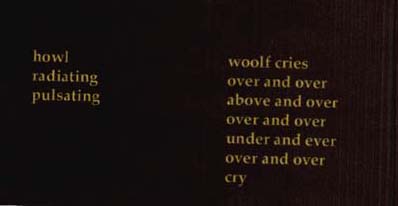
This was torn out of a larger sequence and as I mused in Portrait and Landscape the orientation of the lay out sometimes affects the texture of the reception. Here in blocks along the vertical:

howl
radiating
pulsating

woolf cries
over and over
above and over
over and over
under and ever
over and over
cry

And an image of the horizontal layout: the howl pulsating at the same time as the woolf cries repeat over and over.

Poem Remus Romulus

Remus Romulus

If you know a little about the story of Remus and Romulus, you know that rival hills play an important aspect — not too much of a stretch from hills to separate stanzas.

And so for day 866
27.04.2009

Posted in Booklore, Poetry | Leave a comment

Fiction and Contracts

The measure of metaphor… and the madness of theatre.

The centre of the phenomenon of act A counting as act B is not the existence of rules and conventions, also not the existence of intentions, but rather the acquisition of rights and responsibilities.

Nicholas Wolterstorff. Works and Worlds of Art. (Oxford: Clarendon Press, 1980). p. 205.

How often do readers feel they owe authors something? How often does the viewer, the listener, feel some duty?

And so for day 865
26.04.2009

Posted in Uncategorized | Leave a comment

Beauty Said Sublime Rehearsed

This stanza from a poem in Alicia Ostriker’s The Book of Seventy is shaped like what it is about: it is a thing of beauty.

we have almost escaped the rule of reason
we have almost returned
to the rule of beauty

I like the balance that is achieved and the subtle hint at referencing the “sublime” which is aligned with reason. And from my reading of Burke and Kant (refreshed by entries at Wikipedia, especially the one on the sublime) I remember that the pleasure of beauty derives from the passion of love and that the sublime’s frisson is met in the taming of fear. Such taming proceeds by way of repetition and detachment. In a way the sublime depends upon rehearsal and the carting away of death.

And so for day 864
25.04.2009

Posted in Poetry | Leave a comment

Manual Landscapes

Some time in October 2003 I copied out an excerpt from the poem “Rust” by one Michael Cumming turns out that thanks to modern search engines I am able to correctly identify the poet as Newfoundlander Michael Crummey and the volume in which the poem appears as Hard Light. This is what captivated me:

The boy watches his father’s hands. The faint blue line of veins rivered across the backs, the knuckles like tiny furrowed hills on a plain. A moon rising at the tip of each finger.

This is exquisite. It makes you want to further meditate upon the countries carried in the history of hands. In such small compass, a great expanse.

And so for day 863
24.04.2009

Posted in Poetry | Leave a comment

The Eucharist of Reading

I suggest to a friend exploring questions of time and identity that they might find this brief summary of Ricoeur by Caroline Bassett useful

Ricoeur’s narrative dialectics, in which narrative is at once read as an active and ongoing emplotment (narrative as a dynamic becoming), and as a form that offers resolution (narrative as interpretation), develops out of these meditations. The narrative model emerging out of this dialectic is extensive, and is organised into three moments, or horizons: mimesis1, 2, and 3. The first moment of mimesis reaches backwards towards the horizon of event and experience. The second is the moment of poesis relating to that referent and breaking with it. The third moment of mimesis occurs when the configured text is reconstituted within the horizon of the reader. This is the arc of narrative. It extends across these horizons and is traversed by the reader, who takes from the work its sense of reference and who opens this same work into her or her own horizons.

Bassett goes on in The Arc and the Machine: narrative and new media to supplement the limitations of Ricoeur’s model with some consideration of Fredric Jameson’s work on narrative and ideology. Before she moves on to Jameson she does expose the heart of Ricoeur:

His conception of narrative, as an interpretation of events in the world, locates narrative within the frame of history, memory and futurity. On the other hand, the formal structures of narrative are understood within a wider framework, a metaphysics of temporality that treats the subjective human experience of time within a broader conception of time as infinity or eternity. It is in this way that this is perhaps a theological framework. For Ricoeur […] narrative is more than socially symbolic — and the exceeding of this limit marks the limitations of Ricoeur’s analysis as a historical analysis.

And so I am led to believe that the moves from prefiguration to configuration and refiguration are the steps of a eucharist (ingesting) model of text handling. But how else are we to figure that intuition that stories become parts of ourselves? By remembering that they are not all part of others. For these we are grateful.

And so for day 862
23.04.2009

Posted in Reading, Uncategorized | Leave a comment