Garden Inhabitants

I like how the tricolon trips up on the enjambement.

Then all our goblins would turn out to be elves,
Our vampires guides, our demons angels
In that garden.

Lines from Ted Hughes “Stubbing Wharfe” in Birthday Letters. I like how the proposed metamorphosis depends upon location.

And so for day 790
10.02.2009

Posted in Uncategorized | Tagged | Leave a comment

Parallelism

It is a figure that is in some respects the equivalent of the illusion of parallel lines merging on some vanishing point on the horizon like railway tracks. It is parallelism.

women of work, of leisure, of the night,
in stove-colored silks, in lace, in nothing,
with crewel needles, with books, with wide-open legs,

Lines from Eavan Boland’s “The Women” collected in her selected poems 1980-1990 Outside History in which it is difficult to keep the various women separate — their lines cross and converge and again part.

And so for day 789
09.02.2009

Posted in Poetry | Leave a comment

Railway Hotels

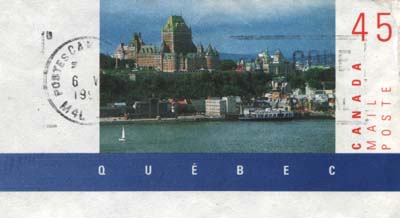
It is still a prominent part of the skyline of Quebec City: the Chateau Frontenac. It wasn’t always there and am reminded so by this brief aperçu of the view from Northrop Frye’s preface to The Bush Garden: Essays on the Canadian Imagination:

As a student going to the University of Toronto, I would take the train to Montreal, sitting up overnight in the coach, and looking forward to the moment in the early morning when the train came into Levis, on the south side of the St. Lawrence, and the great fortress of Quebec loomed out of the bleak dawn mists. I knew much of the panorama was created by a modern railway hotel, but distance and fog lent enchantment even to that.

Romantic and ironic almost within the same breath.

Chateau Frontenac

Chateau Frontenac, Quebec City, depicted on Canadian postage stamp

And so for day 788
08.02.2009

Posted in Uncategorized | Leave a comment

The Good Death

Rifting on Boswell’s reaction to Hume’s death, Michael Ignatieff writes in The Needs of Strangers [published in 1984]

For Hume, spiritual need of Boswell’s sort was a kind of pride, a yearning for certainties beyond the reach of human capacity. In this sense, these needs were a form of alienation. He said we could face the worst if we simply renounced our yearning for certainty. But who among us is capable of that renunciation?

Again let us recall the date (1984) and understand that the question raised is caught in a moment of time. Earlier in the chapter Ignatieff comments on Boswell’s reaction to Hume’s death:

The death that shocked Boswell is ours now, and yet we still do not understand it. We are still coming to terms with what it means to die outside the fold of religious consolation.

A gay man who came of age in the 1980s and survived the 1990s cannot easily identify with that “we”. It is easy to dismantle the representative “we”. It is no doubt more difficult to leap over its barriers and identify in some sense with the speaking voice.

I am grateful for the small thoughtful book that presents itself as “An essay on privacy, solidarity and the politics of being human”. I am even more grateful for Ignatieff’s descriptions of Boswell being haunted by Hume’s death and furthermore the need to keep the teaching moment alive.

We owe it to Hume’s death to keep alive its capacity for instruction. Yet this is not easy. To the extent that most of us die now without religious consoloation, we may fail to understand Boswell’s terror when he watched a man die in this new way.

Hume would be but one of my teachers. And Boswell too as a conveyor for terror in the face of serenity.

And so for day 787
07.02.2009

Posted in Uncategorized | Leave a comment

Pre-genital Crush

Mark Merlis in An Arrow’s Flight [published in the U.K. under the title Pyrrhus] has the narrator meditate on a notion of desire that captures the spirit of boyhood that is a country unto itself. Our narrator says

Do you know how sometimes you see a man, and you’re not sure if you want to get in his pants or if you want to cry? Not because you can’t have him; maybe you can. But you see right away something in him beyond having. You can’t screw your way into it, any more than you can get at the golden eggs by slitting the goose. So you want to cry, not like a child, but like an exile who is reminded of his homeland. That’s what Leucon saw when he first beheld Pyrrhus: as if he were getting a glimpse of that other place we were meant to be, the shore from which we were deported before we were born.

And of course the narration pursues this theme throughout the course of the narrative. Until the very end when there is mention of someone in their seventies assuring Leucon that we never grow up. Or rather we never abandon the emotional landscape that is our home.

This was what being a grown man was like. Though he would never stop feeling like a youth inside — his friend Amyclas assured him, and Amyclas had to be seventy, you never stopped feeling like a kid, playacting at being a grownup.

And the novel rings its changes all about the theme of becoming a man. And what it means to assume one’s destiny and exercise true freedom.

And so for day 786
06.02.2009

Posted in Uncategorized | Tagged | Leave a comment

Fearlessness and Allied Emotions

Linda Hutcheon concludes her introduction to Northrop Frye’s The Bush Garden: Essays on the Canadian Imagination with a quotation from an article by Jon Slan. He wrote that Frye had “the courage to confront the present without distaste, the past without nostalgia, and the future without fear.” All marks of a generous critic.

And so for day 785
05.02.2009

Posted in Uncategorized | Tagged | Leave a comment

Ravaging Beauty

Alessandro Baricco in “Another Kind of Beauty: Note on War” the afterword to An Iliad

For this reason, today, the task of a true pacifism should be not to demonize war excessively so much as to understand that only when we are capable of another kind of beauty will we be able to do without what war has always offered us. To construct another kind of beauty is perhaps the only route to true peace.

He goes on “To give a powerful meaning to things without having to place them in the blinding light of death.”

It is perhaps music that leads the way.

And so for day 784
04.02.2009

Posted in Uncategorized | Leave a comment

Insistence

Some lines, here rearranged. There is something interesting in the repetition of the “p” sound.

pet the scorpion
needle the point
prick the blindness

This is in some ways a piece about persistence. And also in some ways about an habituation to poison, a particular poison that is scrutiny which of course threatens to dissolve what it examines. It is an intellectual invitation to take risks and learn more. To gain by losing.

And so for day 783
03.02.2009

Posted in Poetry | Leave a comment

Cixous on Shakespeare

On the worthiness of certain characters for theatre:

All of Shakespeare’s characters are like that, every one of them is already his own little theater. Every one of them gets up on his own stage. Every one of Shakespeare’s individuals has his little kingdom, his micro-kingdom. We could say that each inhabitant (let us not say character) of Shakespeare is exceptional; he is rich, he affects us, he fascinates us, he is not a person without a kingdom […]

As I reread this I gradually come to understand “kingdom” as a zone of influence. I smirk less and less from the recollection of the lines from Richard III. Little by little I begin to see a concern for sovereignty in the use of the term “kingdom”. And from such a perspective I find it difficult to imagine people without a kingdom notwithstanding Cixous asserting “There are many people without a kingdom”. Those people must be rich in horses (there’s that reference to Richard III again). But then those people or characters would be of some place other than the theatre.

The passage in question appears in an interview (initially appeared in Hors Cadre) and was edited and translated by Verena Andermatt Conley and included in Conley’s Hélène Cixous: Writing the Feminine and it was reprinted in Timothy Murphy ed. Mimesis, Masochism and Mime: The Politics of Theatricality in Contemporary French Thought.

And so for day 782
02.02.2009

Posted in Uncategorized | Leave a comment

Ryoko Sekiguchi

This bit from Two Markets, Once Again translated by Sarah Riggs has Sapphic overtones, especially given the emphasized fragments that follow.

The texts of our forgotten sisters, deformed in girlish songs, fan out in a flight of diaphanous shadows. Already this reading act far from that of constructing of edifice, even by reading out loud they couldn’t provoke a city into being, and from this market, however much we might wish it, it’s not easy to step into another text. Migrating being only possible within images. Tossing, the flat surface so lively, a sea where to dive in doesn’t exist, the cliff being a means to fly and not to fall; in whirling air currents, we would come across words and little agile consonants, and mark each one of them with fluorescent signals akin to the traces of kisses.

A mellow voice … my tongue … rasping … on their soft cushions … ephemeral … Attis, Lydia, golden-outlined lips … saffron colored … by the dew … born away … of Artemis .. from the Phrygian lands

Ryoko Sekiguchi concludes this gathering of prose pieces with a paragraph that sums up what it means to inhabit a construction of words, or rather marks, which being read bring a place into being.

Living in this place, with eyes open, sure to stay here longer, we have written texts by pencil and hand in our notebook. So it is that we can say: the market, present from the beginning of our reading, begins finally to exist in this place, once again.

There is more to discover in this small book and the sisterhood extends in many directions.

And so for day 781
01.02.2009

Posted in Uncategorized | Leave a comment