Mumbo Jumbo

I unfolded what looked like a topographic map of Pikwakwud Creek in the Kenora District (Patricia Portion) of Ontario to find on the obverse a poster for Mumbo Jumbo Voodoo Combo appearing at the Silver Dollar at 1 A.M. “Tonight”. The poster advertises “Cajun-inflected psycho Blues that can make the dead get up and dance!” and on internal evidence (the quotations from newspapers all date from ’92 to ’94) I would venture to peg the event of the group’s appearance at the Silver Dollar (a venue located in Toronto) to the mid 90s. And a bit of searching tells the story of their longevity. See http://www.mumbojumbo.ca/ where they proudly boast of “Celebrating 20 years of HooDoo”.

I’m sure the poster got folded up among my files because I was at the time interested in magic and Black American writing. Of course, my shelves contained Ishmael Reed’s Mumbo Jumbo. They also housed Mama Day by Gloria Naylor and the rich tapestry of Sassafrass, Cypress & Indigo by ntozake shange. And the criticism of Houston A. Baker Jr. Workings of the Spirit: The Poetics of Afro-American Women’s Writing. The books still reside in my library and I can thank some wise recycler of maps for finding my way back to a universe of historical and theoretical lore arising out of lived experience, resilience and a quest for the future.

Time to check out the video store to see if they have a copy of Julie Dash’s Daughters of the Dust which I want to see again and which is now I learn also a novel.

And so for day 780
31.01.2009
Posted in Ephemera | Leave a comment

creating, communicating, collaborating

Donald G. Lenihan with Jay Kaufman. Centre for Collaborative Government. Leveraging our Diversity: Canada as a Learning Society. Changing Government Volume 4. November 2001.

Planning and building a learning society thus goes well beyond preparing Canadians for participation in the knowledge-based economy. It requires cultural change that involves three basic values, on three levels. At the individual level it requires openness; at the organizational/institutional level, it requires inclusiveness; and at at the societal level, it requires recognition. In this paper these are referred to as the three pillars of intercultural learning.

For some reason I am reminded of the triplets of constructivist pedagogy: create, communicate, collaborate.

And so for day 779
30.01.2009

Posted in Uncategorized | Tagged | Leave a comment

Understanding Stein

It was published in 1951. Gertrude Stein: A Biography of Her Work by Donald Sutherland ends with a chapter on the “meditations” mode of Stein and it is a section delivered in a Q + A dialogue. Both in style and substance, it presents a take on the author and on criticism that is worth quoting at length for two main reasons: the emphasis on forces, tensions, etc. and for the connectedness of something belonging to anything (which is different from everything). Here goes.

Sooner or later criticism will have to get used to thinking in terms of forces, tensions, movements, speeds, attractions, etc., as well as in terms of constructs and animals — not because science says so or philosophy says so at all but because life is conducted more and more in those terms and it is the way life is conducted in a time that is the prime source of steady energy and solid reality in a work that outlasts its time. This kind of composition is getting to be more and more the composition of reality as everyone sees it. It amused Gertrude Stein to find that her early arrangements and abstractions, which had seemed to be highly acrobatic and gratuitous if refined formal exercises, were turning out to be literal transcriptions of the most evident realities, that is the same abstractions and arrangements on which life is more and more consciously conducted by people at large. It is true that we are more comfortable in the composition of 19th century life and literature, in which an actual or a mentioned cup of tea was part of an hour which was part of a day which was part of a week, month, season, or year, which was part of say the annals of Britain, which were part of the the general onward evolution of something that was part of a cosmic order. A sentence was part of a paragraph which was part of a chapter which was part of a book which was part of a shelf of books which was part of England or America or France and so on. Something belonged to everything automatically. But nothing now is really convincingly a part of anything else; anything stands by itself if at all and its connections are chance encounters.

And so a chance encounter with Susan Stewart’s Poetry and the Fate of the Senses and this remarkable sentence from the opening meditation on night, its privations and the drive to create:

The task of aesthetic production and reception in general is to make visible, tangible, and audible the figures of persons, whether such persons are expressing the particulars of sense impressions or the abstractions of reason or the many ways such particulars and abstractions enter into relations with one another.

And that was published in 2002.

And so for day 778
29.01.2009

Posted in Uncategorized | Leave a comment

Moral Mnemonic

Anne McCaffrey in the first volume of the Harper Hall trilogy, Dragonsong, has a lovely set of verses set as an epigraph to chapter 7.

Who wills,
Can.
Who tries,
Does.
Who loves,
Lives.

I like how the lines are really a set of descriptions but have an imperative import.

And so for day 777
28.01.2009

Posted in Uncategorized | Tagged , | Leave a comment

Neutron Picasso

The copy on the back cover nicely encapsulates the premise of this romance-essay (somewhat like William Morris’s News From Nowhere).

Descendants of the original forty-four emerge to an hospitable Earth nearly four centuries after the Bomb. They are met with the ruined artifacts of a once mighty civilization and find no clue as to why the pre-Bomb people committed global suicide. Only after the works of four pre-Bomb artists (Picasso, Pollock, Moore and Beckett) are unearthed can the descendants begin to grasp what went wrong. […] But when a fringe element of the post-Bomb society gets possession of the works […]

I have one quibble. In this fiction, the Moore sculpture is described as a bronze in an intro to an interview where the discussion is all about stone and carving rather than modelling and casting. Nonetheless, it is a satisfying little book given the range of voices it contains. It invites the reader to stretch imagination and it helps with such descriptions of the annihilation of all traces of culture:

Suffice here to reiterate that the charnelization of the world consumed every device and medium of human expression and memory. Every data bank, archive, gallery, library. No music survives, no painted or sculpted artifact, no written word. Only a melted, congealed detritus that yields, ever more intriguingly, mute witness to all-engulfing catastrophe.

Michael Carin. The Neutron Picasso. 1989.

And so for day 776
27.01.2009

Posted in Uncategorized | Leave a comment

English Words on Stein in Japanese

Kyong-Mi Park has translated Gertrude Stein into Japanese. In an essay “My Asian Bones Are Ringing” she muses on how the acquisition of any language is an encounter through the bones of the ears with the other. She reminds us, “Words that we call words all belong to others.” She continues:

What I discovered through my own personal experience of translating Stein, the mother of modernism, was the spell-like quality of words, that language was in fact a medium — a spiritual medium as well as an intermediary — and that the act of using words is that of being possessed by the words of someone else.

One other someone else that appears in this essay is Theresa Hak Kyung (represented by an excerpt from Dictée).

“My Asian Bones Are Ringing” is found in Four From Japan: Contemporary Poetry and Essays by Women introduced and translated by Sawako Nakayasu.

And so for day 775
26.01.2009

Posted in Translations | Leave a comment

Long Time With Small

I was first alerted to the stamp artwork of Donald Evans by a note on miniature reproductions of work by Gertrude Stein (note found in Susan Stewart’s On Longing p. 180 n. 45). So, of course, I had to see for myself and consulted the catalogue The World of Donald Evans with text by Will Eisenhart. I found the Stein stamps: one set depicting some of the shorter sections from Tender Buttons; the other, a selection from “A Valentine to Sherwood Anderson” upon its fiftieth anniversary in 1972. And I found in “The Life of Donald Evans” (in the catalogue) a little description of the delights of Holland. Willy Eisenhart writes:

Holland seemed to Donald Evans a perfect place to be: he liked the small scale of the country; Dutch openness to new ideas coupled with hard headed practicality; an ongoing tradition of painting small-scale realism; the high Dutch skies and special light; a national hobby of stamp collecting; and the soft gutteral language with all its fond diminutives.

I love the pile up of small tiny elements perhaps because it connects in some way to a childhood memory of visiting a miniature village in Holland (or Belgium?) and being treated to the magic lantern slide show of the experience thanks to my father’s camera. Fun to see oneself with a giant perspective yet still a small wee person.

And I like in these contexts the big-small and am reminded of Cid Corman’s rendering of a haiku by Bashō

touring the world
tilling a small field
to its limits

Voltaire’s garden.

And so for day 774
25.01.2009

Posted in Uncategorized | Tagged | Leave a comment

Love, Self and Other

Michael Warner “Thoreau’s Bottom” in Raritan XI:3 (Winter 1992).

On Hegel on love:

In Philosophy of Right, for example, Hegel declared that “love” could be defined as the experience of a problem: “The first moment in love is that I do not wish to be a self-subsistent and independent person and that, if I were, then I would feel defective and incomplete. The second moment is that I find myself in another person, that I count for something in the other, while the other in turn comes to count for something in me. Love, therefore, is the most tremendous contradiction.”

On Thoreau on the other, object of love:

“Thou hast loved me,” he exclaims in the privacy of his journal, “for what I wast not — but for what I aspired to be.” In these moments of desire, a self/other opposition becomes an unstable antinomy. By dint of his very insistence on the integration and autonomy of “self,” Thoreau divides himself from an ideal self. Self is an object to itself, even another self, rather than an experiential unity. “May I be to myself as one is to me whom I love,” he says, “a dear and cherished object.”

“Je est un autre.”

And so for day 773
24.01.2009

Posted in Uncategorized | Leave a comment

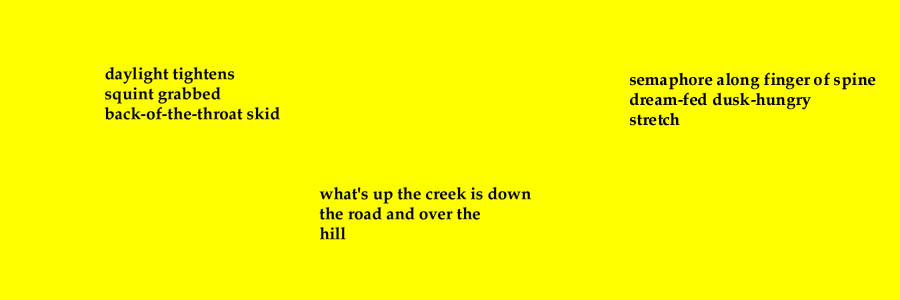
Portrait and Landscape

It is perhaps evident that orientation influences the flow. The plane affects the pace of reading. I am reminded of Wasssily Kandinsky’s remarks on the basic plane (BP) in Point and Line to Plane.

At all events, certain forces of resistance can be felt upon approaching each of the four borders of the BP, and these definitely separate the unit BP from the world surrounding it. The approach of a form to the border is, therefore, subject to a special influence, which is of critical importance in the composition. [trans. Howard Dearstyne and Hilla Rebay]

Take for example the layout of the following poem in three horizontal blocks:

Text of poem transcribed in body of blog entry

Elocution (poem)

It is difficult to achieve similar results with a vertical arrangement:

daylight tightens
squint grabbed
back-of-the-throat skid

what’s up the creek is down
the road and over the
hill

semaphore along finger of spine
dream-fed dusk-hungry
stretch

And of course the addition of a yellow background is also an element at play…

And so for day 772
23.01.2009

Posted in Booklore, Poetry | Leave a comment

Cricket Ways

Cid Corman conveys the sound of the insect with economy and elegance

a cricket crickets

It is the concluding line of a version of a haiku by Bashō. It is collected in One Man’s Moon.

My own take on crickets is weak…

Cricket sounds penetrate
the latices’ work of frogs’ voice
carry
carry

from Juvenilia (the third in a series of twelve “transcriptions”). It must be a special place from which to hear the liquid sounds of frogs punctured by that of crickets. And an even more special place to keep in mind the play with the one “t” spelling of “latices” which the eye may glance over and read “lattices”. Far, far too elaborate —

And so for day 771
22.01.2009

Posted in Poetry | Leave a comment