Bearing With Loss

There is an entry for Gilgamesh in The Gay and Lesbian Literary Heritage edited by Claude J. Summers. It is an inclusion that comes back to me when I read the version by Herbert Mason which opens

It is an old story
But one that can still be told
About a man who loved
And lost a friend to death
And learned he lacked the power
To bring him back to life.
It is the story of Gilgamesh
And his friend Enkidu.

In the afterward, John H. Marks offers the following comment on Mason’s “verse narrative”:

The present rendering by Herbert Mason is properly called a verse narrative. It is a sensitive, authentic retelling of the old story, an attempt to convey the profound anguish Gilgamesh suffered after his constant companion and friend, Enkidu, died. The author makes no claim to present an accurate rendering of the cuneiform text. He knows the ancient story well and tells it in the way it has become memorable to him. His narrative has its own spellbinding power, evoking feelings and thoughts familiar to all who suffer the loss of loved companions.

There are other versions of the Gilgamesh material but none quite so poignant.

And so for day 760
11.01.2009
Posted in Translations | Leave a comment

Autobiographical Artefacts

To participate in MOOs and Talkers I have created “yred”. The name comes from a feature from the now defunct web-based chat room Bianca’s Smut Shack where the name “red” was made to appear in yellow type. Hence “yellow-red” shortened to the Anglo-Saxon hero-of-a-saga-sounding “yred”.

On the talker Philly, yred recorded profile information which announced an interest in text encoding. It’s an interesting bit of information that reads almost like a didactic poem:

structure – content – format
three important concepts
for developing an appreciation
for markup

Yred on Philly used the tag line “on a questless journey” to appear on screen upon entrance into a room. I still like the paradox of the wanderer without aim. Eternal browser.

And so for day 759
10.01.2009

Posted in Transcriptions | Leave a comment

Atmosphere

Poet and novelist, Mark Sinnett constructs a quiet, contemplative atmosphere all the while conveying the sharp feeling of an ardent love poem (“the inhibiting physical properties of air / are nonexistent.”). Take for instance these lines from “State” collected in Some Late Adventure of the Feelings:

I recognized that she is wholly responsible
for all the unheard joys tunnelling away,
and is probable cause of this focused interlude,

And in very many ways the poems gathered in this collection are like “focused interludes”. There is something arresting in Sinnett’s description. Moments are poised for reflection and the next stage, if there is a next stage. Salvaging from the ephemeral something that binds one to the other, in love.

And so for day 758
09.01.2009

Posted in Poetry | Leave a comment

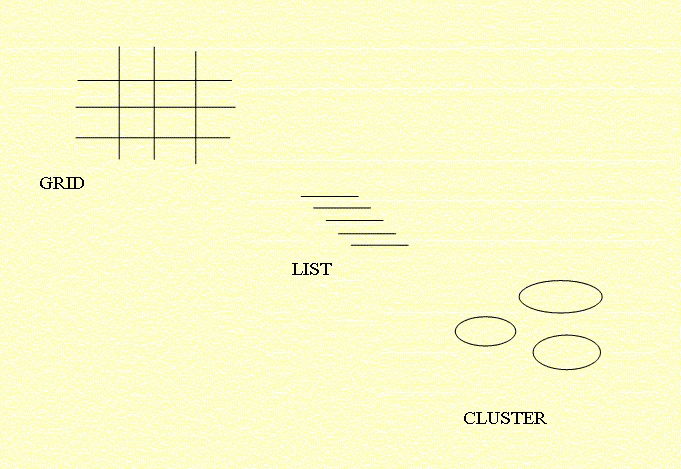
Grids, Lists, Clusters

Humanist Discussion Group, Vol. 18, No. 347.

To extrapolate: the electronic medium facilitates reading in terms of clusters, lists, and tables (a type of reading that was always available to the clever manipulator of index cards).

I like to think of these as the primary ways of organizing information:

GRID, LIST, CLUSTER: types of groupings

GRID, LIST, CLUSTER

A word on converting groupings. Consider whether this image references a “list” or a “cluster”.

And so for day 757
08.01.2009

Posted in Uncategorized | Tagged , | Leave a comment

Asking Why

Vita Sackville-West in the very entertaining Nursery Rhymes (1947 Dropmore Press) prefaces a section with the marginal rubric “Further Awkward Dialgoue” with this delightful bit:

Pity the pedagogue. It is indeed difficult to instruct the young. Arbitrary and ill-informed, they strike no happy mean between a bland acceptance and the inconvenient, unexpected challenge.

There follows a number of snippets of dialogue, most involving the charged question, “why.” Very funny.

I used to have a motto: No 4 Y. Every now and then a “wherefore” slipped into my thinking — couldn’t resist that metaphysical itch for an inkling into the purpose of what is the case. Ever a child.

And so for day 756
07.01.2009

Posted in Uncategorized | Tagged | Leave a comment

Perspectives and Perversions

Dave Morris begins his “Opening Doors” article about Rick Bébout’s web site (Eye May 12/05) by quoting Bébout on gay people and what they offer:

“We should be gift-givers,” says Rick Bébout. “We should be people who understand we have huge, invaluable perceptions to offer the rest of the world.”

If that sounds grandiose, set it alongside the ranting that would deem us worthless or worse. For me, Bébout’s gay gift-giver is epitomized by the idler or the flaneur. I am reminded, in particular, of the set of qualities listed in the characterization offered by Robert Louis Stevenson in his “Apology for Idlers”:

[T]he idler has another and more important quality than these. I mean his wisdom. He who has much looked on the childish satisfaction of other people in their hobbies, will regard his own with only a very ironical indulgence. He will not be heard among the dogmatists. He will have a great and cool allowance for all sorts of people and opinions.

Of course, a flair for tolerance from time to time manifests in flights of indignation. The observer is at times an arbitrator. This is a gift. A set of tinted-glasses for watching the show go by…

And so for day 755
06.01.2009

Posted in Uncategorized | Tagged , | Leave a comment

Stretching for Allusion

I wonder how some lines in a poem by Tim Dlugos play out if you don’t connect with an allusion to Raymond Burr’s character, Perry Mason, in Ironside. The gestural quality transcends the allusion:

Like wheelchair detectives
we reach for the sky

The reader gets to participate in that “we” that denotes the speaking voice and the intended recipient of “Note to J.A.” and to experience a sympathetic response to the poem’s ending:

Like wheelchair detectives
we reach for the sky

and come back with hands
full of energy. It
dissipates faster than
our eyes can record.

One small detail that makes the allusion recede and allows those challenged by popular culture references to enjoy the poem is that “detectives” appears in the plural. It’s a species not a specimen.

And so for day 754
05.01.2009

Posted in Uncategorized | Tagged , | Leave a comment

Training and Birthing

In Against Interpretation, Susan Sontag offers this one striking line: “Anthropology is necrology.” Short and pithy, it occurs in an essay full of luxurious sentences where the elegant comma reigns; it is entitled “The anthropologist as hero” and I begin to understand why the pithy sentence resonates when several paragraphs later I read:

Because anthropology, for Lévi-Strauss, is an intensely personal kind of intellectual discipline, like psychoanalysis. A spell in the field is the exact equivalent of the training analysis undergone by candidate psychoanalysts. The purpose of field work, Lévi-Strauss writes, is to “create that psychological revolution which marks the decisive turning point in the training of the anthropologist.” And no written tests, but only the judgment of “experienced members of the profession” who have undergone the same psychological ordeal, can determine “if and when” a candidate anthropologist “has, as a result of field work, accomplished that inner revolution that will really make him into a new man.”

Back to necrology. After the statement Sontag quotes Lévi-Strauss. “Let’s go and study the primitives,” say Lévi-Strauss and his pupils, “before they disappear.” Reread in light of the comparison with psychoanalysis — there is some fear of contagion at work. Those death notices point back to the anthropologist. Nothing like facing one’s own mortality and the perishability of one’s own society but living for a time with the imperilled. Creating hope in rebirth by reading the obits.

And so for day 753
04.01.2009

Posted in Uncategorized | Tagged | Leave a comment

Active Mind

Nella Cotrupi in Northrop Frye and the Poetics of Process draws attention to Frye’s discussion of Blake.

In Fearful Symmetry, Frye used Blake’s distinction between the visonary ‘Hallelujah-Chorus’ perception of the sun and its more prosaic, rationalistic reception as a round shining disc or ‘guinea-sun’ in order to explore the ethical reasons for privileging the former mental mode of operation over the latter.

On the next page, she cites Frye himself.

We see the guinea-sun automatically: seeing the Hallelujah-Chorus sun demands a voluntary and conscious imaginative effort; or rather, it demands an exuberantly active mind which will not be a quiescent blank slate. The imaginative mind, therefore, is the one which has realized its own freedom and understood that perception is self-development.

Cotrupi draws parallels between Frye’s approach to Blake and beyond to Vico’s principle of verum factum.

For some reason when I re-read in isolation the quotation from Frye concerning the distinction between the two types of sun, I kept envisioning a fowl and not a round coin. My guinea was a species of phoenix.

Meaning is indeed made. And memory influences perception. And imagination plays with memory and meaning in an exuberant and active fashion — sometimes by being caught up in the details and the prosaic.

And so for day 752
03.01.2009

Posted in Perception | Tagged , | Leave a comment

Xenobotany

That Sandra Kasturi got me to thinking. There is in her collection The Animal Bridgroom a final poem called “Falling” where some lines just drag upon the brain of the dendrologist.

[…]
or frenzied whirl of helicopter seed pods
from oaks so distant they blot out even the warm
of shooting stars. Let us praise the falling
[…]

Oaks of course have acrons; maple keys (and others) have the shape of helicopter blades. These oaks are very peculiar. They are very, very distant. Alien oaks.

However let us recall that the poem opens:

Let us now praise the falling things that fall
from trees and skies and gaseous nebulas,

These oaks need not belong to our world but we do have access to the strange beautiful world of the poem where they take root.

And so for day 751
02.01.2009

Posted in Poetry, Uncategorized | Leave a comment