Limits and the Nature of Surprise

Samuel R. Delany in “Atlantis: Model 1924” astonishes the reader with an evocation of the evanescent stream of perception and the inability of recall to master every moment. What at first seems like a melancholy meditation on the passage of time becomes a means of celebrating the often untapped potential for new patterns to emerge and delight.

Watching the dawnscape, still iceless, flip along, he contemplated for the thousandth time the astonishing process by which the seamless and inexorable progression of the present slipped away to pack the past with memories, like numbered stanzas in a song, like cells in a comb, like cakes in a carton, to be called back (though, he’d already ascertained, most he’d never recall) in whatever surprising, associative order.

It is worth noting that the contemplation occurs on a moving train. The passage itself offers an interesting associative order — song to honey comb to cake. For some reason there is some Homeric echo here. And the hero of other travels and the constant question about being-at-home-in-the-world.

And so for day 680
23.10.2008
Posted in Uncategorized | Leave a comment

Fragrant Fragments

I did a double take.

They [various techniques of avant garde poets] invite the mind to a widened sense of the possible, opening it to the fragrant […]

I read this as an opening to the fragment. Imagine my surprise when I read on: “opening it to the fragrant, stored oils of the unconscious.” Here are the two parts restored from “The Question of Originality” by Jane Hirshfield (collected in Nine Gates: Entering the Mind of Poetry)

They invite the mind to a widened sense of the possible, opening it to the fragrant, stored oils of the unconscious.

I remain amazed at the power of a comma to halt the mind that is galloping off in one direction and bring it back to a different track, slowing down to savour the fragrance.

And so for day 679
22.10.2008

Posted in Poetry, Reading | Leave a comment

Melodies of Cakes

Susan Drodge in a review covering several books of poetry by Canadian authors (Canadian Literature 165 (2000)) entices the reader with a quotation from Dream Museum by Liliane Welch. Our appetite is whetted:

She was still young,
in her late twenties
when she put on weight.
Did she simply open
the doors of her mind
to the melodies of cakes?

A choice: be satisfied with this modest morsel or engage in the practice covered by the French verb se gaver — to turn to the source and stuff oneself until full and to relish every moment of the feasting.

And so for day 678
21.10.2008

Posted in Food Writing, Poetry | Leave a comment

Robust Struggles

It is perhaps not particularly fair to pull out this fighting-words excerpt from one of Christopher Norris’s lectures (the Bucknell Lectures in Literary Theory published under the title Spinoza & the Origins of Modern Critical Theory) — but while you read just keep in mind that the springboard for the remarks is the Rushdie case:

On the one side are those who advocate an allegiance to truths beyond reach of critical assessment or reasoned debate. On the other are those — admittedly in a state of some confusion at present — whose appeal (or whose best possible ground of appeal) is to the interests of open discussion and enquiry into the values that sustain both their own and their opponents’ argumentative positions. Any hint of ethnocentric smugness here should be amply dispelled by the occasional reminder — such as Empson provides — of just how long it took for courageous free-thinkers like Erasmus, Montaigne, Spinoza, or Voltaire to knock Christianity into some kind of civilized shape.

I am very taken by the image of being knocked into some kind of civilized shape. Not a parenting style presently favoured. Still, given the context, pretty mild medicine.

And so for day 677
20.10.2008

Posted in Uncategorized | Leave a comment

Small Furniture Big Imaginations

For some reason, it is the mention of the furnishings of the library that capture my attention in an article about the institutional recognition of children’s literature (Beverly Lyon Clark, “Kiddie Lit in Academe” in Profession 1996 published by the Modern Language Association)

As early as 1877 Minerva L. Saunders — perhaps the first librarian to allow children under twelve to use public library books — set aside a corner of the Pawtucket, Rhode Island, library for children, even providing special small chairs for them.

And this provokes the memory of being a small child in a big big armchair next to an adult as I plodded through the words beneath a set of illustrations. And at times the reading would break off into an explication of the events unfolding in the pictures and their continuation in the mind at play.

And so for day 676
19.10.2008

Posted in Reading | Tagged , | Leave a comment

Ballot Bullets

Steve McCaffery in “Bill Bissett: A Writing Outside Writing” collected in North of Intention: Critical Writings 1973-1986 advocates a type of anti-reading that emphasizes concentration on the graphic and sonic elements of a poem, that is attention to the materiality of the materials. He writes: “Which is to suggest that Bissett’s anti-inscriptional strategies are matchable by the reader’s own anti-reading that would affirm a motion, not comprehend a sense.” Instead of seeking an example in Bissett’s oeuvre, allow me to draw attention to Colin Morton “Election Day Ballet” from The Merzbook: Kurt Schwitters Poems where the concrete poem progressively deforms/reforms the word “ballot” into a line of bullets, to end with this:

bulletbulletbulletbullet    bulletbulletbullet

It is not quite accurate to say that the poem deforms/reforms the words. The words appear as in a ballet. They dance in various slots and positions. It is only the last line that trips up the usual spacing between words. Nevertheless, the overall impression is one of movement from “ballot” to “bullet”. However the poem can be read from bottom-up and the movement from rat-tat-tat of bullets to the measured incidence of ballots. The anti-reading is in a sense antiphonal: it turns the other way. And along the way discovers other senses.

And so for day 675

18.10.2008

Posted in Poetry | Tagged | Leave a comment

Hum Along

Speaking to oneself is cured by singing
As if the sad soul were stammering …

Found in a notebook entry dated October 16, 2004, an entry on interior monologue (its displacement by “vocalization of a mesmerizing tune”). And a year later (2005) there is this thought

Time in its rhythmic dimension is a way of parsing experience to manage having the desired actions match the desired space. Time as duration and time as punctuation.

Synchronization seems to be psychological in nature — its fitness is marked by an interior justness.

And so for day 674
17.10.2008

Posted in Transcriptions | Tagged | Leave a comment

Sneeze Response

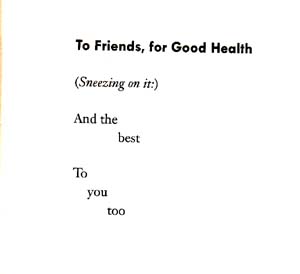
Louis Zukofsky honours the atheist’s heart with a poem entitled “To Friends, for Good Health” collected in selected poems edited by Charles Bernstein. There is a wonderful play between “best” and “blest”. It reads “And the / best / To / you / too”. And its display on the page captures nicely the explosive return of a sneeze. See

To Friends, For Good Health / (Sneezing on it:) / And the / best / To / you / too

Sneeze poem from Zukofsky

And so for day 673
16.10.2008

Posted in Poetry, Uncategorized | Leave a comment

The Further Adventures of e

Lola Lemire Tostevin in an essay on Canadian poet bp Nichol (“Is This Where the Poem Begins?” collected in Subject to Criticism: Essays) suggests that “[w]hat bp Nichol wrote of Marshall McLuhan could easily apply to his own writing:”

There is a lightness of touch to McLuhan’s writing, an airiness, that has often been mistaken for a lack of depth. But the wonderful thing in reading McLuhan is precisely that he was using language to take off, using it to soar free of an artificial notion of what constitutes profound thinking, utilizing instead the mind’s ability to leap, to follow fictional highways to real destinations …

Odd, when I find myself reading the twists and turns of the oeuvre of bp Nichol I am more inclined to plunk myself down and mine the text rather than soar (i.e. use the text as a springboard). Recall my being caught up in cogitating about the spacing “no is e” culled from “Coda: Mid-Initial Sequence” from The Martyrology: Book III reprinted in As Elected. I plod along sensitive to the sense making machinery. Later in that particular sequence one comes across the following line:

i (n) am e

The poetic subject “names” and negates. And the non-soaring reader is attentive to the echo with the earlier line “no is e”. On offer is the negation of an “h”.

11 years since i first conceived myself a writer
took up the task to earn the name
& now i see
i (n) am e

Now it is possible to also read, slowly, a different parsing “in am e”. I see the enemy. And ‘e is us. Or not entirely since the slow reader can resist easy identification with the shifter “i”. I guess I am a sore reader prone to scratching…

And so for day 672
15.10.2008

Posted in Poetry, Reading | Leave a comment

Shine

Robert Haas ends “Songs to Survive the Summer” which itself ends Praise with the following set of verses:

all things lustered
by the steady thoughtlessness
of human use.

Through the polish of use the objects in our daily lives develop a patina. Repetition adds a depth and a charm to the objects.

The process can also apply to the tales we tell and the lines of poetry we read. In the re-telling and the re-reading the objects not only furnish our minds but also acquire a lustre. Hass himself might include in “all things lustered” the passages in his poem about the making of onion soup (simply sumptuous from the cutting of the onions to the ladling and eating) or those about the grandfather-carved wooden nickel.

Of course there is a place in human experience for the enjoyment of the fresh and the new — the before-patina effects.

And so for day 671
14.10.2008

Posted in Reading, Storytelling | Tagged , | Leave a comment