Locution Locution Locution

M.A. Screech in his book on Erasmus, Ecstasy and the Praise of Folly, provides this intriguing look into the tradition of a playful expression:

The soul of Paul, says Erasmus, in gloss on II Corinthians 5:13, like the anima of all lovers, ‘is not where it animates but where it loves’ (anima non est ubi animat, sed ubi amat). This famous phrase which does not occur in the Moira but is implied there, links the ecstatic love explained in the Annotations and praised by Folly, with a millenium and a half of Christian mysticism.

The Latin is special. And to continue reading Screech is in part to learn why.

The standard expression is Verius est anima ubi amat quam ubi animat — the soul, that is, more truly belongs where it loves than where it simply animates. The expression was coined by St Bonaventura (Solioquium II. 2, no. 12, in Opera VIII, Quaracchi 1898, 49, col. 1). Bonaventura took the notion over from St Bernard, where it is less memorable since it is applied to the spiritus, not the anima (ibid. note 5); so in St Bernard there is no play on the words anima and animat. As Bonaventura coined it, it is one of those powerful expressions which was so widely used that its source was sometimes lost to view; Aquinas even attributed it to St Augustine. In the history of mysticism the idea which it embodies constitutes a bridge by which Platonic rapture passed through Pseudo-Dionysius to Bernard, Bonaventura and mediaeval mysticism generally, then on to high Renaissance ecstatics like John of the Cross, as well as to a scholarly saint like François de Sales.

And so for day 540
05.06.2008
Posted in Uncategorized | Leave a comment

Accidental: New Roses

Page 415 in the 2000 paperback edition of China Miéville’s Perdido Street Station blooms this piece of typesetting magic which snags my attention like a thorn:

“I do not dream, der Grimnebulin. I am a calculating machine that has calculated how to think. I do not dream. I have no neu-roses, no hidden depths.

The hyphenation is a product of the layout and it somehow is like a dream element that triggers a reverie of associations.

And so for day 539
04.06.2008

Posted in Metaphor | Tagged | Leave a comment

Form of a Bifurcation

In Every Force Evolves a Form there is an essay on the painter Balthus, an essay structured as a series of aphoristic paragraphs. In one of those paragraphs, Guy Davenport draws what could be characterized as a distinction between experience and description. He affixes labels to both sides of the distinction and places the subject of the essay in one of the camps:

Where in Greek writing you always find a running account of all the senses in intimate contact with the world, in Latin you find instead a pedantry accustomed to substituting some rhetorical convention for honest and immediate perception. Balthus has Greek wholeness.

Ironic that Davenport is accomplishing the comparison through a trope sketched via a rhetorical dichotomy — a very Latin move.

And so for day 538
03.06.2008

Posted in Dichotomies | Leave a comment

Principles and Stories

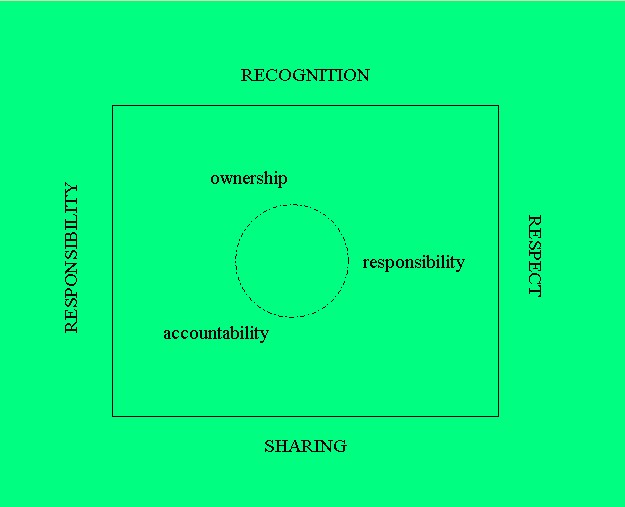
The Royal Commission on Aboriginal Peoples advanced four principles for engaging in meaningful relationship building. They are: Recognition, Respect, Sharing and Responsibility. They are presented in that order. I believe that the order matters. A relationship progresses through these stages. The listing of the principles presents a narrative and the narration matters. It’s an ongoing story that can be represented as a mandala. In the centre of the square are three principles that are often invoked in models in the design of effective organizations. They do not immediately tell a story, at least not from the point of view of the individual actor, yet they represent, like the RCAP principles, states that are desirable. However, in this mandala formation, one might think that “responsibility” is reached through a cycle of claiming “ownership” and giving an “account” or that responsibility is manifested through owning and accounting. What do you make of this arrangement?

Royal Commission on Aboriginal Peoples (RCAP) Principles

Mandala of RCAP Principles

For the complete RCAP report see
http://www.bac-lac.gc.ca/eng/discover/aboriginal-heritage/royal-commission-aboriginal-peoples/Pages/introduction.aspx

And so for day 537
02.06.2008

Posted in Uncategorized | Leave a comment

Within and Between

Justice Bastarache wrote in the Supreme Court of Canada decision in M. v. H. (1999)

https://scc-csc.lexum.com/scc-csc/scc-csc/en/item/1702/index.do

It would be consistent with Charter values of equality and inclusion to treat all members in a family relationship equally and all types of family relationships equally.

For me the social ideal of equality within and between families resonates with a 1994 vision statement “All people, including youth, determine for themselves their personal relationships. This is based upon the ability to move in and out of relations. This requires the recognition of both formal and substantial rights, both in law and in government policy.” http://chass.utoronto.ca/~lachance/eqf03.htm

And so for day 536
01.06.2008

Posted in Uncategorized | Leave a comment

Ravages

Simon Schama in a September issue of The New Yorker (2003) writes about sculptor Andy Goldsworthy: “Sometimes misread as a placid pastoralist, Goldsworthy is in fact a dramaturge of nature’s temper, often fickle, often foul.” Schama references a documentary film of Goldsworthy at work — Rivers and Tides: Andy Goldsworthy Working with Time

in which an artist is seen enduring repeatedly, the collapse of his own creation, as he attempts to build a cone of dark seashore stones. The idea, a dream of every seven-year-old sandcastle engineer, was that the cone should stand sentinel, almost submerged in the high tide, yet survive intact to reappear as the water receded.

So very specific yet so very emblematic.

And so for day 535
31.05.2008

Posted in Uncategorized | Leave a comment

Expression: Sensations and Representations

Malebranche offers an interesting take on the signifying limits of words. Consider this explanation from Thomas M. Carr Descartes and the Resilience of Rhetoric.

The ideal use of words, according to Malebranche, is to communicate the pure ideas of the mind. […] Sensations cannot be adequately represented by words. While pure ideas are objective and perceived in a uniform manner by all because they are seen in God, the sensations are subjective and vary from individual to individual. They can only be experienced, not represented or described by an arbitrary sign like a word. […] Since words are inadequate to communicate a message that is primarily sensible, the speaker of strong imagination will have to look elsewhere for a medium. Indeed, according to Malebranche, the rhetoric of imitation depends more on delivery than speech to persuade. Gesture, animation, and tone of voice carry the principal burden.

One is of course capable of making the call to body language without passing through the dichotomy between thought and feeling, between representation and sensation. There can be a body language that supports the work of representation. The key lies in not positioning either sensation or thought as a function of language’s distance from God. The uniform perception can be rooted in a community of practice (and not a higher being). Still it is very tempting to distinguish representation and sensation according to the felicity conditions of their reception. However, one can inhabit a universe where all communication be it of sensations or of representations is to be tested repeatedly to determine if the transmission is at all successful in meeting the quality of uniformity. Apart from the question of uniformity, it is also useful for all communication to have a residue that is perceived in a non-uniform manner. That is, a potential miscommunication accompanies every message and provides opportunities for surprise and creative slippage.

And so for day 534
30.05.2008

Posted in Dichotomies, Perception | Tagged | Leave a comment

Theatre, Picture, Word

There is mystery. Wendell Piez reminds the TEI [Text Encoding Initiative] gang in a posting of July 31, 2006:

There may actually be a hidden lesson here, Martin, especially in view of the last exchange on editing software. You recall that one of the most tantalizing things we know (of the little we know) of the mysteries at Eleusis is that they involved not just what was said (ta legomena) but what was shown (ta deiknymena) and what was performed (ta dromena).

https://listserv.brown.edu/cgi-bin/wa?A2=ind0607&L=TEI-L&P=42668

Rather fun to decontextualize and generalize the trio of actions. Talk, show, do. A syntagm for blogger times?

And so for day 533
29.05.2008

Posted in Uncategorized | Tagged | Leave a comment

Craft, Value and Economy

Wendell Berry in an essay entitled “Preserving Wildness” collected in Home Economics makes the case for what may be called an economy of attentiveness (as opposed to an economy of mere attention).

The good worker loves the board before it becomes a table, loves the tree before it yields the board, loves the forest before it gives up the tree. The good worker understands that a badly made artifact is both an insult to its user and a danger to its source. We could say, then, that good forestry begins with the respectful husbanding of the forest that we call stewardship and ends with well-made tables and chairs and houses, just as good agriculture begins with stewardship of the fields and ends with good meals.

Care for quality at every moment.

And so for day 532
28.05.2008

Posted in Uncategorized | Tagged | Leave a comment

Deconstructing Sculpture in Music

Here are some notes made after a presentation or lecture by David Toop. They are dated November 14, 2002.

At one point David Toop touched upon the commonplace figure of the move in Western musical discourse about composition from auditory to haptic relations to the body. Asked to elaborate, he pinpointed the moment this way of speaking came into the discourse: jazz improvisation. A moment not untainted by the stakes involved in the praise of primitivism. [McLuhan caught the buzz in the air already there with such texts as Lévi-Strauss on le jazz hot] It was evident from David’s remarks that at some point in the development of a Western discourse about musical subjects it is the sculptural dimension of such objects that becomes predominant. And now in the work of such reporters/thinkers/composers as Toop it provides a pivotal spot for considerations of the connection between gesture and thought — rather amazing to watch musicians trace paths and movements in the air when discussing the shape of sound.

Also in David’s remarks there is something that triggers for me an interesting question: how theorists position themselves vis-a-vis la voix humanine. I think there is this tension to explore between the (in)attention to voice and to the clapping/slapping hand. Vocalization/percussion which of course at the level of the phoneme disappears: explosives, dentals, fricatives, nasals.

Intriguing to consider the vocal apparatus as a machine, humming along. A machine in touch — throat. lips, nose — sensing the movements of air. It is possible to still the hand and remain haptic.

And so for day 531
27.05.2008

Posted in Transcriptions | Tagged | Leave a comment