Thicker Than Blood

A.S. Byatt in a fiction piece in an October issue of The New Yorker writes about a female character metamorphosed into a stone woman:

That evening she understood that she might be wrong about her immediate fate […] the bread knife slipped and sliced her stone hand, between finger and thumb. She felt pain, which surprised her, and saw a spurt of hot blood from the wound whose depth she could not gauge. She watched the thick liquid run down the back of her hand, onto the bread, onto the table. It was ruddy-gold, dripping in long glassy strings, and where it touched the bread the bread went up in smoke, and where […] Her veins were full of molten lava.

I like how the commonplace in this passage is transformed by a simple conceit.

And so for day 530
26.05.2008
Posted in Uncategorized | Leave a comment

What Works Well

The preparation for reading appeals to all the senses. It is a cross-modal activity. It sounds like a lot of fun.

Teachers help children become more aware of the phonemes within words through a sort of armamentarium of opportunities — such as nursery rhymes that enhance a child’s ability to hear and segment the rhymes and alliterative structure of words, and little “instant games” in which clapping, writing, and dancing bear out the sounds in words.

From the passage, “When ‘Cat’ Has Three Sounds, None of Which Is ‘Meow’: Phonological Development” from the book Proust and the Squid: The Story and Science of the Reading Brain by Maryanne Wolf.

And so for day 529
25.05.2008

Posted in Reading | Tagged | Leave a comment

Inveighing

I almost think that the succession of poems in the complete poetry of Catullus is meant to weary the reader. Invective succeeds invective to the point of tedium. And then, the concluding poem ends with a taunt addressed to Gellius but easily read as a rejoinder to posterity:

well, hurl away! my guard is up against you

but I’ll wound you and bring you to your knees.

I like how the translation by Frank O. Copley offers the reader a chance to identify with either position: the cocky “I” or the marked “you”. I wish I could say more but I just can’t manage to let my guard down.

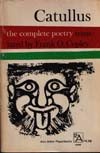
As I close the book, I chuckle at the sassy cover designed by Quentin Fiore.

Cover of Catullus by Quentin Fiore

Cover of Catullus by Quentin Fiore

That protruding tongue makes me stick mine out in imitation. Impudent.

And so for day 528
24.05.2008

Posted in Booklore | Leave a comment

Of endings.

From Andrew Holleran’s 1983 novel Nights in Aruba, from its concluding pages … our rather listless hero is looking for conclusion if not closure.

I no longer believed when I awoke in the morning that I could, by lying still in my dark room, balance past, present, and future, or figure everything out. I was certain that even death would provide no illumination — that we died ignorant, confused, like novelists who cannot bring an aesthetic shape to their material.
[…]
As I sat there in my silent room I saw these memories would be with me forever, that wherever they were, I was: some part of me. But the life I must begin was my own — a separate person’s. This was difficult. For I realized that so much memory and desire swirl about in the hearts of men on this planet that, just as we can look at Neptune and say it is covered with liquid nitrogen, or Venus and see a mantle of hydrochloric acid, so it seemed to me that were one to look at Earth from afar one would say it is covered completely in Ignorance.

And the reader is thus left to ponder. And perhaps conclude that a closer view, a view perhaps more down to earth, is possible and through which one appreciates that allegorical figure of Ignorance as the product of a novelist certainly not confused nor ignorant. Our author is in no need of illumination to provide the ending a novel. He knows how to insert a self-destructing allegory.

And so for day 527
23.05.2008

Posted in Uncategorized | Tagged | Leave a comment

v i s i t o r s

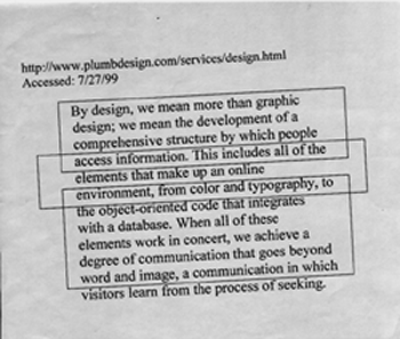
A little piece of text given line breaks and some boxes. [Our addition of interlinked “boxes”.]

Ephemera: Plumb Design Vision

Plumb Design Vision with boxes by Francois

By design, we mean more than graphic design; we mean the development of a comprehensive structure by which people access information. This includes all of the elements that make up an online environment, from color and typography, to the object-oriented code that integrates with a database. When all of these elements work in concert, we achieve a degree of communication that goes beyond word and image, a communication in which visitors learn from the process of seeking.

http://wwww.plumbdesign.com/services/design.html
Accessed 7/27/99

And so for day 526
22.05.2008

Posted in Uncategorized | Leave a comment

Homage

Andrew Holleran in his essays collected in Ground Zero strikes a tone that borders on the ironic and then pulls away to a quiet, contemplative assertion of the value of pragmatic attention. Take, for instance, the conclusion to “The Absence of Anger” where heroics are celebrated in a muted comparison with histrionics.

And so, as with victims of rape or any misfortune, gay men have been silenced by a peculiar guilt induced by the misfortune — which makes the minority who have formed organizations, raised money, prodded government, gone on television to educate others, defended themselves against the Pat Buchanans and Robert Novaks and Jerry Falwells, all the more admirable. The fact that gay men did not throw rocks, set cars on fire, or besiege the White House was chiefly because they did other things that seemed more constructive at the time. They did march on Washington, they did print newspapers, they did criticize elected politicians. They did picket the airlines when Northwest refused to fly a sick man back from the Orient because he had AIDS. It is a long battle ahead, after all, and it will be necessary, of course, to confront this sort of unacceptable behavior each time it occurs. The fact is that in some curious way, though the people in this room have been told flat out that half of them will be dead in five years, none of them knows what else he can do about it — except for what he has already done. And because, most curious of all, most odd, most marvelous, the truth is none of them is really chilled by the assertion — each of them thinks he will escape, I suspect. As Freud also said, “No one really believes in his own death.”

And so for day 525
21.05.2008

Posted in Uncategorized | Tagged | Leave a comment

Markets and Sensuality

But a small excerpt from a travel piece built around enumeration, Anaïs Nin “The Labyrinthine City of Fez” in the section “Enchanted Places” in In Favor of the Sensitive Man and other essays

After color and the graceful sway of robes, the flares, the stance, the swing of loose clothes, come the odors. One stand is devoted to sandalwood from Indonesia and the Philippines. It lies in huge round baskets and is sold by weight, for it is a precious luxury wood for burning as incense. The walls of the cubicle are lined with small bottles containing the essence of flowers — jasmine, rose, honeysuckle, and the rose water that is used to perfume guests. In the same baskets lie the henna leaves that the women distill and use on their hair and hands and feet. For the affluent, the henna comes in liquid form. And there is, too, the famous khohl, the dust from antimony that gives the women such a soft, iridescent, smoky radiance around the eyes.

The smell of fruit, the smell of perfumes, and the smell of leather intermingle with the smell of wet wool hanging outside the shops to dry — gold bedspreads hanging like flags in the breeze, sheep’s-wool rugs, the favored cherry-red wool blankets, and rose carpets, like fields of daisies, lilies, apple blossoms.

She goes on to state that Fez is the city where one rediscovers the meaning of the word “azure” by contemplating the sky. A nice break after the riot of sensation and always at hand to provide surcease to the palate.

And so for day 524
20.05.2008

Posted in Uncategorized | Leave a comment

Proofing, Reading, Discovering

Jonah Lehrer in the chapter “Gertrude Stein: The Structure of Language” in Proust Was a Neuroscientist

What Stein discovered was a writing style that celebrated its grammatical mistakes. In her most radical prose, she manages to make us conscious of all the linguistic work that is normally done unconsciously. We notice the way verbs instantly get conjugated (even irregular verbs), the way nouns naturally become plural, and the way we amend articles to fit their subjects. Stein always said that the only way to read her writing was to proofread it, to pay acute attention to all the rules she violates. Her errors trace the syntactical structures we can’t see, as our “inside becomes outside.” Stein showed us what we put into language by leaving it out.

what awe put into a we

And so for day 523
19.05.2008

Posted in Reading | Tagged , | Leave a comment

Laboratory, Sanctuary, Diary

Anaïs Nin in a 1971 interview in Vogue collected in In Favor of the Sensitive Man and other essays talks about the origins of her famous diary.

I began the diary at the age of eleven on the ship coming to America, separated from my father, to describe to him this strange land and entice him to come. It would enable him to follow our lives. The diary was begun to bring someone back. My mother didn’t let me mail it; and it became private, a house of the spirit, a laboratory. It became a refuge, a sanctuary.

It begins with the wished for presence of an interlocutor. In a sense speech for the other predates dialogue for the self.

And so for day 522
18.05.2008

Posted in Uncategorized | Leave a comment

Value and Price and Respect

From the essay “A Nation Rich in Natural Resources” collected in Home Economics comes this meditation by Wendell Berry upon the notion of value.

We must also notice that as the natural energy approaches human usability, it passes through a declension of forms less and less complex. A potato is less complex than the topsoil, a steak than a steer, a cooked meal than a farm. If, in the human economy, a squash on the table is worth more than a squash in the field, and a squash in the field is worth more than a bushel of soil, that does not mean that food is more valuable than soil; it means simply that we do not know how to value the soil. In its complexity and its potential longevity, the soil exceeds our comprehension; we do not know how to place a just market value on it, and we will never learn how. Its value is inestimable; we must value it, beyond whatever price we put on it, by respecting it.

One could ask whether or not we truly comprehend the simplicity of the potato. If the answer is no, we may not be able to truly value the potato.

And so for day 521
17.05.2008

Posted in Gardens | Tagged | Leave a comment