Order disorder

In the Brick issue from Winter 2004, comes this lovely and instructive anecdote by Simon McBurney. The context is the conclusion of a Japanese tea ceremony.

When it is over and after an hour of kneeling on the matting, however, I decide to skip the next bit of formality. The sequence is about how one should stand at the end of the tea ceremony. I have been told to bring my left foot slowly forward, place it in front of me, wait, then do the some with my right foot before I stand. But I can’t be bothered, no one is watching, it is so much easier to stand directly, and I am dying for a pee. But as I try to stand, my legs buckle and I fall forward, spilling tea and tray over the straw matting. Everyone breaks into peals of laughter.

Stand in order; there is no blood in the legs after kneeling, says the tea master through his hilarity.

The order of gestures functions like a mnemonic. The same gestures repeated over and over become ingrained and graceful.

I kneel and begin again as I am instructed, and I find I can now stand with ease. And then I understand. the sequence is the thing. The order is all.

And so for day 221
23.07.2007
Posted in Uncategorized | Leave a comment

Mental and Manual

The key move in this sentence from Boris Rybak Anachroniques is the coinage of the term “psycho-manuel”.

La recherche scientifique est une mobilisation psycho-manuelle constante du chercheur

Scientific research is constant mobilization of the researcher’s mental and manual faculties

“Psycho-motor” is an alternative way of capturing the imaginative and cognitive work that goes hand-in-hand, so to say, with physical activity.

Elsewhere in the same collection of reviews Rybak remarks upon the import of the hand for humans as a species:

Cette conscience, prolongée par un organe polyvalent, la main, fait que non seulement Homo sapiens est capable d’une activité réfléchie, qui le mène à poser notamment le problème de sa signification et de celle du monde, mais aussi d’une activité créatrice concrète. […] c’est ce qui rend unique la position d’Homo sapiens et donne sa grandeur à son psychisme créateur.

I like the description of the multi-valued (polyvalent) hand as connected with reasoning power and both combine to provide the essence of Homo sapiens as a thinking-creating being.

And so for day 220
22.07.2007

Posted in Uncategorized | Tagged | Leave a comment

Aleatory Listening for the Random

In the concluding indictment of technocracy in the Appendix to The Making of a Counter Culture: Reflections on the Technocratic Society and Its Youthful Opposition Theodore Rosazk documents a way of listening to music generated by chance operations.

Where moral discrimination is concerned, the scientific and technical mandarins of the technocracy operate not very differently from the composer of chance music who offers us a chaos of sound: if we do not like what we hear, we need only wait a little longer. Eventually … eventually … there will come a concatenation of noises that charms our taste. At that point, presumably, the score as a whole is vindicated.

The ostensible target (“the lowest conceivable level of moral discourse: ex post facto tabulation and averaging within a context of randomized human conduct”) seems to me far from the spirit of listening to the music generated by chance operations. I’m not sure how averaging and waiting are analogous. Furthermore, there is a difference between the music of chance and chance music. There is a difference in being intent on seizing the musical moment that comes to one by chance (chance music) and being attentive to the music of chance. To observe the random is indeed to test the limits of attention. The not-pattern is demanding.

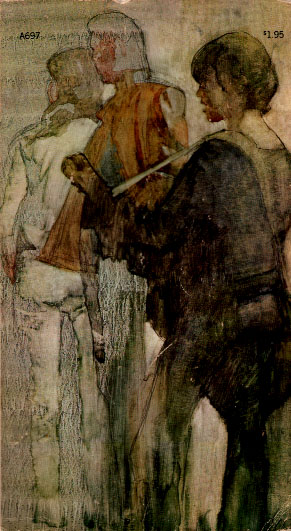
The two ways of listening or observing are not mutually exclusive. The random inhabits at some level of granularity the patterns we perceive. Take for example, the lovely cover art by Daniel Schwartz to the Doubleday Anchor Book edition of Rosazk’s provocative book.

Making Counter Culture - cover art

Cover art by Daniel Schwartz

Figures on a ground, yes. Pigment and texture, yes. The random is at hand in the specificity of the material. To listen to the environment and the flow is to find at hand the specificity of the random. The very point that Rosazk is trying to make (respect for the specific, the unaveraged conduct) gets lost in the vehement concentration on the event to come “eventually”. It is not easy to listen as if each moment is eventful. And yet perhaps it is too easy.

And so for day 219
21.07.2007

Posted in Uncategorized | Leave a comment

Ludology Lessons

One of the best explanations of the relations between narration and narrated (I avoid the term “narrative” which in some usage conflates or overlooks the distinction between the telling and the told.) is to be found in Edmund White’s biography of Jean Genet.

The usual form/content dichotomy for analyzing fiction is not very useful then, since the formal excitement is induced precisely by our shifting sympathies for Genet as narrator and for Genet’s ideas and characters. But the distinction between ‘story’ and ‘plot’ might serve us better. The ‘story’ is the simplest, most straightforward reconstruction of the unadorned events, told chronologically; the story as you might recount to a friend after you read the book. The ‘plot’, on the other hand, is the author’s often indirect and non-sequential method of presenting the narrative, his way of distorting chronology or moulding sympathies or even deliberately misleading the reader for strictly artistic reasons. Genet’s ‘story’ is often confused, even effaced, but his ‘plot’ is an efficient machine for manipulating the reader’s responses.

By analogy I like to argue that ludology can learn from narratology that to play a match is not necessarily to know a game.

And so for day 218
20.07.2007

Posted in Uncategorized | Leave a comment

Physiology of Enthusiasm

I like to juxtapose this character-focalized definition of eroticism as “a collusion of rhythms” [I think it’s “collusion” and not “collision”] from Julia Kristeva’s novel The Samurai with this excerpt from the chapter “Prophet Dances” in Alice Beck Kehoe’s book, The Ghost Dance: ethnohistory and revitalization

Some of the parallels between Christian and American Indian religious behavior go deep into human physiology. Building up rhythm and loudness of speech from slow and soft to fast and loud tends to catch listeners up, their own heartbeats increasing in rapidity along with the speech rhythm to produce a feeling of excitement. […] Gestures may focus listener’s attention on the speaker to the point where the audience is almost hypnotized. Changing the pitch of voice, now high, now deep, induces subconscious mood changes in listeners. Frenzied dancing tends to induce hyperventilation and cause that mental dissociation we term trance. These basic human physiological responses are likely to have been independently discovered in many societies and also to have facilitated borrowings of rituals from culture to culture. Thus human physiology makes it probable that societies will discover and institutionalize “enthusiast” behavior.

Metaerotics automagically!

And so for day 217
19.07.2007

Posted in Uncategorized | Leave a comment

Modes of forgetfulness

Anne Galloway author of Purse Lips Square Jaw rifts on the fashioning of forgetfulness. (And I forget in which entry or at what date)

When I was at UbiComp, surrounded by examples of ubiquitous and merciless memory, I again wondered about the differences between dementia (as forced forgetfulness), nostalgia (as voluntary forgetfulness) and hope (as necessary forgetfulness).

The strength of the truism becomes apparent if you substitute “memory” for “forgetfulness”: memories forcing themselves through the body in dementia; memories picked through at will in the sad movements of nostalgia and the necessary memory that connects the sad and the mad with the gay.

And so for day 216
18.07.2007

Posted in Uncategorized | Tagged | Leave a comment

Cures and Curiosity

Source: Espen Anderson “The S-Curves of Sinks, and Technology”
Ubiquity, Volume 6, Issue 19 (June 1-8 2005)

Dorothy Parker said: “The cure for boredom is curiosity. There is no cure for curiosity.” The problem is that not enough people suffer from curiosity, but instead accept the world as it is, without wondering (and, eventually, learning) how it really works. That being said, my wife has a knitting machine, and I cannot for the life of me figure out how it works […]

The balance and decorum make this self-deprecating anecdote engaging. Its construction values curiosity without turning towards more curiosity as a panacea. There is no cure for there is no end of objects, technologies and entities that perk interest.

And so for day 215
17.07.2007

Posted in Uncategorized | Leave a comment

Ditty for the Digital Age

Somewhere somehow this crossed one of the screens upon which my attention was attached for a moment:

Information is not knowledge.
Knowledge is not wisdom.
Wisdom is not truth.
Truth is not beauty.
Beauty is not love.
Love is not music.
Music is the best.

Frank Zappa “Packard Goose”. Just what is it that music possesses or gives? All of the above but at various times and in various degrees.

And so for day 214
16.07.2007

Posted in Uncategorized | Leave a comment

Recreation

Thinking of vacations …

Until all employees are deemed replaceable, some are deemed disposable.

I wonder if economists tote up the true expesne of all those indispensable people.

And so for day 213
15.07.2007

Posted in Uncategorized | Tagged | Leave a comment

Yogurt Yoga and Contortions

Gayl Jones has a narrator in Mosquito do some neat twists and turns with language, all in a particular voice.

[…] less they thinks everybody got the dextrosity, I means dexterity, of them circus jugglers. Or what them other circus creatures? Not them acrobats. Them contortionists. They think everybody got the dextrosity and dexterity of them contortionists. Well, I guess them contortionists they supposed to be acrobats too, but they seem more extraordinary then them ordinary acrobats. Or like them that do that yoga. Like my friend Delgadina she do that yoga. She say that yoga ain’t just exercise, it a whole philosophy. Be saying there’s different types of yoga. Not that yogurt, ’cause that yoga and that yogurt do got the same sound to them and a lot of the peoples that does that yoga eats that yogurt. Ain’t just the countercultural neither, like it usedta be. That yoga and that yogurt is mainstream today. Them yoga postures only makes you look like you’s a contortionist, but you ain’t a true contortionist.

Again that voice, most particular.

And so for day 212
14.07.2007

Posted in Uncategorized | Tagged | Leave a comment