Out of Not Enough

I invite you to consider regeneration as a waiting on, not a waiting for.

New Directions reprinted Muriel Rukeyser‘s Elegies which first appeared in a limited (300 copies) edition in 1949. In their introduction to the reprinting, Jan Heller Levi and Christoph Keller write

Meanings, Rukeyser held, were the first casualties of war; the search for meanings would always be deferred till “afterward,” when it was too late and the meanings were lost. The Elegies do not wait.

They lie dormant for meaning to connect with them. They are a bridge over time. I take as my text a stanza from the eighth, the “Children’s Elegy”

However long they loved us, it was not enough.
For we have to be strong, to know what they did, and then
our people are saved in time, our houses built again.

In my mind’s eye I appropriate the lines to the experience of a whole generation of gay men fighting a dreaded disease and a society reluctant to provide the resources to turn the tide. Like Rukeyser’s war the worst of the AIDS crisis is in the past and yet the sentiment of saving (Benjamin – even the dead will not be safe…) our people, those that belong to us, and the historical task of rebuilding resonate strongly.

But how?

And in my bricolage fashion I mount a collage here with the third elegy “The Fear of Form”

Blackness, obscurity, bravado were the three colors;
wit-play, movement, and wartime the three moments;
formal groups, fire, facility, the three hounds.

See the documentation brought together by Douglas Crimp of the cultural interventions and formations, especially AIDS Demo Graphics. Fear of form overcome, very much along the lines described by Rukeyser. Uncanny to find resilience celebrated in the poetic record long before one’s personal witnessing. And yet not so unfamiliar and alien. There is no waiting for the rebuilding. The barbarians are always with us. We don’t have to wait. We are not characters in a poem by Cavafy. We do not wonder what next : “Now what’s going to happen to us without barbarians? / Those people were a kind of solution.” We find our own solutions (and our memory traces of barbarians) in such places as Rukeyser’s Elegies while there is still time.

And so for day 1252
18.05.2010
Posted in Poetry | Leave a comment

House Hunting

It might reappear at some point in time on her website. Meanwhile guard your clippings. It did appear in the Globe and Mail – Toronto Saturday edition (14.01.2012). Not online at the Globe and Mail but they do provide a listing about her show at the Art Gallery of Hamilton.

Featuring works made during a recent residency on the island of Gotland, Sweden, the Alberta-born surrealist’s lyrical watercolours drew inspiration from the region’s mythology, and intertwine feminist themes with fables. The works, according to Globe art critic R.M. Vaughan, are “charmingly whimsical at first glance, but grow increasingly spirited (in all senses of the word), and at times menacing, upon further inspection.”

My description of one piece that the Globe and Mail chose to reproduce in its print edition: six figures of women look as if they have just pushed a building over a cliff look down upon their handiwork (a clapboard house collapsed and sending up dust clouds). The piece is called “The Father’s House”. This rough description does not do justice to its feminist wit. Our six characters do strike a pose.

One wishes that more of Kristin of Bjornerud’s work was available for viewing. Or simply close your eyes (after reading her description).

Bjornerud says. “For me, the house is a wonderfully rich symbol full of contradictions and narrative possibilities. It can be read at once as a domestic space, a shelter, a sanctuary or a prison.” As for the female figures, the artist says they’re “taking control of the symbol” as well as an act of solidarity and a small rebellion. “It’s destructive, but it’s also a joyful act, at least for some of the characters.”

From a Galleries West write up by Janet Nicol of a show at Gallery Jones, Vancouver.

And thanks to Gallery Jones one can view a small reproduction of the watercolour and gouache work on paper. Still seeing a small digital image or even a sizeable reproduction in a newspaper, would not match seeing the 60″ x 40″ piece. Different ways of seeing. A point not lost on the artist who knows that even in the face of the same object, viewers views will differ or as Janet Nicol concludes “She talks about leaving certain ambiguity in the work to invite conversation with the viewer. ‘It would be quite boring if we all read images the same way.'” Or approached wrecking the same way.

And so for day 1251
17.05.2010

Posted in Uncategorized | Leave a comment

Familiar Complexity

From 2004, on John Forbes Nash from a posting to Humanist Humanist Discussion Group, Vol. 18, No. 220 picking up a thread from Re Humanist: 18.127 Nash’s hope. Bringing in proximity a biographical note and a reference to a book on complexity.

In reading this and re-reading your [Willard McCarty’s] comments on the unique value of wanderings, I recall back at the beginning of March 2004, John Bonnett [Humanist Discussion Group, Vol. 17, No. 693] recommend Alicia Juarrero‘s Dynamics in Action : Intentional Behaviour as a Complex System. (Cambridge, MA: MIT Press, 1999) and wonder if in the case of Nash, Princeton didn’t serve as a strange attractor bringing him round and round to the sanity threshold which he eventually crossed again. See Sylvia Nasar’s biography of Nash in particular where basing herself on an interview with James Glass she argues “that, for Nash, Princeton functioned as a therapeutic community. It was quiet and safe; its lecture halls, libraries, and dining halls were open to him; its members were for the most part respectful; human contact was available, but not intrusive. Here he found what he so desperately wanted in Roanoke: safety, freedom, friends.”

And glossed that set of desiderata as “Sounds a bit like Humanist, for some of us out here.” Risqué but apt.

Three quotations about community and imagination are interwoven on the Humanist home page. They echo for me the “safety, freedom, friends” triad Nasar gleans from Glass.

«Communities are to be distinguished… by the style in which they are imagined.» «Collective imagining… takes shape through discursive engagement among interlocutors…. Discourse functions in this context not as a vehicle for transmitting information and beliefs but as a constitutive force.» «It takes some imagination and experience to know how to pose a question big enough, because this goes against all our training. Then, even after we have posed the problem as broadly as we know how, we always have to be aware that there is more out there that might overwhelm our theories and thwart our best intentions.» Benedict Anderson, Imagined Communities (rev. edn., 1991): 4; Robert Asen, “Imagining in the Public Sphere”, Philosophy and Rhetoric 35.4 (2002): 349; Richard Levins, “Strategies of abstraction”, Biology and Philosophy 21 (2006): 742

Constitutive forces at work via the tiny acts of communication. Engagement with the edge-wise.

And so for day 1250
16.05.2010

Posted in Uncategorized | Leave a comment

Hauteur

Liz Smith has enthused about mayonnaise, about fried chicken and about French cuisine and she wrote in the New York Times “We ate high off the hog, low off the calf” and told in that space another good anecdote:

I learned a lot about comfort from Henri Soulé. One weekend the elegant DuPont-wed Francis — yes, with an “i” — Carpenter and her friend Shirley Maytag sailed into Sag Harbor. “We must go to the Hedges,” Francis said, and so they set out for East Hampton. Arriving, Francis was stunned to see only a few cars. The dining room was all set up but empty. “Tell Mr. Soulé that Mrs. Carpenter is here for lunch,” Francis said to a passing busboy. Soon, Soulé appeared in a bloody apron wiping his hands. Apologizing that he’d been butchering, he was charm itself, seating the ladies and asking what they’d like. “Whatever you’d like us to have,” responded the gracious Francis. To Mrs. Maytag, she whispered: “Poor Henri. He has no customers.”

Soulé served them a fine lunch accompanied by an excellent white Bordeaux. When Francis asked for the check. “Oh, madam,” Soulé said, bowing. “There is no check. For you see, there is no lunch at the Hedges!”

So, who says there’s no free lunch? If you’re lucky, you eat high, and you eat low.

Liz Smith
Mayo With A Slice of Life
The New York Times Magazine
November 4, 2001

And so for day 1249
15.05.2010

Posted in Food Writing | Leave a comment

Smothered

Étouffée: A method of cooking food in a tightly closed vessel with very little liquid or even without liquid, often called à l’étuvée.

Étuver: To cook food in covered pan, without moistening. This method of cooking is suitable for all kinds of meat, poultry, vegetables and fruit. A suitable quantity of butter, fat or oil is added. [Larousse Gastronomique]

Therefore, and as much as intervening is no mere uncovering of a desire or meaning, associating is no simple enumeration or reporting; each utterance can reconfigure the many series that precede it, invest them with new meanings and project them in different directions, help them produce further associations or altogether stifle them.

Fadi Abou-Rihan
“Constructions Revisited: Winnicott, Deleuze and Guattari, Freud”
British Journal of Psychotherapy 31, 1 (2015) 20–37

And so for day 1248
14.05.2010

Posted in Food Writing | Tagged | Leave a comment

Phono Photo Places

Imagine a clacking keyboard throughout the duration of reading this entry.

From the archives and a review of Dianne Bos exhibit at Wynick/Tuck by Thomas Hirschman [“Sensory Deception: Two Shows Play Tricks with Sight and Sound” Now, Vol. 22, No. 41, June 12-18, 2003].

A lot of art stimulates the brain. Some pieces excite the theatre of the mind – where sounds stimulate the imagination to create imagery. At Wynick/Tuck, a body of new work by Dianne Bos takes that a step further, mixing audio with still images to create moving pictures in your head.

The length of each audio recording corresponds to the duration of the exposure. One photo captured three minutes and 33 seconds of a French carousel spinning around and around. The result is photo of a grey blur accompanied by the sounds of merry-go-round music and excited children. Voices and the constant crash of water hitting the pool of a fountain can be heard for one minute and 39 seconds at St. Peter’s Square in Vatican City. The accompanying image shows off the beautiful architecture of the space, its stillness contrasting with the motion of the water.

Looking at the pictures, listening to the ambient sounds, the scenes spring to life. And for the length of time dictated by the exposure of the film, it’s as if you are there.

Or elsewhere. I would argue that there is a décrochage. There is a still photograph and ambient sound. No matter how transported the viewer/listener may be, the sound is coming towards you and the photograph is before you. You are not simply there. You are elsewhere. You never get here.

Stop keyboard clacking.

And so for day 1247
13.05.2010

Posted in Perception | Leave a comment

Hurry of the Unharried

The context is very specific to a drive through a given landscape but the image can be applied to our being in the world as

A hurry through which known and strange things pass

The line speaks to me of our modern condition and the sense that both the familiar (known) and the exquisitely bizarre (strange) come to us even as we remain still in place treading like a mad red queen.

The line by the way is from “Postscript” collected in The Spirit Level by Seamus Heaney. The line itself strikes us as both strange and known (because we return to it and return to it “Now, here, you see, it takes all the running you can do, to keep in the same place.”)

And so for day 1246
12.05.2010

Posted in Poetry | Leave a comment

Meat: Horrid & Otherwise

In the middle of the anthology edited by Mark Strand [The Golden Ecco Anthology: 100 Great Poems of the English Language] there is Melville’s “The Maldive Shark” which has striking ending epithet for the maritime beast:

Pale ravener of horrible meat

In the middle of another anthology there is a hunger of a different sort:

I have broken the sound barrier of morality
with one crunchy bite on the phallic biscuit.
In my boyish womanhood, with my soul in drag,
I have been personal concubine to hundreds
of queens and princes, mistress of many
hedonists, lover of all.

The poet is William Barber. The poem, “The Gay Poet” collected by Gavin Geoffrey Dillard in A Day for a Lay: a century of gay poetry.

And so for day 1245
11.05.2010

Posted in Poetry | Leave a comment

SHORTS ON SHORTNESS OF LIFE

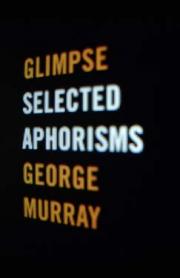
To judge a book by its cover, this one is an homage to Jenny Holzer. Holzer on screen and cityscape (from the days of Truisms) and George Murray in book work (Glimpse) trade in aphorisms.

Cover - George Murray - Glimpse: Selected Aphorisms

One of my favourites from Murray:

The only reliable form of time travel is living.

And so by moving forward in our reading we turn to the past and open the book Jenny Holzer: The Venice Installations to Michael Auping’s curatorial statement in which we read “Given the character of Holzer’s texts, the quietude of Holzer’s antechambers is decidedly unsettling.” Consider the opening and closing of “LAMENTS 1987-89”.

THE NEW DISEASE CAME.
I LEARN THAT TIME
DOES NOT HEAL.
EVERYTHING GETS
WORSE WITH DAYS.
I HAVE SPOTS
LIKE A DOG.

[…]

I WANT TO GO TO
THE FUTURE PLEASE.

As Murray writes, “We’re already being studied by the future.”

And so for day 1244
10.05.2010

Posted in Uncategorized | Tagged | Leave a comment

Marker Mindfulness

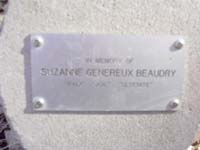
At the corner of Crawford and Barton, north west corner of Christie Pits, in the tree-planted area where the Garrison Creek is marked, across from St. Raymond Catholic School. One tree caught my attention, not so much for is commemorative plaque, but more for the words on that plaque.

IN MEMORY OF

SUZANNE GENEREUX BEAUDRY

“Paix” “Joie” “Sérenité”

But a name and a sentiment. A reminder to be mindful. And so easy to pass by without noticing.

tree marker for Suzanne Genereux

I hope the tree fares well. And its tripartite motto carries on.

And so for day 1243
09.05.2010

Posted in Uncategorized | Leave a comment