Varieties of Orgasmic Experience

The book first appeared as Elements of a Coffee Service in 1982 and then when it was published by Ithuriel’s Spear, Robert Glück, the author, noted “We dropped of a Coffee Service from the original title of Elements: I got tired of saying it and no one else seemed to remember it.” Good story. Worth adding to a trove of lore.

Notice how the shortened title opens up the set of elements.

This is in tune with the varieties of experience exposed in the pieces:

Orgasms come in all shapes and sizes, sometimes mechanical as a jack-in-the box — an obsessive little tune, tension, pop goes the weasel — other times they brim with meaning. And other times, like now, they are the complimentary close that signals the end of a lengthy exchange. I recall a memorable climax, a terrific taste of existence in the summer of ’73. I was with Ed; we weren’t doing anything special but the orgasm started clearly with the fluttering of my prostate, usually a distant gland, sending icy waves to my extremities. Then a hot rush carried my torso up into an arc and just before I came a ball bearing of energy ping-ponged up and down my spine.

Juxtapose with the description of the pace and form of conversation:

We settled in, obligingly gauging ourselves to each other’s rhythm as a sign of friendship: my abbreviations and wisecracking, Bruce’s paragraphs and meditative periods.

Note the order of presentation: abbreviations then meditative periods. A capsule history of the title.

And so for day 1242
08.05.2010
Posted in Booklore | Leave a comment

Escape Velocities and Stillness

“Notes Towards a Minor Art Practice”
Simon O’Sullivan
http://drainmag.com Vol 2.2. Syncretism (2005)

It is then as if there must be two moments, or movements, to a minor practice: one of dissent (either a strategic withdrawal as a form of engagement, or strategic engagement itself), and one of creativity (the production of new forms). Art is a name for each of these strategies. We might reformulate this as a question of moving at different speeds to various institutional apparatus of capture, of moving faster, but also, if we take Henri Bergson’s thesis into account, of sometimes moving slower (and sometimes even standing still).[19]

[19] I am thinking here of Henri Bergson’s gap, or hesitation, between stimulus and reaction which in itself allows creativity to arise. See Bergson’s Matter and Memory, and especially chapter 3 ‘On the Survival of Images’ (MM 133-177).

(MM) Bergson, H. Matter and Memory, trans. N. M. Paul and W. S. Palmer (New York: Zone Books, 1991).

See work of Suzy Lake. In particular the concept of Reduced Performing. With attention to the execution of extended breathing in public places. Especially “Extended Breathing on the Steps of the Detroit Institute of Art”.

And so for day 1241
07.05.2010

Posted in Uncategorized | Tagged | Leave a comment

What Pops Up Pops Out

The copy in Robarts Library was presented by Jearld Moldenhauer.

Robert Glück. Family Poems. “The Body” (1979)

Some of us went on to wear our erections
like jewelry and others of us didn’t.

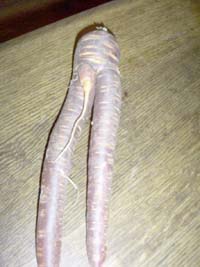
two prong purple carrot with a bump in the middle

An unusual carrot — purple with two “legs” and a “pelvic bump” puts me in mind of Glück’s lines.

And so for day 1240
06.05.2010

Posted in Poetry, Uncategorized | Leave a comment

From Ludological Retelling to Possible Worlds

Jason Rhody
Miscellany is the Largest Category
Games, Fictions, Narratives (2006)
http://misc.wordherders.net/?p=479

I construe the relation between game playing and story telling as one of encapsulation. The ludic drive as hypothesis forming and testing is a type of drive to narrativization. People play games to tell stories. People conduct experiments to tell stories. Or reshape the stories that are told.

Jason’s astute reply

Having narrativity, at least in the sense that Ryan (Narrative Across Media) implies, is thus distinguishable from being a narrative. Many things have narrativity (the potential for narrative), but not all are narratives without the accompanying act of retelling.

Postscript from a retelling in off-line notes:

Jason Rhody’s discussion of “game fiction” has me thinking. Script became an interesting term in our exchange. Prince’s dictionary [Gerald Prince, A Dictionary of Narratology] allowed me to distinguish script from rule. The one has as its aim “role”; the other, “move”. That led me to query the ordering Marie-Laure Ryan made in an abstract [“Narratology beyond Literary Criticism” housed on the portal of the Narratology Research Group (Forschergruppe Narratologie)], an ordering that reminded me of the work of [Lubomír] Doležel on possible worlds and fiction. I am struck with remarking that both populate worlds before describing changes in states of affairs.

Could it be that the line of description goes:
state of affairs –> world –> agents

Description )) Collection )) Motivation
    Displacements    
    Revision    
    open for    
    retelling    

This seems complicated … it is trying to tease out the imbrication of narration with narrative. Description-Collection-Motivation is an abstract way of trying to capture world-building as a cumulative activity. The key I now realize is the switch from Observation (Description) to Curating (Collection). In other words a fictional world can be populated by agents once the elements of that world are deemed movable. It is also the distinctive move from state of affairs to world. In conclusion, we might be able to align games with the move from state of affairs to state of affairs and fiction with move from possible world to possible world (which is totally erroneous direction since in some fictions there is no change of world but simply a change of the state of affairs in a world). Game fiction complicates the picture further.

Best to end, for the moment on an orthogonal comment on the phenomenology of participant-approaches to games and stories

Susan Stewart in On Longing (1993) in the section on the miniature writes: “The toy is the physical embodiment of the fiction: it is a device for fantasy, a point of beginning for narrative. The toy opens an interior world, lending itself to fantasy and privacy in a way that the abstract space, the playground, of social play does not.”

Of course, the toy is not the game. The map is not the territory.

And so for day 1239
05.05.2010

Posted in Uncategorized | Leave a comment

Myth At Hand

Ron Paulson “Crow Creek” in First Person Plural edited by Judith Fitzgerald. It is sharp. And wise. Recall doesn’t lead to nostalgia. It looks forward to the telling of the story. Here are the last three stanzas:

There probably isn’t enough creek left
to produce a sense of loss as my grandfather
felt his lost manhood and I my boyhood
and there’s nothing left for me in the factory farm
but dust and ammonia.

There is something exaggerated
about my sentimentality, however.
I never saw the farm when is was unbroken prairie
covered with buffalo, not to mention when it was an inland sea
hunted by plesiosaurs.
When I first saw it the creek was polluted
with agricultural run-off and the pheasant my grandfather shot
had ancestors on the steppes of Asia.

But, we make
our myths, I guess,
from what we have
at hand.

Doing this entry lead to a search for Ron Paulson, the Kingston bookseller. The search netted a hit to this bit from George Fetherling [The Writing Life: Journals, 1975-2005] which is told either with chagrin or antipathy — difficult to judge the true motive of an outing.

But he was a fine poet, in my view, and a firm friend of poetry. I always felt sad that he only ever came but partway out of the closet. To my knowledge, he always lived alone, never a stable relationship with another man. But then 20 years ago […] I remember what Ron Paulson, the Kingston bookseller, told me once of having some rough trade come into his shop in the morning to sell books obviously stolen from Tom’s shelves while Tom slept.

There is myth work to be done here in rereading Marshall’s oeuvre for hints of queerness.

And so for day 1238
04.05.2010

Posted in Booklore | Tagged | Leave a comment

Intertwingling Tingles

Ted Nelson. Dream Machines

Everything is deeply intertwingled.

Presentational sequences are arbitrary.

Birds –> Bees –> Flowers
Flowers –> Birds –> Bees
Flowers –> People –> Birds

Hierarchies are typically spurious.

Language God
Truth Man
Logic Yale

Boundaries of fields are arbitrary.

[image of a circle with Yin Yang curve and radial segments: two overlapping ways of organizing the space]

So Nelson asserts: “Compartmentalized and stratified teaching produces compartmentalized and stratified minds.” It does not follow. For example rote learning such as memorizing times tables leads to an ability to navigate the matrix at will i.e. disciplined learning is the bedrock of flexibility. See Grids, Lists, Clusters. The shapes of presentation are indeed fungible. From that insight one ought not to leap to the conclusion that shapes are prisons.

And so for day 1237
03.05.2010

Posted in Uncategorized | Leave a comment

Smut is Also a Word for Fungus, I Remember

Yi Yŏn-ju “Dusk in Winter”

Life’s end, does anyone
really live beyond it?

Let’s start again.
Power of
filthy
memories.

Collected in Anxiety of Words: Contemporary Poetry by Korean Women Ch’oe Sŭng-ja, Kim Hyesoon and Yi Yŏn-ju translated by Don Mee Choi.

And so for day 1236
02.05.2010

Posted in Poetry, Translations | Leave a comment

Uni Ennui

Who could get bored with sea urchin? Not anyone in our household. The phrase combining Japanese (uni) and French (ennui) only came up as a suggested substitution game for the caterpillarbutterfly duo so prominent in this third section of Regarding Love 2 by Kim Hyesoon.

caterpillarandcaterpillararemakingcaterpillarlovebutifcaterpillar becomesbutterflywillitlovelikecaterpillarIshedcterpillarandflyhigh
upmadlywillbutterflyrecognizecaterpillariscaterpillarskinevenyouare
sheddingcaterpillarandflyingoverhereiscaterpillarmotherorsonhowwill
twocaterpillarsandtwobutterfliesresolvetheirlove

Collected in Anxiety of Words: Contemporary Poetry by Korean Women Ch’oe Sŭng-ja, Kim Hyesoon and Yi Yŏn-ju translated by Don Mee Choi.

And so for day 1235
01.05.2010

Posted in Food Writing, Poetry, Translations | Leave a comment

Anne Sofie and Her Stars

The intimacy of a first name basis.

There are some people I’d like to thank and since this is my pop record I know I’m allowed: Joni, Carole, Judy C, Carly, Mama Cass Eliot, Barbra et al whose songs and voices I have always loved and who certainly inspired me.

I seem to be a sucker for catalogues. My attempt at expanding the names from Anne Sofie von Otter’s acknowledgements from For the Stars, her 2001 CD with Elvis Costello: Joni Mitchell, Carole King, Judy Collins, Carly Simon, Mama Cass Eliot [known simply to me and others as Mama Cass], Barbra Streisand and other unnamed stars. Which reminds me, o how i loved the Fauré Pavane in vocalise style from Classical Barbra (1976) …

And so for day 1234
30.04.2010

Posted in Uncategorized | Tagged | Leave a comment

Never Mind Cabin Fever

Hut.

In The Albertine Workout Anne Carson strings us along. In appendix 33 (a) there is an explanation of what purports to be the difference between metaphor and metonymy.

Since this question has arisen, here’s the difference: in a group of children asked to respond to the word “hut,” some said a small cabin, some said it burned down.

Which is retracted in appendix 33 (b)

Now that I give it a second thought, the difference between a small cabin and it burned down doesn’t illuminate anything about metaphor and metonymy. It does however speak to the fragility of the adventure of thinking.

And in the very last of the appendices at the end of appendix 59, our author comments on a photograph of Proust and chauffeur Alfred Agostinelli and muses about what they may have been thinking while posing.

Or what the two of them talked about under their breath that day, as the photographer fiddled with his lenses and the cicadas sang in the hawthorn hedge and a summer afternoon at the farthest edge of human love extended itself before them into, apparently, eternity. Maybe they discussed a small cabin. Maybe it burned down.

So like the Recherche in a nutshell to carry over a little motif into different contexts and reward the memory.

Hot.

And so for day 1233
29.04.2010

Posted in Metaphor, Poetry | Leave a comment