Sleeping and Thinking

Brillat-Savarin in Anne Drayton’s translation of the The Philosopher in the Kitchen (La Physiologie du goût) offers the following words in the midst of a meditation upon sleep.

What of the mind in the meantime? It lives its separate life; it is like the pilot of a ship becalmed, a mirror in the night; a lute which no one touches; it awaits some new stimulation.

Our author does concede that certain psychologists “maintain that the mind is never inactive” and he goes on in the next meditation to examine dreaming. And leaves all metaphors of inactivity behind.

And so for day 921
21.06.2009

Posted in Food Writing | Leave a comment

Building and Being

Lew Welch in the conclusion of How I Read Gertrude Stein offers a picture of the artist not as a tortured soul but as a builder.

And if you listen long enough you get the whole of art from her. You get no rule-of-thumb formulations, but you get thousands of ideas which you yourself can apply. You can build your own art, because she has shown you that art is what the artist makes it, and that artists are just like everyone else. You may not build anything that anyone else wants, or finds exciting, but that is just one of the rules of the game. No one can ever know, while he is building something, if it is the thing that must be built, that everyone will one day recognize as being the thing that defines the time in which it was built. But you go right on building, because if you are building something you are most like yourself, and after all what else can you be?

I like how this passage moves from learning something through a continuous building to a question of authenticity. Which is posed as a question. Because it is a question, I note a slight edge of hesitancy. It could very well be you are most unlike yourself when you are building.

And so for day 920
20.06.2009

Posted in Uncategorized | Leave a comment

Scarry on Beauty

First delivered as a Tanner Lecture, On Beauty and Being Just by Elaine Scarry has two parts: “On Beauty and Being Wrong” and “On Beauty and Being Fair”. The argument in the second part is etymologically driven and phenomenologically derived. It is a remarkable feat to link beauty with justice through subtle shifts in a semantic field.

The notion of a pact here again comes into play. A single word, “fairness,” is used both in referring to loveliness of countenance and in referring to the ethical requirement for “being fair,” “playing fair” and “fair distribution.” One might suppose that “fairness” as an ethical principle had come not from the adjective for comely beauty but instead from the wholly distinct noun for the yearly agricultural fair, the “periodical gathering of buyers and sellers.” But it instead — as scholars of etymology have shown — travels from a cluster of roots in European languages (Old English, Old Norse, Gothic), as well as cognates in both Eastern European and Sanskrit, that all originally express the aesthetic use of “fair” to mean “beautiful” or “fit” — fit both in the sense of “pleasing to the eye” and in the sense of “firmly placed,” as when something matches or exists in accord with another thing’s shape or size. “Fair” is connected to the verbs “vegen” (Dutch) and “fegen” (German) meaning “to adorn,” “to decorate,” and “to sweep.” […] But “fegen” is in turn connected to the verb “fay,” the transitive and intransitive verb meaning “to join,” “to fit,” “to unite,” “to pact.” “Pact” in turn — the making of a covenant or treaty or agreement — is form the same root as “pax, pacis,” the word for peace.

It would be a stretch to allow the argument to rest on this relay. Scarry will examine other links based on a typology of thing, beholder and creator.

When we speak about beauty, attention sometimes falls on the beautiful object, at other times on the perceiver’s cognitive act of beholding the beautiful thing, and at still other times on the creative act that is prompted by one’s being in the presence of what is beautiful. The invitation to ethical fairness can be found at each of these three sites […]

It is easy to follow Scarry through this trajectory though I somehow find myself resisting her critique of those that invoke the danger of reification in regards to beauty. The old fashioned notion of idolatry is worth broaching.

And so for day 919
19.06.2009

Posted in Uncategorized | Leave a comment

Accompaniment

If the cogency of the incoherent can be compelling what is there to commend the command of coherence?

The answer resides in the relation between force and the dissipation of form.

What is thrown away is what is collected. Rejection rebounds into projection.

With assurance continue to decompose. Risk composure. A gamble on adhering reassembly.

co/gent co/herent
cog/ent coher/ent
cogen/t cohere/nt

Stickyslashes, virgulesgluing.

And so for day 918
18.06.2009

Posted in Uncategorized | Leave a comment

Apprehension

Briefly, alliteration abbreviates the breakless breath in a tug that permits the round: voice joining voice in a game that is more trip up than catch up.

skipper shipper
skirt shirt

Following a long line of feeling recalling the rupture rapture of an earlier inscription of “sheer” an imitation of Robert Creeley’s Pieces races to enjambement

glint on glass
sheer as slick as sheen
sheer as pure
as transparent
sparkle sharp sheer

And in some made up language

shka
skosh

translates as

drunken daffodils
sodden ground
rain Sorge

And so for day 917
17.06.2009

Posted in Poetry | Leave a comment

Salty Passions

Peter Kline in The Everyday Genius makes a useful observation about how theory cleaves to practice. Theory often meditates between two practices or two aspects of a multi-player activity. Kline is concerned with the connection between thinking about learning and reflecting upon teaching:

Take a notion about learning, turn it over, and what you will see on the other side is a notion about teaching. That’s because any attempt to understand learning usually derives from someone’s effort to teach something. And in practice, any theory about learning worth its salt will be based on the desire to teach and the practical experiences of teaching.

The mention of salt and the divergent vision of salaries (salt payments) troubles the easy insistence on passion (sans recompense) and is worth taking with a pinch of salt. Look at how the “what” – the something that was the object of a someone’s effort to teach – disappears into desire and practical experiences. Odd formulation given how very much of Kline’s book leads one to observe carefully the dynamics of a situation and invites a full bodied interaction with the learning environment. What — there’s the rub.

And so for day 916
16.06.2009

Posted in Uncategorized | Tagged , | Leave a comment

Materiality of Language

One of the best examples of the materiality of language at work has been provided by Adrian Miles in a posting to the Humanist discussion list. Humanist 26.663 “digital materiality”

A simple example I use with undergraduates. In a lecture I ask “What rhymes with shop and you buy at the butchers?” Someone answers “chop”. I repeat this until the whole room replies with “chop”, I then ask “what do you do at a green light?” And the room replies “stop”. Most have no awareness of the error until I point out that they would have failed their driving test.

The point? That there is a material facet to language that is present, easily able to disrupt logic, reason, the rationale, that it has its own pleasures of the body (it can be carnal and corporeal) and its own resistances. After all only some things rhyme with each other, intonation can fundamentally change meaning, and as Derrida in Limited Inc demonstrated, even accurate quotation is no guarantor of the integrity or sovereignty of reason. (Or I could use Kristeva and her notion of the chora as a way to think about a materiality outside of the rational.) These material aspects have qualities and they push back, offer resistance on their own terms […] In many ways it is what it means to be an artist in any medium, to live with the materiality of your medium so you learn how to listen to it.

I flunked the driving test, captivated by rhyme, I said “stop” [the effect is even more pronounced as the eye scans ahead and finds the word – silent reading is no safeguard of sense].

And so for day 915
15.06.2009

Posted in Uncategorized | Tagged | Leave a comment

1846

I recently found myself recommending a neat site for the grandchildren of my sister. (Parks Canada has great site on the Burgess Shale with a virtual submarine ride. See http://burgess-shale.rom.on.ca/en/index.php).

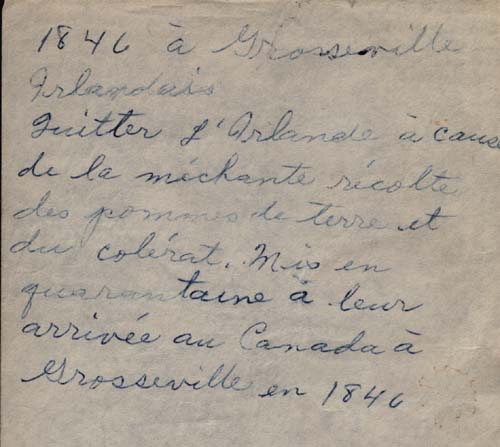
My repeating this here serves as a pretext to introduce an image that reproduces my mother’s hand written note on the Irish potato famine and immigration to Canada. She was ironing one day in the early 70s and she heard a piece on the radio and transcribed the particulars for me and I have kept the item tucked away in a Larouse dictionary through countless moves over the years. If I recall correctly there was a theme of social justice in the remarks made by my mother as she passed on the note about 1846. Something about the duty of welcoming.

handwritten note - 1846 - irish immigration to canada

1846 – Irish Immigration to Canada

Never undervalue the impact of the hand written note.

And so for day 914
14.06.2009

Posted in Ephemera, Transcriptions | Leave a comment

No Quotation Recommendation

Kuldip Gill’s posthumous Valley Sutra (Caitlin Press, 2009) reminds me of two other books of poetry. The first part of Valley Sutra is called “The Mill Town” and because of its focus on locale and people in a specific region of British Columbia it reminds me of Daphne Marlatt’s Steveston. The two are distinctly different in style but in ethos they resemble each other with how through the poet’s voice people and place garner attention to both their specificity and their transcending the local. The second part of Valley Sutra is given over to poems centred on a criminal but which reflect different points of view. The reader of Canadian poetry would make the connection between “Bill Miner’s Notebook” and Michael Ondaatje’s The Collected Works of Billy the Kid. There is even one poem in a style developed by Ondaatje as he says in the Afterword to the 2008 edition “I attempted everything. I took a stanza and wrote it backwards and in one case I kept the result”. Kuldip Gill picks up the form and makes it her own.

Elsewhere I have praised Kuldip Gill’s earlier work Dharma Rasa. I liked her then. I like her now.

And so for day 913
13.06.2009

Posted in Poetry | Leave a comment

Speculations Chronotopological

We are infected.

“retrochronal semiovirus, in which a time further in the future than the one in which we exist and choose infects the host present, introducing itself in simulacra, until it destroys all the original chronotocytes of the host imagination”

Istvan Csicsery-Ronay Jr. Fiction 2000. eds. George Slusser and Tom Shippey (U. of Georgia Press, 1992) p. 26

Symptom: we have begun to speculate on Buddhist underpinnings to Russian logic and mathematics that would have influenced Bakhtin’s chronotope studies.

Besides the Asiatic Researches (issues as early as 1799 are quoted by Schopenhauer), it can be seen from the same list [of best books on Buddhism] that in the middle period of his lifelong and careful studies of these problems there followed a better acquaintance with the Mahāyāna sources, mainly of Tibetan Buddhism, thanks to the outstanding scholarly services rendered to the promotion of Asian studies by the Russian St. Petersburg Academy. The high standard of the internationally organized research work carried out by this Academy and the fundamental importance, even today, of some works, especially the Sanskrit Dictionary (in seven volumes) and the famous series of the Bibliotheca Buddhica, should be better known and appreciated by Buddhists in Asia. […] The books published in the 20th century (down to 1930) by the leading scholar of that Academy, Th. Stcherbatsky, and his collaborators (Rosenberg, Obermuller) on special problems of Buddhist philosophy (Buddhist Logic and Epistemology, Nirvāna, and detailed analysis of Abhidhamma terms and implicit philosophical questions) may rightly be considered as the most concise Buddhist studies that the West has produced down to the present time.

Bhikkhu Nanajivako Schopenhauer and Buddhism (Kandy, Ceylon: the Buddhist Publication Society, 1970)

Just one more take on twisted time.

And so for day 912
12.06.2009

Posted in Uncategorized | Tagged | Leave a comment