Connecting

Involved. Attached. Applied.

Engagement is a construct involving three dimensions: behavioural (involvement); affective (personal attachment to others, such as teachers and classmates); and cognitive (application to learning). Engagement is critical because it makes a difference to academic achievement and fosters in students a sense of belonging and self-worth. In addition, ‘engaged learners are doers and decision-makers who develop skills in learning, participation and communication that will accompany them throughout adulthood.’

(From Australian Directions in Indigenous Education 2005-2008)

Applied. Attached. Involved.

And so for day 911
11.06.2009

Posted in Uncategorized | Tagged | Leave a comment

Comprehending Through Creation, Collaboration and Communication

This bit on the Categories of Knowledge and Skills

The achievement chart identifies four categories of knowledge and skills that are common to both the elementary and secondary panels and to all subject areas and disciplines. The categories, defined by clear criteria, represent four broad areas of knowledge and skills within which the expectations for any given subject/course can be organized. The four categories should be considered as interrelated, reflecting the wholeness and interconnectedness of learning. The categories help teachers to focus not only on students’ acquisition of knowledge but also on their development of the skills of thinking, communication, and application.

The categories of knowledge and skills are as follows:

Knowledge and Understanding: Subject-specific content acquired in each grade/course (knowledge), and the comprehension of its meaning and significance (understanding)

Thinking: The use of critical and creative thinking skills and/or processes

Communication: The conveying of meaning through various forms

Application: The use of knowledge and skills to make connections within and between various contexts

In all subjects and courses, students should be given numerous and varied opportunities to demonstrate the full extent of their achievement of the curriculum expectations (content standards) across all four categories of knowledge and skills.

(From Page 17 Growing Success (Ontario 2010)
http://www.edu.gov.on.ca/eng/policyfunding/growSuccess.pdf

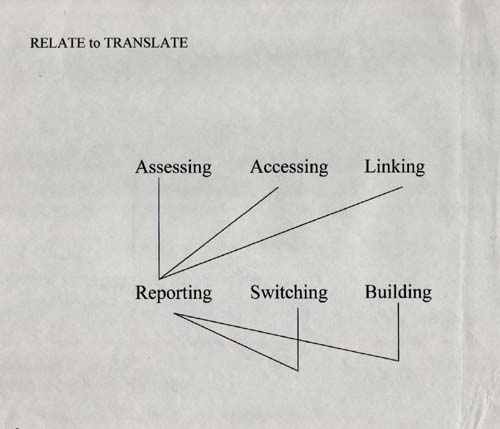
Reminded me of a graphic I produced a while ago about the various activities that a digital humanist (or general cultural worker for that matter) engages in: six moves.

Six Moves - Assessing Accessing Linking Reporting Switching Building

Six Moves

At the base is reporting and connected to it are: Assessing, Accessing, Linking, Switching, Building.

And so for day 910
10.06.2009

Posted in Uncategorized | Tagged , | Leave a comment

Digital Materiality

Read in the Globe and Mail

Quebec is touting its cool climate, plentiful water supply, relatively cheap, clean and reliable electricity supply and attractive high-tech talent pool as reasons that make the province the ideal place for the high-heat generating, energy-hungry data warehouses.

Made me think of apocalyptic visions where the power supply is cut. Odd little world when a plug makes one think of memento mori.

And so for day 909
09.06.2009

Posted in Uncategorized | Tagged | Leave a comment

Spoiler

Patricia Young has a lovely poem in An Auto-Erotic History of Swings which has the speaker in love with a mushroom collecting girl. The poem is filled with mycological references: morels, puffballs, hens of the woods, slippery jacks, cauliflower fungi. The ending is very smart. Our speaker turns into a treasure, a mushroom picker’s treasure.

for I am sick as an old conk, darker than a truffle
buried in damp earth. For love of the mushroom

picker I lie on the forest floor and break down break
down break down into a pestilence of sweet rot.

The lusciousness achieved by the repetition and the enjambement is an echo of the “Fruiting Bodies” of the title as they ripely burst.

And so for day 908
08.06.2009

Posted in Poetry | Leave a comment

Digital Virtues

The following comes from a rather lapidary text from 2001: Per Interactivity ad Virtuality via Textuality.

http://homes.chass.utoronto.ca/~lachance/ivt.htm

In a way it is a meditation upon the micro-theatre of navigating cyberspace. Each tiny moment is an encounter with decisions and such decisions can be figured as the exercise of a given virtue. It is a glimpse at agency.

Meet the digitalized cardinal virtues.

Prudence is responsible for juggling bonds that link the here and the not here, for the means that link the this and the not this, and the norms that link the now and the not now. Prudence asks the question: is this or is this not the correct question. Prudence invites us to choose between concentrating on time, on person or on place.

Fortitude deals with cognitive overhead with a fight or flee response. Fortitude is concerned with space. Fortitude asks whether to stay or to go. Fortitude manages bases.

Temperance asks whether it is time or not. Temperance manages messages and cues.

Justice assesses who counts as a person and by which names they are to be known.

Their portfolios can be shuffled. Prudence need not be the exclusive metacognitive virtue, that role can be played by the time management guru, Temperance. Fortitude is sometimes needed to ask the question about the question. Justice can sit in judgement, of course.

The text of course needs to be aerated, supplied with examples.

And so for day 907
07.06.2009

Posted in Uncategorized | Tagged | Leave a comment

First Letters First

Phil Hall ends “Adios Polka” the opening poem of Killdeer with the observation

  there is nowhere to go off
but wordward

And so it is no great surprise that a line from earlier work (White Porcupine) comes to mind:

that is distance or history — histance or distory

whose play with the signifier exemplifies a kind of word work that mimics a natural process:

the idea dies
 then the animal inside the idea
crawls out & clings

I want to signal here the delicate play that Hall’s poetry makes with line indentations. It creates a rippling effect down the left margin — it is more noticeable on larger runs of text than those quoted here. Not all the poems play with such lineation which makes it distinctive when deployed.

  First character first, be it a blank space.

And so for day 906
06.06.2009

Posted in Poetry | Leave a comment

Algebra Builds Homes

I have blogged before about Sachiko Murakami’s online poetry project http://projectrebuild.ca and now I have the pleasure of quoting from the book Rebuild.

Let the home stand for us
Let the beauty of our form be complex. Let our complexity be known.

This is from “Let The Home”. I like how a simple statement with a hint of algebraic form gives rise to the the sonorous repetition of “let” and “complex”. Such simple means to achieve an intricate structure. And very reflective of the way in which metaphor works.

And so for day 905
05.06.2009

Posted in Metaphor, Poetry | Leave a comment

Wonder of Words

Diana Kuprel and Marek Kusiba in their translation of selections form the poetry of Ryszard Kapuściński (I Wrote Stone) render a stanza from “The Laws of Nature” with economy and attention to the sparseness of the gesture being described. We can sense the stretch of the reach:

the word
an appearance
an attempt to grasp
the ungraspable

This is the middle stanza of a poem devoted to silence and the failure of words or at least to the tendency of words to lead to temptation and dead ends. I like how the middle is about the attempt and it is only later that judgement intervenes about success or failure.

The Kapuściński, especially this particular stanza, reminds me of a passage in J. Edward Chamberlin’s If This Is Your Land, Where Are Your Stories? Finding Common Ground which is more positive in tone and yet equally fascinated by the wonder that is word use.

We recognize the strangeness of reality in the strangeness of our imaginations; and this recognition comes to us in moments of wonder.

All this happens within the traditions of words and images and sounds and movement in the arts and the sciences that together constitute our cultures and give shape and character to our communities. It is these traditions that have permanence, that define what is worthwhile in our lives, and that prevent us from being immobilized by a dumb despair or (what may be worse) mobilized into a blind fury. The only education that matters is the one that teaches us how to watch and listen to them, for it is the ear that is sensitive to sound and rhythm, and the eye that is attentive to pattern and design, that make available their imaginative resources and the nourishment they provide, and that show us how to take comfort in contradiction.

One is lush. The other spare. And in both we have the eye and the ear working together but not necessarily in tandem.

And so for day 904
04.06.2009

Posted in Perception, Poetry | Leave a comment

Doreen Dotto

Celebrating Couples. I like the composition on this card announcing a photography exhibition at the Photo Passage at Harbourfront. The layout nicely frames the subjects in a bed with an amazing headboard with scroll work and beneath the photo is the reproduction of their handwritten comments about life together.

We’ve lived together for five years with
a cat and a dog in an overpriced Toronto
apartment
We have the same birthday
We are always polite
Oh… and one of us tells really excellent jokes
Yeah… and one of us laughs a lot.
Linda & Maria

Celebrating Couples - Photographs by Doreen Dotto

Celebrating Couples – Photographs by Doreen Dotto

There is a timeless quality to this piece of ephemera. And that is abetted by Doreen Dotto’s website where her exhibits are simply listed without dates. http://www.doreendotto.com/about.html

And so for day 903
03.06.2009

Posted in Uncategorized | Leave a comment

Walking Reading Writing

Feel free to wander through the alleys and avenues of this paragraph.

In The Practice of Everyday Life, de Certeau refers to “the long poem of walking” as a series of rhetorical strategies expressed in physical space: at street level the body turns, detours and returns in the same way a phrase manifests, inverts and completes itself on the printed page. In this sense walking is at once lyrical and vividly metaphorical: we leap ahead, retrace our steps, omit passages, take shortcuts, lose ourselves, experience surprise and become open to discovery. In short, we walk in the same way we read — and for that matter, write.

From Amy Lavender Harris, Imagining Toronto.

And so for day 902
02.06.2009

Posted in Reading | Leave a comment