Readers, Intergenerational

A photograph by Sidney Weaver adorns the back dust jacket of 1968 Citadel publication of Secrets of the British Museum by Peter Fryer (originally published as Private Case — Public Scandal 1966)

Child and Adult Reading

From the cover of Secrets of the British Museum
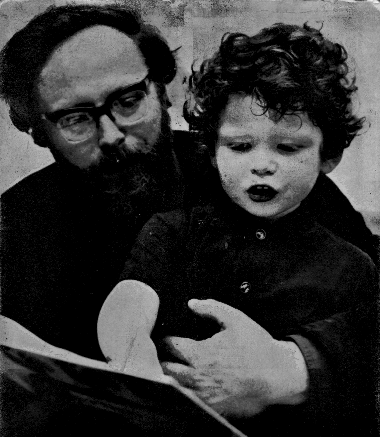
It is a touching photograph which given the context is a tad subversive. The photograph depicts an adult and child with an open book in front of them. I like its appeal given that it adorns a book presented as “a revealing account of the classic works of erotica kept under lock and key in the British Museum”. It illustrates well the concluding sentence in the “About the Author” description on the inner panel of the dust jacket: “Peter Fryer is married and has two children.” Solid credentials for the author of an anti-censorship tract. Simply disarming.

And so for day 201
03.07.2007

Posted in Reading, Uncategorized | Tagged | Leave a comment

Timbre, Smile-Stamped

Of the many facts found in Angus Tremble’s introduction to A Brief History of the Smile this one makes me close my eyes and listen and attempt to project myself into a different sensory experience of the world.

Blind people are keenly aware of the change of timbre that may be detected in the voice of a smiling interlocutor. Many of us can tell when a person at the other end of the telephone is distracted by something funny but gamely tries to continue an otherwise serious conversation. Smiling changes the sound of the voice no less than the shape of the mouth.

No thanks to the publisher who after the addition of the “Preface to the Paperback Edition” did not repaginate the front matter [two prefaces and the introduction] numbered with Roman numerals to align properly with the endnotes, one is able to find a reference for further exploration.

“blind people”: See, for example, “Anecdotes of the Life of Mademoiselle de Salignac, A Blind French Lady,” in Wilson, J. (1821/1995). Biography of the Blind …, edited by K. Stuckey, Washington, D.C.: Library of Congress, pp. 457.462.

Worth a little experiment with recording equipment …

And so for day 200
02.07.2007

Posted in Introductions, Perception | Leave a comment

Broken Circles, Scattered Pearls

A passage from Edmund Gosse on Swinburne’s compositional technique offers some alternative vocabulary to the nodes and webs of hypertext. From Aspects and Impressions

It may be observed that Dolores is a rosary of stanza-beads on an invisible string; in other words, that the string might be broken, the beads shaken together, and the stanzas arranged in an entirely new sequence, without any injury to the effect of the poem […] It is now clear that Swinburne forged his brilliant Dryden-like couplets as though each one were a stanza, and practically treated them as bits of mosaic to be fitted, in cooler blood, into a scheme not present to his mind when his inspiration seized him.

Ironically I transcribed this passage while listening to recordings of Indian music that include ghazals — a form if I recall correctly where couplets can tumble their order.

And so for day 199
01.07.2007

Posted in Uncategorized | Tagged | Leave a comment

Zest for Zen

Mikhail Bulgakov The Master and Margarita translated by Diana Burgin and Katherine Tiernan O’Connor provides a most marvellous set of casuistic teasers.

Despite the theater manager’s promise to Azazello never to lie again, he began with a lie. Although one should not judge him too harshly for that. After all, Azazello had forbidden him to tell lies and be rude over the telephone, but in the given instance the manager was speaking without the aid of such an instrument.

Ah the kind narrator ever attentive to details! Ever ready to set the readers in disarray…

It is, of course, doubtful that that was what happened, but we can’t tell what we don’t know.

Such is the power of telling to send us on a trip. In all the succession of states that a reader may traverse in a sustained encounter with this novel and tall tale, there is one that is inscribed within the narration almost as in invitation to mimesis. This last description of the Master is worthy of emulation.

He began to listen carefully and pay close attention to everything that was happening in his soul. His excitement, it seemed to him, had turned into a feeling of deep and deadly resentment. But it was short-lived, it passed, and gave way for some reason to a felling of proud indifference, which, in turn, became a presentiment of permanent peace.

The Epilogue presenting the fate of another character who is calm and well until the next full moon. Pick your ending and pay attention to the details.

And so for day 198
30.06.2007

Posted in Uncategorized | Tagged , | Leave a comment

Dissipation Anticipation

It is fun to find traces of the French text (spelling Zhabotinski with a terminal ‘i’ in the caption to Figure 16 p. 168 and ‘échelle’ in the legend to Figure F p. 185). Fun because they illustrate marvellously bedevilling details still there after 4 printings and they have absolutely no bearing on comprehension and show a reader-tolerance for variation [fluctuation?].

The question of the limits of complexity has often been raised. Indeed, the more complex a system is, the more numerous are the types of fluctuations that threaten its stability. How then, it has been asked, can systems as complex as ecological or human organizations possibly exist? How do they manage to avoid permanent chaos? the stabilizing effect of communication, of diffusion processes, could be a partial answer to these questions. In complex systems, where species and individuals interact in many different ways, diffusion and communication among various parts of the system are likely to be efficient. There is competition between stabilization through communication and instability through fluctuations. The outcome of that competition determines the threshold of stability.

From Ilya Prigogine and Isabelle Stengers, Order out of chaos: man’s new dialogue with nature based on the author’s La nouvelle alliance.

Sign of another competition: the publication information claims trademark protection.

Bantam New Age and the accompanying figure design as well as the statement “the search for meaning, growth and change” are trademarks of […]

Funny. The statement that accompanies the logo [figure design] reads “A Search for Meaning, Growth and Change” Does capitalization count?

No eluding the fluctuations.

And so for day 197
29.06.2007

Posted in Uncategorized | Tagged , | Leave a comment

Precious

What is prized, what is praised …

They [disciplines in the humanities and social sciences] are indeed precious heritages. […] Like all responsible renovators, we should first check the foundations. Furthermore, we should realize that something of this challenge should (and if we have the wisdom to encourage it, will) come from our students, who are at the end of the day our most precious and enduring heritage.

From Ted Chamberlin “Tradition and renovation” University of Toronto Bulletin, January 21, 1991.

And so for day 196
28.06.2007

Posted in Uncategorized | Tagged | Leave a comment

Letting go, connecting

It is a pleasure to lift out a single sentence and savour it.

Alienation and mediation are conditions of agency.

From Susan Stewart “The Interdiction” Profession 89, Modern Language Association.

It is a sentence that so nicely captures the nature of the work of an engaged intellectual or a scholar. The words leave us. And we connect the words that have left others.

And so for day 195
27.06.2007

Posted in Uncategorized | Leave a comment

Bushes of Constellations

Part of an endnote:

” […] At its most literal and modest, hypertext is a computer-mediated indexing apparatus that allows one to craft and follow many bushes of connections among the variables internal to a category. Hypertext is easy to use and easy to construct, and it can change common sense about what is related to what.” See Donna J. Haraway, Modest_Witness@Second_Millennium.FemaleMan©_Meets_OncoMouseTM (New York: Routledge, 1997): 125.

Which word above would you begin to hyperlink? “Connections”?

The endnote references a passage in a question by Thyrza Nichols Goodeve which contrasts academic style writing with a theory of “hypertext poetics — that are not integral to the modalities of academic writing”. The question is found in the “Cyborg Surrealisms” section of How Like a Leaf. The question and the endnote give rise to the thought that there is an “academic surrealism” or “surreal sim”.

And so for day 194
26.06.2007

Posted in Uncategorized | Tagged | Leave a comment

Journeys, Roads and Companions

A commonplace passage dedicated to anyone who served on a clean up crew after a community event:

It takes hours of hierarchy, mind you, to achieve minutes of community, but that may always be true. People who start off by defining themselves as very separate slowly, quietly, provisionally, and without much wanting to be reminded of what they are doing, allow themselves to be reabsorbed. And if you want a one-sentence history of the gay movement in this country over the last fifteen years, you missed it. That was it.

Concluding excerpt from Adam Mars-Jones, “Gay London 1984” reprinted in Blind Bitter Happiness. “Gay London 1984” first appeared in the Tatler.

And so for day 193
25.06.2007

Posted in Uncategorized | Leave a comment

Lesbian and Gay Pride Day

Adam Mars-Jones, “Gay Rights and Wrongs” collected in Blind Bitter Happiness reviewing among others David Halperin’s Saint Foucault

A man who could say (speaking to Gilles Barbedette), ‘I think we should consider the battle for gay rights as an episode that cannot be the final stage’, was someone for whom gay rights was not a category mistake but an insufficient agenda.

And so for day 192
24.06.2007

Posted in Uncategorized | Tagged , | Leave a comment